
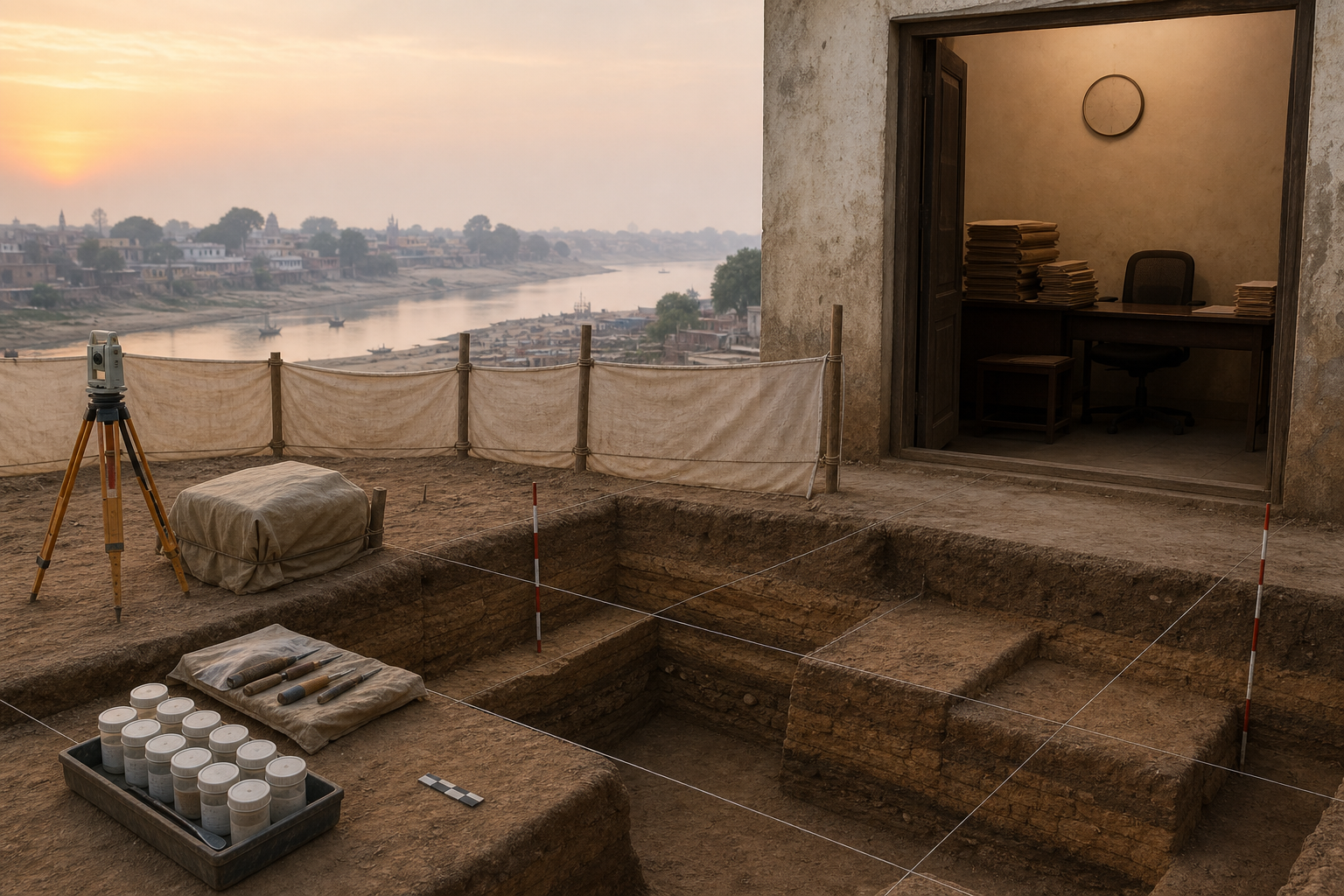
If you are trying to understand whether bureaucracy materially delayed the search for historical clarity at Ayodhya, slogans will not help you. The useful question is narrower: what happens to an archaeological investigation when an administrative instruction interrupts fieldwork, reporting, and judicial access to the resulting evidence?
The answer matters beyond one temple dispute. Administrative delay can change when evidence becomes available and how confidently it can be interpreted. It does not, by itself, prove a political motive, establish that evidence was destroyed, or settle what the archaeology ultimately means. You need to keep those claims separate if you want an account that can withstand scrutiny.
Start with the narrow claim, not the political legend
In the charged period following December 6, 1992, the Archaeological Survey of India was engaged in court-mandated work intended to provide a factual basis for legal and administrative decisions concerning Ayodhya. At the centre of the controversy is a reported overnight directive from then Human Resource Development Minister Arjun Singh to K.V. Ramesh, a former Joint Director General of the ASI, which allegedly constrained the excavation effort.
The operational allegation is more precise than the political rhetoric that grew around it. Field seasons were delayed, review cycles lengthened, and the institution adopted a more cautious posture. Those effects could postpone the synthesis and submission of archaeological findings. They could therefore extend both judicial uncertainty and public argument.
That is not the same as proving why the instruction was issued. Defenders of administrative restraint could invoke procedure, public order, or the risk of communal tension. Critics could see the same intervention as an attempt to impede the pursuit of historical truth. A consequence can be documented without the motive being conclusively established.
When you assess this episode, separate three propositions:
- The documentary proposition: What did the instruction say, who possessed the authority to issue it, how long was it meant to operate, and what reasons were recorded?
- The operational proposition: Which excavation, recording, review, or submission activities changed after the instruction?
- The political proposition: Was the purpose legitimate precaution, bureaucratic avoidance, political obstruction, or some combination of these?
Each proposition needs a different kind of evidence. The written direction and administrative file bear on the first. Dated field diaries, excavation schedules, correspondence, and court submissions bear on the second. Motive requires a wider record and should not be inferred merely from the existence of a delay.
The same discipline applies to archaeological claims. The facts available here do not establish a particular object, inscription, wall, pillar base, measurement, or stratigraphic date. Do not attach such specifics to this administrative episode unless you have the relevant excavation record in front of you. Defending Ayodhya’s civilizational importance does not require adding facts that the evidence at hand cannot support.
Why an interruption is not neutral for archaeology
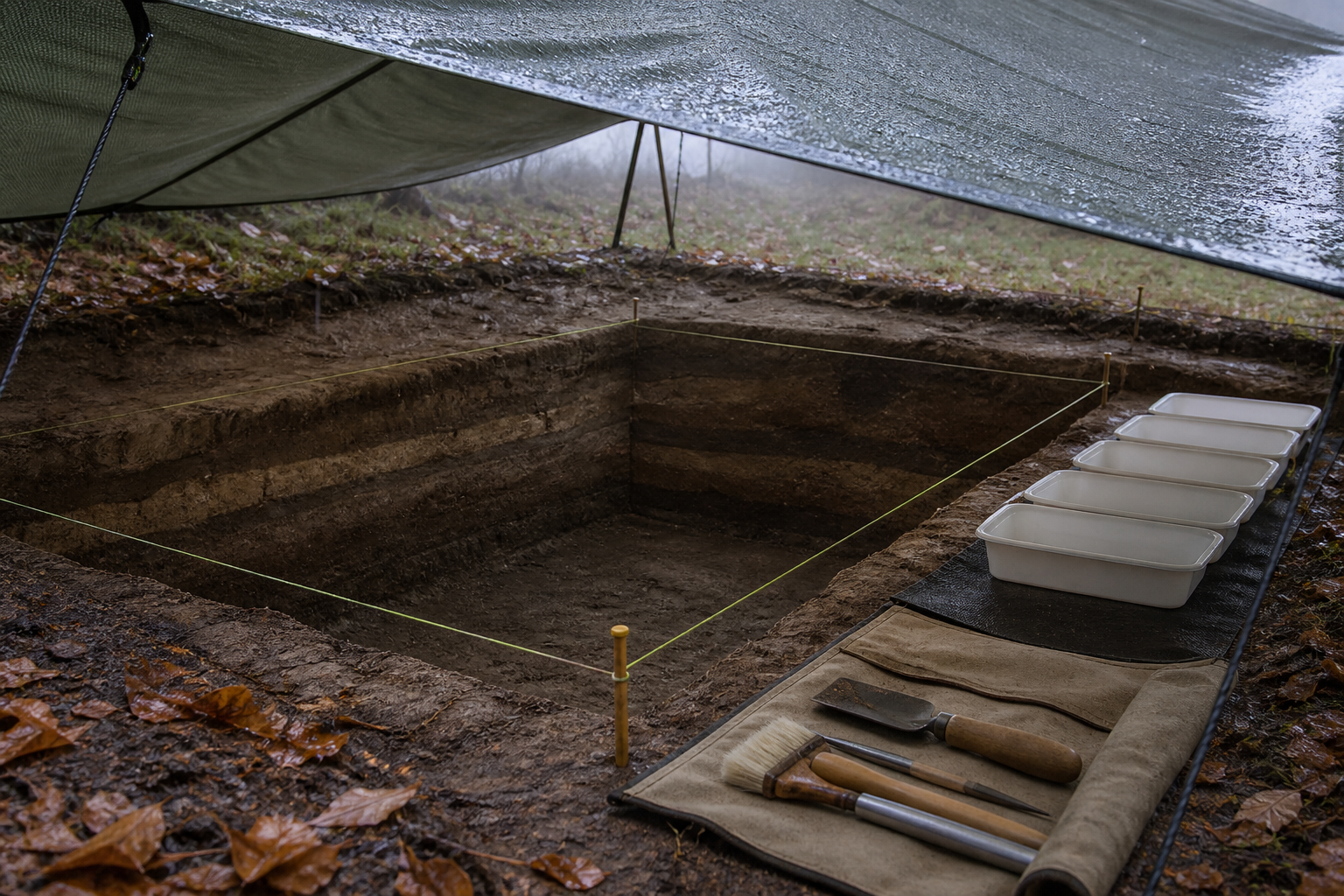
An excavation is not simply a search for interesting objects. Its evidentiary value lies in relationships: where a feature appeared, which layer contained it, what lay above and below it, and how the observation was recorded. Once a layer has been excavated, its original arrangement cannot be reconstructed physically. The field diary, plan, grid reference, photograph, catalogue entry, and custody record must preserve that context.
A pause does not automatically destroy evidence or invalidate an excavation. That claim would go too far. An unplanned interruption can, however, complicate trench sequencing, continuity across excavation grids, consistent recording of features, and the later synthesis of observations. The greater the sensitivity of the site, the more consequential those coordination burdens become.
The delay also travels through an institutional chain. Archaeological evidence does not move directly from the soil to a courtroom:
- Fieldwork must be authorised, planned, and sequenced.
- Observations must be recorded while their physical context remains intelligible.
- Finds must be catalogued and maintained through a clear chain of custody.
- Specialists must relate individual observations to the site’s wider stratigraphy.
- Interim or final assessments must be reviewed and prepared for submission.
- Courts and other decision-makers must receive the technical record in a usable form.
A slowdown near the beginning can therefore reappear at every later stage. Less completed fieldwork means less material ready for synthesis. Extended synthesis delays expert review. Delayed review postpones court submissions. Public debate then continues in the absence of the fuller record everyone claims to want.
This is the most defensible meaning of the claim that administrative intervention shaped the Ram Mandir timeline. The intervention need not have altered what was under the ground. It could alter when the relevant material record became available, how efficiently it was assembled, and how long legal and public uncertainty persisted.
Continuity of fieldwork is important, but it is not an absolute command to excavate through unsafe or unlawful circumstances. A temporary pause may be justified. The safeguard is a written reason, a defined scope, a review date, protection for exposed contexts and records, and a credible plan for resumption. Without those limits, a precautionary pause can quietly become an indefinite administrative veto.
Key takeaways
- The central allegation concerns delayed excavation and reporting, not proof that an administrative instruction changed the physical evidence at Ayodhya.
- Interrupted fieldwork can complicate trench sequencing, stratigraphic interpretation, and consistent recording, but interruption alone does not prove that evidence was lost or corrupted.
- The existence of an instruction, its operational consequences, and the motive behind it are three separate claims requiring different evidence.
- Archaeology can illuminate material sequence and historical occupation. It cannot, by itself, exhaust the sacred meaning of Ayodhya or adjudicate a theological truth.
- The strongest protection against both bureaucratic suppression and partisan exaggeration is a dated, inspectable record from excavation through court submission.
How to audit an Ayodhya claim before sharing it
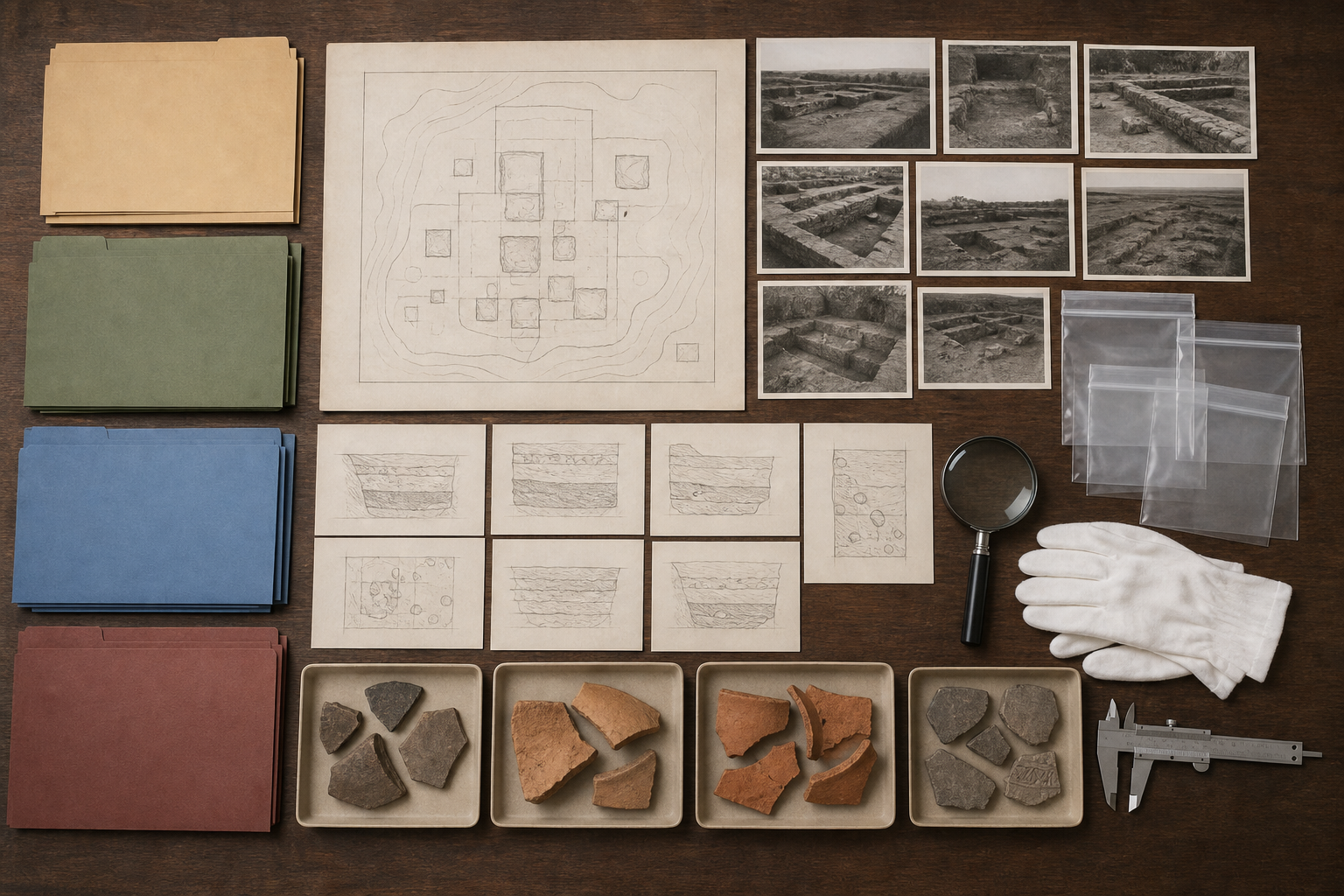
You do not need to become an archaeologist to distinguish a serious historical claim from an emotionally satisfying one. You do need to ask for the record that would make the claim testable.
- Ask for the exact administrative act. Look for the written instruction, its date, author, recipient, legal or departmental basis, stated reason, scope, and duration. A recollection of an order is not identical to the order itself.
- Build a dated operational timeline. Identify what work had been planned, what work actually occurred, which field season or review was deferred, and when activity resumed. A general atmosphere of caution is not a substitute for dates.
- Connect delay to a mechanism. A credible claim should explain whether the interruption affected excavation grids, trench sequencing, documentation, expert synthesis, review, or court submission. Merely saying that archaeology was stalled leaves the consequential step unspecified.
- Separate observation from interpretation. A recorded feature, layer, or object is an observation. Its relationship to an earlier structure is an archaeological interpretation. Its place in a civilizational or political argument is a further interpretation. Do not collapse all three into one sentence.
- Mark motive as motive. If available records show that officials invoked public order, that establishes the stated justification. It does not automatically establish sincerity. Conversely, political suspicion does not by itself prove a concealed purpose.
- Check whether the language outruns the evidence. Words such as delayed, restricted, cancelled, suppressed, compromised, and destroyed are not interchangeable. Use the narrowest term the documented consequence supports.
A simple three-label method helps. Mark each claim in your notes as documented, reported, or inferred. A signed instruction can be documented. An official’s account of its effect may be reported until corroborated by the schedule and field record. A claim about hidden political intention is inferred unless supported by additional evidence. If a social-media summary erases those labels, restore them before you repeat it.
Also notice what archaeology can and cannot answer. Material evidence can help reconstruct sequences of building, occupation, reuse, and change. Courts can assess expert reports as part of a broader legal record. Devotion, sacred memory, and the theological identity of a tirtha belong to a different order of meaning. Confusing these domains either burdens archaeology with proving faith or treats faith as a substitute for material documentation.
For a Hindu reader, refusing to overstate a claim is not a retreat from Ayodhya. It is a refusal to make a just cause depend on a weak assertion. Historical confidence becomes stronger when every conclusion carries the weight its evidence can actually bear.
A dharmic standard for future sacred-site investigations
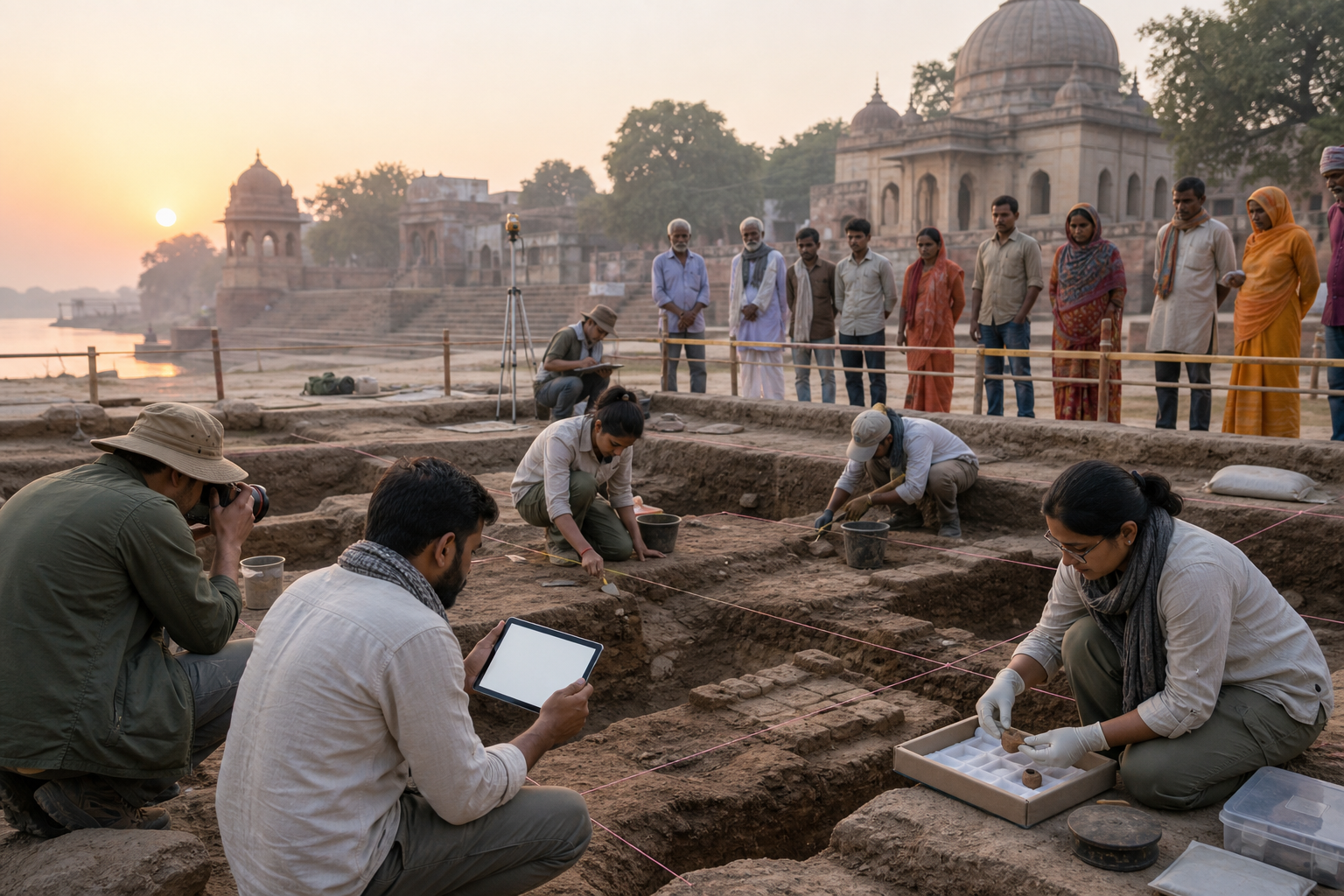
Ayodhya shows why heritage governance cannot be reduced to a choice between truth and social peace. Satya without evidentiary discipline becomes assertion. Ahimsa without institutional candour can become an excuse for silence. A dharmic public ethic requires patient truth-seeking, measured communication, due process, and accountability at the same time.
The practical standard should be visible in records, not merely declared in speeches. For any sensitive excavation, administrators and investigators should provide:
- Contemporaneous field documentation: dated diaries, trench and grid plans, feature records, catalogues, and revisions that preserve how conclusions were reached.
- Traceable custody: a clear record showing how finds were labelled, transferred, stored, examined, and presented.
- Defined administrative interventions: any pause should identify its authority, reason, scope, start, review point, protective measures, and conditions for resumption.
- Honest interim reporting: preliminary assessments should be identified as provisional, with unresolved questions stated rather than concealed.
- Timely judicial communication: courts should receive scheduled submissions or a specific explanation of what prevented them.
- Qualified scrutiny: site plans, methods, and assessments should be available for competent review while lawful protections for the site and proceedings are maintained.
- Regular public explanation: stakeholder briefings should distinguish verified field observations from developing interpretations and contested claims.
These safeguards serve more than institutional reputation. They make it harder for an official to bury inconvenient work, harder for an advocate to invent certainty, and easier for a court to evaluate the evidence without inheriting years of avoidable confusion. They also respect the communities for whom a sacred place is not an abstract policy file.
The reported delays in field activity, review, and institutional reporting at Ayodhya should therefore be treated as a governance warning. Administrative prudence is legitimate only when it protects the integrity of the inquiry and preserves a path back to completion. If it merely postpones evidence without a defined endpoint, it transfers the political cost to courts, communities, scholars, and future generations.
The next time a sacred-site controversy produces a sweeping claim, ask first for five things: the written order, the dated excavation log, the site plan, the custody register, and the court-submission timeline. If those records are absent, say that the conclusion remains provisional. If they are available, let them carry the argument. That is how you defend both civilizational memory and the discipline of truth.
References
