

If you came here asking who Naga King Padma is – and why this epic figure matters – the reliable answer begins with restraint. Padma is identified as a sovereign of the Nagas and is associated with Sabha Parva 9 and Shanti Parva 363-371 of the Mahabharata. These coordinates do not license an invented biography. They direct you toward a disciplined way of thinking about power: rule must remain answerable to dharma.
That distinction matters whether you are studying scripture, resolving a family dispute, serving a temple or community organization, or making decisions at work. Padma’s significance lies in the relationship between authority, restraint, guardianship, and responsibility. Read him carefully, and you gain a practical test for whether your strength is protecting harmony or merely enforcing your preference.
Keep identity, textual setting, and interpretation separate
A careful reading begins by separating three layers that are often blended together. First comes identity: Padma is a king among the Nagas. Second comes textual setting: the cited references belong to the Sabha and Shanti Parvas. Third comes interpretation: Naga guardianship and the Mahabharata’s concern with rajadharma make Padma an instructive image of measured sovereignty.
The distinction prevents a common error. A moral principle found in the surrounding setting should not automatically be turned into a personal deed, speech, or quotation attributed to Padma. The Sabha Parva directs attention toward the political world, where counsel, discernment, and restraint affect collective welfare. The reflective setting of the Shanti Parva brings sovereign conduct into conversation with rajadharma, enduring moral obligation, and the proper use of power. Those settings help you interpret Padma, but context and biography are not the same thing.
Use this four-step method when you examine the passages:
- Locate Sabha Parva 9 and Shanti Parva 363-371 in the edition or translation available to you. Chapter numbering can differ across editions of a long epic, so consult that edition’s contents or concordance if the numbers do not align.
- Record only what the passage explicitly identifies, says, or depicts. Keep those notes separate from later commentary.
- Read the surrounding material closely enough to identify whether the immediate concern is assembly, counsel, duty, restraint, protection, or another aspect of governance.
- Only then ask what ethical principle the passage supports and how that principle applies to a present decision.
This method is not a retreat from reverence. It protects reverence from embellishment. A Dharmic reading becomes stronger when you can tell another reader which part comes from the text, which part comes from its setting, and which part is your reasoned application.
Read Naga kingship as a language of guardianship
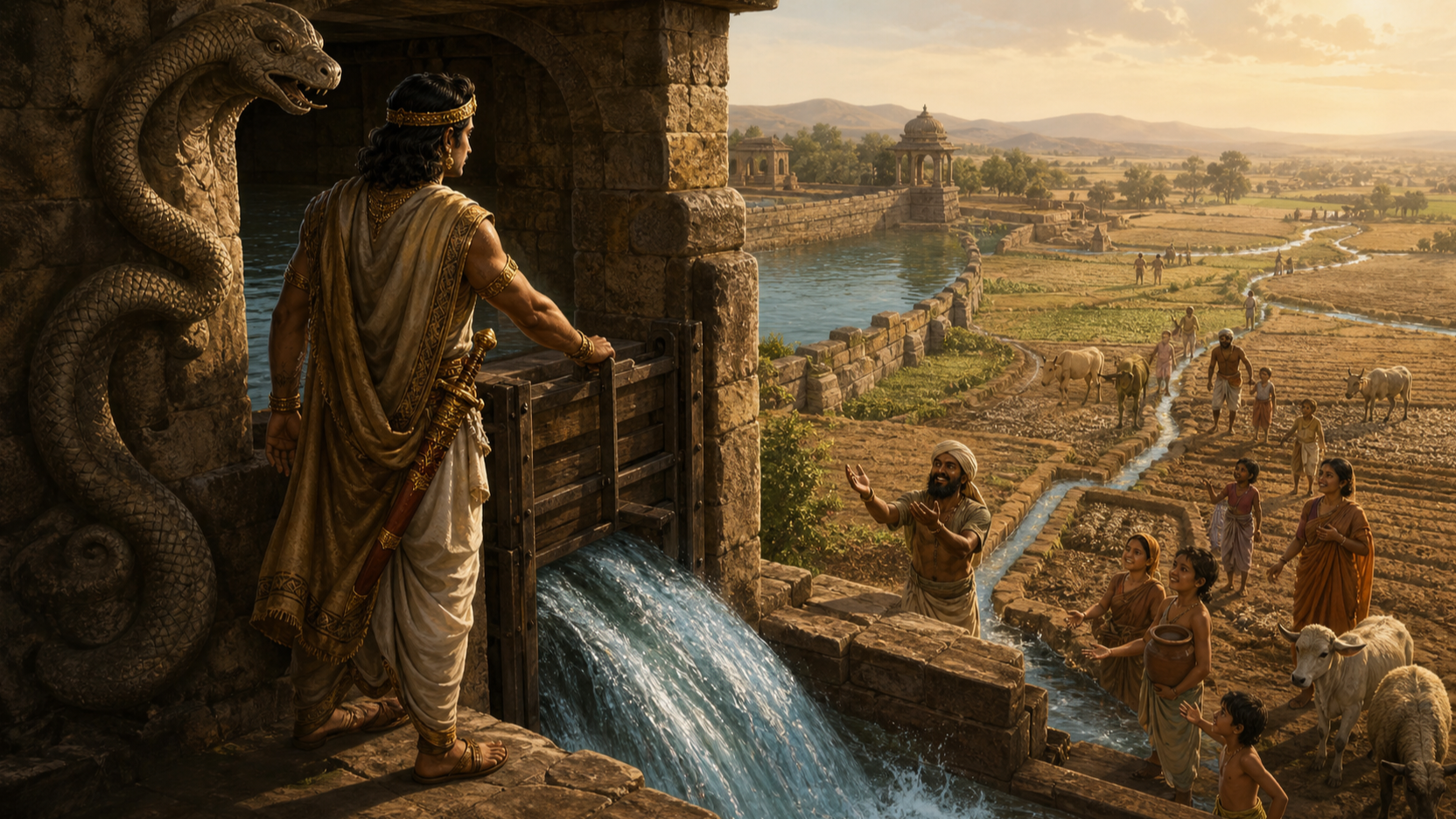
In Indian epic imagination, Nagas are associated with waters, thresholds, guardianship, and hidden wisdom. These associations form a symbolic vocabulary; they are not a complete definition of every Naga figure. In Padma’s case, kingship joins that vocabulary to the problem of authority. The one who possesses power is also the one expected to guard what sustains life and to manage dangerous boundaries responsibly.
You can translate the imagery into three concrete responsibilities:
- Water becomes a test of stewardship. Ask what life-sustaining resource has been placed in your care. It may be money, land, knowledge, trust, institutional access, or another person’s time. The Dharmic question is not merely whether you control it, but whether your use preserves its value for those who depend on it.
- A threshold becomes a test of gatekeeping. Whoever controls admission, information, recognition, or opportunity can protect a community or quietly distort it. Notice who is allowed to cross the boundary, who is kept outside, and whether the rule can be explained without favoritism.
- Hidden wisdom becomes a test of humility. A decision-maker rarely sees every consequence. Before acting, identify what remains unknown, who understands that unknown better than you do, and whose warning would be easiest for authority to dismiss.
This is why restraint should not be mistaken for weakness. A guardian may possess formidable capacity while refusing to use it impulsively. The refusal is meaningful precisely because the power is real. Padma’s image therefore asks a sharper question than whether you can prevail: what will your victory leave alive, trusted, and capable of flourishing?
Use a four-question rajadharma test before you decide
The practical leadership pattern associated with Padma is clear: reflect before acting, prefer dialogue to impulse, protect those with less power, and treat resources as a trust rather than an entitlement. These are aspects of rajadharma applied to responsible sovereignty. You do not need to occupy a throne to use them. Any role that lets your choice shape another person’s welfare carries a portion of this responsibility.
Before a consequential decision, write down answers to four questions:
- What becomes visible when I pause? Name the immediate pressure, the impulse it creates, and the longer consequence that haste might conceal. A pause is useful only if it improves perception.
- Whose counsel can correct me? Include someone with relevant knowledge, someone likely to disagree, and someone close to the consequences. Consultation that includes only supporters is ceremony, not counsel.
- Who bears the cost if I am wrong? Pay special attention when the person making the decision receives the benefit while a quieter or less powerful person absorbs the risk.
- What am I holding in trust? Identify the money, reputation, relationship, natural resource, cultural inheritance, or institutional authority involved. Then ask whether you could explain your decision publicly without relying on rank as the explanation.
Each question also has a failure mode. Reflection can become avoidance if you refuse to decide after the relevant facts are available. Dialogue can become evasion if you collect opinions but accept responsibility for none of them. Protecting the vulnerable can become favoritism if you abandon consistent principles. Stewardship can become a slogan if nobody can see how resources were allocated.
Measured power avoids these evasions. It can state why action is necessary, whose counsel shaped it, what limit it accepts, and how harm will be noticed and corrected. That is a demanding standard, but it is usable in ordinary settings.
- In a family or community dispute, state the other side’s concern accurately before defending your own position. If you cannot do that, you are not yet ready to judge between the positions.
- In a temple or cultural organization, decide the criteria for distributing funds, access, or recognition before deciding which person receives them. This makes favoritism harder to disguise as discretion.
- In an institution, record who gains, who bears risk, and who was consulted. The written record forces consequences into view before authority turns a preference into policy.
Recognize Dharmic kinship without erasing distinctions
Padma also gives you a careful way to approach unity among Dharmic traditions. Hindu sacred geography and worship preserve Naga associations with guardianship and life-giving waters. Buddhist narratives use the protective Naga motif. Jain artistic and narrative memory carries related imagery of vigilance and restraint. The ethical comparison can extend to Sikhism through shared commitments such as truthfulness, compassion, disciplined strength, and protection of others.
None of this makes the traditions interchangeable. A related image is not proof of identical doctrine, and a shared ethical value does not erase differences in theology, scripture, discipline, or worship. In particular, ethical resonance with Sikh teachings should not be converted into an unsupported claim that Naga imagery has the same role there that it has in Hindu, Buddhist, or Jain settings.
Three distinctions keep a conversation about Dharmic unity honest:
- Shared symbol is not identical interpretation. Ask how each tradition uses an image before claiming what the image means across all traditions.
- Shared value is not uniform practice. Compassion, restraint, and guardianship may be expressed through different disciplines and institutions.
- Resonance is an invitation, not a proof. Similarities can begin a serious conversation, but they should not be used to make historical or doctrinal claims that the available material does not establish.
This approach strengthens rather than weakens Dharmic solidarity. Unity that depends on blurred distinctions is fragile. Unity grounded in truthful recognition can honor different paths while still asking a common question: what form does responsible strength take here?
Key takeaways
- Padma is identified as a sovereign among the Nagas, with relevant coordinates in Sabha Parva 9 and Shanti Parva 363-371.
- His significance is best approached through textual setting and Naga symbolism, not through biographical details the available references do not establish.
- Naga associations with water, thresholds, and concealed wisdom turn kingship into a model of stewardship, responsible gatekeeping, and humility about unseen consequences.
- A practical Padma-inspired decision test asks what a pause reveals, whose counsel can correct you, who bears the cost of error, and what you hold in trust.
- Hindu, Buddhist, and Jain Naga imagery can support Dharmic dialogue, while Sikh ethical resonance should be discussed without pretending that every tradition uses the same symbol in the same way.
When you return to the cited passages, divide your notes into two columns: what the text explicitly gives and what you infer from its context. Then take one real decision under your authority and answer the four rajadharma questions in writing. If invoking Padma makes your reasons clearer, your restraint more deliberate, and vulnerable interests more visible, the reading is doing ethical work. If it merely decorates a settled preference with an epic name, begin again.


References
