
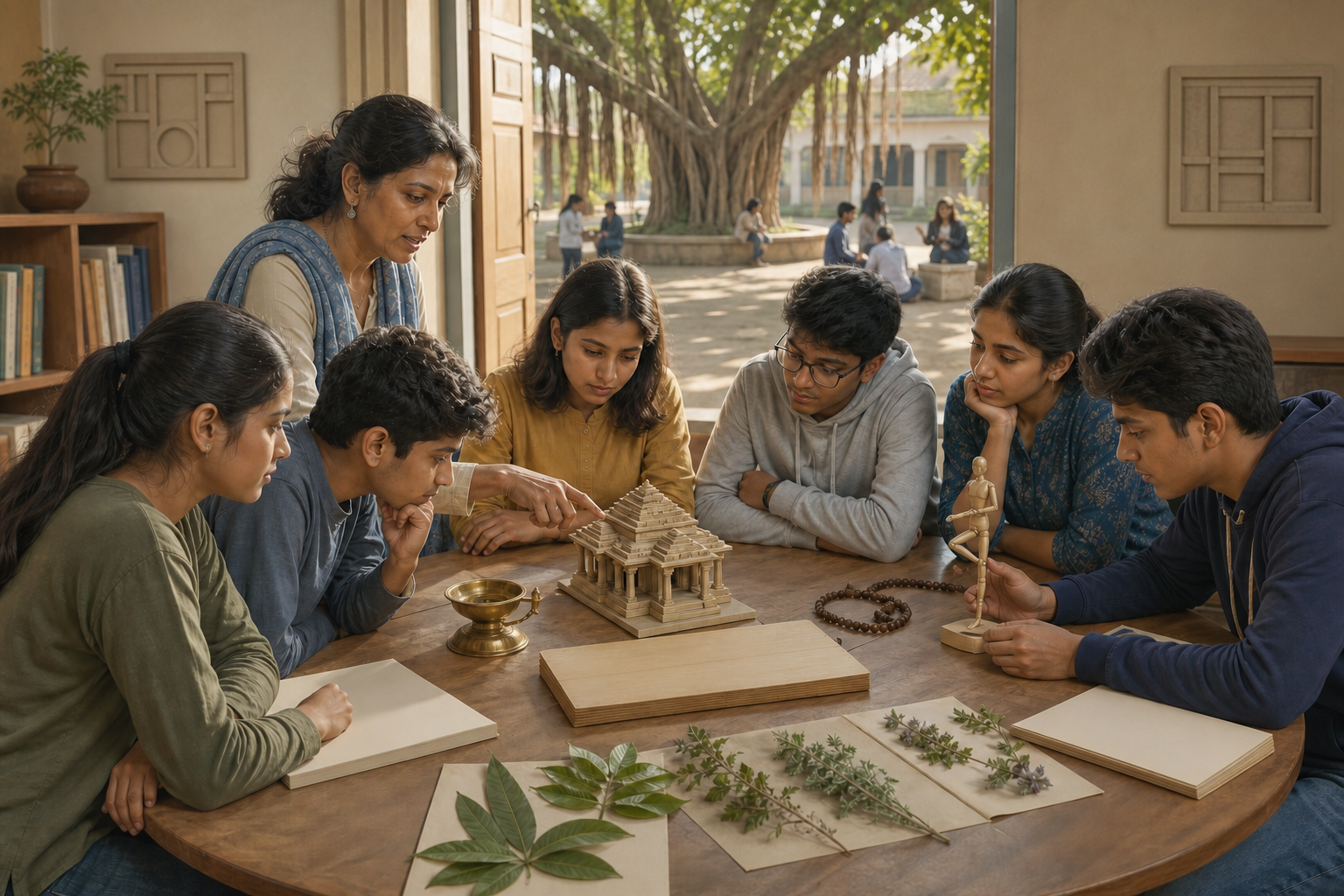
You open a textbook used by your child or class and find a Dharmic tradition reduced to a stereotype, detached from its philosophical setting, or presented as though it no longer lives in the community. What, exactly, should you ask the school or education department to change?
Start with a narrow, defensible goal: students should receive accurate, contextual and academically rigorous education about the Dharmic traditions of Bharat. That goal is stronger than a vague demand for cultural pride, and it gives parents, teachers and policymakers something concrete to examine.
Key takeaways
- Frame the issue as educational accuracy, cultural literacy and pluralism, not as compulsory religious observance.
- Review the whole learning chain: curriculum, textbooks, teacher guidance, classroom practice, co-curricular activity and assessment.
- Document a problem with the edition, page, exact wording, missing context and a workable correction.
- Pair new curriculum content with teacher preparation. An unfamiliar or sensitive lesson can still be mishandled when the educator receives no guidance.
- Use scholars, teachers, community representatives and civil society for different forms of review; no single group can perform every quality check.
- Treat a positive political response as an opening for formal work, not as proof that reform has already occurred.
Define the policy goal before arguing over content

The strongest case for Dharmic heritage in education is not that a classroom should produce religious conformity. It is that a student in Bharat should be able to understand the traditions that shaped the country’s philosophies, ethical vocabularies, communities and living practices.
This distinction protects both cultural inheritance and academic credibility. A lesson may ask a student to describe a belief, interpret an idea, recognize a tradition’s internal diversity or compare different positions. It should not require the student to profess a belief or judge personal devotion. Knowledge can be assessed; faith cannot.
The term Dharmic must also be used carefully. Hinduism, Buddhism, Jainism and Sikhism have civilizational relationships and areas of ethical conversation, but they are not interchangeable versions of one doctrine. A balanced curriculum can show connections without dissolving differences. It can acknowledge shared concerns while making clear which teaching, practice or historical claim belongs to which tradition.
When you evaluate a proposal, apply these practical tests:
- Accuracy: Are names, concepts, practices and historical claims presented correctly?
- Context: Does the lesson explain what an idea means within the tradition, rather than displaying it as an isolated curiosity?
- Internal diversity: Does it avoid presenting every Hindu, Buddhist, Jain or Sikh community as identical?
- Plural fairness: Does it use comparable standards of description, evidence and criticism across religious traditions?
- Academic purpose: Can the school identify what the student is expected to know, interpret or discuss?
- Freedom of conscience: Does the activity teach about a tradition without demanding personal adherence?
This framing prevents two predictable errors. Heritage is not preserved by replacing scholarship with devotional assertion. Pluralism is not protected by making Bharat’s own traditions absent, vague or culturally weightless. A sound policy rejects both errors.
Audit the whole learning chain, not only the textbook

A disputed paragraph is often the visible part of a larger problem. Correcting it may accomplish little if the curriculum omits the subject, the teacher lacks preparation, the classroom activity reproduces the same distortion or the examination rewards memorizing an oversimplification.
Follow the student’s experience from policy to assessment:
- Curriculum: Identify where Dharmic traditions appear, what learning outcome governs the material and which important dimensions are absent. Do not assume that a chapter title guarantees meaningful treatment.
- Textbook: Check the edition and exact page. Mark inaccurate wording, missing context, unexplained terminology, misleading images and captions that contradict the main text.
- Teacher guidance: Look for definitions, discussion prompts, common misconceptions and advice for handling disagreement. Content placed in a syllabus without usable guidance leaves too much to improvisation.
- Classroom practice: Notice whether students encounter the tradition as a living intellectual inheritance or only as a festival, costume, conflict or historical relic.
- Co-curricular activity: Ask what students are meant to learn, how participation is handled and whether explanation accompanies performance. Cultural visibility alone does not guarantee understanding.
- Assessment: Check whether questions reward accurate interpretation. A student should not lose marks for declining to express a personal religious commitment.
Teacher sensitization deserves particular attention. It should not be a ceremonial lecture asking educators to be respectful. Useful preparation equips a teacher to distinguish a tradition’s self-understanding from an outsider’s description, a documented historical question from a theological claim, and legitimate scholarly disagreement from a factual mistake.
A workable training package should include a controlled vocabulary, background notes, examples of misleading formulations, model discussion questions and sample assessments. Teachers also need a route for referring a disputed point instead of settling it through personal confidence. If a policy adds content but supplies none of these tools, implementation remains fragile.
Turn cultural concern into a change officials can evaluate
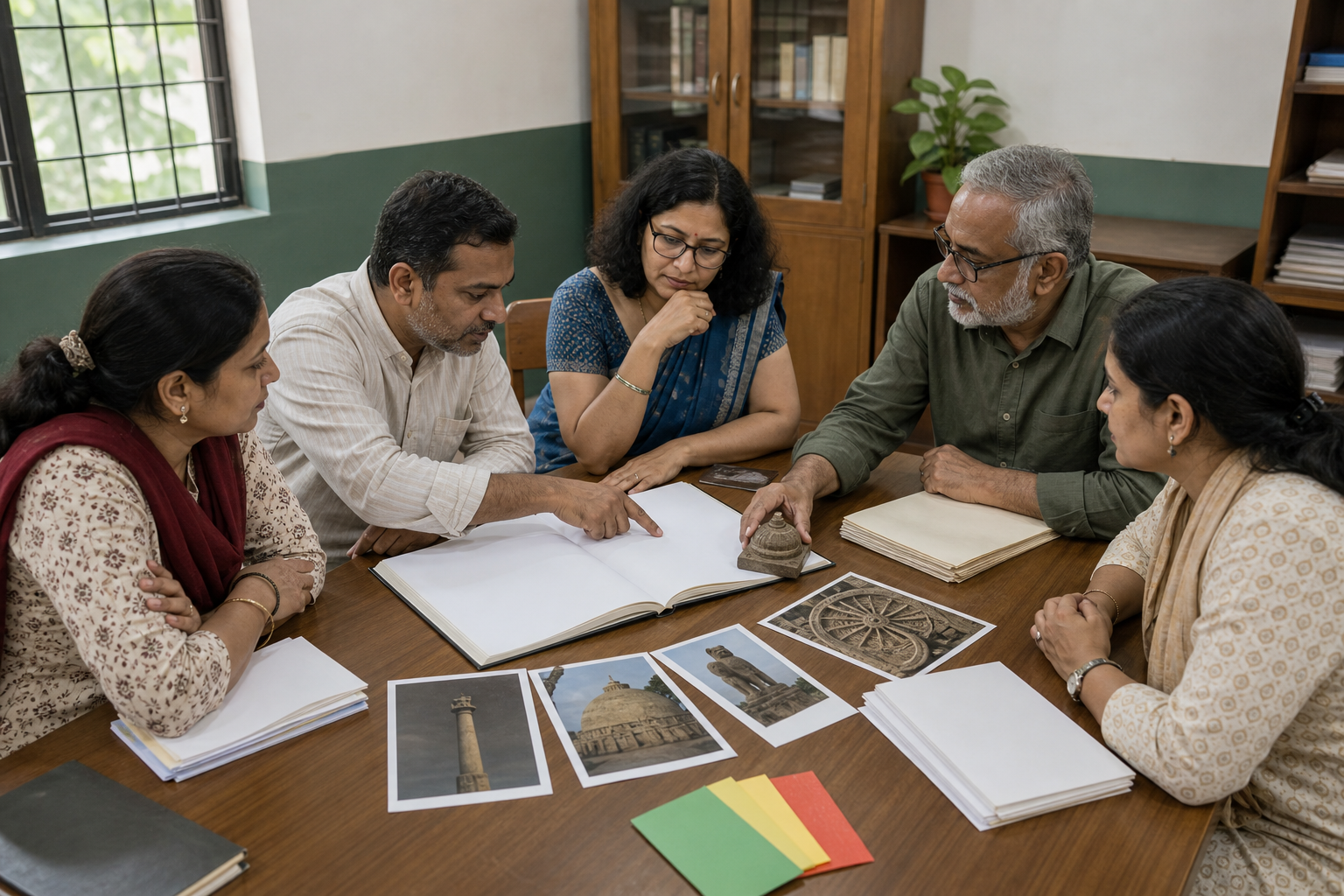
General declarations may express urgency, but they give an education official no clear decision to make. A reviewable request identifies the defect, shows its educational consequence and proposes a remedy that fits the curriculum process.
Build your submission in this order:
- Identify the material. Record the board or institution, subject, class level, edition, chapter, page and exact passage or activity.
- Classify the concern. State whether it involves factual error, missing context, stereotyping, unequal treatment, unsuitable pedagogy or an assessment problem.
- Explain the consequence. Show what a student is likely to misunderstand. Avoid speculating about the writer’s motive when the educational defect itself can be demonstrated.
- Offer precise replacement language. A sentence-level correction is easier to evaluate than a demand to rewrite history. If the problem is omission, identify the concept or context that belongs in the unit.
- Request the right remedy. Ask for an erratum, textbook revision, teacher note, curriculum review, training module or assessment change according to where the problem occurs.
- Propose quality control. Name the kinds of expertise needed and ask how disagreements, approvals and final wording will be recorded.
- Ask for the next formal step. Request the responsible office, review route and a date by which the authority expects to respond.
Consultation works best when each participant has a defined job. Scholars can examine terminology, intellectual context and disputed interpretations. Classroom educators can test whether a lesson is teachable at the intended level. Community representatives can identify distortions that an external reader may miss. Civil-society participants can help keep the process open and accountable. Policymakers must still set learning standards and own the final decision.
Consultation should include appropriate competence across Hindu, Buddhist, Jain and Sikh traditions rather than appointing one voice to speak for all Dharmic communities. It should also distinguish a factual correction from a preference. Where qualified interpretations differ, the curriculum can name the disagreement instead of declaring one contested position universally settled.
The appeal made by Sunil Ghanwat of the Hindu Janajagruti Samiti at the Yuva Warkari Parishad in Pune sought protection for Hindu traditions within education and received a positive response from the Education Minister. That response matters because it opens a route for dialogue. It does not, by itself, change a syllabus, prepare a teacher or correct a textbook.
The useful follow-up is therefore procedural: put the concern in writing, define its scope, identify who will review it and seek a recorded next step. Constructive engagement becomes policy only when goodwill is converted into responsibility, materials, implementation and review.
What you can do in your role now

If you are a parent or student
- Preserve the exact passage, image, assignment or classroom instruction. Include enough context to show how it functions in the lesson.
- Ask the school whether the material is locally chosen or prescribed by another authority. Send the request to the body that can actually change it.
- Describe the misunderstanding created by the material and request a correction, explanation or review. Keep the first request narrow enough to answer.
- If the concern involves classroom conduct, separate what was in the official material from what the teacher added. Those problems may require different remedies.
If you teach or lead a school
- Choose one unit and audit its curriculum outcome, text, classroom activity and assessment together.
- Check whether every important Dharmic term is defined in its own context before students are asked to compare traditions.
- Replace questions about a student’s personal belief with questions that test knowledge, interpretation and reasoned comparison.
- Record where staff need specialist help. A list of recurring uncertainties is more useful for training design than a general request for awareness.
- Create a referral path for contested content so that a teacher does not have to improvise a final judgment in front of the class.
If you represent a community or research institution
- Submit annotated corrections that distinguish errors, omissions and interpretive disagreements.
- Supply concise explanations suitable for the intended class level, not material that can only be understood by specialists.
- Bring more than one qualified perspective when a tradition contains genuine internal diversity.
- Ask for fair inclusion without seeking the erasure or caricature of another community. That strengthens the educational case and the Dharmic commitment to plural coexistence.
If you make education policy
- Publish the scope of the review, the authority responsible and the method for submitting evidence.
- Examine textbooks, teacher education and assessments as connected parts of the same reform.
- Record why proposed changes are accepted, modified or rejected. Transparency helps prevent every revision from reopening the same unresolved dispute.
- Test whether revised material gives teachers enough context to teach it accurately before adopting it more widely.
- Review implementation after the material reaches classrooms. Formal inclusion has limited value if the lesson remains distorted in practice.
You do not need to settle every civilizational debate before improving one lesson. Choose a specific unit, document the problem, propose language an educator can use and ask the responsible authority for a formal next step. That is how concern for Dharmic heritage becomes durable educational policy rather than a passing controversy.
References
