
If you are preparing for Margashirsha Lakshmi Puja on December 4, 2025, the practical question is how the morning tithi change should affect your Thursday observance. You may be wondering whether to worship before the change, wait for Purnima, or follow your household’s usual evening routine.
The simple answer is that the tithi transition and the Thursday vrata can be honored together. For most regions, Shukla Chaturdashi lasts until 7:04 AM and Purnima follows for the rest of December 4. Because exact timings vary by location, use a city-specific panchang for the clock time while keeping the familiar Margashirsha Guruvaar practice of your family or temple.
Read December 4 within the four-Thursday vrata
Margashirsha Lakshmi Puja is especially cherished in Maharashtra, with related Thursday observances also found in parts of Karnataka, Telangana, and Andhra Pradesh. The regional character matters: this is not a single, mechanically uniform ritual. Family parampara and local temple practice should determine details that a general calendar cannot settle.
- November 27 begins the four-Thursday sequence.
- December 4 is the second observance and coincides with the Chaturdashi-to-Purnima transition.
- December 11 continues the household discipline established during the first two weeks.
- December 18 completes the sequence.
This sequence changes how you should plan. December 4 is not an isolated festival for which every element must be made elaborate. It is one step in a steady monthly rhythm. If you began on November 27, retain the same worship space, core prayers, food discipline, and time of day unless your local panchang or family custom gives you a reason to adjust them.
A Hindu civil date can contain more than one tithi because a tithi changes at its own lunar moment rather than at midnight. Thursday therefore remains Thursday even though Chaturdashi gives way to Purnima during the morning. You do not need to create two full Lakshmi pujas merely because the tithi changes. If your family has a specific rule for completing a Chaturdashi vrata or beginning a Purnima observance, preserve that distinction; otherwise, one coherent Margashirsha Thursday puja is the clearer choice.
Choose your puja time in the right order
The 7:04 AM transition is useful for understanding the shape of the day, but it should not be copied as a universal local deadline. Panchang calculations and muhurat windows depend on place. Local sunrise, sunset, longitude, latitude, and time zone all matter. A timing shown for one city can be wrong for another even when both calendars display December 4.
- Start with your location. Check a panchang calculated for your city or use the schedule issued by the temple where you will worship. If the city is not stated, do not assume that an online clock time applies to you.
- Identify what actually requires precision. A formal sankalpa tied to a tithi or muhurat calls for local timing. A regular household Margashirsha Guruvaar puja may continue at the family’s established time, often in the evening.
- Separate preparation from worship. Cleaning, arranging the puja place, preparing naivedya, and making rangoli can be completed earlier. This prevents a timing concern from turning the actual prayer into a rush.
- Use the local Purnima transition if Purnima is important to your observance. For most regions, the broad calendar places Purnima after 7:04 AM on December 4, but your city’s calculation should govern any exact start time.
- Treat Abhijit Muhurat as local, not as a generic noon appointment. It commonly falls around local midday, but its precise span must be checked rather than guessed. There is no need to move a customary evening Lakshmi Puja into midday solely because a general calendar mentions Abhijit Muhurat.
Nakshatra and the Moon’s Rashi can also change during a date and are location-dependent. Check them when your inherited ritual procedure explicitly uses them. If your household practice does not require those details, do not let an incomplete online listing distract you from the vrata’s central disciplines of worship, gratitude, restraint, and giving.
If you cannot obtain a reliable local calculation, avoid inventing an exact muhurat from the 7:04 AM reference. Keep your family’s established Thursday worship time, or follow a nearby temple’s announced schedule. That is more coherent than combining unrelated timings from different cities.
A simple home puja that remains complete
A useful puja plan begins with the practices you can sustain across all four Thursdays. You do not need to add unfamiliar ritual objects or recitations merely to make December 4 feel more significant. Use the form of Lakshmi worship already known in your home, and ask an elder or priest if your family procedure has been forgotten.
- Prepare the space. Clean the worship area and the entrance before the chosen puja time. Make a modest rangoli if that belongs to your practice. Natural colors and reusable materials keep the preparation aligned with care for the household and its surroundings.
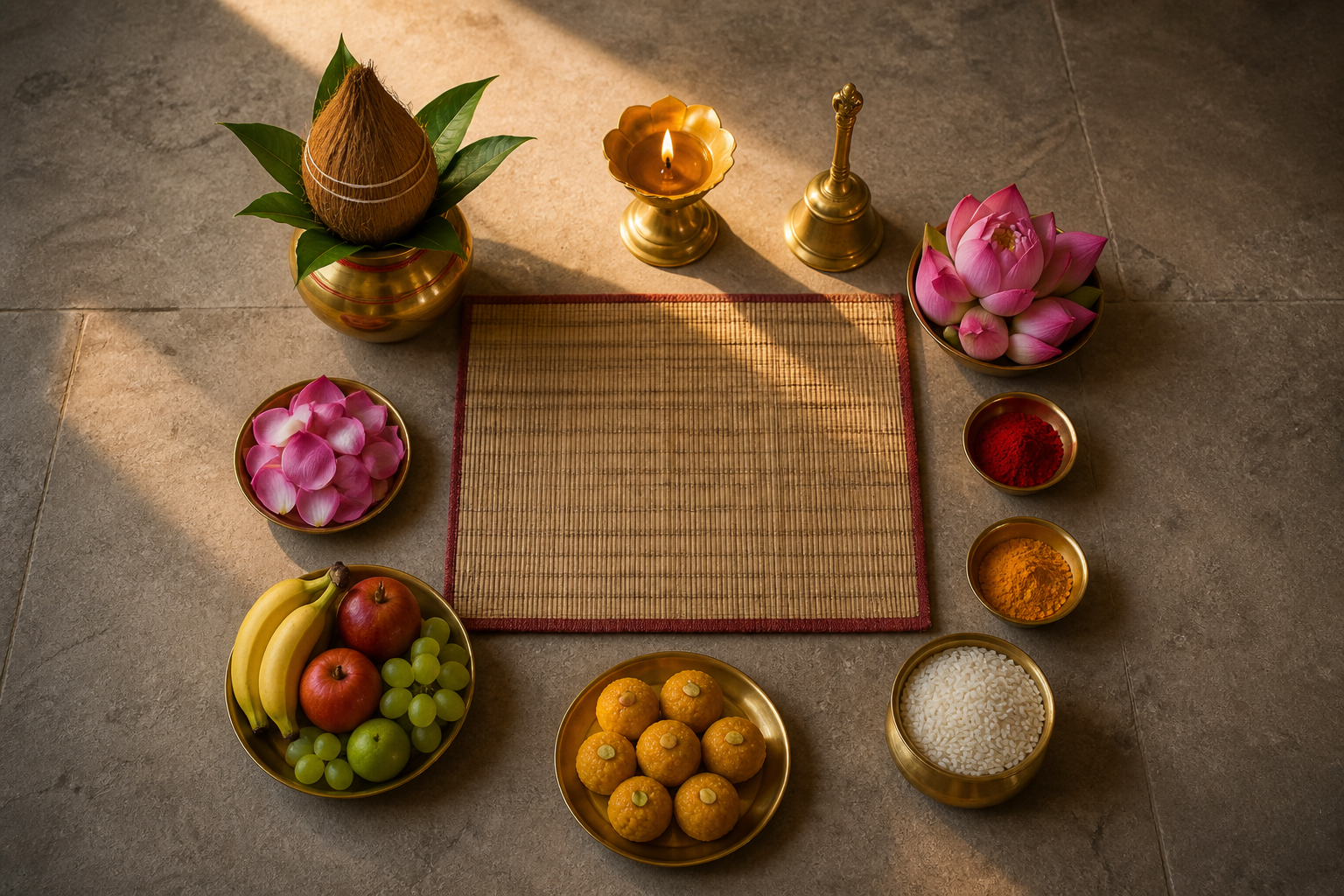
- Gather only what you will use. Keep the lamp, a safe holder, flowers, naivedya, and your familiar stotra or namaavali ready. Preparing these together prevents repeated interruptions once prayer begins.
- Choose a realistic food discipline. Some devotees keep a simple Thursday fast; others take sattvic meals. If fasting is not appropriate for you, choose sattvic food instead of treating physical deprivation as the measure of devotion.
- Settle the household before lighting the lamp. Silence avoidable distractions, gather participating family members, and state the purpose of the vrata clearly. A sincere sankalpa can name gratitude, household harmony, ethical prosperity, and the intention to complete the remaining Thursdays.
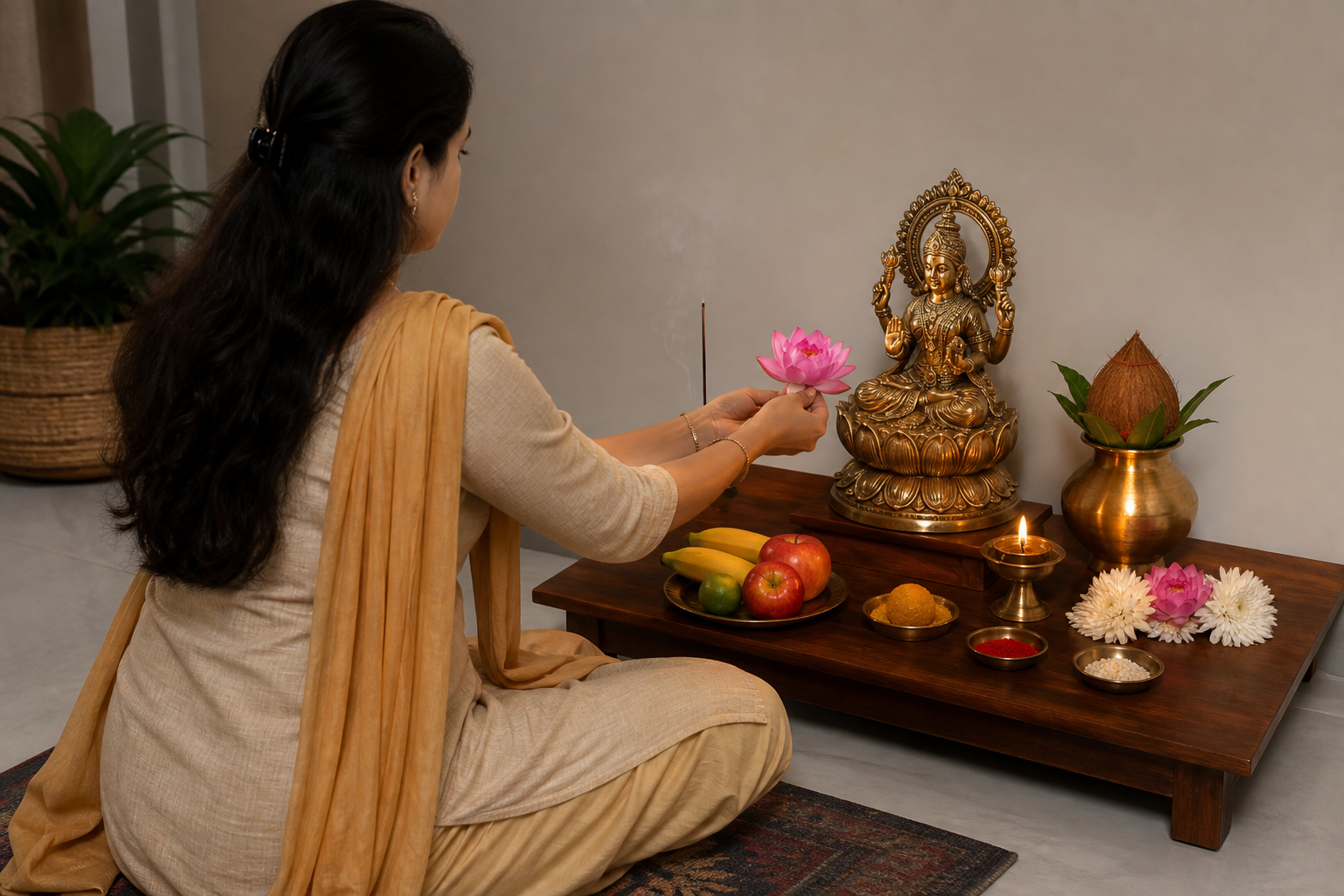
- Offer worship in a familiar order. Light the diya, offer flowers and naivedya, and recite the Lakshmi prayers, stotra, namaavali, or aarti already used in your tradition. A period of japa or quiet meditation can follow. Do not leave a burning lamp unattended.
- Make dana part of the observance. Decide what you will give before the puja ends. Set aside the donation or useful item immediately, then complete the act rather than leaving generosity as a vague future intention.
- Share and reset. Distribute prasad according to your household practice, clean the worship area respectfully, and retain reusable items for December 11. Repetition is part of the vrata, so an orderly close makes the next Thursday easier to observe.
The distinction between simplicity and care is important. Simplicity means removing display and unnecessary complexity. It does not mean beginning without preparation, rushing through familiar prayers, or postponing dana indefinitely. A short observance performed attentively can express the vrata’s purpose better than an elaborate arrangement that leaves the household strained.
Let Purnima deepen the day without overloading it
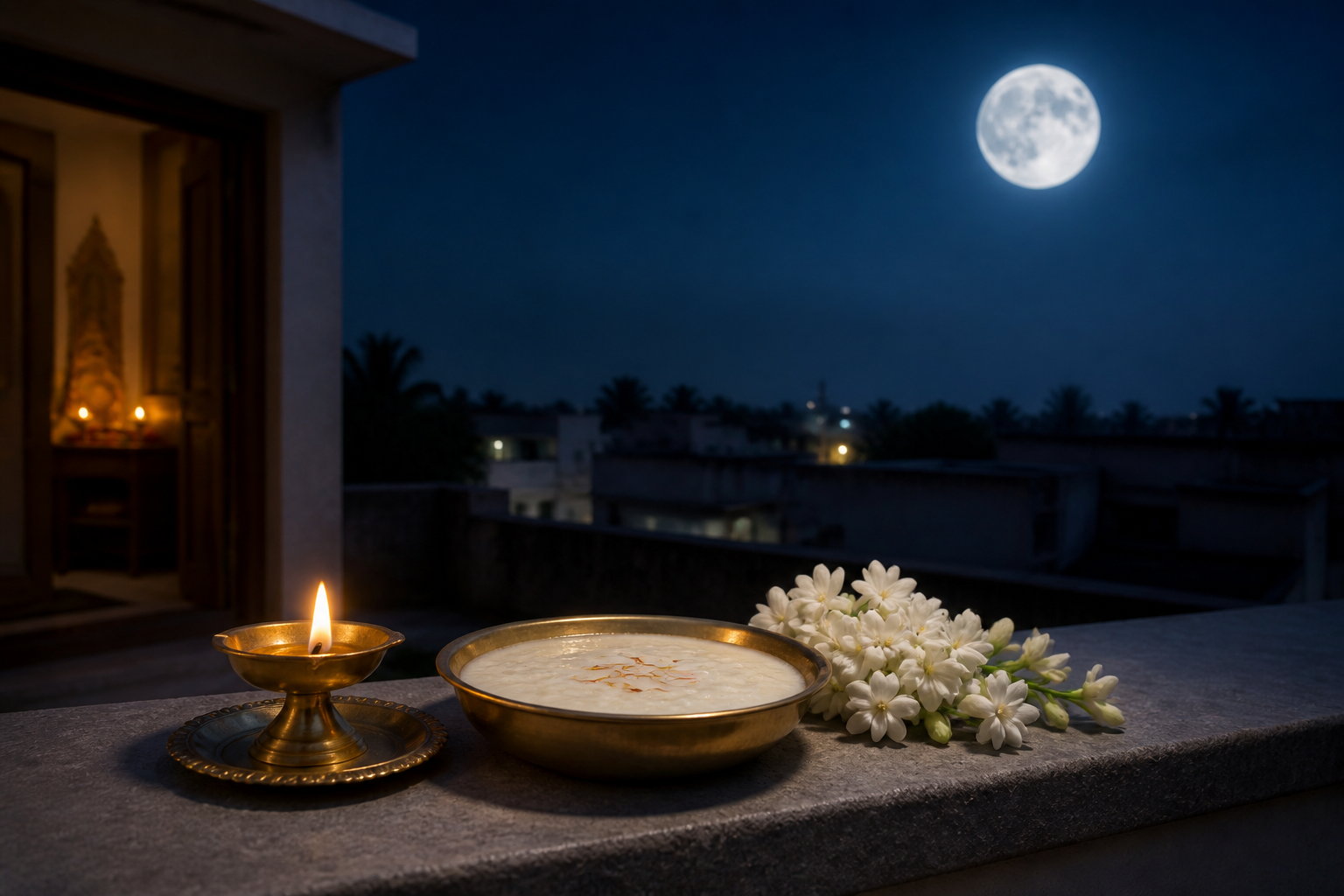
Chaturdashi and Purnima lend different accents to December 4. The early Chaturdashi period supports preparation, refinement of intention, and completion. After the local transition, Purnima turns attention toward fullness, clarity, collective prayer, contemplation, and dana.
You can express that transition without multiplying ceremonies. Use the early morning to prepare the home and examine the intention behind the vrata. During the main puja, add one Purnima-appropriate practice: a period of silent meditation, extra japa, a family scripture reading, or a definite act of charity. Choose one addition and do it attentively rather than assembling a long checklist.
This is also where the meaning of prosperity becomes practical. Lakshmi worship is easily reduced to a request for acquisition, but the Thursday rhythm places receiving beside responsibility. Sattvic restraint limits excess. Dana moves something useful beyond the self. Gratitude changes how existing resources are regarded. Household harmony asks whether prosperity is being pursued without neglecting relationships.
The rituals of Hindu, Buddhist, Jain, and Sikh traditions are not interchangeable, yet ethical generosity, mindful conduct, non-harm, freedom from grasping, remembrance, and service form recognizable points of Dharmic kinship. If relatives or neighbors from different traditions join the gathering, preserve the specifically Hindu identity of Lakshmi Puja while welcoming them through shared silence, hospitality, or service rather than pretending every lineage performs the same rite.
Key takeaways for December 4
- December 4, 2025 is the second of four Margashirsha Lakshmi Vrat Thursdays.
- For most regions, Shukla Chaturdashi continues until 7:04 AM and Purnima follows, but a city-specific panchang should supply the exact local time.
- The morning tithi change does not by itself require two complete Lakshmi pujas.
- Follow family parampara or a local temple notice before relying on a generic online muhurat.
- A sustainable observance can include a clean worship space, diya, flowers, naivedya, familiar prayers, sattvic food or an appropriate fast, and a definite act of dana.
- Check exact Abhijit Muhurat, Nakshatra, and Rashi details only through a location-specific calculation.
- Keep December 11 and December 18 in view so that December 4 strengthens the four-Thursday discipline rather than becoming a one-day display.
Before December 4 worship begins, make three decisions: which local panchang or temple schedule you will trust, what time your household will gather, and what dana you will actually complete. Then mark December 11 and December 18. That small act of planning protects the steadiness at the heart of Margashirsha Lakshmi Vrat.
References
- DharmaRenaissance Blog – Unlock Prosperity: Margashirsha Laxmi Puja 2025 in Maharashtra (Lakshmi Vrat) Dates
- DharmaRenaissance Blog – December 4, 2025 Panchang: Shukla Chaturdashi to Purnima, Auspicious Muhurat, Nakshatra, Rashi
