
If you are trying to decide whether Bihar’s election verdict was a vote for the NDA, a rejection of the INDI alliance, or another turn in caste arithmetic, begin by separating the result from the stories built around it. The NDA secured a commanding majority while the INDI alliance underperformed, but the size of a seat victory cannot explain every constituency or every voter.
The more useful reading is that Bihar delivered three things at once: a mandate to govern, a reward for superior electoral execution, and a contract whose conditions are jobs, safety, infrastructure and reliable public services. If you keep those layers separate, you can understand both why the NDA won and what could undo its advantage.
Separate the mandate from the mandate’s conditions
A commanding majority answers the first constitutional question: who has the numbers to form a stable government? It does not automatically answer the harder political questions. Did voters endorse every part of the winning coalition’s programme? Did the opposition’s social base disappear? Will the same alignment survive if employment and education fail to improve? The result alone cannot tell you.
Read the verdict through three distinct layers:
- The mandate: The NDA has the authority and legislative strength to govern. Political instability cannot serve as a ready excuse for weak execution.
- The electoral mechanism: Candidate choice, alliance coordination, booth organization and localized welfare delivery helped turn support into constituency victories.
- The performance contract: Voters who chose continuity still expect faster progress on employment, quality education, targeted skilling, rural incomes, urban services and public safety.
This distinction protects you from two common errors. The first is treating a large seat tally as proof that every social division has vanished. The second is dismissing the result as nothing more than caste arithmetic. Bihar’s voters can care about community representation and government performance at the same time. The verdict indicates that visible delivery and confidence in public order can modify older loyalties without erasing them.
Key takeaways
- The NDA won more than permission to continue; it assumed responsibility for delivering without the cover of coalition uncertainty.
- The INDI alliance’s problem was not merely persuasion. Weak coordination and poor conversion of support into seats mattered at constituency level.
- Caste remains politically relevant, but it is not the only axis on which voters judge a government.
- Memories of administrative decline and law-and-order stress still influence the value voters place on stability.
- The durability of the verdict will depend on jobs, education, skills, rural opportunity, public services and safety.
- Bihar offers a national political signal, but not a formula that can be copied mechanically in every state.
The decisive gap was seat conversion, not just sentiment

Assembly elections are won constituency by constituency. A coalition can possess a substantial social base and still lose badly if its votes are inefficiently distributed, its partners compete against one another informally, or its local candidates fail to bring supporters to the polling station. Conversely, a disciplined alliance can convert a modest advantage across many constituencies into a much larger advantage in seats.
The NDA’s success rested on aligning a development message with ground-level organization. Candidate selection, booth management and the local visibility of welfare delivery were not secondary details. They were the machinery that translated a broad narrative into individual victories. The INDI alliance struggled with coordination, message discipline and the same conversion problem.
That gives you a practical way to read the result without getting trapped in statewide slogans. For any constituency you care about, ask four questions:
- Was the candidate locally credible? A popular party label cannot always rescue a weak nominee, especially where local networks determine turnout.
- Did the alliance operate as one unit? Formal seat sharing means little if workers and voters of one partner do not transfer their support to another.
- Was a government benefit visible at household level? Voters judge delivery through the road they use, the health facility they can reach, the benefit they actually receive and the safety they experience.
- Did the organization protect its vote on polling day? Mobilization at the booth is where general approval becomes an electoral result.
This is also why you should not confuse a seat landslide with uniform social consensus. Seat totals measure victories under constituency rules. They do not reveal identical voter motivations, equal margins or permanent loyalty. A serious interpretation therefore moves downward from the statewide map to candidate quality, alliance transfer and local delivery.
History survives as a benchmark, not an iron law

Bihar’s political language carries an unusually long memory. The region associated with Magadha evokes organized statecraft and civilizational power. Nalanda and Vaishali evoke learning, debate and institutional life. More recent memory runs through Congress-era administration under leaders such as Jagannath Mishra and the political transformation associated with Lalu Prasad Yadav.
These periods are not interchangeable, and history should not be flattened into a morality tale. Yet the law-and-order and administrative strains associated with the 1990s remain part of Bihar’s political imagination. They created a durable benchmark: voters may disagree over identity, redistribution and representation, but many still ask whether the state can keep order and make ordinary life function.
Political memory works through comparison rather than nostalgia. A voter need not endorse every decision of the present government to fear a return to a period remembered as less secure. Nor does a preference for stability mean that the voter has abandoned demands for dignity or representation. The same person can value social recognition, a functioning road, a predictable welfare payment and the freedom to travel without fear.
Caste and performance are interacting forces
The claim that development has replaced caste does not hold up. Caste can shape political trust, candidate acceptability, social networks and expectations of representation. Performance addresses another set of questions: Can the government deliver? Is the administration accessible? Are public spaces safe? Does a household see a credible path to greater opportunity?
The Bihar verdict is better understood as a recalibration between these forces. Welfare delivery, infrastructure and assurances of public safety appear to have softened some inherited loyalties without eliminating community identity. That is a conditional shift. If delivery weakens, voters can reorganize around older solidarities or new grievances.
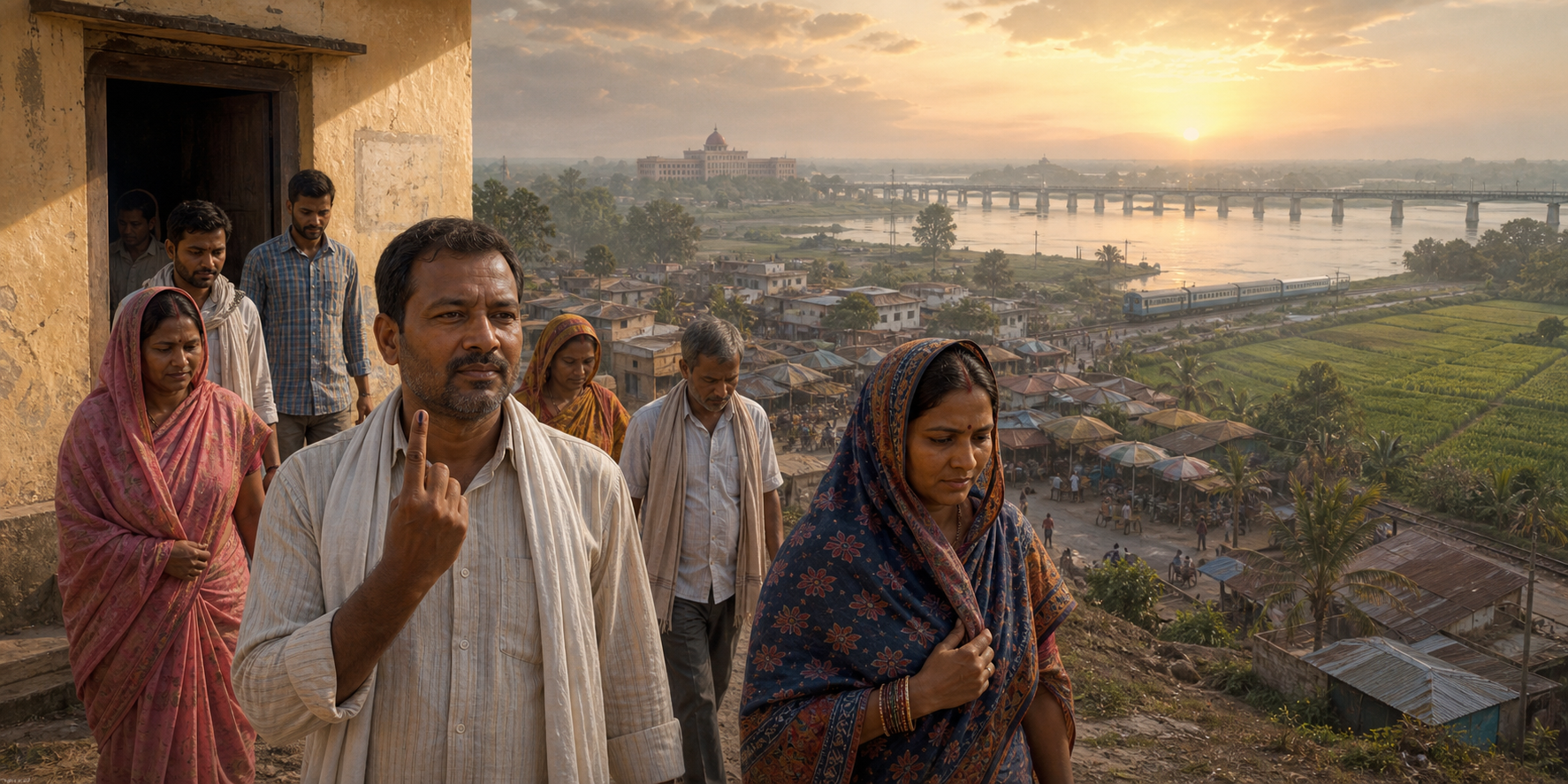
You should apply the same caution to demographic stories. At several observed booths, women appeared in greater numbers, while first-time voters queued early and discussed migration and skilling. These scenes reveal the concerns present in the electorate, but they are not a statewide statistical measure. Do not turn women, young people or first-time voters into a single bloc merely because their participation fits a convenient narrative.
Instead, look for evidence at the level where preferences become concrete. Did women respond to safety and dependable benefits? Did young voters see a credible route from education to work? Did families affected by migration judge continuity as the safer option? Did a particular candidate bridge community boundaries? Those questions are more informative than declaring that Bihar has entered either a post-caste age or an unchanging caste order.
The mandate becomes measurable after counting ends

A stable majority lowers the cost of political coordination. It also raises the standard by which the government should be judged. When a coalition has sufficient authority to act, voters can more reasonably attribute success or failure to its choices. The NDA’s task is therefore not to keep celebrating the verdict but to convert organizational strength into administrative capacity.
The electoral pattern linked stronger support for continuity with better road connectivity, healthcare access and digital services in several districts. Areas facing agrarian distress or limited non-farm employment applied sharper scrutiny to promises and timelines. The next verdict will depend on whether these gaps narrow in lived experience, not merely in announcements.
Use the following scorecard to assess the government. Keep it at constituency or district level where possible, because statewide averages can hide the places where implementation fails.
- Employment: Look beyond recruitment announcements and investment declarations. Ask whether stable local work is becoming easier to obtain and whether migration is increasingly a choice rather than an economic compulsion.
- Education and skilling: Count outcomes, not training events. A useful programme should connect instruction to a recognizable employment path and should be accessible outside major urban centres.
- Rural incomes: Watch both agriculture and non-farm work. A road or digital connection matters most when it helps a household reach markets, services or employment.
- Health, roads and digital access: Completion is only the first test. Reliability, maintenance, travel time and last-mile availability determine whether an asset changes daily life.
- Urban services: Judge whether growing towns receive predictable basic services rather than episodic interventions. Bihar’s development challenge is not exclusively rural.
- Public safety: Look for consistent rule enforcement, not occasional displays of force. Safety becomes credible when ordinary people can move, work and seek administrative help without relying on political patronage.
- Welfare delivery: Ask whether eligible households receive benefits regularly and whether errors can be corrected through a usable grievance process.
- Social cohesion: Track whether political competition remains bounded by law and whether communities can disagree without intimidation or collective blame.
You do not need to wait until the next election to make this assessment. Review the first major budget for priorities, revisit the same indicators at regular intervals, and compare completed work with the promise that justified it. A simple district-level ledger of commitment, deadline, completion and lived effect will tell you more than a stream of campaign speeches.
The opposition faces an equally concrete test. It must decide whether to repair candidate selection, alliance coordination and booth organization, or merely intensify its rhetoric. It also needs an answer to the voter’s demand for safety and delivery. Social arithmetic can identify a potential coalition; it cannot substitute for a credible governing proposition.
A dharmic verdict demands more than partisan victory
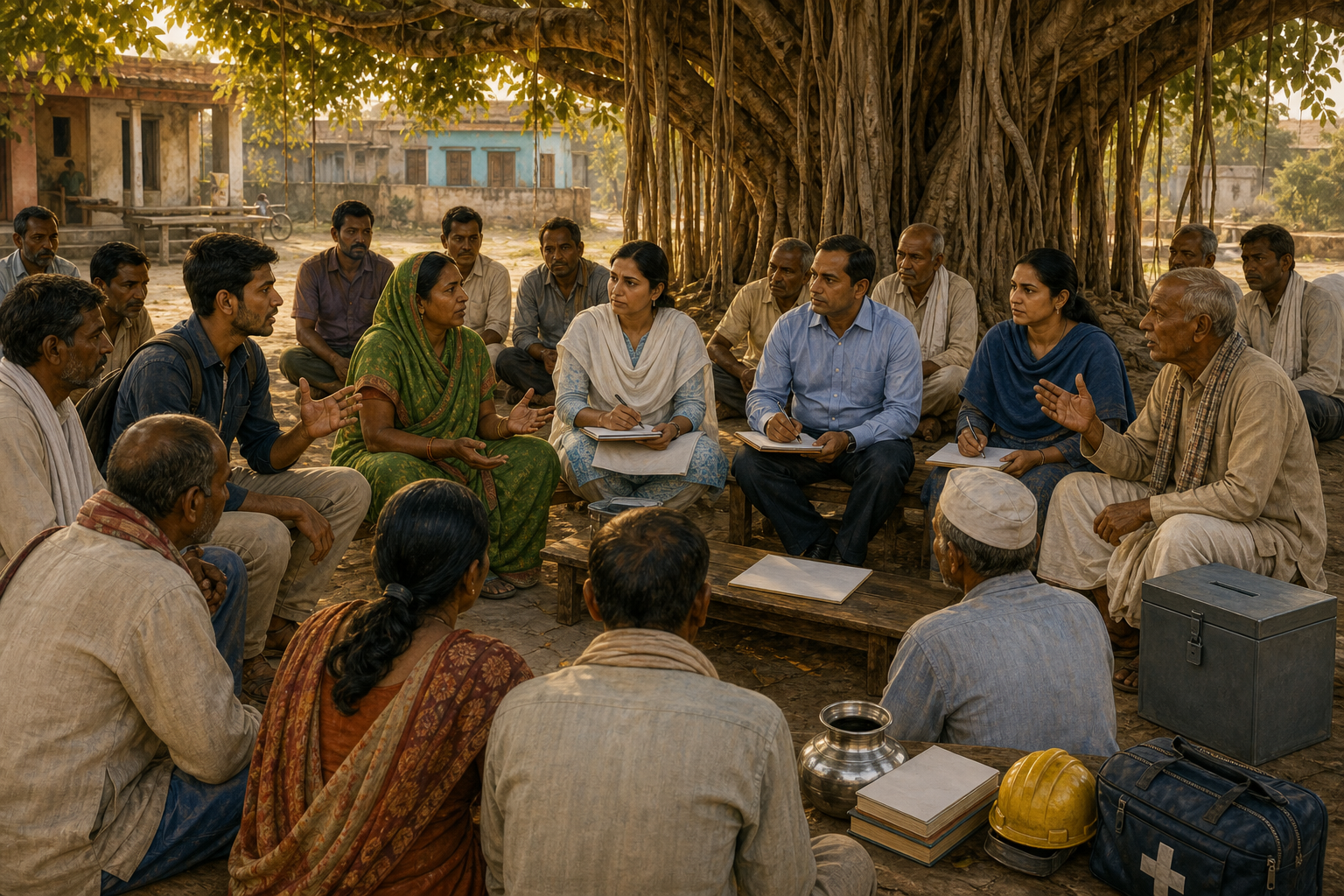
Bihar’s civilizational inheritance makes the standard of governance larger than electoral success. Magadha represents the power of organized statecraft. Nalanda and Vaishali represent intellectual openness, institutional confidence and the capacity to live with competing traditions. The shared presence of Hindu, Buddhist, Jain and Sikh inheritances invites a public ethic built on dignity, dialogue and collective well-being.
A pro-dharma reading should therefore resist the temptation to treat state power as tribal possession. Dharma places duties on authority. A government must maintain order without arbitrariness, deliver welfare without turning citizens into political dependants, and respect plural traditions without surrendering the civilizational character of Bharat. Rule of law, social harmony and inclusive development are not ornamental ideals under this test; they are measures of legitimate statecraft.
This framework also clarifies what the verdict does not authorize. It does not justify neglect of districts that voted differently. It does not convert political opponents into enemies of society. It does not excuse administrative favouritism. A majority is strongest when citizens outside the winning coalition can still expect equal protection and competent service.
Bihar is a national signal, not a national template
The outcome matters beyond the state because it can influence coalition calculations, cabinet priorities and federal-state coordination on welfare, infrastructure and investment. It strengthens the argument that voters will support continuity when stability is joined to visible delivery. Stability by itself is not the lesson.
Nor should anyone mechanically project Bihar’s result onto another state or a national election. Candidate networks, community coalitions, alliance structures and local memories differ. What can travel is the underlying political discipline: construct a coherent coalition, choose viable candidates, organize at booth level, make benefits visible and connect continuity to a believable future.
For national politics, watch whether the mandate produces sustained coordination between Bihar and the Union government, whether investment creates work rather than headlines, and whether the opposition learns to compete at constituency level. Those developments will reveal more than speculative claims about a permanent realignment.
Your best test is deliberately simple. Keep a local ledger of jobs, schools, skills, roads, health access, welfare reliability and safety. Then ask whether each has improved for people who lack political connections. If the answer grows stronger over the term, the verdict may mark a durable shift toward performance-based legitimacy. If it does not, Bihar’s history shows that a commanding mandate can become another benchmark against which the next government is chosen.
References
