
You have found Viscount Valentia quoted as an eyewitness to India during the East India Company’s ascent. Your immediate problem is not whether to accept or reject a colonial traveller. It is how to recover place-specific evidence without allowing his imperial assumptions to dictate your conclusion.
Begin by reading him in layers. George Viscount Valentia sailed from the Downs aboard the Minerva on 5 June 1802, travelled for four years through India, Ceylon, the Red Sea, Abyssinia, and Egypt, and published his record in three volumes in 1809. He kept a dated journal and noticed unusually small particulars. Those strengths make him valuable, but they also make misuse easy: precision about weather, roads, or buildings can lend undeserved authority to a judgement about an entire people.
Fix the imperial moment before trusting the narrator
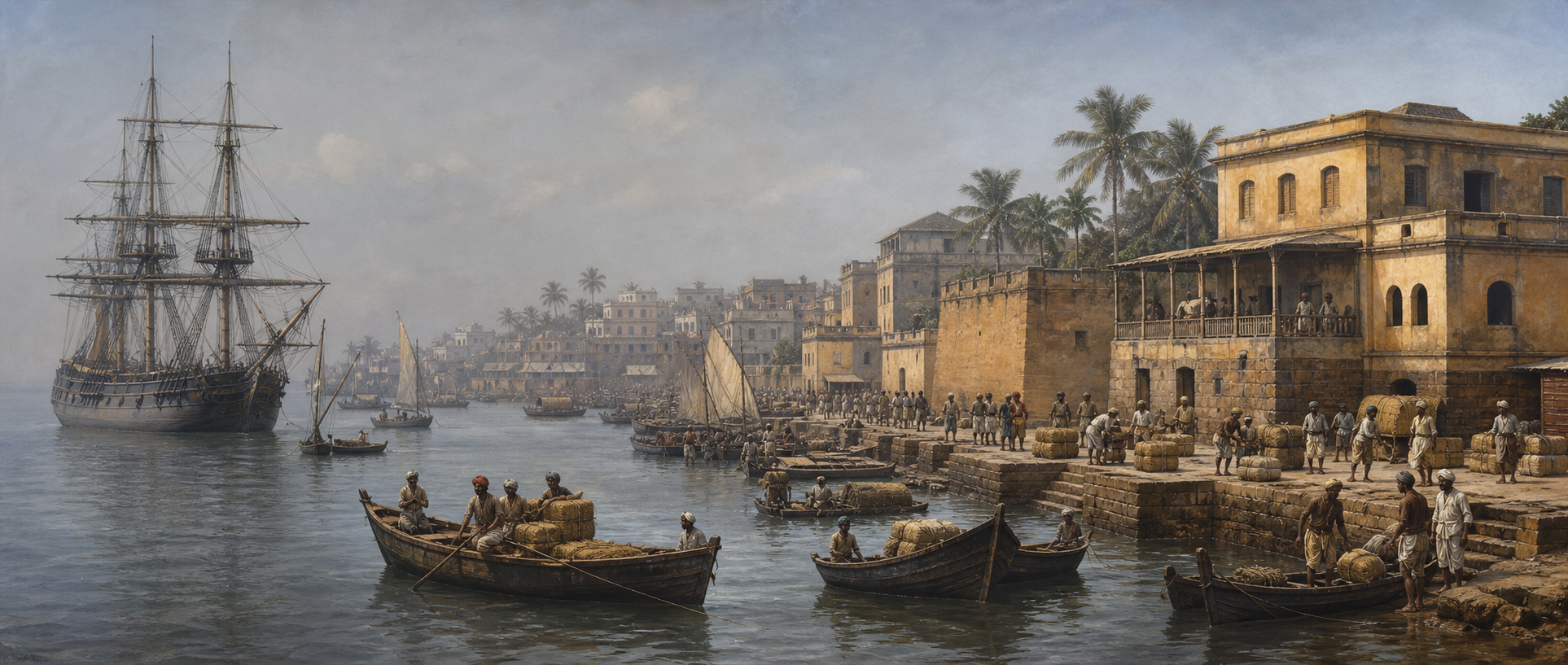
Valentia entered India roughly half a century after the Battle of Plassey in 1757. Tipu Sultan had fallen in 1799. Maratha power was under severe strain, while the Mughal emperor Shah Alam II retained nominal sovereignty beneath growing Company power. Portuguese and Dutch influence had diminished, French positions were receding, and Richard Wellesley’s assertive policies were accelerating British consolidation.
That sequence can make the British victory look preordained. Resist that retrospective illusion. Valentia travelled when Company supremacy appeared increasingly likely to British observers, but an observer’s confidence is not the same thing as historical inevitability. Indigenous rulers still made choices, alliances still mattered, and political fragmentation did not mean the disappearance of Indian civilization.
Before using any entry, place it on two maps at once. The first is geographical: the town, road, river, fort, sacred site, or court he actually encountered. The second is political: who claimed sovereignty there, who exercised military power, whose cooperation enabled his access, and what the Company hoped to secure. If you cannot answer all four political questions, mark the gaps instead of filling them with Valentia’s confidence.
His choice of detail also reveals his priorities. Garrisons, forts, roads, harvests, livestock, and terrain mattered to a traveller moving through an expanding imperial system. Dress, diet, etiquette, hygiene, sounds, and smells supplied material for ranking societies. When one entry moves from a hill contour to a civilizational verdict, separate the two claims. The first may be an observation. The second is an interpretation shaped by power.
Separate what Valentia saw from what empire taught him to see
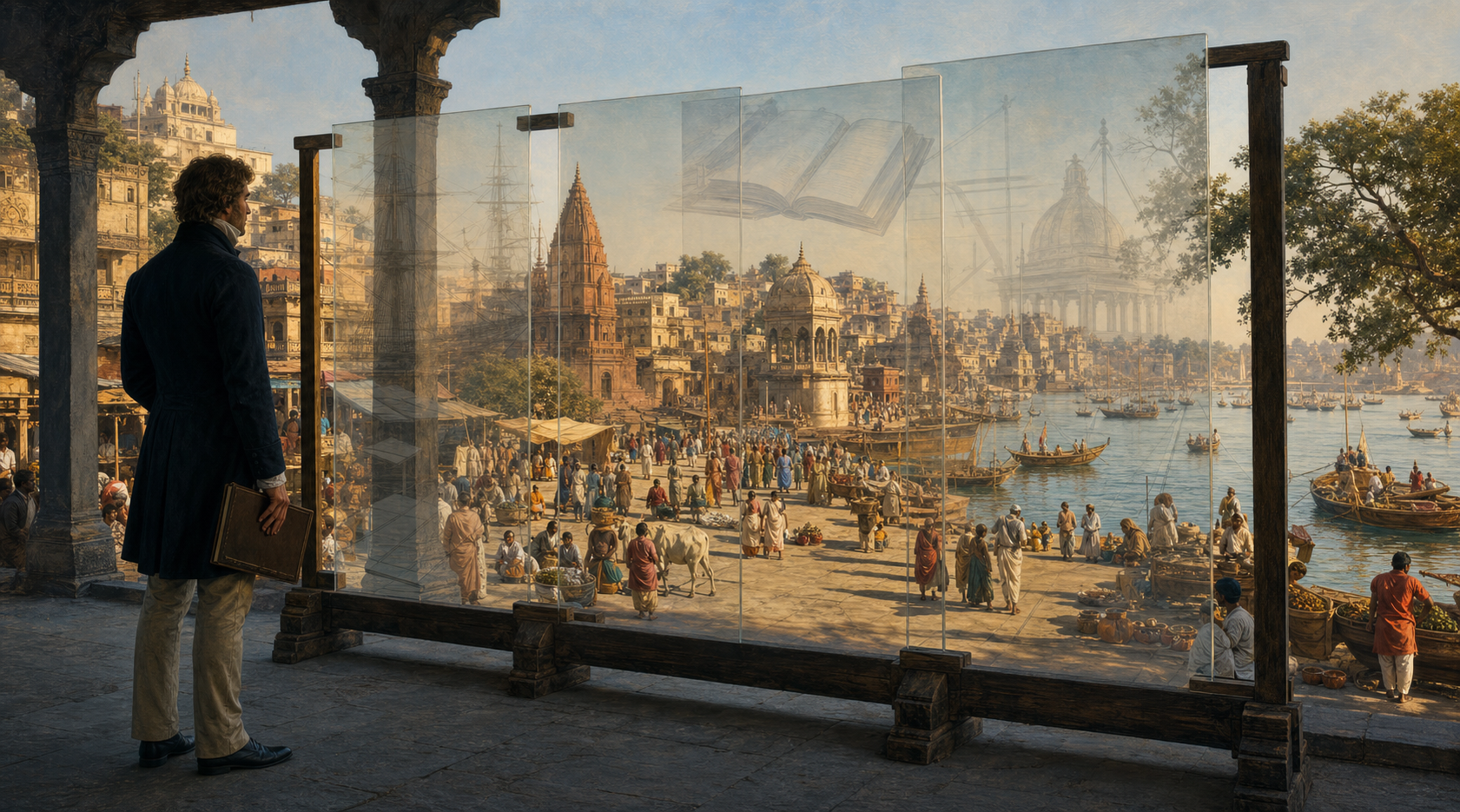
Use three labels in your notes. They prevent vivid prose from collapsing observation, judgement, and policy into a single authoritative voice.
- Recorded observation: a dated location, road condition, cloud colour, rock formation, tree density, crop, building, fortification, garment, ceremony, sound, or meal that Valentia says he encountered.
- Interpretive judgement: a claim about cleanliness, refinement, decay, morality, manners, competence, or the character of a religious community.
- Imperial prescription: a proposal about what British government should preserve, remove, reform, control, or reorganize.
The first category is often the best starting point, especially when Valentia supplies a date and place. It is still one person’s testimony, not an all-seeing record. The second category requires stronger corroboration because standards of hygiene, religion, etiquette, and political order were filtered through early nineteenth-century British expectations. The third tells you as much about imperial ambition as it does about India.
Never let descriptive density substitute for proof. Accuracy about the colour of a cloud does not validate a civilizational judgement two lines later. A traveller can observe one street carefully and still generalize carelessly about a city, a ruler, or a religious tradition.
Keep Valentia’s loaded vocabulary visible when it affects the claim. Terms such as heathen or his period spelling Hindoo are not neutral synonyms for Hindu. They disclose the confessional categories through which he interpreted Sanatana Dharma. You need not repeat such language as your own, but silently modernizing it can conceal the bias you are trying to evaluate.
Then apply the missing-witness test. Ask who speaks, who is described, and who never gets to explain a practice in their own terms. A courtly host, Company officer, priest, guide, merchant, labourer, and pilgrim would not have experienced the same place in the same way. When only Valentia’s voice survives in the passage before you, narrow your conclusion accordingly.
Varanasi exposes both sympathy and colonial entitlement
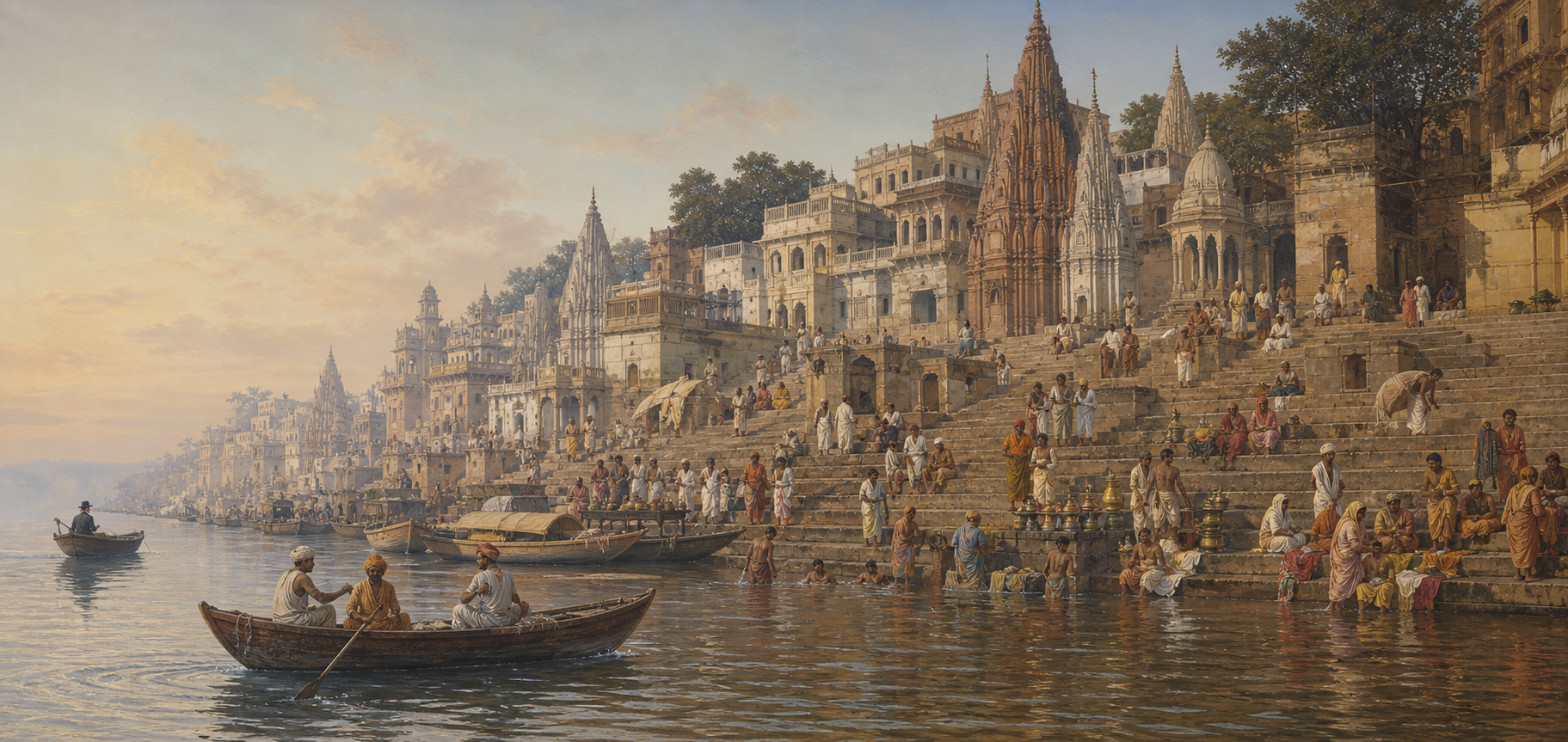
Varanasi is the clearest place to practise this layered reading. Valentia recognized that Hindus gained religious merit by forming ghats and building temples along the Ganga. Confronted by the city’s sacred landscape and contested structures, he wrote:
George Viscount Valentia, Voyages and Travels to India, Ceylon, the Red Sea, Abyssinia and Egypt
Read three layers within those words. First, Valentia recognizes the sanctity of the Hindu city instead of treating its religious life as meaningless superstition. His reaction records genuine aesthetic and religious sympathy. That matters because it complicates any claim that the colonial gaze was uniform.
Second, he immediately converts sympathy into a governmental remedy. British authority appears in his mind as the power able to decide who should possess the site and what should be removed. Even when he favours Hindu custodianship, he places the colonial state above the sacred community as final arbiter.
Third, his phrase original owners is a historical claim, not a demonstrated chain of title. His testimony can show that an early nineteenth-century British visitor perceived dispossession, sacred injury, and an unresolved conflict in Varanasi. It cannot, by itself, establish every stage of a site’s history or determine a present remedy.
Do not recruit Valentia as either a flawless defender of Hindu interests or an observer whose every word must be discarded. Both reactions waste the evidence. Cite him for what he personally recorded, identify his inference, and state what additional evidence would be needed to move from perception to historical conclusion.
Use dharmic unity without flattening distinct traditions

An imperial storyline naturally gives battles, treaties, garrisons, and dynastic decline most of the space. You can correct that imbalance by following the civilizational infrastructure beneath political change. Even while judging India through British categories, Valentia noticed sacred geography, temples, ghats, religious merit, dress, diet, etiquette, harvests, and the everyday order of towns. Political authority was shifting, but communities continued to create meaning through practice and place.
A dharmic-unity reading should therefore ask questions at the level of function rather than declaring Hinduism, Buddhism, Jainism, and Sikhism identical.
- Continuity: Which practices, institutions, teachers, pilgrimage networks, and forms of learning carried a community through political disruption?
- Sacred geography: How did rivers, temples, monasteries, pilgrimage routes, and inherited places bind ethical life to the land?
- Shared responsibility: Where did different dharmic communities protect learning, disciplined conduct, plural worship, or the custody of sacred space?
- Distinctiveness: Which doctrines, authorities, histories, and community institutions must remain specific to Hindu, Buddhist, Jain, or Sikh experience?
- Agency: Who maintained the practice under discussion, and does Valentia name those people or merely describe them from outside?
This method treats unity as civilizational relationship, not sameness. It allows you to notice shared resources without forcing every tradition into a single theology. It also shifts attention from rulers alone to the custodians who preserved worship, learning, ethics, and social memory while empires competed above them.
Apply the same discipline when Valentia harshly judges Mughal governance or Islamic polities. His verdicts belong partly to the polemical habits of early nineteenth-century British writing. Do not adopt them as neutral findings. At the same time, rejecting imperial bias does not require erasing documented conflict or contested sacred space. The responsible move is to proportion each conclusion to the evidence and distinguish a witnessed event from a sweeping judgement about a whole community.
Key takeaways: a five-pass method for every entry
- Locate it. Write down the exact date, place, route, and political setting. Do not let a local encounter become a claim about all of India.
- Extract it. Copy only the concrete detail you need: the structure, ceremony, landscape, person, sound, material condition, or administrative act Valentia says he encountered.
- Label it. Mark each statement as observation, interpretation, or imperial prescription. If one sentence contains more than one layer, split it.
- Restore context. Identify the ruler, community, sacred institution, or regional power whose own perspective is absent. Treat that absence as a limit on your conclusion.
- Conclude proportionately. Say that Valentia recorded a particular thing at a particular place and time. Do not claim that his moral explanation, political remedy, or generalization is thereby proven.
A sound historical sentence will often have three parts: what Valentia saw, what he assumed, and what the surrounding dharmic life continued to sustain. That form preserves the eyewitness value while refusing the victor’s tone hidden inside it.
On your next reading session, choose one dated entry and make those three statements separately. If you cannot separate them, do not cite the entry yet. Once you can, Valentia stops functioning as a colonial verdict on Bharat and becomes something more useful: a bounded witness whose testimony can be questioned, compared, and placed within the longer continuity of dharmic civilization.
References
