
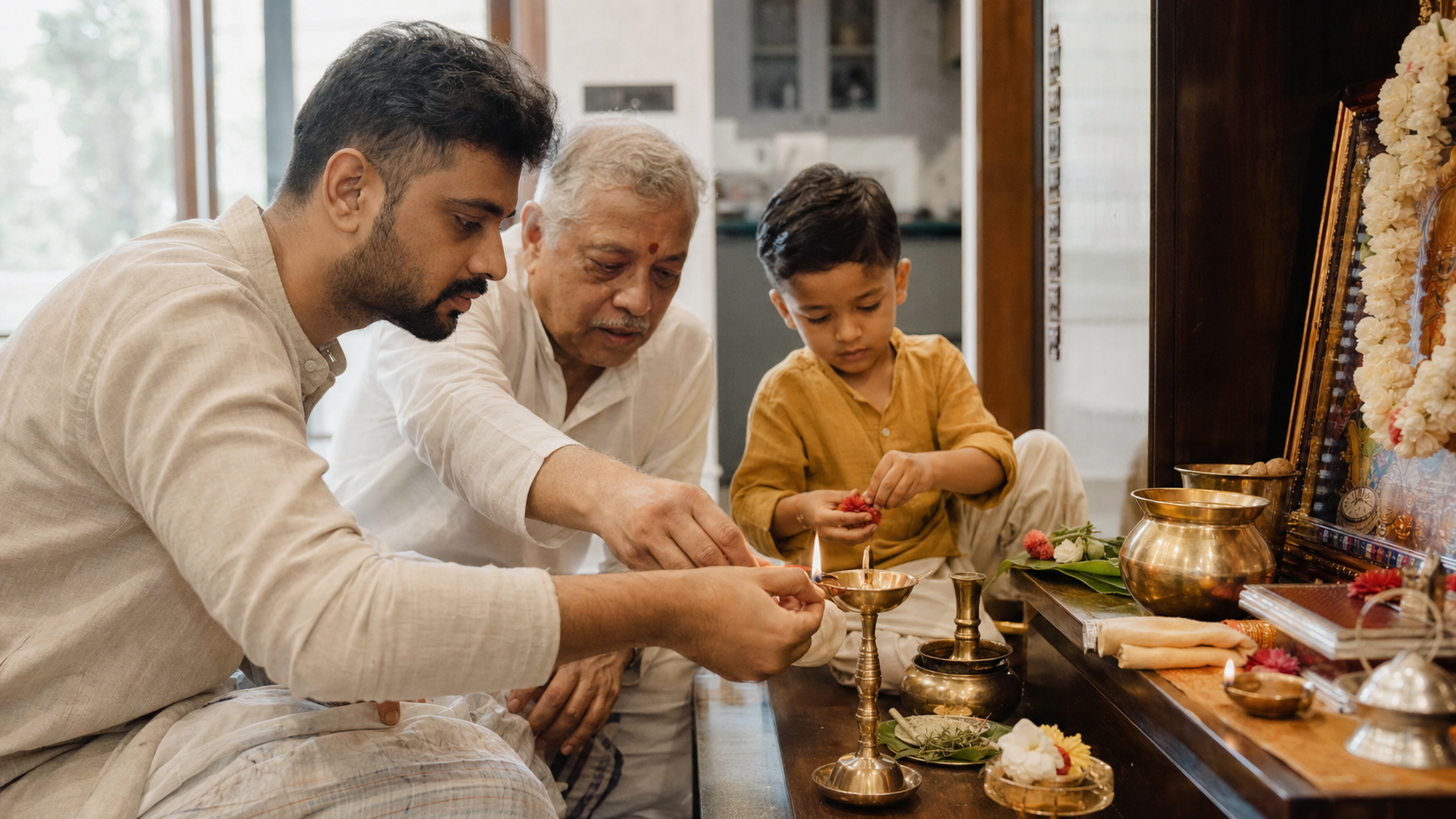
You may still know how a family ritual looks while quietly wondering whether anyone will know how to perform it after the present elders are gone. A photograph can preserve the finished arrangement. A video can preserve the motions. Neither, by itself, can preserve the judgement that tells the next person what must remain, what may change, and why the practice deserves to return.
Living continuity begins when form, meaning, and responsibility pass together. That principle works at a household threshold, inside a temple, and at a public gathering around an ancient site. If you want to protect a sacred practice, your task is not to freeze it at one moment. Your task is to give it a faithful next practitioner.
Living continuity needs form, meaning, and custody
A ritual remains alive through three connected strands. Form is what people actually do: the sequence, gestures, materials, place, timing, recitation, or pattern. Meaning is the relationship being enacted, whether that is devotion, remembrance, purification, hospitality, gratitude, restraint, or service. Custody is the human chain that knows how to perform the practice, correct mistakes, authorize adaptations, and care for its sacred setting.
- Form without meaning becomes a display that can be copied without being understood.
- Meaning without form becomes an inspiring idea that no longer shapes the body or the day.
- Form and meaning without custody disappear when the last knowledgeable practitioner is unavailable.
The South Indian practice of making a kolam at the household threshold makes this structure visible. In Tamil Nadu, the design is commonly drawn with rice flour or rock powder. A grid of dots gives order to interlaced curves, while symmetry, proportion, and measured hand movements turn a patch of ground into a field of concentrated attention.
Yet the finished pattern is not the whole inheritance. The kolam is renewed, exposed to footsteps and weather, and eventually cleared. Its continuity lies in its return. In many Hindu households, it joins cleanliness and order with sacred welcome, readiness to receive guests, and an invitation to Lakshmi. The practice survives because someone prepares the threshold again, not because yesterday’s design is made permanent.
This gives you a useful test for any tradition you hope to carry forward. Ask what recurs, what relationship the recurrence expresses, and who is learning to take responsibility for it. If you can answer only the first question, you have documentation but not yet continuity.
- Name the recurring act precisely. Do not write only “do puja” or “make rangoli.” Record the local name, place, materials, order, and occasion.
- State its purpose in the language of the tradition. “It helps us relax” may describe an effect, but it does not replace devotion, auspicious welcome, seva, remembrance, or another inherited purpose.
- Identify the present custodian and the next learner. A ritual described as “everyone’s responsibility” often has no person preparing for its next occurrence.
- Separate fixed elements from adaptable ones. Ask the practitioner who carries the tradition; do not infer the boundary from appearance alone.
Preserve the core before adapting the outward form
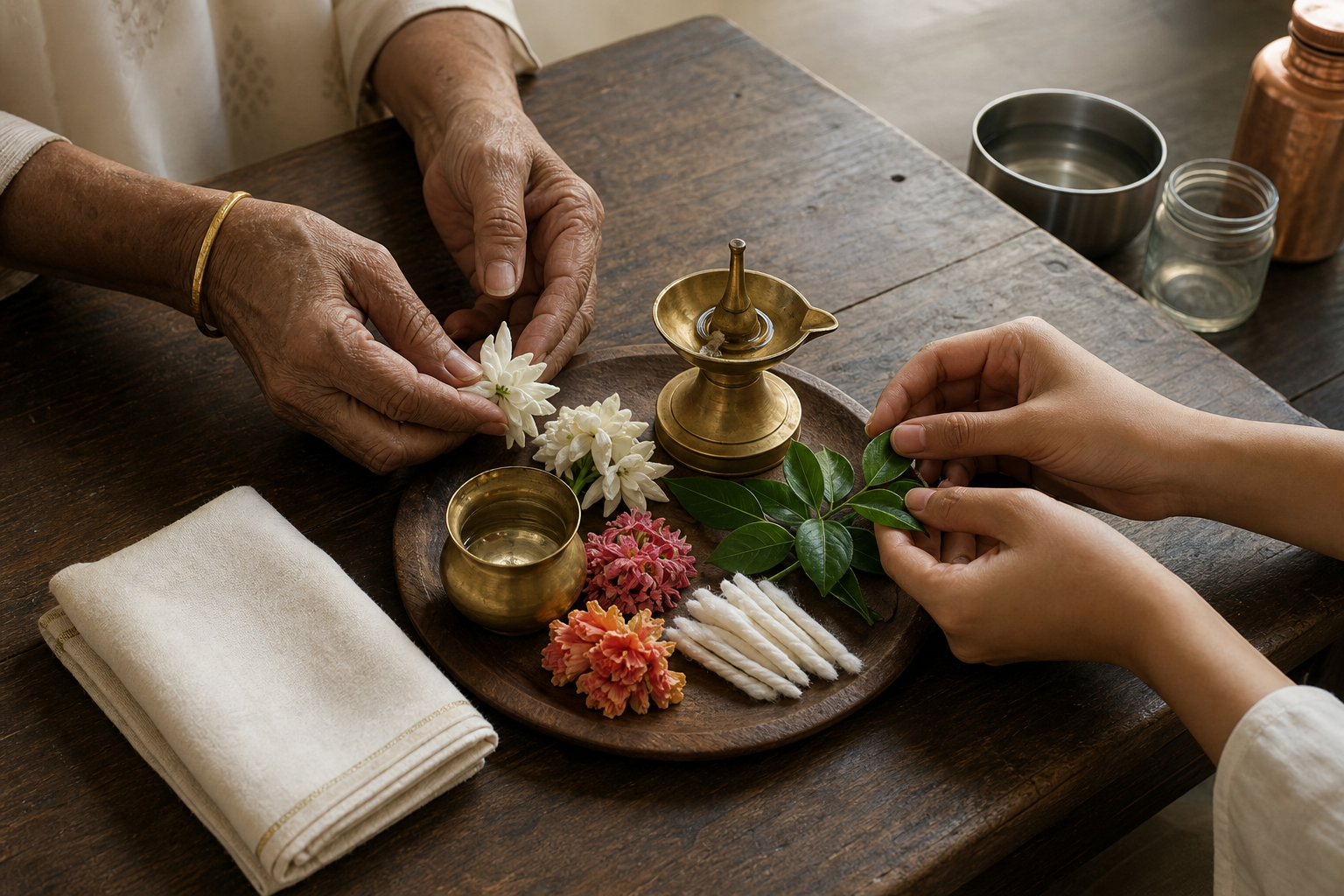
Adaptation is not automatically dilution. Refusing every change can make a practice impossible in a new home, climate, schedule, or diaspora setting. Changing whatever seems inconvenient can remove the ethical or devotional logic that made the act worth preserving. Faithful adaptation starts by distinguishing the core practice from its present carrier.
Kolam offers a concrete example. Urban households may use stone or chalk powder, beginners may work with stencils, and families outside Bharat may exchange patterns through new channels. Those changes can help the recurring threshold practice continue. They do not make every material spiritually or ecologically equivalent.
Where it is practical and appropriate, rice flour can feed ants and birds at the edge of human space. The material then participates in ahimsa and generosity rather than serving only as pigment. If a household substitutes a material that small creatures cannot eat, the visual form may remain while that particular ecological offering does not. Honest continuity names the difference instead of pretending that no meaning has changed.
Use a simple hierarchy when you assess a practice. First identify what is essential for it to remain recognizably faithful in your lineage. Then record what is preferred when circumstances allow. Finally, name what is decorative or contextual. The contents of these levels cannot be prescribed from outside; a family elder, granthi, acharya, monk, temple custodian, or another legitimate bearer of the relevant tradition may draw the boundaries differently.
- Essential: the intention, obligation, sequence, restriction, or sacred relationship without which the practice becomes something else.
- Preferred: inherited materials, fuller elaborations, or customary preparations that should be retained when they are available.
- Contextual: scale, decorative variation, and other features that knowledgeable practitioners already allow to vary.
This hierarchy also helps you create a smallest faithful form for ordinary days. The most elaborate festival version may be valuable, but it cannot carry a daily tradition alone. A modest version that preserves the core can keep the rhythm alive until the fuller observance is possible.
Do not keep a practice alive by emptying it of sacred claims. Some oral lineages understand sustained kolam-making as a discipline that can purify karmic burdens across seven janmas. That is a lineage-based spiritual belief, not an empirically measurable guarantee. It should be transmitted as the lineage holds it, without being marketed as a result that can be proven on demand. Alongside it, you can point to the observable virtues cultivated by the practice: attention, patience, non-harm, generosity, and a willingness to begin again.
Teach the movement, not just the symbolism
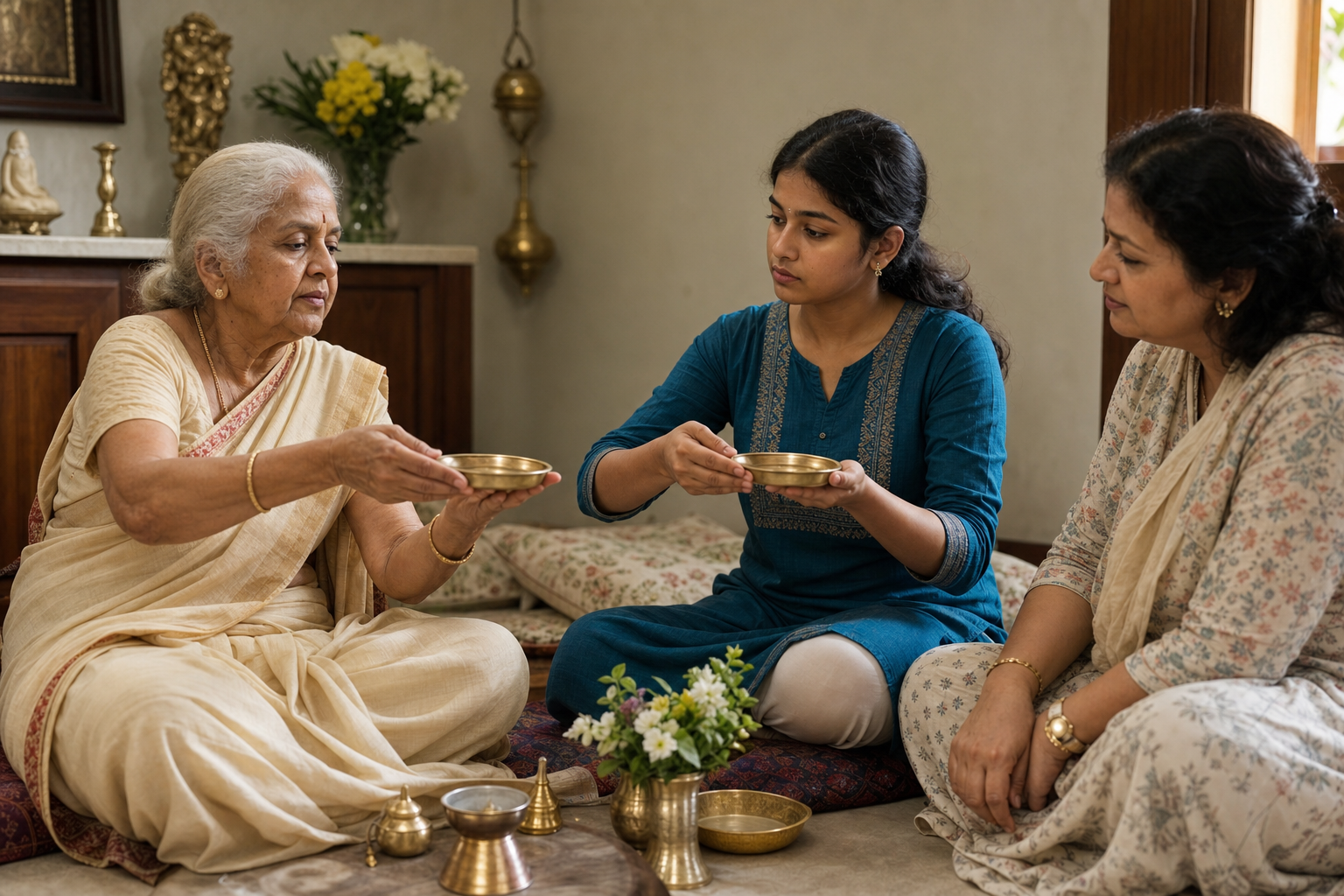
Ritual knowledge is often lost in a predictable way. A family records the story and photographs the result but leaves no learner who can perform the sequence without prompting. The archive may remain impressive while the embodied knowledge disappears.
Transmission should therefore include observation, guided performance, correction, repetition, and explanation. For a beginner learning kolam, a simple dot grid and a few interlinking curves are enough to begin. The learner can prepare the ground, steady the hand and breath, follow the design around the dots, observe where symmetry is broken, and return later to clear the old pattern respectfully. Complexity can grow after the rhythm becomes familiar.
- Let the learner watch one complete, ordinary performance before reducing it to verbal instructions.
- Repeat the practice while naming the sequence, materials, bodily cues, and reasons for any restrictions.
- Let the learner perform it. Correct breaches of the core practice while allowing harmless differences in pace or style.
- Ask the learner to explain the meaning back in their own words. This reveals whether they understand the relationship being enacted or have memorized only the motions.
- Have the learner take responsibility at a real occurrence. A demonstration staged for recording does not test preparation, timing, cleanup, or care under normal conditions.
- Record accepted variations and unresolved questions. Uncertainty should be marked honestly rather than filled with an attractive invention.
A useful continuity record should contain more than a polished image. Include the local name and spelling, occasion, location, preparation, materials, sequence, associated words or stories, closing action, restrictions, permitted variations, source of instruction, and the person to consult when a problem arises. If the practice includes a sacred object or site, add the care rules and escalation route for damage.
Pair every recording with an apprentice whenever possible. A video cannot feel resistance in a material, notice that a recitation has slipped out of order, or decide whether a substitution is permissible. It becomes much more valuable when a living practitioner can interpret it.
Comparisons across Dharmic traditions require the same care. Buddhist mandalas, Jain yantras and auspicious motifs, and floral floor patterns used in Sikh households during festivals can all express aspirations toward order, clarity, service, or compassion. Such resonances can deepen mutual regard. They do not prove that the forms are interchangeable or that their theologies are identical. Teach each practice under its own name before drawing a shared-values connection.
Care for sacred places as sanctuaries and heritage
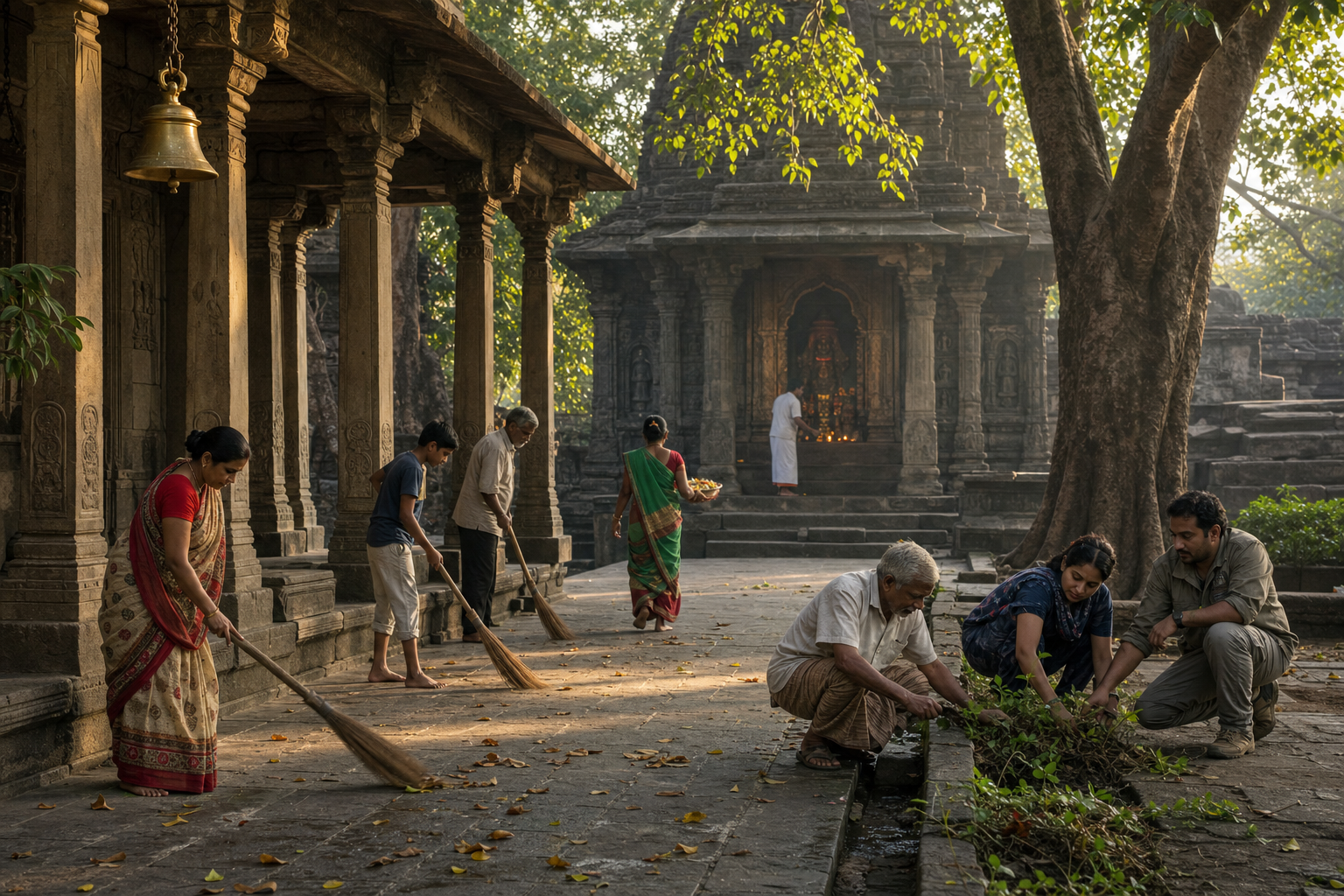
A sacred object is not protected merely because people revere it. Reverence must be joined to clear custody, condition checks, qualified conservation, and accountability. For devotees, a murti may be a focus of living worship rather than an art object. Its material history and ritual status both matter, which is why an improvised repair can be doubly harmful.
At Shri Kshetra Tuljapur, Hindu Janajagruti Samiti asked the Guardian Minister of Dharashiv for an impartial investigation after damage to an ancient Shri Brahmadev idol. It also sought criminal proceedings against officials it alleged were responsible. That demand does not establish guilt; an evidence-based inquiry is needed to determine what happened and who, if anyone, bears responsibility. The episode nevertheless shows why a sacred institution needs a response protocol before damage occurs.
- Stop unnecessary touching, cleaning, movement, or amateur repair. Well-meant intervention can worsen physical damage or disturb evidence.
- Notify the recognized custodian immediately. Record when and where the condition was noticed and what appears to have changed, without asserting a cause that has not been established.
- Create non-invasive visual documentation if the site’s rules permit it. Preserve original files and written observations rather than circulating edited images as proof of blame.
- Define who has authority over worship, physical conservation, security, and public communication. These roles may belong to different people, but responsibility should not disappear between them.
- Bring qualified conservation expertise into dialogue with the ritual custodians. A technically neat treatment can still violate sacred requirements, while a ritually motivated intervention can still damage historic material.
- Use a written plan that distinguishes immediate stabilization, investigation, proposed restoration, approval, and later monitoring.
- Give the community factual, time-bound updates. Transparency limits rumor and makes it harder for preventable neglect to be quietly forgotten.
Accountability is not hostility toward a temple or its servants. Properly handled, it is seva to future worshippers. The aim is not a rush to accusation, nor a rush to cosmetic repair, but a trustworthy process that protects sacred status, original material, and public confidence.
When a sacred landscape welcomes a crowd
Public observance adds another duty: hospitality must operate within the limits of the place. At the winter solstice gathering at Stonehenge in Wiltshire, thousands assembled around sunrise at the UNESCO World Heritage Site as drumming, singing, dancing, contemplation, and spiritual observance unfolded. Hindu participants have also offered prayers in previous years as a gesture of solidarity with revived indigenous customs.
The gathering illustrates a workable principle: a heritage landscape can support living observance when access is governed by stewardship. Site guidelines and conservation measures are not interruptions to reverence. They are part of what makes repeated gathering possible.
- State the sacred or cultural purpose before describing the spectacle. Visitors should know what they are entering, not merely what they can photograph.
- Distinguish what guests may observe, what they may join by invitation, and what remains the responsibility of initiated or recognized practitioners.
- Set physical limits around contact, materials, paths, sound, fire, capacity, and cleanup according to the actual site’s rules.
- Appoint both a tradition lead and a site-stewardship lead. One protects the integrity of the observance; the other protects the place that hosts it.
- Use interfaith language precisely. Shared reverence for nature, light, renewal, non-harm, or community can build solidarity without collapsing distinct histories and doctrines into a single invented religion.
Public attention can support continuity, but it can also distort it when the camera schedule begins to govern the sacred schedule. Decide in advance what cannot be rearranged for an audience. Welcome should widen respect for a tradition, not transfer ownership of it to whoever attracts the largest crowd.
Put one practice on a continuity footing now
Do not begin by trying to preserve an entire civilization in one project. Choose one recurring practice that still has a knowledgeable custodian but lacks a prepared successor. A household observance is often the best place to start because you can follow its full cycle rather than collecting fragments from a distance.
- Choose the practice. Name one actual ritual, craft, recitation, offering, procession, care duty, or seasonal observance.
- Watch the full cycle. Include preparation and closing, not just the visually impressive middle.
- Write the continuity record. Capture form, meaning, custody, restrictions, variations, and care requirements.
- Define the smallest faithful form. Ask what must survive when time, space, skill, or materials are limited.
- Name the learner. Consent and commitment matter more than assuming that the youngest relative will eventually take over.
- Prepare for the next real occurrence. Gather materials and assign responsibility before the ritual is due, rather than waiting for a ceremonial teaching day.
- Build the escalation route. Record whom to contact about a disputed variation, damaged object, inaccessible site, or missing instruction.
- Review after performance. Add what the written record failed to capture while the experience is still clear.
If no trusted practitioner remains, do not manufacture certainty. Preserve the fragments, label disputed or missing steps, and seek guidance from the relevant family, lineage, institution, or community authority. An honest gap can invite recovery. An invented answer may be repeated until nobody remembers that it was invented.
Key takeaways
- Sacred heritage remains living when form, meaning, and custody are transmitted together.
- Adapt the material or scale only after identifying what your tradition considers essential.
- Teach a learner to perform, explain, close, and eventually carry the practice at a real occurrence.
- Preserve devotional claims as devotional claims; do not dismiss them, flatten them into generic wellness, or advertise them as empirical guarantees.
- Treat damage to a sacred object through immediate restraint, documentation, qualified conservation, ritual consultation, and transparent accountability.
- Build public and interfaith welcome around clear participation boundaries and strict care for the site.
Before the next observance, bring a current custodian, a willing learner, and a continuity record around the actual practice. Once responsibility changes hands in real time, heritage has moved beyond remembrance. It has acquired a future.
References
- DharmaRenaissance Blog – Sacred Kolam at Dawn: How Rice-Powder Geometry Cleanses Karma and Blesses Homes
- DharmaRenaissance Blog – Stonehenge Winter Solstice: Thousands Gather in Awe, Ritual, and Interfaith Harmony
- DharmaRenaissance Blog – Protect Tuljapur’s Legacy: HJS Demands Probe into Damage of Ancient Brahmadev Idol
