

If you help manage a temple in Maharashtra, the dangerous moment is often not the first rumour of encroachment. It is the later discovery that a boundary is unclear, an important record is missing, or nobody knows who was authorised to respond. Your immediate task is to make the temple’s rights, possession and decisions provable.
Maharashtra’s proposed policy changes could make that work less expensive and give religious institutions stronger remedies. They are not yet a substitute for disciplined property management. The practical course is therefore a two-track one: protect each property under the framework available now, while helping shape reforms that temples can actually use.
Know what the Maharashtra proposal can and cannot do

The Maharashtra Mandir Mahasangh has formally sought a waiver of stamp duty and registration charges on temple lands, together with an anti-land-grabbing law. Initial indications describe the Chief Minister as positive toward examining these requests within the legal and administrative framework. That is a meaningful opening, but it is not the same as an enacted waiver, a notified procedure or an enforceable new remedy.
The distinction matters. A waiver could reduce the cost of registering or regularising eligible temple property transactions. It would not, by itself, establish ownership, reconcile inconsistent records or decide a disputed boundary. A stronger anti-encroachment framework could provide clearer procedures, firmer enforcement and time-bound decisions. Until its language and implementation are known, however, a temple committee should not assume that a particular dispute will qualify or that an existing deadline has stopped running.
Do not postpone a necessary filing, response or professional consultation in anticipation of reform. If occupation has changed, a notice has arrived, litigation is pending or a transaction is proposed, take the documents to a Maharashtra property lawyer familiar with public or charitable trusts. The correct remedy and deadline depend on the property’s records and the facts of the dispute; a general campaign demand cannot answer that individual legal question.
Build a property file that survives a change of trustees
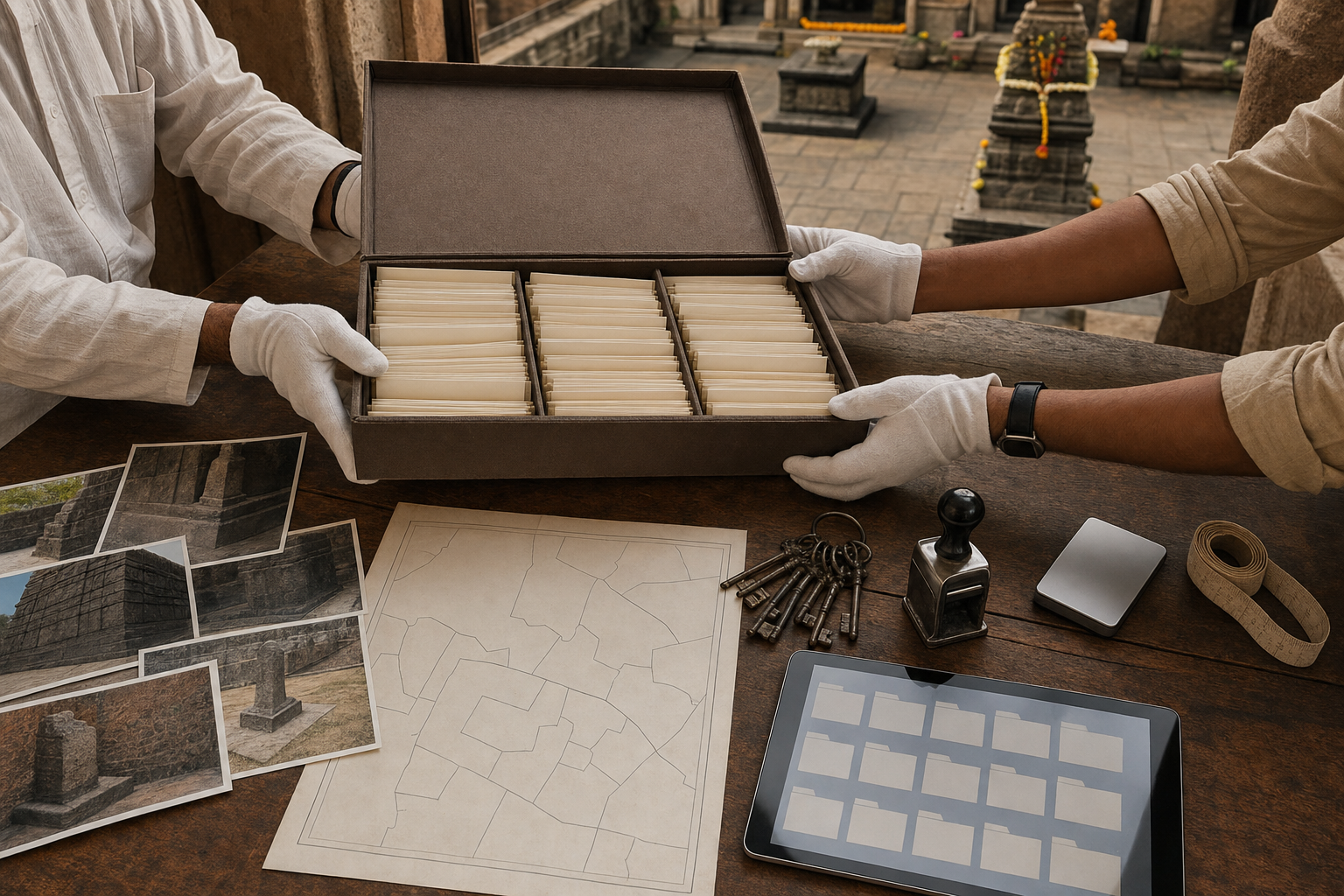
A temple is vulnerable when knowledge about its land exists only in the memory of a priest, trustee or local devotee. Build a master property register that a newly appointed committee member can understand without relying on oral history. Create a separate indexed file for every parcel, building and other immovable asset.
- Identify the property exactly. Record its official location, parcel or record identifiers, documented area, access points and present religious or institutional use. Copy names and identifiers exactly as they appear in official records; do not silently correct spelling or measurement differences.
- Assemble the basis of the temple’s claim. Preserve documents relating to acquisition, dedication, donation, ownership, management, registration, revenue entries, permissions and relevant administrative or judicial orders. Arrange them chronologically so that gaps in the chain become visible.
- Record possession and present use. Note who physically uses each part of the property, under what documented arrangement, and whether any tenant, licensee, caretaker, vendor, neighbour or other occupant asserts an interest. Include maps, lawful survey material, dated photographs and descriptions of boundaries and access.
- Connect every action to authority. File trust resolutions, delegations, agreements, notices, correspondence, complaints and professional opinions with the asset concerned. The file should show who approved an action, when it was approved and who was permitted to sign.
- Track money and pending obligations. Keep receipts for applicable fees, charges and taxes, along with estimates or demands relating to registration and regularisation. This protects financial accountability and produces concrete evidence of the burden that a waiver might relieve.
Do not discard an older document merely because a newer record appears more accurate. A discrepancy can be evidence of the problem that must be resolved. Preserve originals, make readable digital copies, maintain a backup under controlled access and record where each original is held. Avoid backdating, rewriting, annotating or informally replacing legal records; those actions can damage the temple’s position and should never be used to fill a gap.
Give each asset a simple risk status. Mark it urgent when possession, access, a boundary or a legal deadline may be changing. Mark it unresolved when records conflict or a supporting document is missing. Mark it reconciled only when the committee has checked the file against current official records and actual ground conditions. The label is an internal management tool, not a legal conclusion, but it tells the committee where attention is needed first.
Respond to suspected encroachment without creating another problem
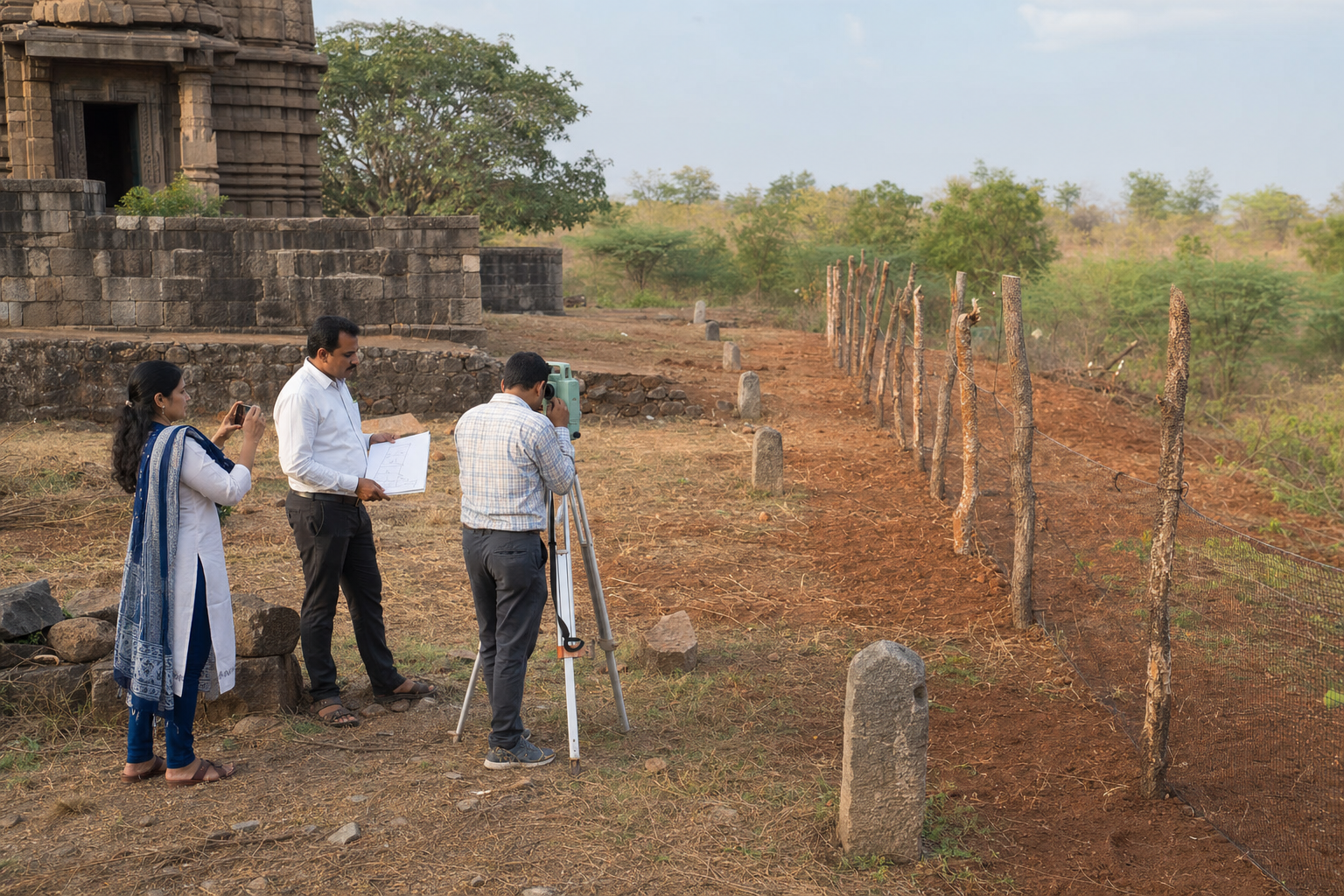
An unauthorised structure, shifted marker, blocked path or new occupant can provoke an emotional response. A physical confrontation or improvised removal may create safety risks, competing allegations and additional legal exposure. Protect people first, preserve evidence and move through an authorised process.
- Record observable facts. Note when the change was first seen, its exact location and what is different. Take dated photographs from places where you are lawfully entitled to stand. Keep original files and do not edit them in a way that obscures their provenance.
- Separate facts from conclusions. Write that a fence appeared or access was blocked; do not label a person a land grabber before identity, boundaries and rights have been verified. Record names only when they are known, and preserve messages or statements in their original form.
- Check the asset file. Match the affected ground to official identifiers, maps, agreements and prior photographs. A dispute that looks like encroachment may also involve a record mismatch, an old occupancy arrangement or an uncertain boundary. That distinction changes the appropriate response.
- Confirm who may act for the temple. The trust should identify who can instruct counsel, communicate with authorities, sign a complaint or approve expenditure. An unauthorised letter or contradictory statements from committee members can weaken an otherwise sound case.
- Use the right professional route. Ask counsel to determine the available legal or administrative remedy and any deadline. Use an appropriately qualified survey or land-records professional when the dispute turns on location, measurement or record identity. Do not move a marker, evict an occupant, sign a settlement or admit another party’s claim without case-specific advice and proper trust authority.
- Maintain an action log. Keep every submission, acknowledgement, hearing date, instruction and response in sequence. Assign each pending item to a named person and bring missed responses back before the committee promptly.
Public mobilisation may support a wider policy campaign, but social-media accusations are a poor substitute for a verified case file. A mistaken identification or exaggerated claim can injure another person, expose the temple to legal risk and distract from the underlying property issue. Share sensitive records only with people who need them for governance, professional advice or an authorised proceeding.
Turn the policy opening into workable protection

Similar representations have been made to district administrations across Maharashtra as part of a coordinated effort. Temple committees can strengthen that effort by supplying administrative evidence: the types of transactions being delayed, the documents that are difficult to reconcile, the applicable fees being faced and the points at which an encroachment complaint stalls. Remove unnecessary personal information before using an individual case for policy advocacy.
A headline promise will not protect land unless the operational rules answer practical questions. When trustees, devotees or representative organisations participate in consultations, they should seek clarity on the following points:
- Eligibility: Which temples, trusts, properties and transactions would qualify for relief?
- Scope: Would the measure cover stamp duty, registration charges or both, and would it apply only to future transactions or also to eligible regularisation work already pending?
- Proof: What documents would establish that a property is a temple asset, and how would authorities handle incomplete, inconsistent or disputed records?
- Procedure: Where would an application or complaint be filed, who would acknowledge it, how could its status be tracked, and what review or grievance route would be available?
- Urgent protection: How would the framework handle an active change in possession or construction while the underlying claim is being examined?
- Accountability: What written reasons, monitoring records and reporting would show whether applications and encroachment complaints are being handled consistently?
An effective system will require coordination among the Revenue Department, the Department of Registration and Stamps and the Charity Commissioner. Digitised land records and monitoring can help, but digitisation should not be mistaken for automatic accuracy. Temples still need a process for reporting a mismatch, presenting supporting material and obtaining a reasoned correction or decision.
Relief should also preserve governance safeguards. Lower compliance costs can free temple resources for conservation, worship, maintenance and community service, but a waiver must not become permission for undocumented transactions. Transparent resolutions, authorised signatures, traceable records and appropriate scrutiny remain essential.
This work has value beyond the defence of real estate. Hindu, Buddhist, Jain and Sikh sacred institutions can sustain worship, learning, service and community cohesion. Where a particular institution performs those functions, protecting its land protects the physical base from which that dharmic life continues.
Key takeaways for a temple committee
- A positive response to a reform request is not an enacted waiver or a new legal remedy. Continue protecting the property under the framework presently available.
- A stamp-duty or registration-charge waiver could reduce compliance costs, but it would not create title or cure inconsistent records automatically.
- Maintain an indexed file for every immovable asset, covering identity, the basis of the temple’s claim, possession, governance decisions, correspondence and applicable costs.
- When encroachment is suspected, document observable changes, verify the property and obtain authorised legal guidance. Avoid confrontation, self-help removal and unverified public accusations.
- Advocate for rules that define eligibility, proof, procedure, urgent protection, review and administrative accountability.
At the next committee meeting, appoint a named custodian for the property register and place every unresolved asset on a written action list with an owner and review date. That gives the temple a stronger position now and gives Maharashtra’s policymakers better evidence for reforms that can work in practice.
References
