
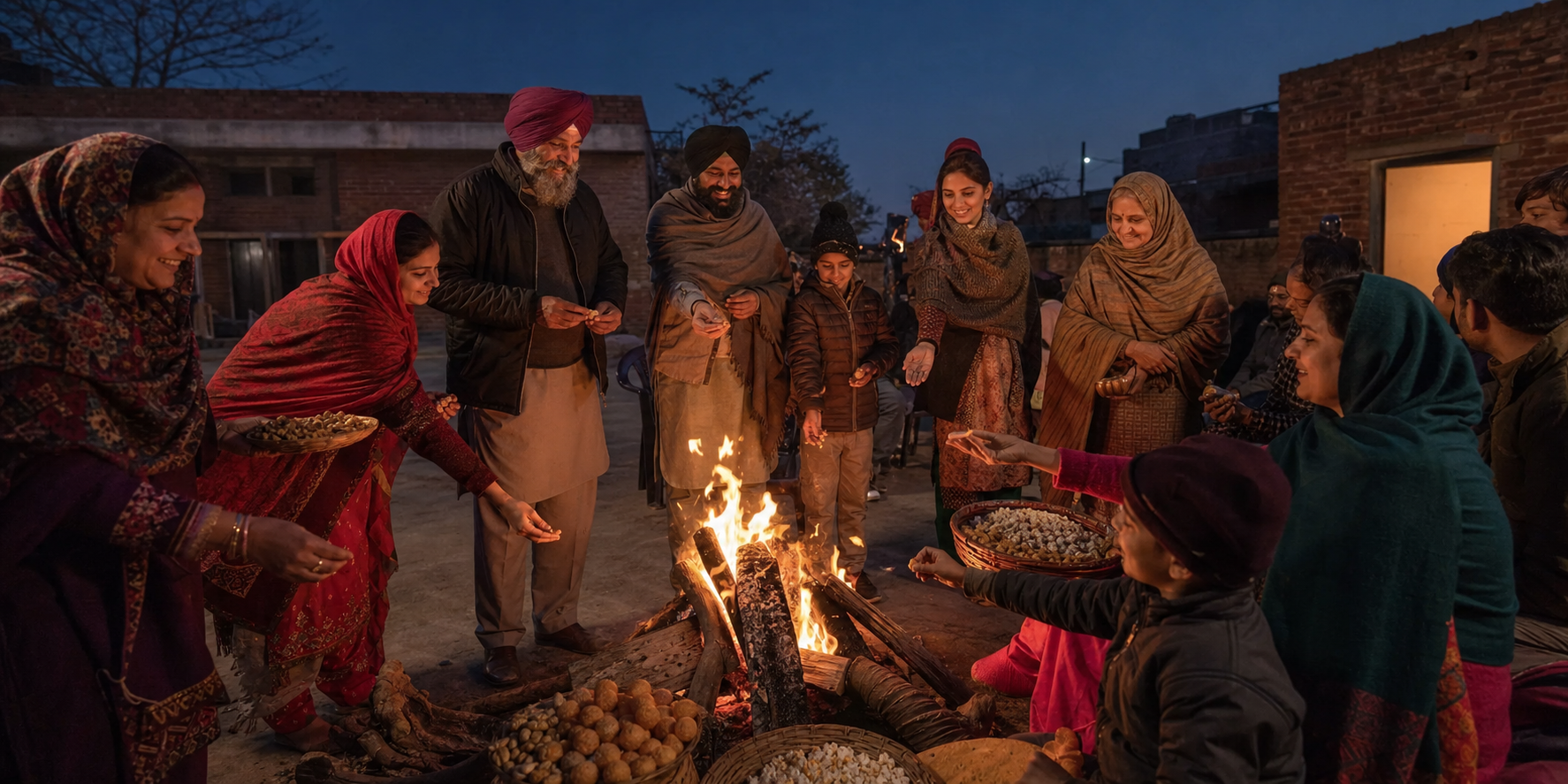
If you came here asking when Lohri fell in 2026 and what a family or community was meant to do around the bonfire, the short answer is clear: Lohri was observed on 13 January 2026, one day before Makara Sankranti.
The more useful answer is that Lohri is not merely an evening with fire, sweets and loud music. Its customs form a sequence: acknowledge the season, offer part of its abundance, share food with others, and renew the relationships that make a community more than a collection of households. If you preserve that sequence, even a modest celebration can carry the festival’s meaning.
Key takeaways
- Lohri 2026 fell on 13 January, immediately before Makara Sankranti.
- It is a North Indian harvest-time festival rooted especially in Punjab, Haryana, Himachal Pradesh, Jammu and Delhi.
- The familiar observance centres on a dusk bonfire, offerings of seasonal foods, circling the fire, music, dance and the sharing of prasad.
- Common offerings include til, gur, rewri, peanuts, popcorn and pieces of sugarcane.
- Births and recent marriages often receive special recognition, while children, neighbours and guests turn a household observance into a community one.
- Hindu and Sikh families commonly celebrate together, with Jain, Buddhist and other well-wishers able to join without pretending that every Dharmic tradition follows an identical rite.
The 2026 date: Lohri and Makara Sankranti are neighbours, not duplicates
Lohri’s placement on 13 January connects it to the winter seasonal transition honoured around Makara Sankranti. The two observances are close in the calendar and share themes of renewal, nature’s rhythms and gratitude, but their names should not be treated as interchangeable. For 2026, the practical distinction was simple: Lohri belonged to the evening of 13 January; Makara Sankranti followed the next day.
The connection with the winter solstice cycle also needs careful wording. Lohri does not claim that the solstice itself occurs on 13 January. It marks the passage beyond the darkest and coldest stretch of the season, welcoming the return of longer, warmer days. Fire makes that transition visible: people gather around warmth at the point in the year when warmth carries both physical and emotional force.
This is why the date matters even if a diaspora association or apartment community moves its large gathering to a convenient weekend. If you reschedule the social event, keep the calendar meaning legible. State that Lohri 2026 was observed on 13 January and describe the later programme as the community celebration. Convenience need not erase the tradition’s place in the seasonal cycle.
Geography matters too. Lohri is widely recognised across North India, with particularly strong associations in Punjab, Haryana, Himachal Pradesh, Jammu and Delhi. Families elsewhere in Bharat and throughout the diaspora can participate sincerely, but they should name that regional inheritance rather than presenting Lohri as a uniform custom followed in exactly the same way across every part of India.
What the bonfire and offerings mean
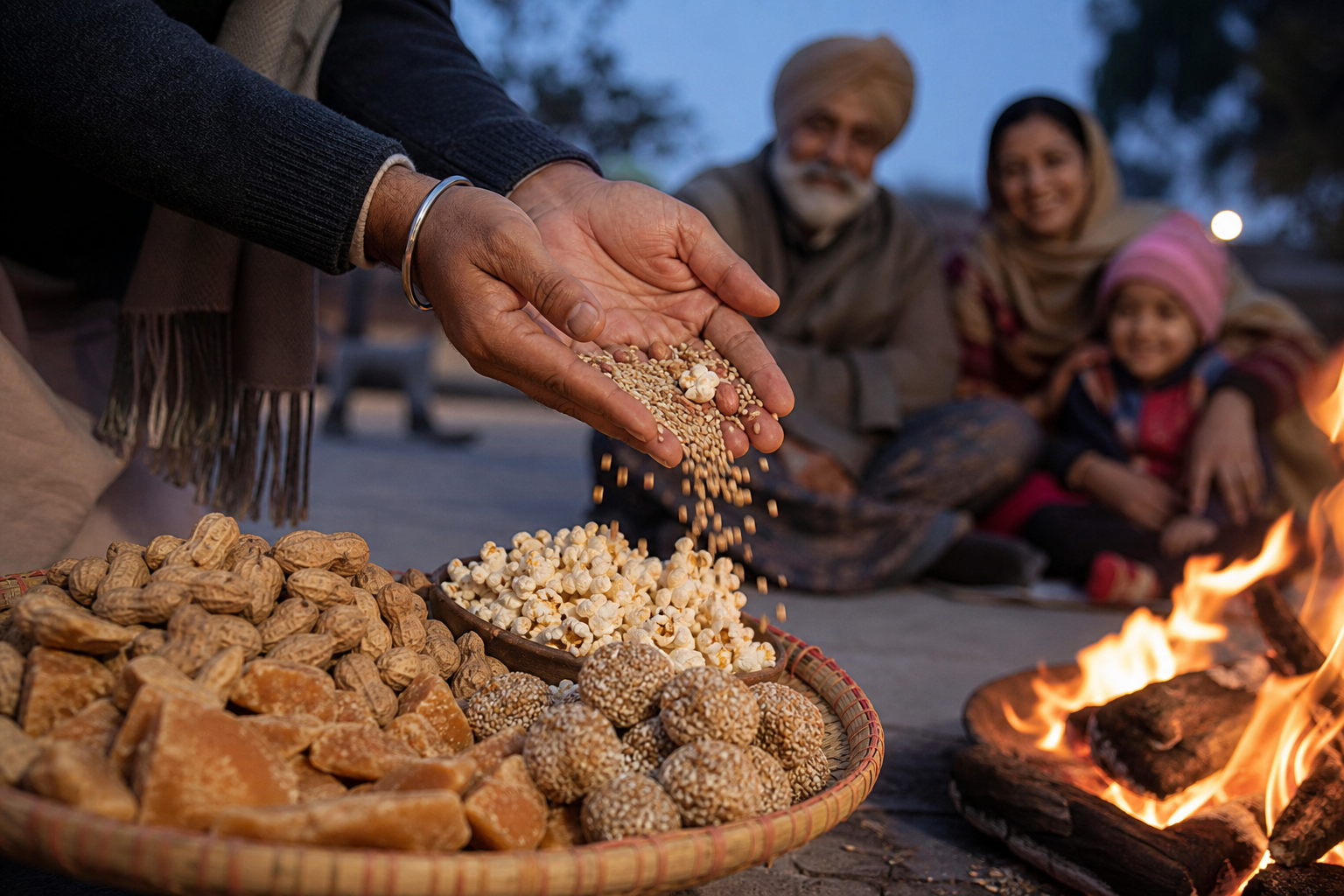
The bonfire holds three layers of meaning at once. Seasonally, it represents warmth and renewal after winter’s hardest passage. Agriculturally, it becomes a focal point for thanksgiving and abundance. Socially, it draws people into a circle where an offering is made publicly and food is then shared. Remove any one of those layers and the evening becomes thinner: fire without gratitude is spectacle, food without sharing is private consumption, and celebration without neighbours loses Lohri’s communal character.
The recognisable foods are til or sesame, gur or jaggery, rewri, peanuts, popcorn and pieces of sugarcane. Participants place portions in the flames, circle the fire and share seasonal foods as prasad. These are not random party snacks. Their presence links the gathering to harvest, season and gratitude.
A sensible host separates the offering portion from the sharing portion before people gather. Put small quantities intended for the fire in one set of bowls and keep the food for guests in clean serving dishes. This prevents wrappers, serving utensils and large amounts of food from drifting toward an open flame. It also keeps the central movement clear: offer a portion, then circulate abundance among the people present.
Peanuts should be clearly labelled because they are a serious allergen for some guests. Do not assume that a traditional ingredient is safe for everyone simply because it is familiar. Keep an uncontaminated alternative apart from peanuts and use separate serving utensils.
The fire itself deserves the same care. Choose clean, eco-conscious bonfire material permitted in your location. Never burn plastic, packaging, rubbish, painted wood or chemically treated material. The smoke from inappropriate fuel harms the people gathered around it and contradicts a festival rooted in gratitude toward nature. If your venue does not authorize an outdoor fire, do not improvise with one indoors; arrange a permitted setting or hold a clearly described fire-free community adaptation.
A practical Lohri evening, from preparation to prasad
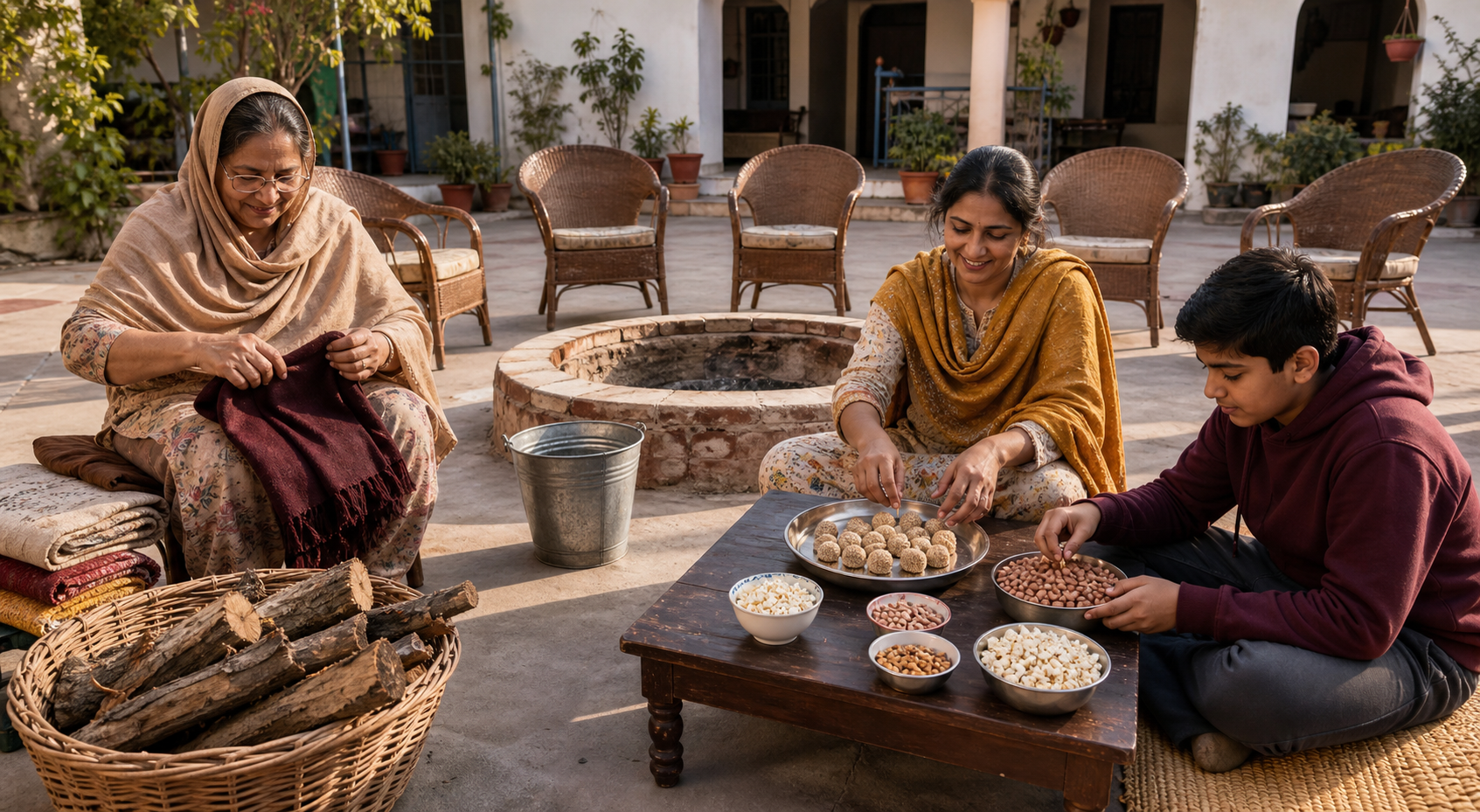
You do not need to turn Lohri into an elaborate staged production. A coherent gathering needs a safe fire, the customary foods, a few words that establish the purpose, enough room for people to gather, and a plan for sharing. The following order keeps the meaning visible without imposing one household’s detailed customs on every other family.
- Confirm the setting: use a permitted outdoor location with clear space around the fire and an agreed method for extinguishing it completely.
- Choose responsible fire attendants: one or two adults should manage lighting, fuel and extinguishing. They should remain responsible even after music and dancing begin.
- Prepare two food stations: one for small offerings and another, safely away from the flames, for prasad and refreshments.
- Make the culture audible: arrange for the dhol, recorded folk music or confident singers rather than relying on an unrelated party playlist.
- Make movement possible: leave an uncluttered path for circling the fire and a separate area for Bhangra and Giddha.
- Tell guests what will happen: a short explanation helps children, neighbours and first-time participants join respectfully instead of watching uncertainly from the edge.
Once the gathering begins, use a simple sequence:
- Welcome everyone at dusk. Explain that the gathering expresses gratitude for harvest, warmth, seasonal renewal and community.
- Light the bonfire safely. Keep children and loose clothing away from the ignition area, and let the designated adults control the fuel.
- Offer a brief prayer or intention. Follow your family’s customary words if you have them. If you do not, a plain expression of thanks is better than inventing a supposedly ancient mantra.
- Make the offerings in manageable groups. Place small portions of til, gur, rewri, peanuts, popcorn or sugarcane in the flames. Avoid crowding around the fire.
- Circle the fire. Let household elders guide any local or family-specific convention rather than assuming that every community follows the same detailed order.
- Bring in song and dance. The dhol, Bhangra, Giddha and the familiar refrain Sunder mundriye ho carry the celebration from formal gratitude into collective joy.
- Distribute prasad. Make sure children, elders, guests and people managing the fire are served, not only those nearest the food table.
- Close responsibly. Extinguish the bonfire fully and leave the location clean. An unattended fire is still a hazard after the ceremonial part has ended.
This order is a framework, not a claim that every Punjabi, Haryanvi, Himachali, Jammu or Delhi household performs Lohri identically. If your family has inherited songs, blessings or a customary sequence, preserve them. The practical test is whether guests can still recognise the evening’s four movements: gathering, offering, rejoicing and sharing.
Make births, marriages, children and neighbours part of the ritual
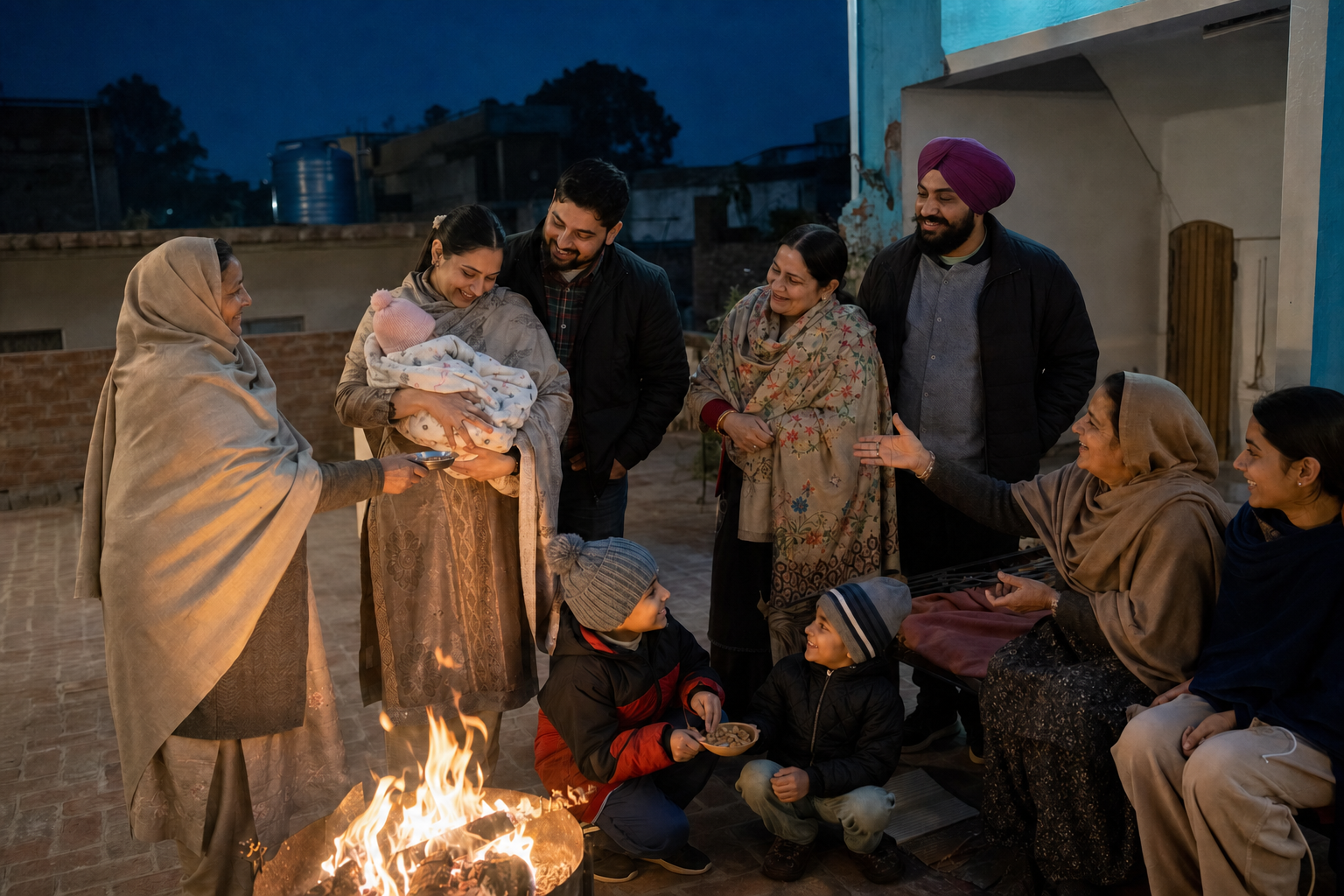
Lohri often carries extra significance when a child has been born or a marriage has taken place since the previous celebration. The family milestone is not merely announced between songs. It is brought into the community’s circle through blessings, gathering and generous sharing. If your household is marking such an occasion, place the blessing near the beginning of the evening, while the purpose of the gathering is still clear.
Ask an elder or another person trusted by the family to offer a few words. Introduce the new family member or couple without turning them into performers. Then let the household share seasonal food generously according to its means. Generosity is central; competitive display is not. A smaller gathering in which every guest is welcomed and fed carries more of Lohri’s spirit than an expensive event that leaves neighbours outside the gate.
Children traditionally add another form of reciprocity by going from house to house, singing folk songs and receiving treats. In a village or established neighbourhood, households may already understand the custom. In an apartment building or diaspora setting, coordinate it first. Tell participating homes when the children will arrive, keep them in a supervised group and agree on a short route. That preserves the door-to-door exchange without creating confusion or sending children to unknown homes.
If younger participants know only the refrain Sunder mundriye ho, let an elder or experienced singer lead the fuller folk song. The aim is transmission, not a flawless stage performance. Give children one concrete responsibility as well: carrying a treat basket, welcoming another family, helping distribute prasad or learning when the offering is made. A tradition survives more reliably when the next generation has a role within it.
Dhol, Bhangra and Giddha create Lohri’s energetic public character. Keep space for skilled dancers, but do not make skill a condition for participation. A circle that allows elders, newcomers and children to enter at their comfort level reflects the same communal principle as the shared food. If the event is in a residential area, set the music schedule with neighbours in mind; fellowship is weakened when celebration becomes disregard for the people living nearby.
Celebrate Dharmic fellowship without flattening differences
Lohri offers a particularly tangible form of North Indian fellowship. Hindu and Sikh families frequently gather together, while Jain and Buddhist friends and households may also participate as well-wishers. The shared ground is not a claim that every tradition has the same theology or requires the same observance. It is the lived practice of gratitude, compassion, hospitality and respect for the rhythms of nature.
This distinction matters when you write an invitation or introduce the evening. Do not describe Lohri as a compulsory rite for every Hindu, Sikh, Jain or Buddhist. Say what will actually happen: a community will gather around a bonfire, give thanks for seasonal abundance, make traditional offerings, share food, sing and dance. That language welcomes participation while respecting differences in belief and family practice.
For a mixed neighbourhood or diaspora gathering, five choices make inclusion practical:
- Name the regional roots. Explain Lohri’s strong North Indian and especially Punjabi cultural setting rather than presenting it as a generic Indian fire festival.
- Explain unfamiliar foods. Label til, gur, rewri, peanuts, popcorn and sugarcane so that guests understand what is offered and what is eaten.
- Make participation voluntary. A guest can stand respectfully, share food or join the music without being pressured to perform a gesture that conflicts with personal practice.
- Invite across generations. Elders carry memory, children carry continuity, and new neighbours prevent the gathering from closing in on itself.
- Keep environmental care visible. Use appropriate bonfire material, locally available seasonal foods where practical, sensible portions and a thorough clean-up.
Distance from Punjab does not require an imitation of scale. A modest gathering can remain culturally legible if it uses the traditional foods, names their meaning, includes the bonfire where safely permitted, makes room for folk song and dance, and shares prasad with everyone present. What should not disappear is the movement from gratitude to generosity.
If you are organizing a future Lohri, write down four decisions before designing invitations or decorations: the correct calendar date, the authorized fire location, the offering-and-sharing food list, and the households you will personally welcome. Those decisions protect the festival’s seasonal meaning, its harvest gratitude and its community bonds. Everything decorative can follow.
References
