
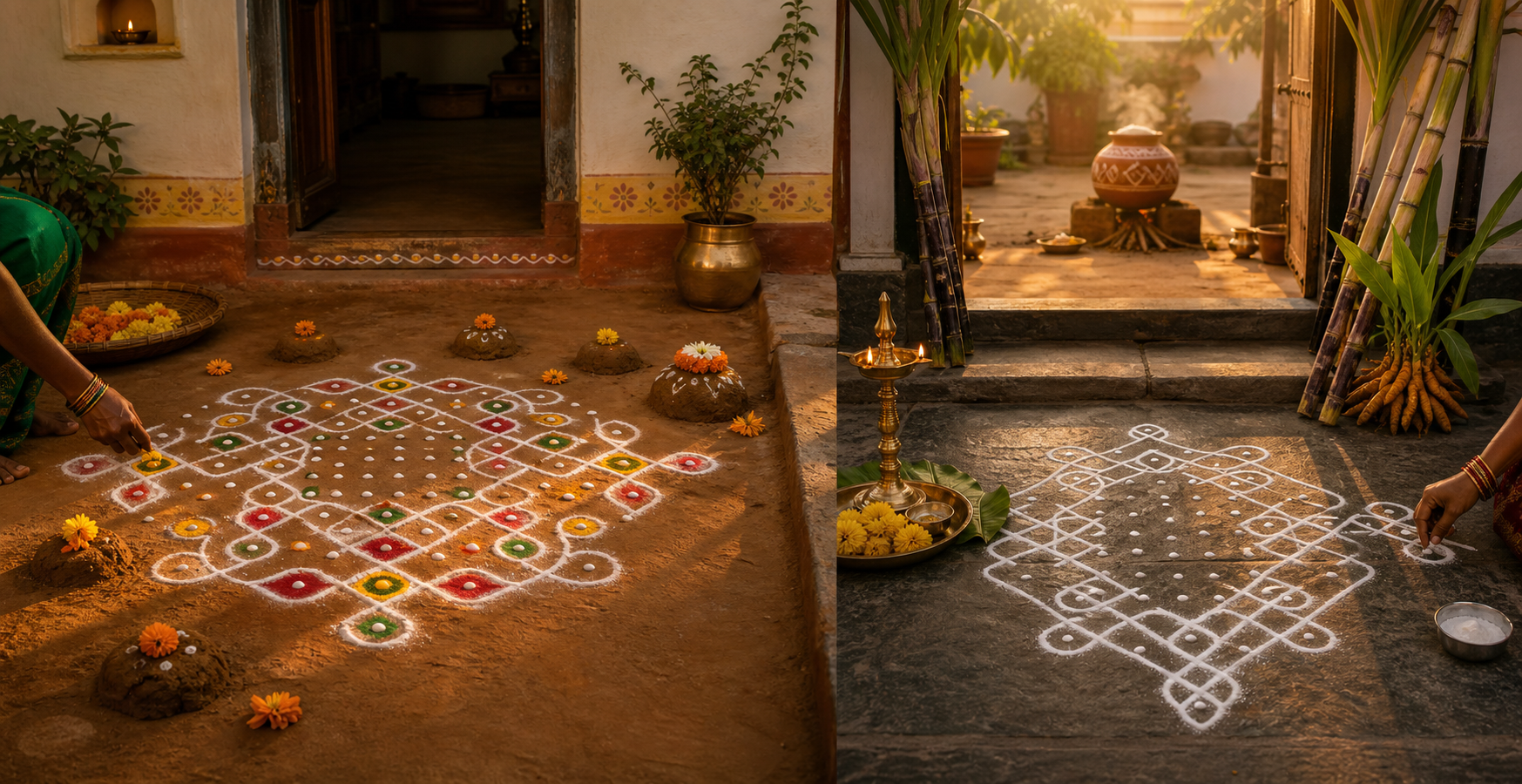
You have swept the entrance, gathered the powders, and saved more designs than you could possibly draw. The real question is not which picture looks most impressive. It is which design belongs at your threshold, suits your skill, and expresses the meaning of each festival day.
A good Sankranthi muggu or Pongal kolam does three things at once: it welcomes those who approach, marks the threshold as an auspicious meeting place, and makes gratitude visible. These threshold traditions connect the home with harvest, renewal, generosity, and community. You do not need the largest pattern to carry that meaning. You need a clear intention, a workable structure, and materials appropriate to the place.
Choose a form that matches your hand and your household
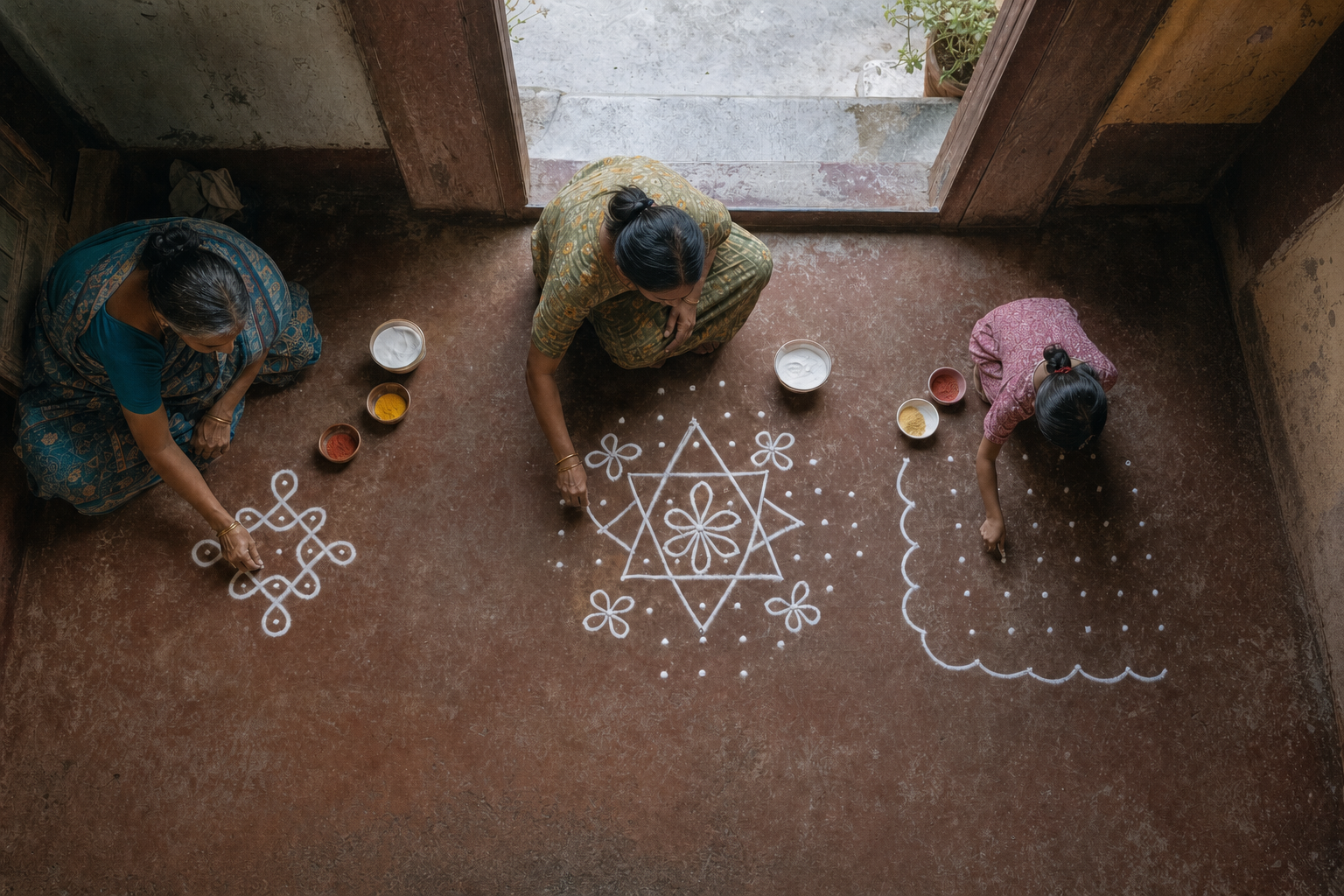
Muggulu, kolam, and rangoli belong to related regional traditions, but they are not merely three labels for one standardized craft. Telugu households may speak of muggu or muggulu, Tamil households of kolam, and Kannada households often of rangoli. Family custom should decide the name, visual grammar, and sacred details you use.
Start by choosing a pattern family before choosing the harvest symbol at its center. That decision controls how much space, time, and line confidence the design will require.
- Choose a pulli or dot-based layout when you want a visible framework for proportion and symmetry. The dots give you reference points, which is especially useful on a narrow doorstep or when several family members will complete different parts.
- Choose a sikku kolam when the looping path itself should command attention. Its interlaced movement rewards steady line control, so rehearse the route on paper if the pattern is unfamiliar.
- Choose a padi-style treatment when you want structured lines to frame a central pongal pot, sun, lotus, or another principal emblem. The border creates order without competing with the center.
- Choose a floral and geometric rangoli arrangement for a broad courtyard where petals, colored fields, and repeated borders have room to breathe.
If you are still learning, do not treat intricacy as the measure of devotion. A balanced dot grid with an even border will look deliberate. A complicated interlace that you must rush will not. You can also let the work become more elaborate over the observance, moving from a restrained opening design toward richer harvest and community motifs. That progression from simple geometry to more developed patterns gives the festival a visual rhythm of its own.
Build a four-day sequence instead of four unrelated pictures
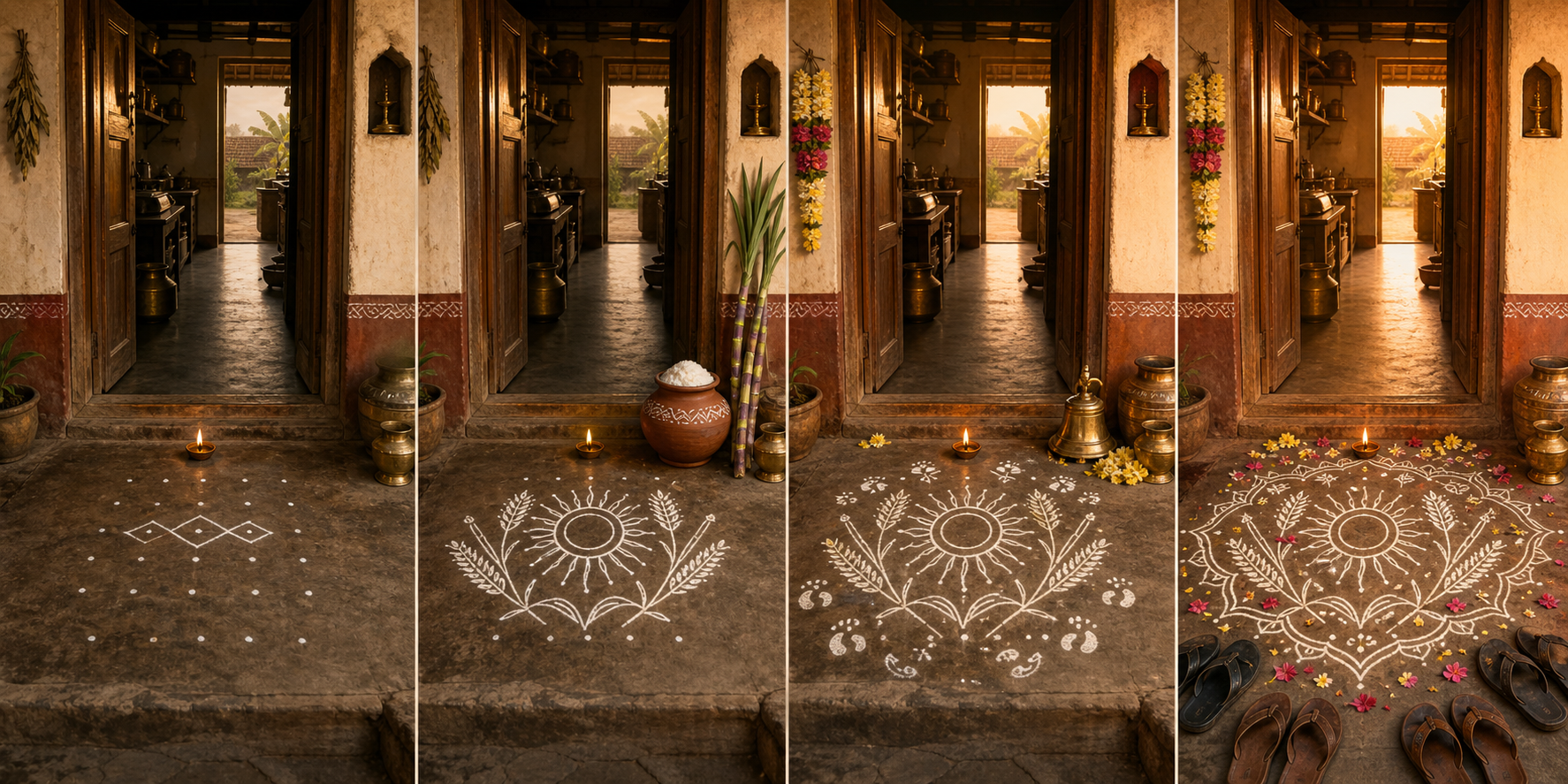
The days are named and observed according to regional and family practice. Use the names your household has inherited. The following plan is a design framework, not a replacement for that tradition.
| Festival moment | Intention | A workable composition |
|---|---|---|
| Bhogi | Cleansing and a fresh beginning | Use a white circular form, a modest pulli layout, or a small mandala enclosed by a neat border. Keep the palette restrained so the renewed, orderly surface remains the focus. |
| Makara Sankranti or Thai Pongal | Gratitude for sunlight, harvest, and abundance | Give the center to an overflowing pongal pot or radiant sun. Place sugarcane or harvest sheaves around it, then contain the scene with a padi-style or geometric border. Add turmeric, kumkum, or selected colored powder as accents. |
| Kanuma or Mattu Pongal | Respect for cattle and the agrarian relationship | Use a gentle bovine form, footprints, floral curves, or a lotus-centered pattern. Near a cowshed or farm pathway, let the design acknowledge service and interdependence rather than treating the animal as incidental decoration. |
| Mukkanuma or Kaanum Pongal | Family bonds, visiting, and collective wellbeing | Choose an interlaced sikku pattern, lotus medallion, sun rays, or a shared courtyard mandala. Repetition and interconnection suit a day directed toward social harmony. |
You do not have to replace the entire design every day. Keep one border, dot rhythm, or central geometry through the sequence and change the principal motif. A Bhogi circle can receive a harvest emblem on the main day, bovine or footprint details on the cattle-honoring day, and a wider interlaced border for the family-centered close. This approach saves effort while making the development intentional.
Control the composition with a center, frame, and accent
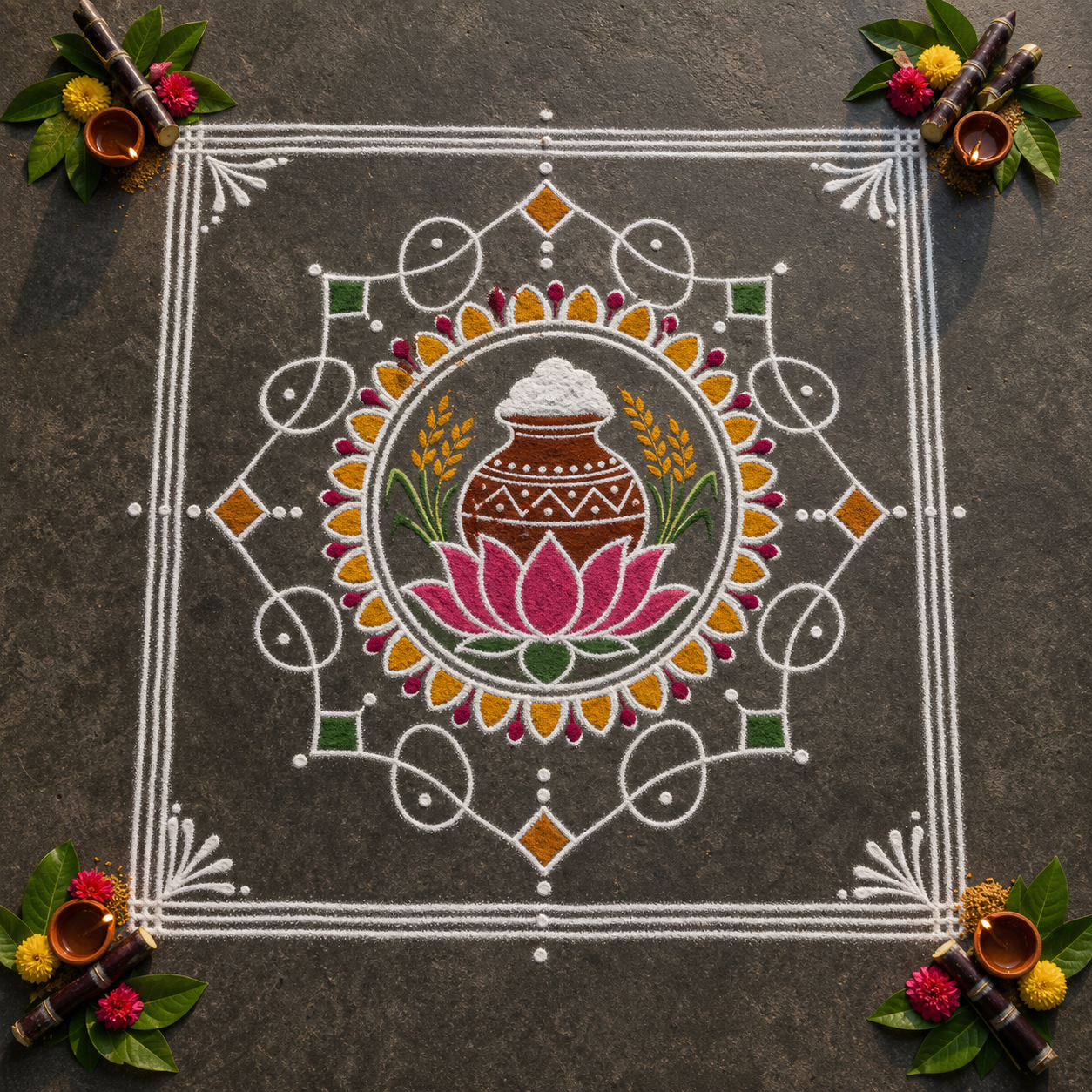
Give each visual element one job
The common mistake is to place every meaningful symbol into one crowded scene. Instead, assign three roles:
- The center carries the day’s main meaning. Choose the sun, pongal pot, lotus, or a geometric medallion.
- The frame controls the shape. Use dots, looping sikku lines, padi-style lines, petals, or a repeated geometric border.
- The accent establishes the festival context. Choose sugarcane, harvest sheaves, bovine footprints, flower petals, turmeric, or kumkum.
Leave open space between these layers. The eye should identify the center before discovering the details. If the doorway is narrow, remove an accent rather than compressing every line. If the courtyard is broad, enlarge the frame before adding more symbols.
Sacred and auspicious signs deserve deliberate placement. A swastika-based grid, for example, should be drawn in the dharmic form transmitted within your household and given enough space to be read clearly. Do not bury it among unrelated decorative fragments. The same principle applies to a lotus or radiant sun: when the sign carries the meaning, let it govern the surrounding geometry.
Scale the design to its actual location
A design that works in a courtyard may become illegible at an apartment entrance. Plan for the surface you have, not the surface in the reference image.
- At the main doorstep, use a centered design that remains visible from the approach while leaving a practical walking line.
- Near the puja room, choose compact geometry or a restrained lotus-centered form so the pattern supports rather than overwhelms the sacred space.
- In a large courtyard, enlarge the main medallion and repeat its border language around the perimeter. Extra area should create breathing room, not compel extra clutter.
- Near a cowshed or agricultural pathway, reserve cattle, footprint, and floral motifs for Kanuma or Mattu Pongal, where their placement directly reinforces the day’s gratitude.
If you are decorating several locations, repeat one element across them: the same petal shape, border rhythm, dot spacing, or central emblem. The doorstep, puja-room, and courtyard designs can differ in scale while still reading as one household observance.
Prepare the surface and materials for clean, durable lines
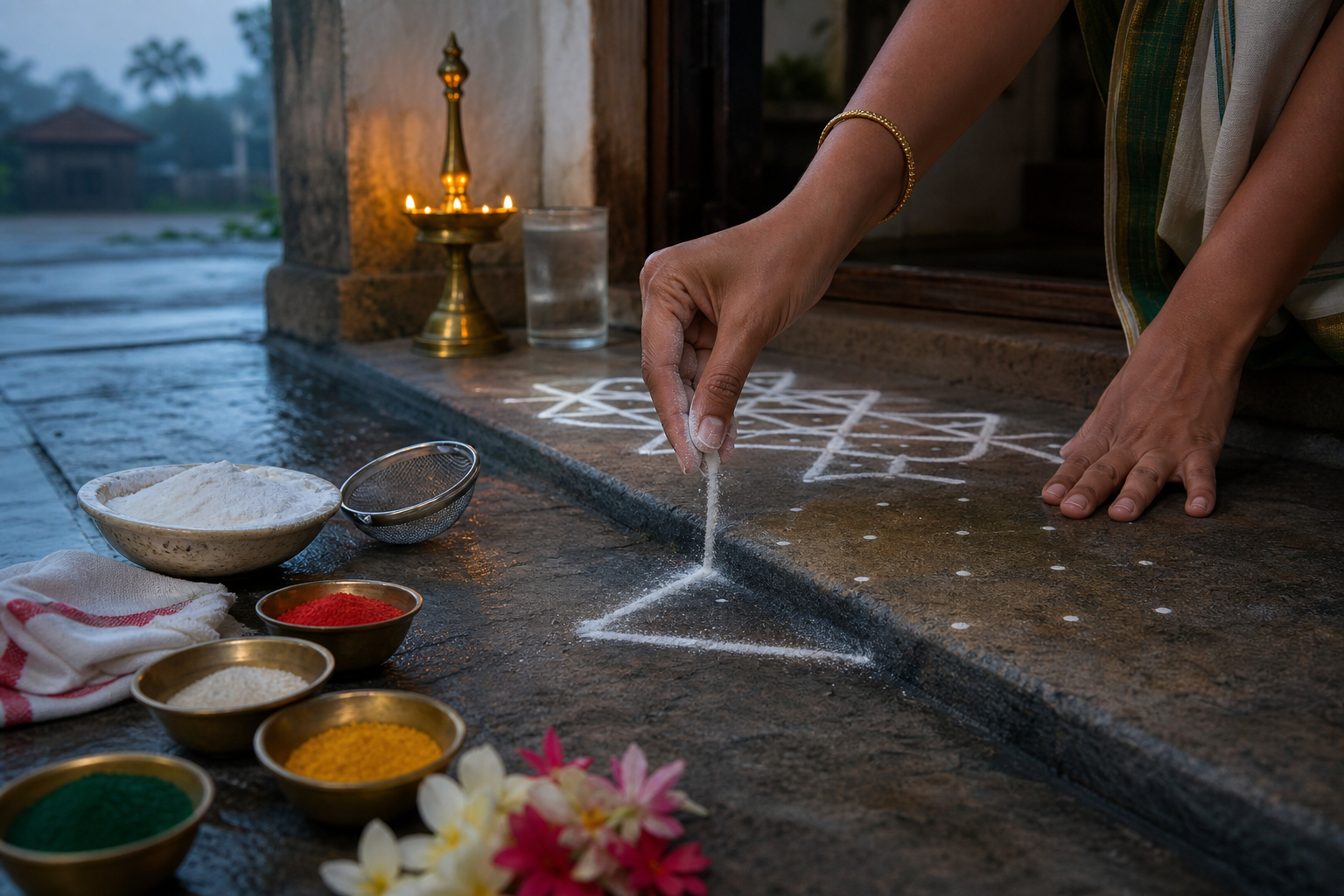
Most preventable problems begin before the first line: dust breaks the powder flow, an unplanned footprint distorts the border, and color added too early hides the underlying geometry. Use this order:
- Decide the complete footprint of the design and identify where people will step. Reduce the pattern now if it blocks the entrance.
- Sweep the surface thoroughly. A smooth threshold or courtyard gives the powder a cleaner edge.
- If the household normally uses it, apply a light base wash of diluted rice paste. This can help the design remain visible where there is foot traffic.
- Mark the central axis, boundary, and necessary dots lightly. Chalk or a dot-grid underlay is useful for large layouts and unfamiliar proportions.
- Draw the central geometry first, then work outward in matching sections. Check the opposite side after each major curve or border segment instead of discovering an imbalance at the end.
- Complete the white structure before adding colored areas. The base lines should remain readable after the accents are placed.
- Clean the outer edge last. A crisp boundary can make a modest design look complete, while scattered powder makes even elaborate geometry appear unfinished.
- If you place deepam around the kolam at dusk, keep them outside the walking route, away from loose clothing and unstable edges, and attend the flames while they are lit.
Choose each material for a particular function. Rice flour gives the traditional white line and can express generosity toward birds and small creatures. Plain rice flour is the meaningful choice when that living relationship is part of your intention; do not assume every decorative colored mixture serves the same purpose. Rock salt can produce a bright white texture. Flower petals add color and softness. Turmeric and kumkum work best as controlled accents because small areas remain visually strong.
The combination of rice flour, natural color, flowers, and simple surface preparation is not merely an aesthetic formula. It keeps the practice connected to hospitality, ecological awareness, and the agrarian gratitude being expressed.
Dawn is a natural time to draw because the entrance is calmer, the surface can be prepared before household traffic begins, and the rising light suits the festival’s solar rhythm. If morning time is limited, mark the grid or rehearse the pattern on paper beforehand. Save the actual threshold work for the observance rather than turning the festival morning into a search for a design you have not yet understood.
Key takeaways
- Let family and regional custom determine whether you call the practice muggu, kolam, or rangoli and which sacred forms belong in it.
- Choose the pattern family before the central motif: pulli for a visible proportional framework, sikku for interlaced movement, padi-style lines for a structured frame, or floral geometry for a broad courtyard.
- Build a sequence across Bhogi, the principal harvest day, the cattle-honoring day, and the family or community day. Complexity can grow with the observance.
- Use one center, one frame, and one accent family. Remove details when the available space cannot support them clearly.
- Prepare the surface, establish the geometry, finish the white structure, and add color last.
- Use plain rice flour deliberately when feeding small creatures is part of the offering, and treat decorative powders as separate materials with separate functions.
Before the festival begins, choose one motif for each day and one border that can connect all four. Sketch the difficult geometry once on paper. Then begin Bhogi with the simplest version your hand can draw calmly, leaving room for the kolam or muggu to grow as gratitude, harvest, cattle, and community each receive their day at the threshold.
References
