
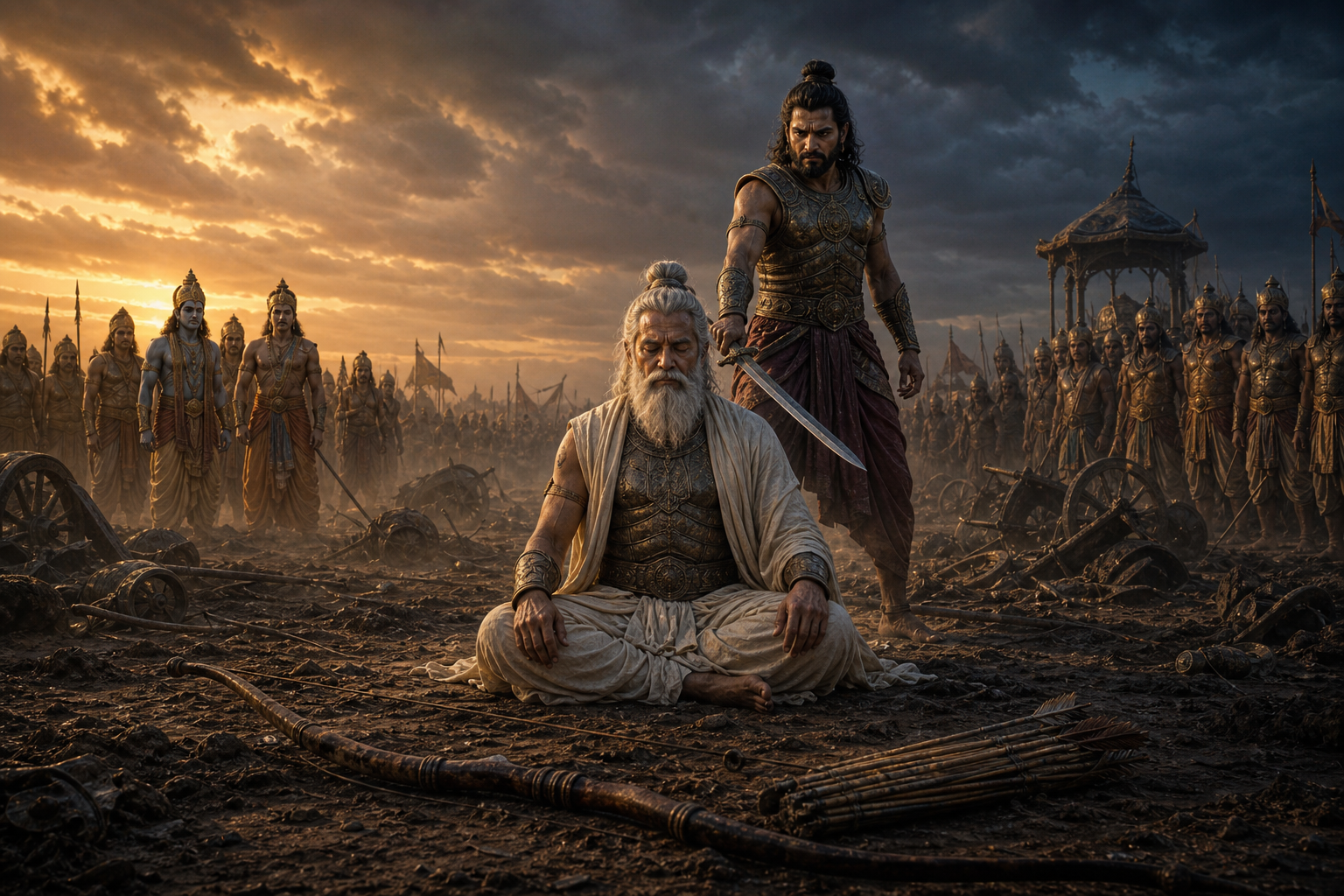
If you came to Dronacharya’s death with a simple question – did the Pandavas abandon dharma to win? – a one-word verdict will mislead you. The episode is difficult precisely because a defensible objective, an urgent military necessity, deceptive speech, personal attachment, and a killing after disarmament all occupy the same moment.
You can reach a clearer judgment by separating those elements. Ask whether the cause was righteous, whether the danger was real, whether the chosen means were necessary, what belief the words were intended to create, and what restraint remained due after Drona laid down his weapons. That approach neither excuses everything as strategy nor dismisses the entire Pandava cause because one act was morally stained.
What happened to Drona, and why the sequence matters
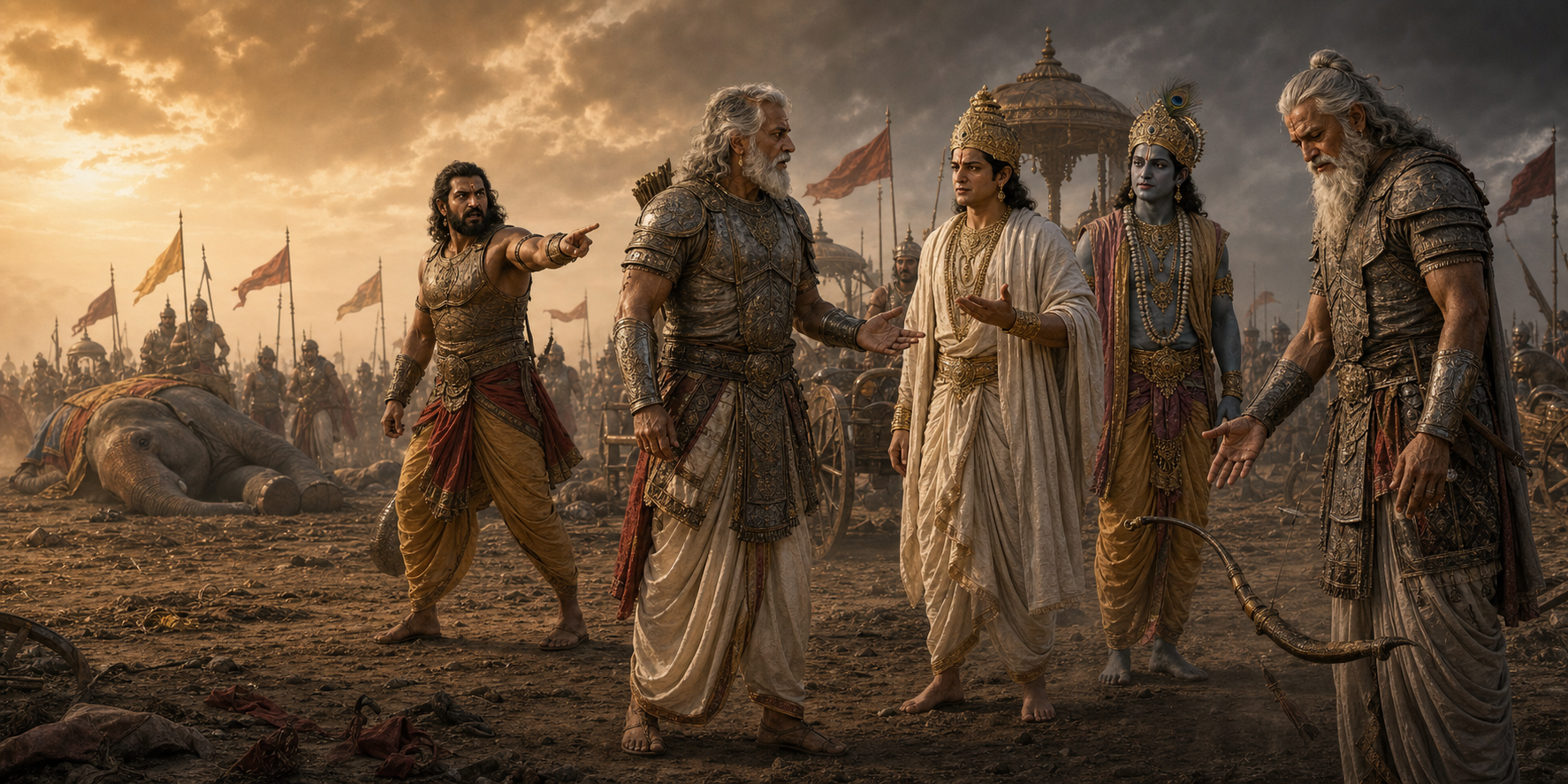
After Bhishma’s fall, Dronacharya became commander of the Kaurava forces. His command, formations, and martial ability brought severe losses to the Pandava army. Traditional tellings present the central military problem starkly: Drona was virtually impossible to defeat while he remained armed.
Krishna therefore proposed breaking Drona’s will to fight rather than overcoming his weapons directly. The plan used the shared name of Drona’s son, Ashwatthama, and an elephant. Bhima killed the elephant and announced that Ashwatthama had been slain. Because Drona did not trust the announcement by itself, he turned to Yudhishthira, whose truthfulness carried exceptional authority.
In many retellings, Yudhishthira confirmed that Ashwatthama was dead and then added gaja, meaning the elephant. The crucial qualification was obscured by the sound of drums and conches. Drona heard what the strategy required him to hear: that his son was dead. Overcome by grief, he put down his weapons and entered meditation. Dhrishtadyumna, the warrior marked out as Drona’s slayer, then struck him. Some tellings describe a beheading, while others narrate the death less graphically.
The order of these actions is ethically decisive. Drona was not beaten in a contest of arms. His trust in Yudhishthira was used to turn an ambiguous statement into a weapon. He disarmed because of the false belief that followed, and the final blow came only after that change in his condition. If you compress the episode into the claim that Drona was killed in battle, you lose the very details that make it a test of dharma.
A technically true sentence can still violate satya
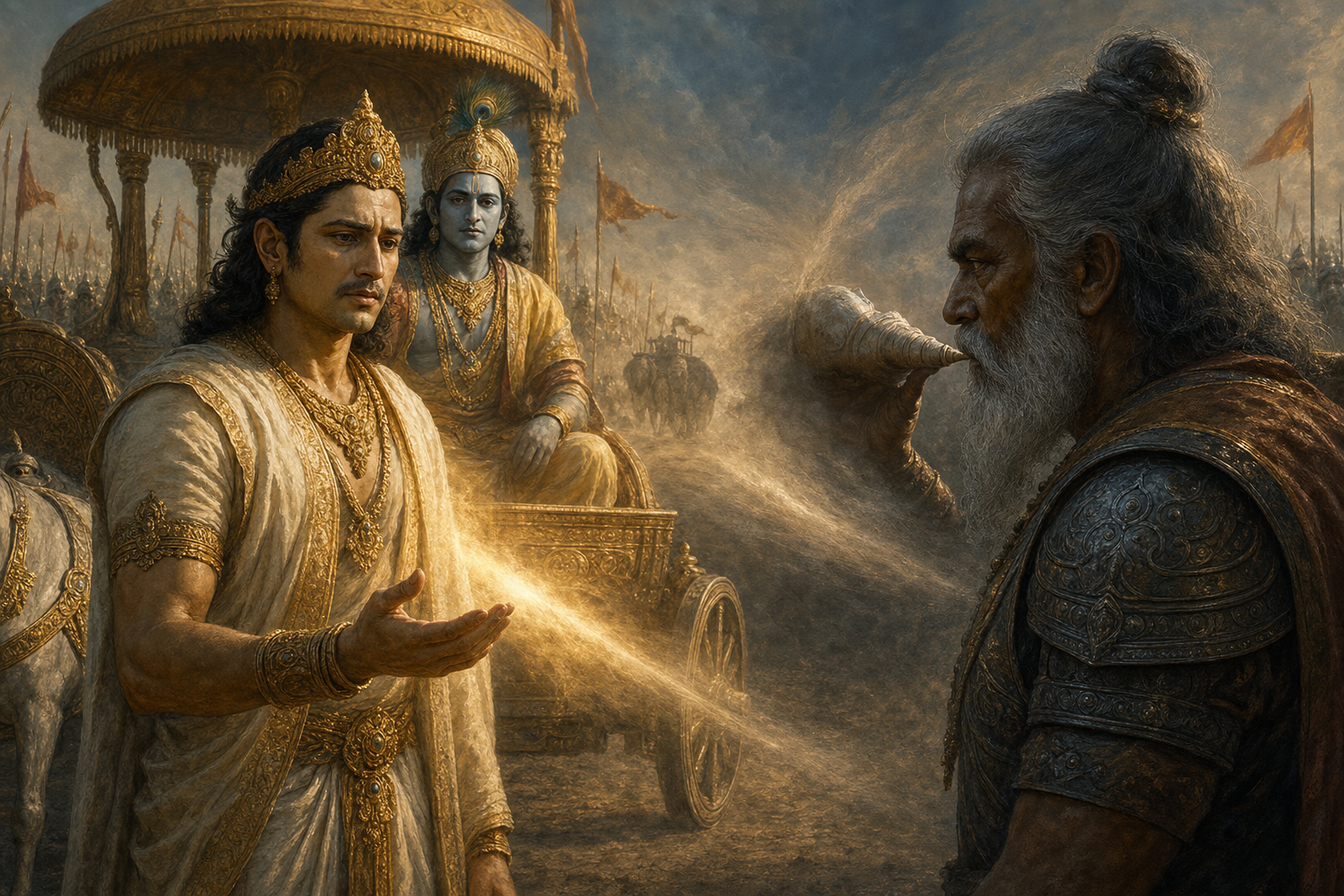
Yudhishthira’s words invite a distinction between factual accuracy and truthful communication. The reference to the elephant gave his statement a literally defensible meaning. Yet the plan depended on Drona not receiving that meaning. The qualification was not offered so that Drona could understand the truth; it allowed the speaker to preserve the wording of truth while producing the effect of a lie.
To judge speech in the spirit of satya, examine four layers:
- Factual content: Is the sentence, taken in full, accurate?
- Intended belief: What does the speaker want the listener to conclude?
- Conditions of delivery: Is an important qualification audible, visible, timely, and understandable?
- Foreseeable reliance: Will the listener act on the misleading impression because the speaker is trusted?
Yudhishthira’s answer fares differently at each layer. Its complete verbal content could refer to the elephant, but its strategic purpose was to make Drona believe that his son had died. The noise prevented the qualification from correcting that belief. Yudhishthira’s reputation then supplied the credibility without which the device might have failed.
This is why a transcript alone cannot settle the moral question. If you choose words because their predictable misunderstanding will benefit you, a hidden qualifier does not restore the spirit of truth. The same test applies when someone buries a decisive condition in small print, answers a direct question with a technically accurate fragment, or lets another person act on an inference the speaker knows is false.
Later traditions express the cost symbolically by describing Yudhishthira’s chariot, once elevated because of his truthfulness, descending to the ground. The image should not be reduced to a mechanical penalty for uttering the wrong phrase. It marks the loss incurred when moral authority accumulated through truth is spent on deception. A good reputation is not merely a private ornament; once others rely on it, using it strategically creates a special responsibility.
Necessity can explain a tactic without making it pure
Wartime dharma exists because a righteous objective does not automatically make every available method righteous. Drona posed an immediate and devastating threat, and direct defeat appeared unavailable while he retained his weapons. Those facts give the Pandava dilemma moral seriousness. They do not, by themselves, cleanse every step taken in response.
A disciplined necessity test has five parts:
- Right objective: Is the action protecting a legitimate cause or merely securing advantage?
- Serious and present danger: Is the threatened harm real enough to justify an exception, rather than merely inconvenient?
- No cleaner effective option: Have less corrupting means genuinely failed or become unavailable?
- Limited means: Does the action do only what is needed to stop the danger?
- Accountability afterward: Will those responsible acknowledge the harm, or will victory be used to declare every means righteous?
The plan against Drona has a strong claim under the first two questions. It was directed at stopping a commander who was inflicting severe losses, and the danger was not hypothetical. The traditional claim that he could not be defeated while armed also gives weight to the third question. But the fourth question divides the episode in two. Causing Drona to lay down his weapons removed the immediate military obstacle; killing him after he had done so raises a separate question about the restraint due to a disarmed warrior.
That distinction matters. An emergency permission to neutralize a threat is not necessarily permission to do whatever becomes possible once the threat has changed. A stopping rule is part of dharma, not an administrative detail added after the action. When circumstances shift, the moral judgment must be made again.
The dharmic traditions illuminate different parts of this test without collapsing into one identical verdict. Hindu reflection places satya, duty, and freedom from attachment beside the demands of battle. Buddhist Right Speech asks whether communication is truthful and compassionate even under pressure. Jain emphasis on ahimsa keeps violence and manipulative speech under the deepest suspicion. Sikh understandings of Dharam Yudh insist that righteous intent be joined to discipline and restraint. Their shared minimum is demanding: crisis does not make conduct morally neutral.
The moral responsibility belongs to more than one person
Debates about Drona’s death often place the whole burden on Yudhishthira because his reputation made the deception effective. His responsibility is real, but the act was collective. A useful moral accounting follows each contribution separately:
- Krishna devised or advised the strategy of disarming Drona through grief. His responsibility concerns the design of the means and the judgment that necessity warranted it.
- Bhima killed the elephant and made the announcement that created the ambiguity. He enabled the plan but could not supply the trusted confirmation Drona demanded.
- Yudhishthira placed his credibility behind the misleading belief. His part was brief in duration but indispensable in effect.
- Drona was an active commander causing grave battlefield losses, not merely a revered teacher standing outside the war. At the same time, his grief and disarmament changed the condition under which others acted against him.
- Dhrishtadyumna delivered the final blow after Drona had put down his weapons. Being marked out as Drona’s slayer explains his narrative role; it does not erase moral agency at the moment of action.
Distributed responsibility does not mean equal responsibility. The person who designs a plan, the person whose credibility legitimizes it, and the person who executes the irreversible act may bear different kinds and degrees of accountability. Nor does acting under counsel, loyalty, destiny, or military pressure make any participant a mere instrument.
This ledger also prevents two convenient distortions. Reverence for Dronacharya as an acharya must not erase his role as commander of the Kaurava army. Conversely, his status as an enemy commander must not erase the ethical importance of his laying down his weapons. Dharma requires you to hold both facts at once. Respect does not confer immunity from judgment, and opposition does not cancel restraint.
Use the same actor-by-actor method when judging a collective wrong outside warfare. Ask who conceived the action, who supplied the pretext, who vouched for it, who executed it, and who refused to stop it when conditions changed. That is more accurate than looking for one villain who can absorb everyone else’s responsibility.
A dharmic protocol for decisions made under pressure
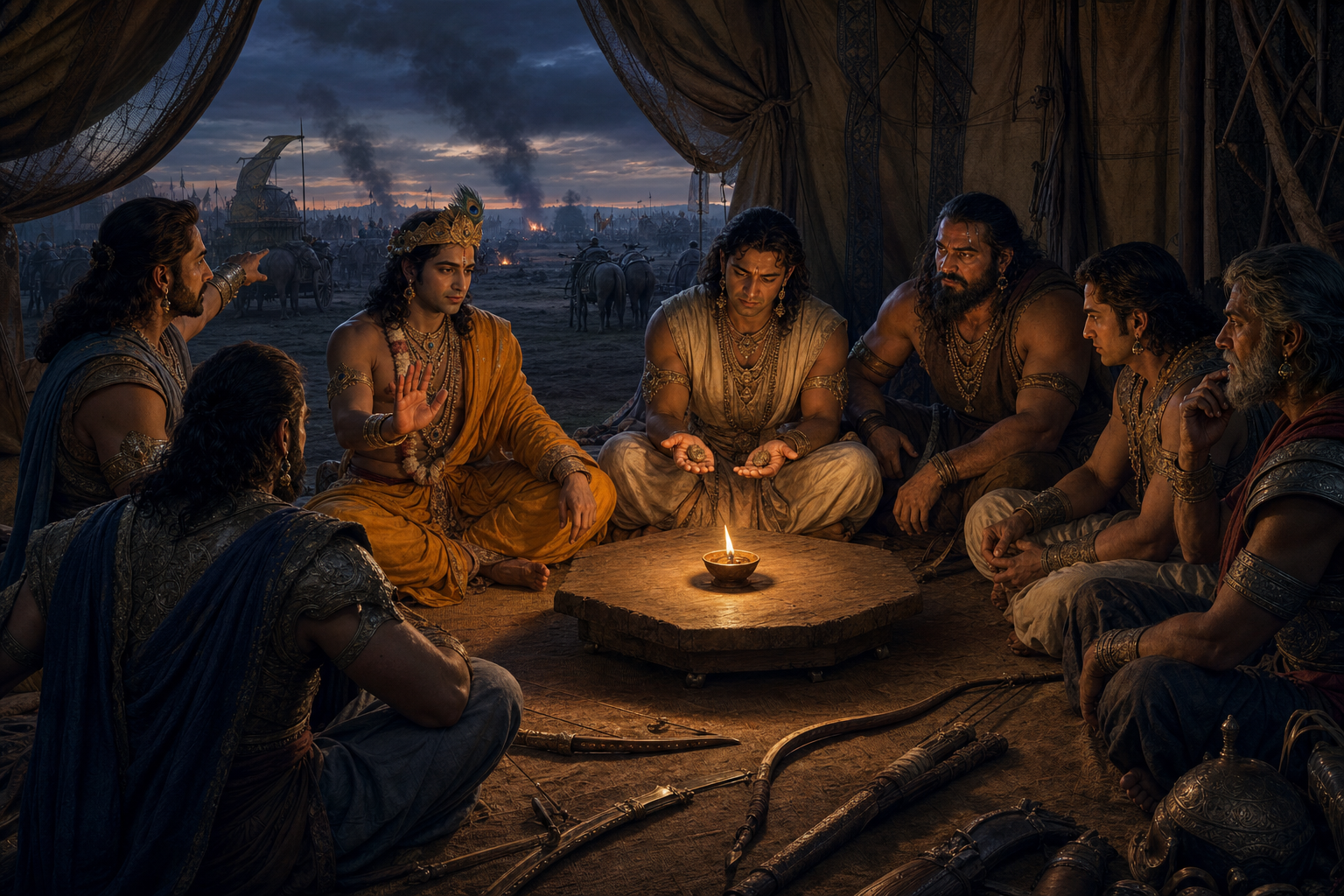
Drona’s death should sharpen ordinary judgment, not turn every disagreement into Kurukshetra. Most disputes in family, professional, religious, and political life do not meet the threshold of an existential battlefield. If you can pause, verify, disclose, recuse yourself, or seek an independent judgment, you have not established the necessity for a wartime exception.
When a genuinely urgent decision sets duties against one another, use this sequence:
- Name the collision precisely. Write both duties without weakening either one: protect those in danger, and do not create a false belief; stop the threat, and restrain force after it ends.
- Separate the cause from the means. A worthy cause establishes what you are trying to protect. It does not settle how you may protect it.
- State the belief your words will create. Do not ask only whether every sentence is defensible. Ask what a reasonable listener will believe and whether you intend that belief to be false.
- Demand evidence of necessity. Difficult, costly, slow, and embarrassing are not the same as impossible. An exception becomes plausible only when cleaner effective choices are genuinely unavailable.
- Define the stopping point in advance. Decide what change will end the permission for deception, coercion, or force. Reassess as soon as that change occurs.
- Keep the moral remainder visible. If the least-wrong option still injures truth, trust, or life, acknowledge the injury. Correct false impressions where possible, accept responsibility, and do not rename the cost as virtue merely because the objective succeeded.
The last step is especially important. A morally serious person may decide that an imperfect action was necessary and still refuse to celebrate its imperfection. Remorse, accountability, and repair do not always prove that the decision was wrong. They may show that the decision-maker understands what the necessity cost.
Key takeaways
- A righteous cause does not sanctify every tactic used on its behalf.
- A statement can preserve literal accuracy while violating the spirit of satya if it is designed to create a false belief.
- Necessity must be demonstrated, not merely asserted, and its permission must end when the threat changes.
- Collective action requires actor-specific accountability; shared responsibility is not automatically equal responsibility.
- Drona’s attachment helps explain his vulnerability, but it does not transfer responsibility away from those who exploited it.
- Moral cost should be acknowledged even when the least-wrong option appears strategically necessary.
The next time someone argues that dharma requires victory at any cost – or that one compromised tactic makes an entire cause worthless – reject both shortcuts. Write down the objective, the belief your words will create, the necessity for the proposed exception, the point at which it must stop, and the cost for which you will remain accountable. That five-line discipline is a better tribute to the Mahabharata’s moral seriousness than an easy verdict on its characters.
References
