

You encounter a hymn credited to an acharya, a saint placed within a temple lineage, or an epic said to have been inscribed on mountain stone. The choice before you is not simply whether to believe or disbelieve. You first need to know what kind of authorship claim you are being asked to receive.
Treating every sacred attribution like a modern byline makes tradition look careless. Treating every devotional narrative like archival evidence makes reverence unnecessarily fragile. A better reading discipline lets historical judgment, inherited tradition, and spiritual meaning remain distinct while still speaking to one another.
Three authorship claims need three reading habits

The word author can carry several meanings in devotional literature. It may identify a historically situated writer, preserve a traditional attribution, or place authorship inside a sacred teaching story. Each kind of claim requires different language and a different standard of evidence.
| Kind of claim | What you are being told | Responsible way to state it |
|---|---|---|
| Historically situated authorship | A named person is connected to a period, place, lineage, and body of work. | Umapathi Sivam was a 13th-century CE Shaivite sage associated with Chidambaram and the Dikshithar family who authored sacred works on Shaivism. |
| Traditional attribution | A community receives and transmits a work under the name of a revered teacher, whether or not the surviving information settles modern historical questions. | Sri Dharma Sastha Bhujangam is traditionally attributed to Adi Sankara. |
| Sacred authorship legend | The act of composition is itself a teaching about devotion, humility, authority, or transmission. | The Hanumad Ramayana legend relates that Hanuman inscribed a Ramayana on Himalayan rocks and later effaced it. |
These categories are not a ranking from valuable to worthless. They identify what a claim can responsibly support. Historically situated authorship can connect a work to a cultural setting. Traditional attribution tells you how a community has received a composition. Sacred legend communicates meaning through the remembered act of authorship itself.
Let the verb preserve that distinction. Use wrote or authored when you mean a direct authorship claim. Retain traditionally attributed to when that is the inherited formulation. Use the legend relates when an authorship event belongs to sacred narrative. Precision is not an apology for tradition; it is a form of respect for what the tradition actually preserves.
- Ask what survives: a complete composition, manuscript witnesses, quotations, a remembered title, or only a narrative about a vanished work.
- Notice whether the attribution is asserted directly or carried with a qualifier such as traditionally attributed.
- Look for concrete historical anchors: period, place, lineage, teachers, temple setting, and associated works.
- Identify the genre. A stotra, philosophical treatise, epic, and sacred legend do not ask to be read in identical ways.
- Check whether the authorship story explains its own lack of a surviving text. If it does, preserve that explanation as part of the narrative without turning it into material evidence.
Let the remembered author shape your interpretation
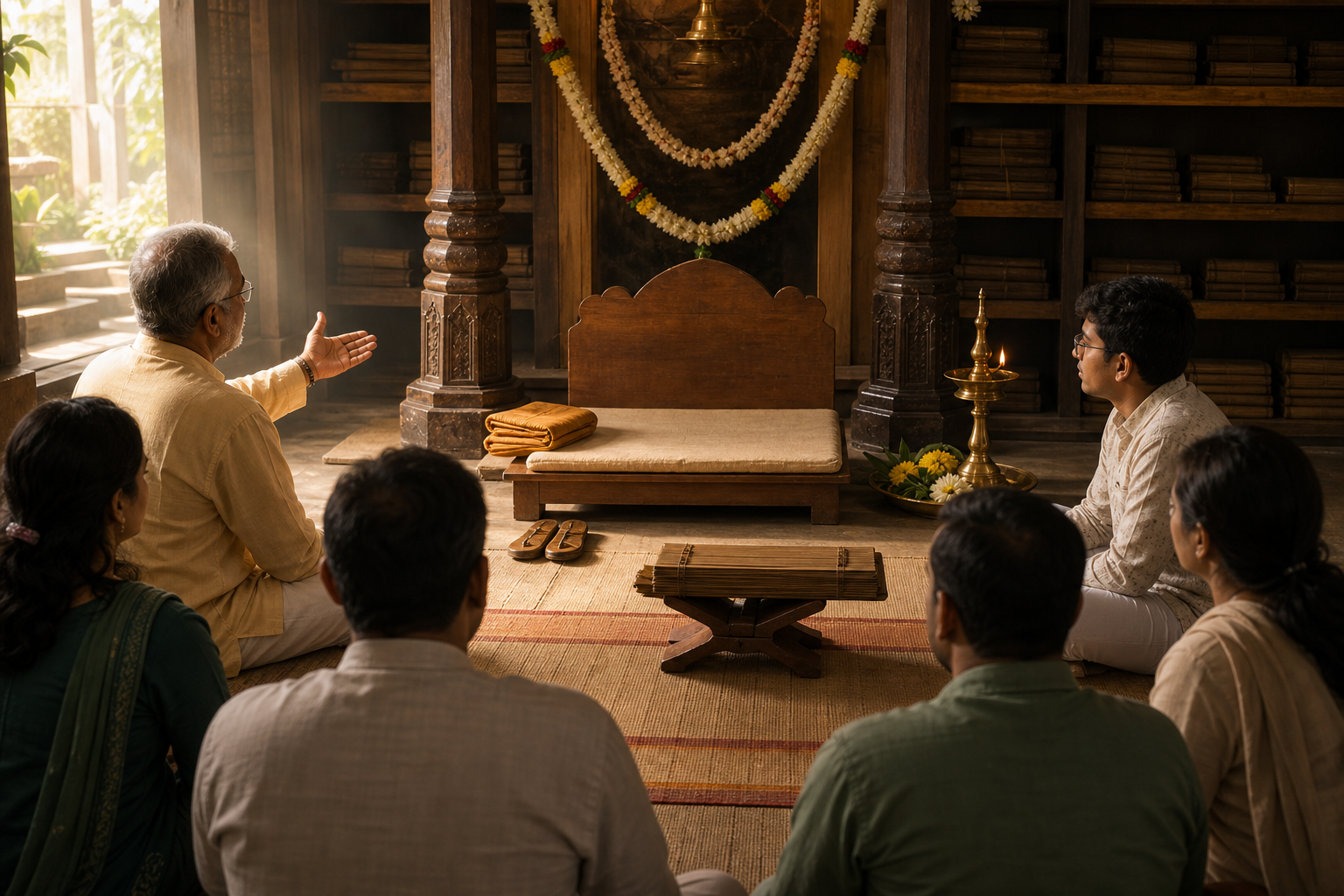
A sacred name attached to a work often does more than answer who composed its words. The name can tell you what kind of authority, discipline, or devotional posture should guide your reading.
Umapathi Sivam’s authorship belongs to a setting where Vedic learning, Shaivite philosophy, temple worship, ritual discipline, and ethical life converged around Chidambaram’s Thillai Natarajar Temple. That setting changes how you should approach his legacy. Learning is not merely the collection of propositions about Shiva. Study becomes sadhana when it is joined to worship and conduct.
Sri Dharma Sastha Bhujangam presents another relationship between name and interpretation. Its attribution to Adi Sankara places a devotional hymn beside the philosophical precision associated with Advaita. The work praises Dharma Sastha as a compassionate protector and guide of dharma, while the deity’s Harihara identity brings Shiva and Vishnu into a vision of integration. You should therefore notice that non-dual inquiry and personal devotion are not being treated as mutually exclusive temperaments.
The Hanumad Ramayana carries authorship into a different register. Hanuman is remembered as inscribing his Rama-katha on Himalayan rocks with his nails, seeing the destined importance of Valmiki’s Ramayana, and effacing his own composition. No physical text survives, and there is no archaeological or manuscript evidence for a distinct Hanumad Ramayana. The responsible historical judgment is therefore limited. The ethical force, however, remains clear within the legend: Hanuman completes an extraordinary work and then releases his claim to recognition so that another work may serve the world.
The contrast between stone and erasure makes the lesson especially sharp. Stone suggests permanence. Voluntary effacement reveals freedom from the need to be remembered as the creator. Authorship becomes seva rather than possession, and ananya-bhakti becomes more important than literary fame.
When a sacred author or attributed author appears, ask questions that move beyond the byline:
- What quality does this remembered figure embody: disciplined learning, surrender, courage, humility, or service?
- What kind of authority does the name invoke: temple lineage, philosophical teaching, direct devotion, or sacred narrative?
- Does the authorship memory ask you to preserve something, transmit it, recite it, or release ownership of it?
- What would be missing from your interpretation if you considered only the words and ignored the remembered manner of their composition?
Keep evidence, devotion, and practice on separate tracks

You do not have to force every question about a devotional work into a single verdict. Keep several judgments separate in your notes, then consider how they relate.
- Historical judgment: What evidence survives for the person, period, composition, and transmission?
- Attributional judgment: How exactly does the receiving tradition connect the work with a saint, acharya, rishi, or deity?
- Literary and theological judgment: What does the work say, and how do its meter, imagery, divine names, and narrative choices carry that meaning?
- Practical judgment: How is the work recited, studied, contemplated, or translated into conduct?
These tracks can produce different conclusions without contradiction. The lack of a surviving Hanumad Ramayana limits what you can claim about an ancient composition, but it does not prevent you from receiving the legend’s teaching on humility. A traditional attribution to Adi Sankara is not identical to demonstrated historical authorship, but it remains important to the devotional identity through which Sri Dharma Sastha Bhujangam is transmitted. A historically situated author such as Umapathi Sivam gives you firmer cultural coordinates, but those coordinates alone do not perform the inner work of study, worship, and ethical refinement.
This distinction protects you from two opposite errors. Apologetic inflation turns every sacred memory into a claim of documentary certainty. Reductive dismissal assumes that uncertainty about provenance empties a hymn or legend of spiritual, literary, and ethical value. Neither response reads carefully enough.
You can say that a legend teaches without claiming that its vanished object has been recovered. You can recite a traditionally attributed hymn without pretending that recitation proves its historical authorship. You can also investigate provenance without treating investigation as hostility. Truthfulness is itself a dharmic obligation.
A practical method for reading an attributed devotional work
Once you have identified the kind of authorship claim, bring the work into a disciplined reading practice. The following method works for personal study, a temple discussion, or an editorial note introducing a sacred composition.
- Preserve the attribution exactly. Copy the wording you received before paraphrasing it. If it says traditionally attributed to, do not silently upgrade that to written by. If it calls an account a legend, retain that designation.
- Establish the survival status. Note whether you have the work itself, a translation, a transliteration, a retelling, or a narrative about a text that no longer exists. Do not cite an absent composition as though you had read it.
- Identify what the genre asks you to do. A stotra is meant to be voiced and heard as well as analyzed. A philosophical work requires attention to its reasoning. A teaching legend requires attention to the moral meaning created by its plot.
- Read first for its representation of the sacred. Mark the names, qualities, relationships, and actions assigned to the deity or exemplary figure. In Sri Dharma Sastha Bhujangam, protective compassion, guidance in dharma, and the integration represented by Harihara form a coherent devotional pattern.
- Read again for the human discipline. Ask what the work expects from the devotee. Possible answers within these examples include rigorous study joined to worship, steadiness in recitation, service without attachment to praise, and ethical conduct shaped by devotion.
- Record a paired conclusion. State what you can responsibly say about provenance, then state what the work asks you to contemplate or practise. Keeping those conclusions beside each other prevents either one from swallowing the other.
For Sri Dharma Sastha Bhujangam, the rhythmic bhujangam meter lends itself to steady breathing and concentrated recitation. A quiet morning or evening setting and a simple lamp can help define the practice. If Sanskrit pronunciation is unfamiliar, use a careful transliteration or a trusted translation. Let the cadence steady your attention, but do not force the breath or confuse atmosphere with proof of authorship.
For the Hanumad Ramayana legend, the practical question is not where to obtain a nonexistent manuscript. Ask instead where the desire for recognition enters your own work. Complete your duty carefully, offer its benefit where it is needed, and notice whether praise has become more important than service.
For Umapathi Sivam, resist reducing sacred learning to detached information. Pair study with the devotional and ethical context that gives it purpose. The useful question after reading is not only whether you can explain a doctrine, but whether clearer understanding has refined worship, attention, or conduct.
This method also travels across the wider dharmic family without flattening its differences. Hindu, Buddhist, Jain, and Sikh traditions do not authorize every text in the same way. You can nevertheless approach each tradition with the same intellectual virtues: preserve its own claim, avoid exaggeration, attend to disciplined practice, and look for the ethical formation expressed through truthfulness, compassion, self-restraint, and service.
Key takeaways
- A sacred name may identify historically situated authorship, preserve traditional attribution, or belong to a devotional legend. Determine which claim you have before judging it.
- Use authored, traditionally attributed, and the legend relates deliberately. The right qualifier protects both accuracy and reverence.
- Historical uncertainty does not automatically erase literary, theological, or ethical value. Devotional value does not automatically prove historical provenance.
- Read authorship as part of the teaching. Umapathi Sivam joins study to worship, Adi Sankara’s traditional association joins Advaita to bhakti, and Hanuman’s remembered self-effacement places seva above fame.
- Complete your reading with a concrete practice: careful recitation, disciplined study, ethical refinement, or work offered without attachment to recognition.
The next time you meet a sacred name on a hymn, treatise, or legend, write the claim type in the margin before deciding what you accept. Then name the virtue and action the work asks from you. That small discipline makes room for intellectual honesty and devotion to strengthen each other.
References
- DharmaRenaissance Blog — Sri Umapathi Sivam: A Luminous Shaivite Sage from Chidambaram’s Sacred Tradition
- DharmaRenaissance Blog — Sri Dharma Sastha Bhujangam: Adi Sankara’s Powerful Hymn of Unity, Devotion, and Dharma
- DharmaRenaissance Blog — Sri Hanumad Ramayana: The Awe-Inspiring Himalayan Legend of Hanuman’s Sacred Epic
