
When a leader invokes duty, how do you tell whether it is dharma or self-interest dressed in noble language? Ayodhya Kanda gives you a demanding test because its central conflict places several real obligations against one another: a king’s promise, a son’s duty, a kingdom’s welfare, a rightful succession, and a family’s loyalty.
Read this part of the Ramayana as more than an account of sacrifice. It becomes a practical guide to judging power. Watch who gains, who bears the cost, whether dissent is permitted, and whether authority is treated as property or as a trust. Those questions reveal more about righteous leadership than any declaration of virtue.
Character must come before the crown
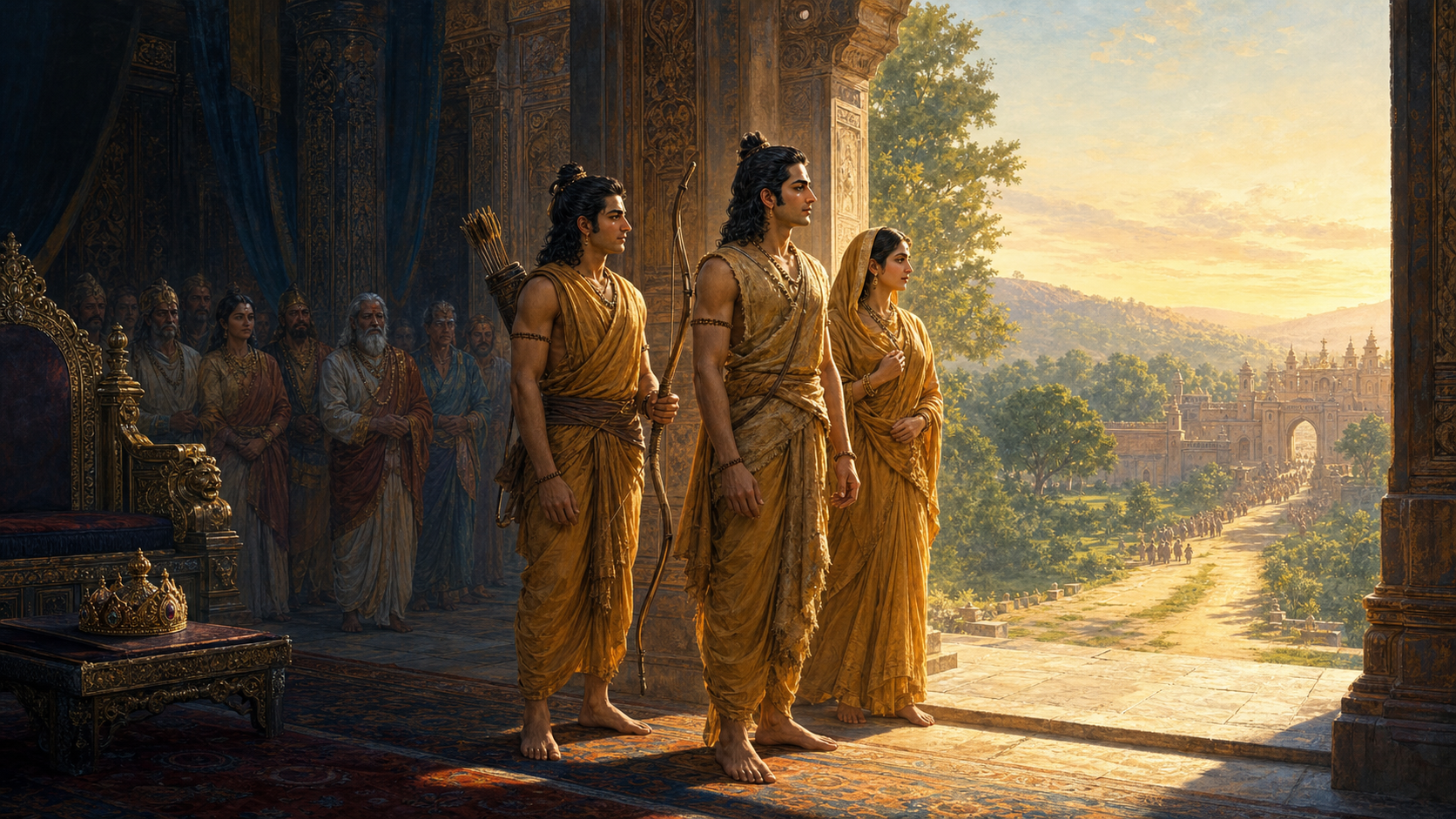
King Dasharatha’s decision to install Rama as Yuvaraja is not presented as an arbitrary preference. Rama has already earned confidence through truthfulness, restraint, compassion, and commitment to dharma. Ayodhya’s joyful preparations show that the expected succession also carries broad social trust.
This establishes the first leadership principle: a title should recognize demonstrated character, not manufacture legitimacy after the appointment. Competence matters, but competence without restraint can become efficient exploitation. Personal virtue matters, but virtue without the capacity to carry responsibility can leave a community unprotected. Righteous succession requires both fitness for office and the confidence of those who will live under its consequences.
The planned coronation nevertheless contains a hidden weakness. Kaikeyi invokes two boons previously granted by Dasharatha: Bharata is to receive the throne, while Rama must spend fourteen years in exile. Manthara’s influence helps bring the demand forward, but reducing the crisis to one person’s manipulation misses the institutional failure. A private obligation has been allowed to determine public succession.
Dasharatha’s dilemma therefore carries a warning for anyone responsible for a family, temple, association, company, or state. A promise may be sincere and still be dangerously unbounded. Before transferring authority, a leader should disclose commitments that could affect the transition, settle conflicting claims, and make the limits of personal discretion clear. If an old favor can overturn an entire succession at the last moment, the institution has been resting on personality rather than order.
When you evaluate a proposed leader, examine three distinct things: the candidate’s character, the community’s justified confidence, and the institution’s ability to survive unresolved personal claims. Ayodhya possesses the first two. The third is where the crisis enters.
Rama’s obedience is righteous because he bears its cost
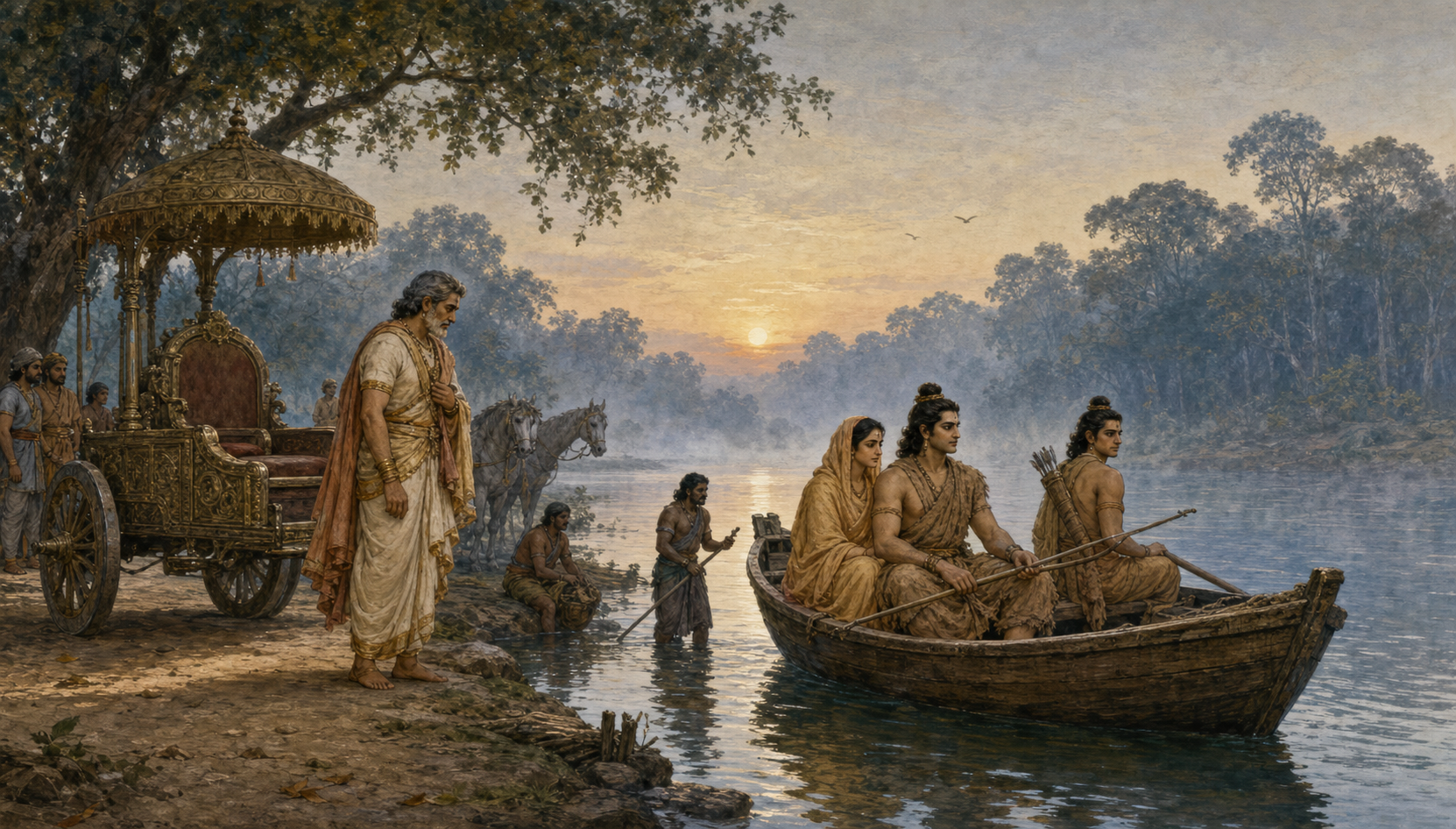
Rama’s response is serene rather than calculating. He accepts the fourteen-year exile to uphold his father’s word, even though the decision removes him from the throne on the eve of his coronation. He does not invoke dharma to acquire privilege. He accepts the personal loss required by the principle he affirms.
That placement of cost is one of the clearest tests of ethical leadership. Be cautious when someone cites duty while securing the reward for himself and transferring the hardship to subordinates, relatives, or the public. A principle becomes credible when the person invoking it is willing to carry its burden. Rama loses position, comfort, and immediate political authority; he does not ask others to pay so that his reputation can remain pure.
It would still be a mistake to turn Rama’s conduct into a command for unquestioning obedience. Ayodhya Kanda does not give every person the same duty. Rama responds as the son whose father’s truth is at stake. Bharata later responds as the intended beneficiary of a wrongful arrangement. One accepts exile; the other refuses the throne. Their actions differ because their roles and moral exposure differ.
Before calling compliance dharmic, ask four questions. Whose obligation created the demand? Who receives the benefit? Who bears the loss? Will fulfilling it protect truth, or merely shield a powerful person from accountability? Rama’s choice survives these questions because he receives no improper advantage and accepts the consequence himself.
His acceptance also shows that righteous action does not guarantee a painless outcome. Ayodhya grieves, Dasharatha dies, and the royal household is shattered. Dharma is not a technique for making every consequence pleasant. It is the discipline of refusing to add falsehood, ambition, and retaliation to an already painful situation.
Bharata shows how to dissent without becoming another usurper
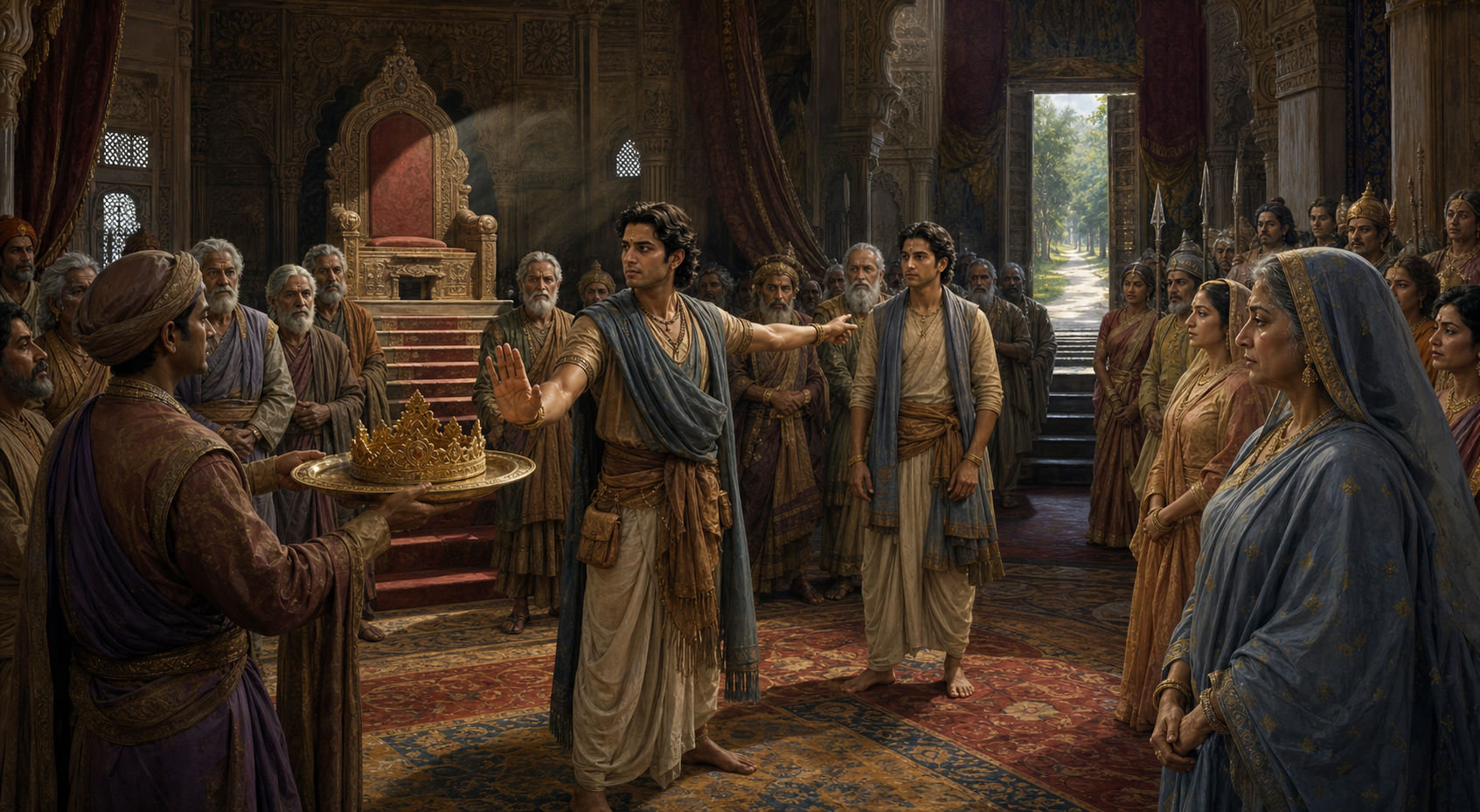
Bharata returns from Kekaya to find a kingdom transformed by grief. The throne has been secured for him, but through an arrangement he did not seek and cannot morally accept. His refusal to profit from the wrong done to Rama makes him one of the clearest models of righteous dissent in the Ramayana.
His first act of credibility is renunciation of the disputed benefit. This matters. A person cannot convincingly condemn an injustice while quietly keeping its proceeds. If a promotion, inheritance, office, or advantage reaches you through a breach of trust, the cleanest first step is to refuse the gain. Only then can your objection be distinguished from a struggle over who gets the prize.
Bharata also refuses a false choice between loyalty and moral clarity. Fidelity to family does not require him to endorse Kaikeyi’s demand. Reverence for Rama does not permit him to abandon Ayodhya. Anger at the circumstances does not authorize him to destroy the royal order. He separates the person, the wrongful outcome, and the institution that still needs care.
The meeting at Chitrakoot sharpens the lesson. Bharata urges Rama to return, while Rama maintains that Dasharatha’s word must be fulfilled. Their disagreement is not a contest between dharma and adharma. It is a conflict between two serious judgments about how dharma should be served from different positions.
This is what principled disagreement looks like in practice. State the wrong plainly. Remove your personal interest from the dispute. Appeal to the legitimate authority rather than manufacturing your own. Listen when another duty limits the outcome you want. Then accept responsibility for protecting the people who would otherwise suffer from the impasse.
Bharata avoids two failures that often masquerade as loyalty: obedience that excuses wrongdoing and outrage that destroys what it claims to defend. If you must oppose a decision made by someone you respect, his example asks you to preserve truth without making humiliation, revenge, or personal advancement your hidden objective.
The paduka turn sovereignty into visible stewardship
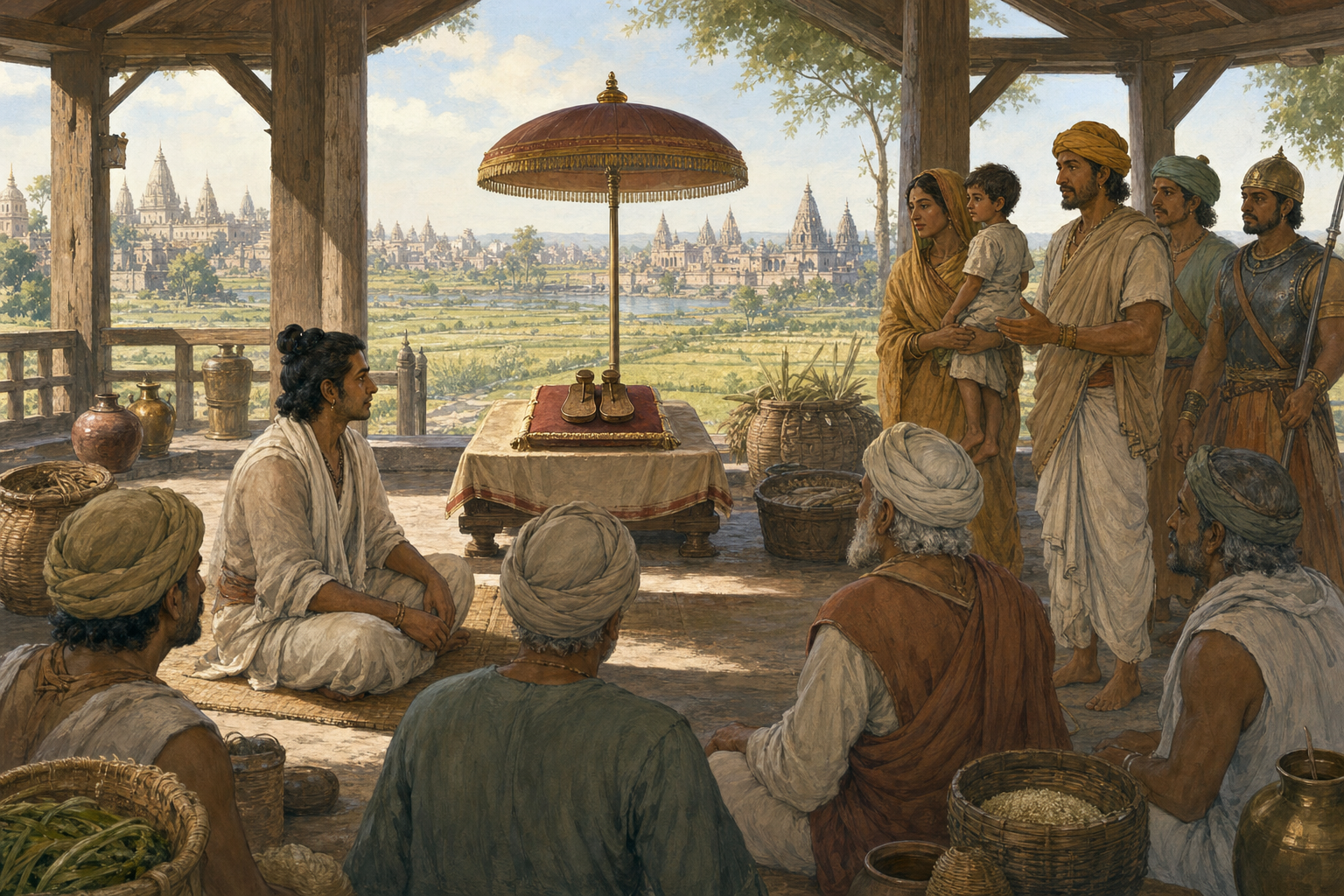
The resolution at Chitrakoot is politically and spiritually unusual. Rama does not abandon his vow, Bharata does not take the kingship as his possession, and Ayodhya is not left without governance. The paduka are installed as the sign of Rama’s continuing authority, while Bharata governs as regent from Nandigrama.
The sandals matter because they make the source and limit of delegated power visible. Bharata cannot quietly convert temporary responsibility into personal entitlement. The throne is being administered through him, but it is not his to absorb into his identity. His restraint gives the symbol its credibility.
This is a usable model of stewardship. Anyone holding delegated authority should be able to answer three questions without ambiguity: From whom does the mandate come? What are its limits? What event ends it or returns it to the rightful holder? When those answers are hidden, temporary power has room to become permanent possession.
A symbol alone, however, cannot create accountability. The paduka would be empty theatre if Bharata behaved as an owner while publicly calling himself a servant. Righteous leadership requires external limits and corresponding personal discipline. The visible arrangement tells the community where sovereignty rests; Bharata’s conduct confirms that he accepts the arrangement.
You can apply this standard wherever one person temporarily manages another’s responsibility: a temple committee, a community trust, a family estate, an organization between leaders, or a public office. Record the mandate, keep the limits visible, prevent private enrichment, and establish how authority will be returned. Stewardship becomes trustworthy when the officeholder cannot erase the distinction between serving the office and owning it.
Righteous leadership depends on a culture of chosen service
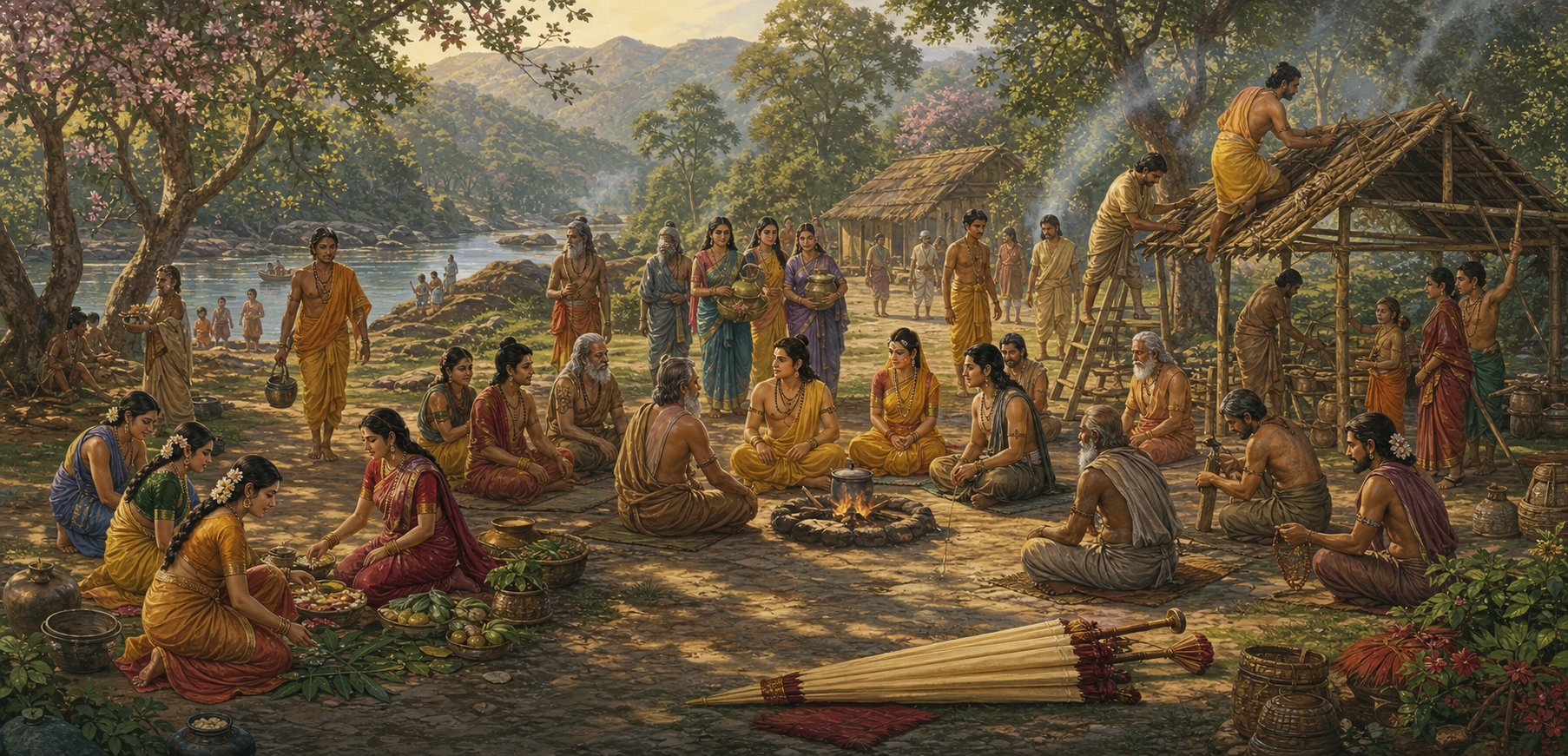
Rama is not the only moral actor in Ayodhya Kanda. Sita resolves to accompany him, Lakshmana offers loyal service, Guha assists at the Ganga, and sages such as Bharadwaja provide hospitality and counsel. At Chitrakoot, renunciation and responsibility remain connected rather than becoming opposites. Later counsel associated with Atri and Anasuya emphasizes simplicity, steadfastness, and gentle strength.
This wider circle prevents leadership from becoming a story about one heroic man doing everything alone. A righteous leader needs people capable of loyalty, hospitality, counsel, restraint, and disagreement. Institutions fail when their ethics depend entirely on the leader’s presence. They endure when these habits are shared by the household and community.
There is also an important boundary here. Sita’s and Lakshmana’s commitments are meaningful as chosen acts of solidarity. Their examples should not be turned into a license for a leader to demand unlimited sacrifice from a spouse, sibling, or subordinate. Voluntary service strengthens dharma; coerced sacrifice lets the powerful display virtue using someone else’s suffering.
Ayodhya Kanda therefore presents inner discipline as public infrastructure. Truthfulness restrains manipulation. Simplicity limits the appetite for office. Compassion keeps duty from becoming cruelty. Self-control enables Bharata to govern without seizing and Rama to renounce without bitterness. These virtues are not decorative qualities added after power is obtained. They are what prevent power from consuming its holder.
When assessing the ethical culture around a leader, notice what happens in the leader’s absence. Can another person hold authority without appropriating it? Can someone reject an improper benefit? Can a loyal relative disagree? Can ordinary responsibilities continue during grief and conflict? If the answer is no, the institution may admire dharma while remaining structurally dependent on personality.
Key takeaways
- Judge a declared principle by where it places the cost. Rama bears the loss created by the duty he accepts.
- Test succession before the ceremony: character, public confidence, and unresolved obligations all affect legitimacy.
- Do not confuse dharma with uniform obedience. Rama and Bharata act differently because their roles and responsibilities differ.
- Reject a tainted advantage before protesting the act that produced it. Bharata’s dissent is credible because he refuses to profit.
- Make delegated power visibly limited. The paduka preserve the distinction between holding authority and owning it.
- Build a culture in which service is voluntary, dissent is principled, and ethical order can survive the leader’s absence.
The next time you must choose, support, replace, or challenge a leader, write down four things: the principle being claimed, the person who benefits, the person who pays, and the limit placed on power. If one person gains while others absorb the cost and no limit is visible, pause before calling the arrangement dharmic. Ayodhya Kanda asks you to look past the language of righteousness and examine the structure of conduct beneath it.
References
