
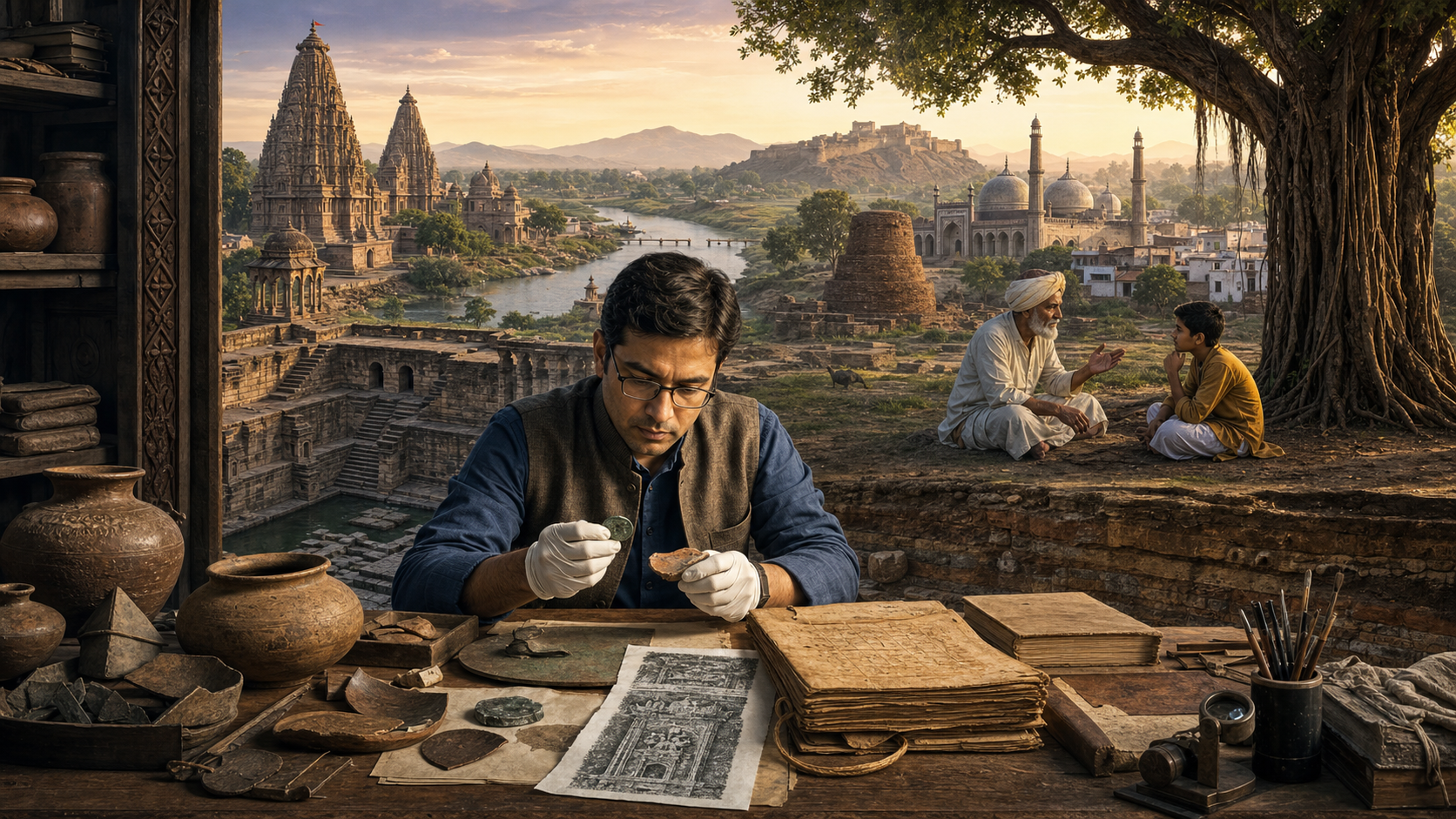
You may have encountered two accounts of India’s past that seem to demand opposite loyalties. One treats inherited memory as an embarrassment to be corrected. The other asks you to accept every inherited claim as proven history. Neither gives you a reliable way to decide what happened, what remains disputed, or why certain events still matter.
You don’t have to choose between civilizational memory and historical discipline. Let memory tell you what deserves investigation, then let evidence determine how confidently you describe it. That method can recover neglected histories without replacing one ideological script with another.
Key takeaways
- Civilizational memory preserves questions, places, injuries, loyalties, and patterns of meaning. It is evidence of what a community remembered, but it is not automatically proof of every remembered detail.
- Separate the event, its later interpretation, and its place in public memory. Confusing these layers produces both denial and exaggeration.
- Read Bharat through sacred geography as well as royal chronology. Temples, viharas, tirthas, gurdwaras, pilgrimage routes, festivals, and scholarly networks reveal forms of continuity that dynastic timelines miss.
- Describe conquest and desecration with named actors, policies, places, evidence, and degrees of certainty. Never transfer responsibility from historical regimes to people living now.
- Treat unresolved questions, including the Aryan Migration versus Out of India debate, as unresolved. Intellectual openness is a sign of civilizational confidence, not weakness.
Keep three ledgers: event, interpretation, and memory
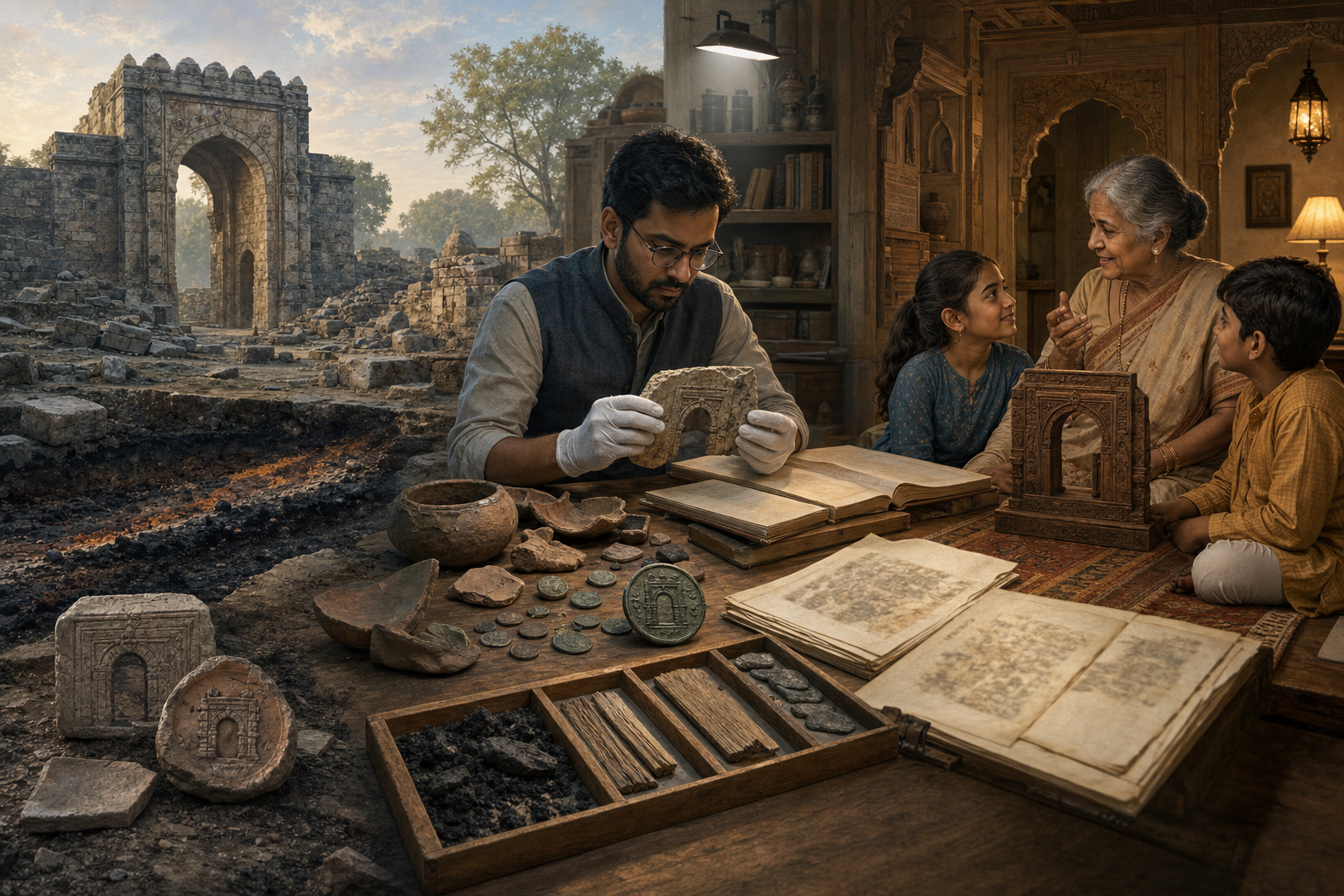
The first discipline is conceptual. History reconstructs what happened. Historiography examines how accounts of what happened were selected, organized, and explained. Civilizational memory concerns what a people carried forward through family narratives, sacred places, rituals, stories, festivals, institutions, and inherited moral judgments.
These three ledgers overlap, but they don’t contain identical entries:
- Event: What action occurred, where, under whose authority, and what primary or material evidence supports it?
- Interpretation: Was the action an isolated episode, a recurring policy, a political expedient, an expression of religious conviction, or some combination of motives?
- Memory: How did affected communities preserve the event, and what moral or civilizational meaning did they attach to it?
Mahmud of Ghazni and Somnath show why the distinction matters. Mahmud remains emblematic in Hindu public memory of temple destruction and iconoclasm, while the evidentiary trail is associated with Persian chronicles, epigraphy, and archaeological traces. You therefore have at least two legitimate inquiries: what the available evidence establishes about the historical action, and why Somnath became a durable symbol of civilizational injury.
Neither inquiry cancels the other. Material evidence cannot by itself explain the full life of a memory. Memory cannot, by itself, settle every material detail. A serious account holds both questions open and states clearly which one it is answering.
The same rule applies to altered sacred sites. Local traditions sometimes remember temple materials being reused in mosque construction or desecrated murtis being placed in steps. Claims connected with steps at Jama Masjids include both confirmed and contested elements. Record the tradition accurately, identify the material or textual evidence available, and label what remains unverified. Dismissing the memory before investigating it is careless; promoting a contested detail as certain is equally careless.
Apply the same restraint to civilizational origins. The Aryan Migration versus Out of India question remains contested across philology, archaeology, and archaeogenetics. No slogan resolves disagreements among distinct fields of evidence. When you encounter a confident verdict, ask five questions:
- What precise proposition is being asserted?
- Which part rests on direct evidence, and which part is an inference?
- Are findings from one discipline being presented as if they settle every other discipline?
- Does the conclusion acknowledge evidence that complicates it?
- What new evidence would cause its advocate to revise the claim?
If those questions don’t receive clear answers, you are probably looking at ideological closure rather than a finished historical argument. Replacing colonial or Nehruvian certainty with an equally rigid counter-orthodoxy would leave the underlying problem untouched.
Read sacred geography as civilizational infrastructure
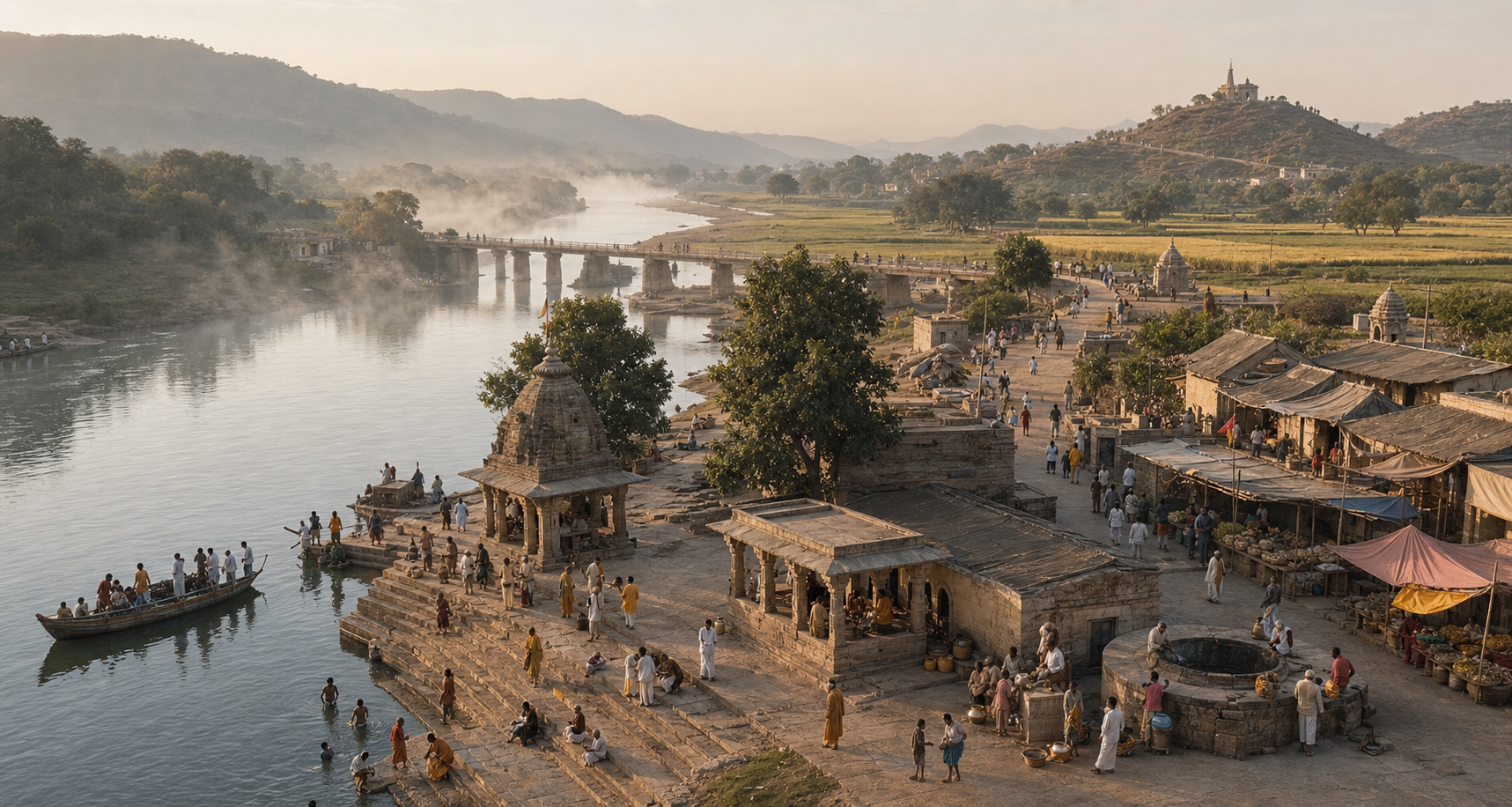
A chronology dominated by courts, capitals, invasions, and successions will naturally make foreign dynasties appear to be the principal authors of Indian history. Change the unit of observation and a different structure becomes visible. Rivers, mountains, forests, kshetras, pilgrimage circuits, monastic centres, temple communities, tirthas, and places of sacrifice carried meaning across the rise and fall of kingdoms.
This is more than devotional decoration around political history. Buddhist sites such as Nalanda and Ajanta, Jain tirthas across different regions, Sikh gurdwaras associated with sacrifice and seva, and Hindu temple and pilgrimage networks belong to a connected sacred map of Bharatavarsha. Each tradition remains distinct, yet all have made the land morally and spiritually legible through places that call forth learning, worship, renunciation, service, pilgrimage, and remembrance.
You can use that insight to investigate the history of your own region. Start small enough to finish:
- Choose one bounded landscape. Use a river corridor, town, pilgrimage route, or district rather than attempting to explain all of Bharat at once.
- Mark institutions from more than one Dharmic tradition. Record temples, viharas, Jain tirthas, gurdwaras, learning centres, and places associated with sacrifice or seva where they are present.
- Identify the function of each place. Distinguish worship, pilgrimage, education, community support, remembrance, and political organization. A site may have served several functions, but don’t assume that without evidence.
- Preserve regional vocabulary. Record local names, oral accounts, inscriptions, and regional-language traditions before translating them into broad national categories.
- Label the status of every claim. Separate securely documented information, plausible reconstruction, community remembrance, and active dispute.
- Trace connections rather than merely plotting dots. Look for pilgrimage movement, festivals, scholarly exchange, and recurring stories that linked the places into a larger moral geography.
Your resulting map should be layered, not blended. Dharmic unity does not require pretending that Hinduism, Buddhism, Jainism, and Sikhism have identical doctrines or histories. It means recognizing their distinctive institutions as participants in a civilizational landscape formed within Bharat and connected through long habits of encounter.
This also clarifies the meaning of a pan-Bharat consciousness. Political unity could weaken or disappear while cultural communication continued through shared epics, pilgrimage circuits, festivals, temple networks, and scholarly exchange. If you look only for a single state, you will miss forms of cohesion that did not depend on one throne.
Describe foreign rule without erasing Indian agency
Whether a ruling house was indigenous is not settled by residence alone, and it is certainly not a blood test. The historical question concerns legitimacy, political conduct, cultural allegiance, and the relationship between power and the sacred life of the people being governed.
Popular Hindu memory generally did not treat the Delhi Sultanate or significant parts of the Mughal order as indigenous formations. Even Akbar’s conciliatory policies did not automatically transform elite marriage or harem connections into proof of civilizational integration. Where relationships involving Hindu women were remembered as coercive or transactional, their memory was one of moral and social injury, not uncomplicated synthesis.
You can address that memory directly without making descendants or present-day religious communities answerable for medieval regimes. Use a five-part rule whenever you write about conquest, iconoclasm, or coercion:
- Name the actor precisely. Identify the ruler, dynasty, official, army, or institution involved instead of assigning an action to an undifferentiated religious population.
- Name the action. Distinguish conquest, temple destruction, reuse of sacred material, accommodation, patronage, resistance, and negotiated coexistence. One label cannot carry every relationship.
- Connect the claim to evidence. State whether the case rests on chronicles, epigraphy, archaeology, an oral tradition, or several forms of evidence.
- Calibrate the conclusion. Use “documents” for what is established, “indicates” where evidence is partial, “is remembered as” for memory, and “remains contested” where the case is unresolved.
- Stop historical responsibility at the historical actor. Criticism of a regime or policy must not become collective suspicion directed at a contemporary neighbour.
This discipline protects truth in both directions. It prevents a language of cultural synthesis from concealing destruction or coercion. It also prevents a documented injury from becoming permission for imprecise hostility in the present.
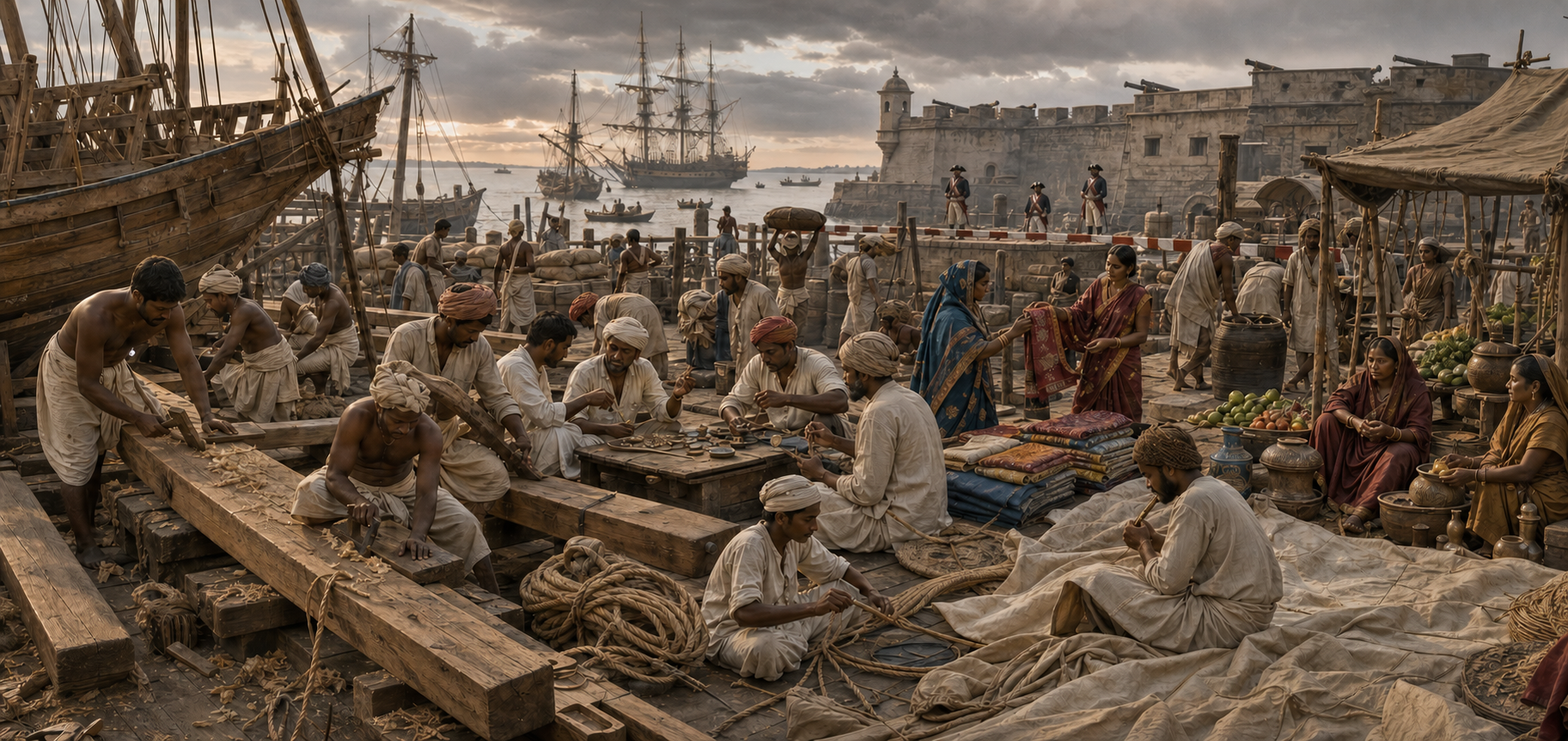
The familiar image of India as a passive land repeatedly made by conquerors also collapses when resistance returns to the chronology. Rajput resistance, Vijayanagara statecraft, the Maratha resurgence, and the Sikh Khalsa’s assertion of sovereignty demonstrate recurring capacities for organization, cultural defence, and political recovery.
These cases do not prove that Indian powers were always united. Internal rivalries were real. Their significance is more precise: political fragmentation did not eliminate civilizational agency, courage, or the ability to organize across regions. The honest correction to the disunity trope is not a fantasy of permanent harmony. It is a fuller record of conflict, cooperation, defeat, survival, and renewal.
When you assess any period of foreign rule, keep a balanced ledger. Ask what was destroyed, what was appropriated, what adapted, what survived, who resisted, and which institutions continued serving communities. A history containing only trauma leaves Indians without agency. A history containing only synthesis leaves injuries without names. A civilizational history needs both truth and proportion.
Build a local history dossier that others can verify
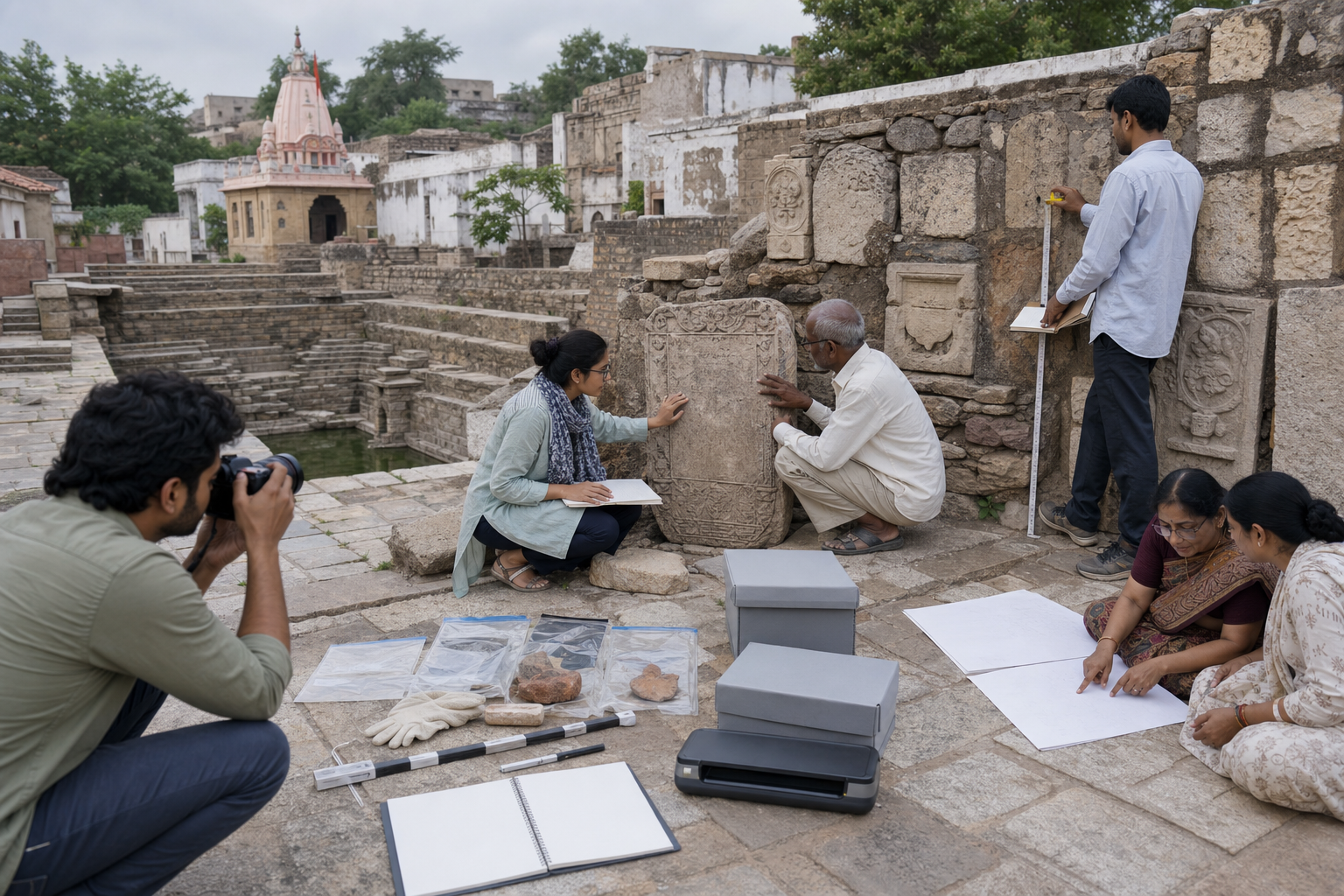
The most useful response to a distorted grand narrative is not another grand narrative. It is a body of well-documented local work that can be checked, corrected, and joined to other regional histories.
Choose one temple, vihara, tirtha, gurdwara, sacred route, or episode of resistance and build a dossier around one narrow proposition. “This site’s material changed under a named regime” is investigable. “Every ruler of an entire era behaved identically” is too broad to test and almost certain to conceal exceptions.
- Write the claim before collecting support. A precise claim prevents you from gathering only material that confirms a conclusion you have not defined.
- Separate evidence by type. Keep chronicles, inscriptions, archaeological or architectural traces, and later retellings in distinct groups. Agreement among different kinds of evidence is more informative than repetition within one kind.
- Add the regional-language record. Local terminology and oral traditions may preserve names, routes, injuries, and associations omitted from elite narratives. Record them faithfully while retaining their status as oral or community memory unless corroborated.
- Track provenance. For every assertion, note where it came from, when it entered the record, and whether you have seen the primary material or only a later description of it.
- Assign a confidence label. Use established, corroborated, plausible, remembered, contested, or unsupported. These labels make disagreement more productive because readers can see where the real evidentiary gap lies.
- Look for continuity and resistance. Don’t end the inquiry at destruction. Record rebuilding, relocation, renewed pilgrimage, preservation of ritual, community defence, and later restoration where the evidence supports them.
- Run an ethical precision check. Replace collective accusations with named actors and actions. Remove any sentence that asks a present community to inherit guilt from a past regime.
- Publish the uncertainty with the conclusion. State what would strengthen, weaken, or overturn your finding. That invitation allows future discoveries to improve the record rather than threaten an identity claim.
This method gives oral memory the respect of documentation without falsely converting it into material proof. It gives primary evidence priority without assuming that an archive is complete or neutral. It also makes revision possible. If an archaeological finding, inscription, or regional account changes the balance, the conclusion should change with it.
The standard matters especially when historical writing is used to support Dharmic unity. Hindu, Buddhist, Jain, and Sikh histories should not be absorbed into a featureless story. Recover each community’s institutions, sacrifices, sacred sites, and vocabulary on its own terms, then show the relationships that the evidence actually supports. Solidarity built through accurate recognition will endure disagreement better than solidarity built through appropriation.
Begin with one place you can study closely and one claim you can state precisely. If the claim survives scrutiny, you will have strengthened the civilizational record. If it weakens, Dharma loses nothing by refusing false certainty. The next generation needs a history it can inherit with confidence because it was written carefully enough to be questioned.
References
