
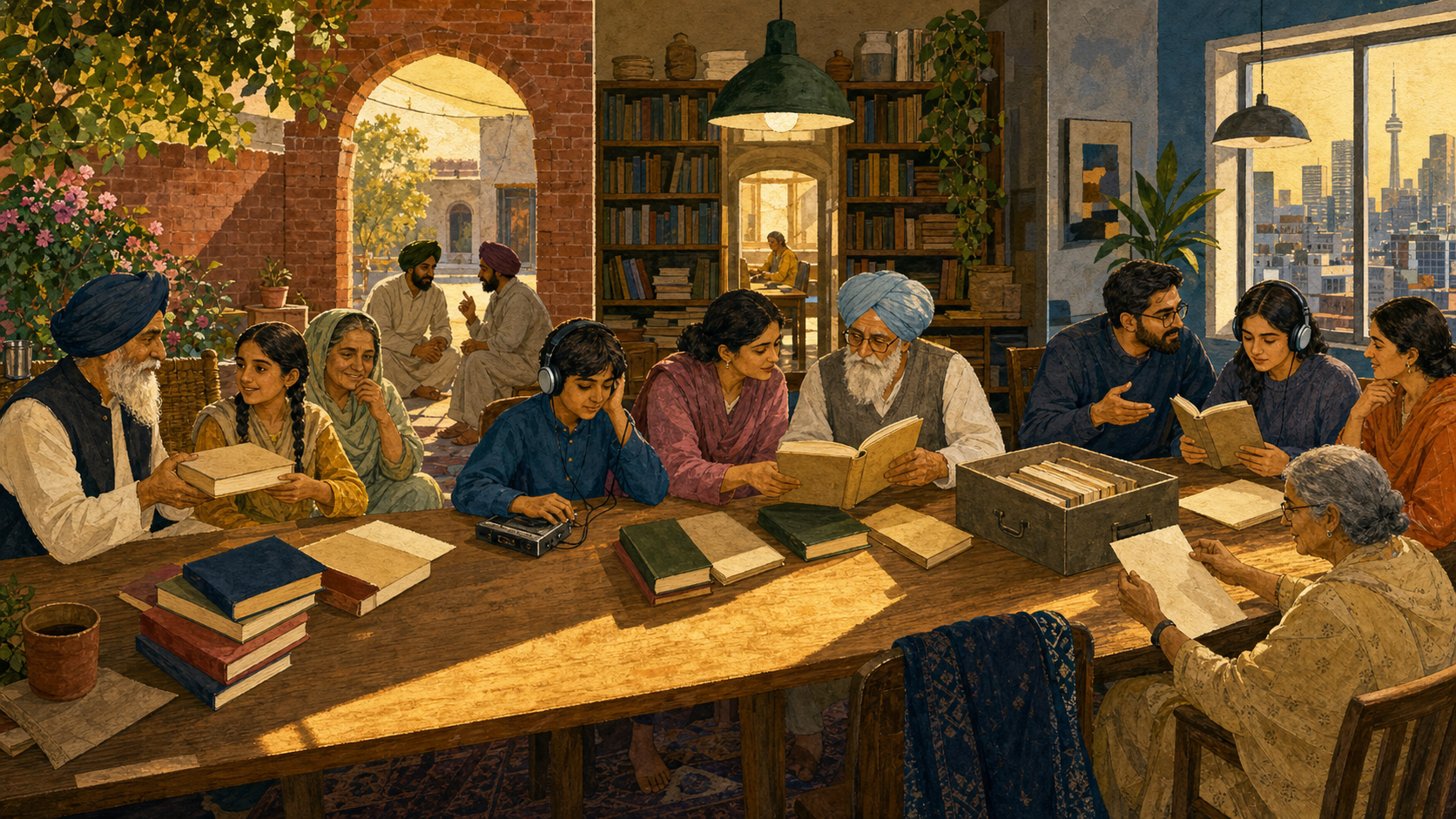
You may have inherited Punjabi first as sound: a grandparent’s cadence, a line of shabad, a family expression that loses something when translated. Yet sound alone can become fragile when later generations cannot read the script, recognize the form, or understand why a familiar verse matters.
If you want your family, reading group, classroom, or community library to carry Punjabi literature forward, don’t begin by searching for one book that represents everything. Build a chain between text, voice, context, and conversation. That chain can accommodate fluent readers, hesitant speakers, and people entering Punjabi culture through English.
Stop treating transmission as only a language problem
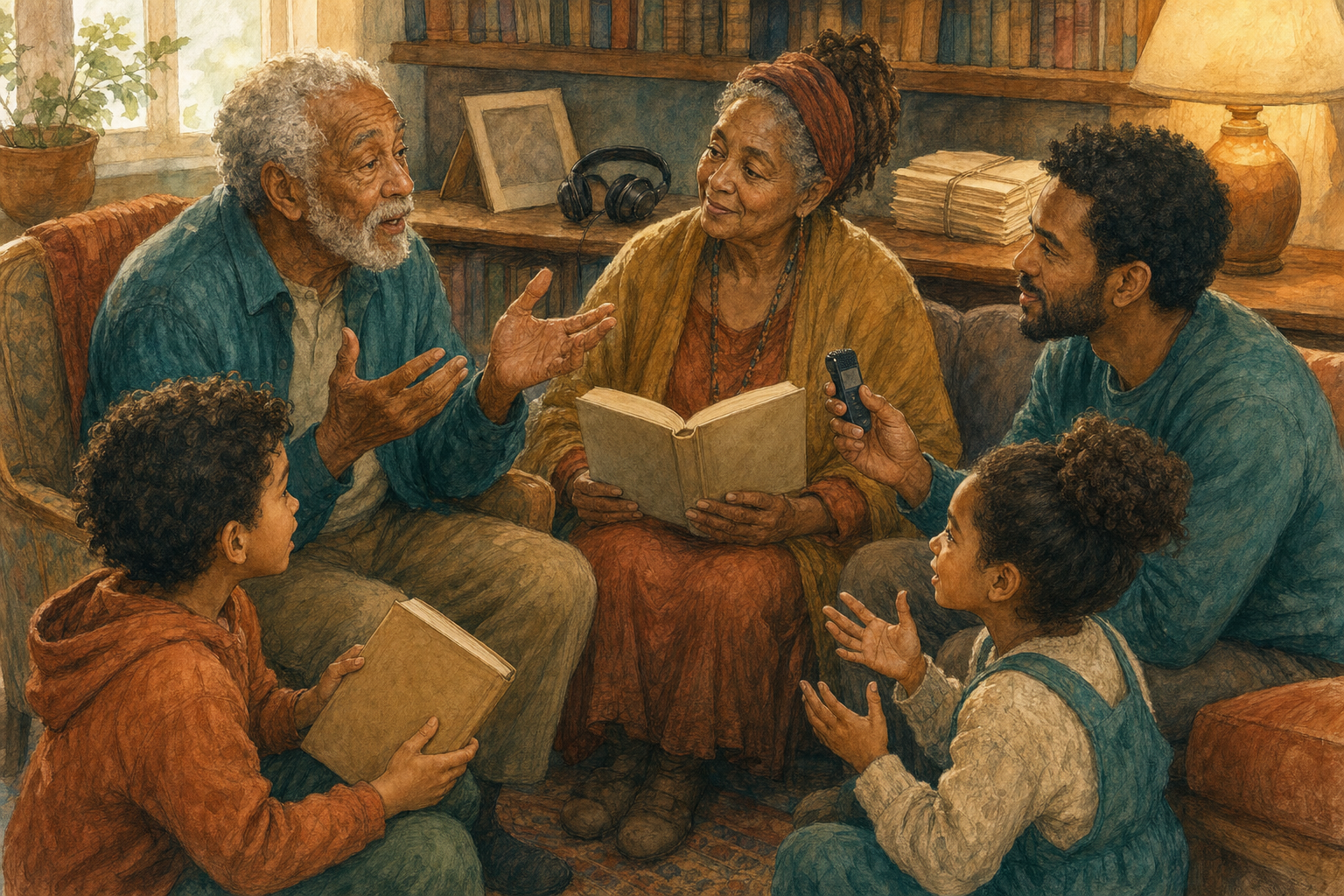
Loss of vocabulary is visible, so it receives most of the attention. The deeper break may be elsewhere. Someone can understand conversational Punjabi but have no way into a qissa. Another person can sound out Gurmukhi while missing the idiom. A third may know a poem through English but never have heard its rhythm performed.
Treat Punjabi literary culture as an ecosystem with several connected parts:
- The work itself: shabad, qissa, var, katha, lyric poetry, drama, or contemporary spoken word.
- The written form: Gurmukhi, Shahmukhi, transliteration, or translation.
- The sounded form: recitation, kirtan, storytelling, theatre, or musical interpretation.
- The interpretive setting: the history, spiritual vocabulary, metaphor, and social relationships that make a passage intelligible.
- The community response: discussion, memorization, performance, adaptation, and disagreement.
Before choosing a programme, diagnose which connection is missing. Can participants read but not interpret? Can they understand but not read? Do they encounter Punjabi only in devotional settings, or only as entertainment? Is English helping them enter the tradition, or silently replacing every route back to Punjabi?
Choose the weakest connection as your starting point. If script is the obstacle, pair the original with transliteration and audio. If context is the obstacle, add a short note rather than a long lecture. If literature feels remote, begin with performance and place the text in participants’ hands afterwards. The aim is not to solve every problem at once. It is to ensure that each encounter opens a path to the next one.
Read Punjab’s plural inheritance without blurring its differences
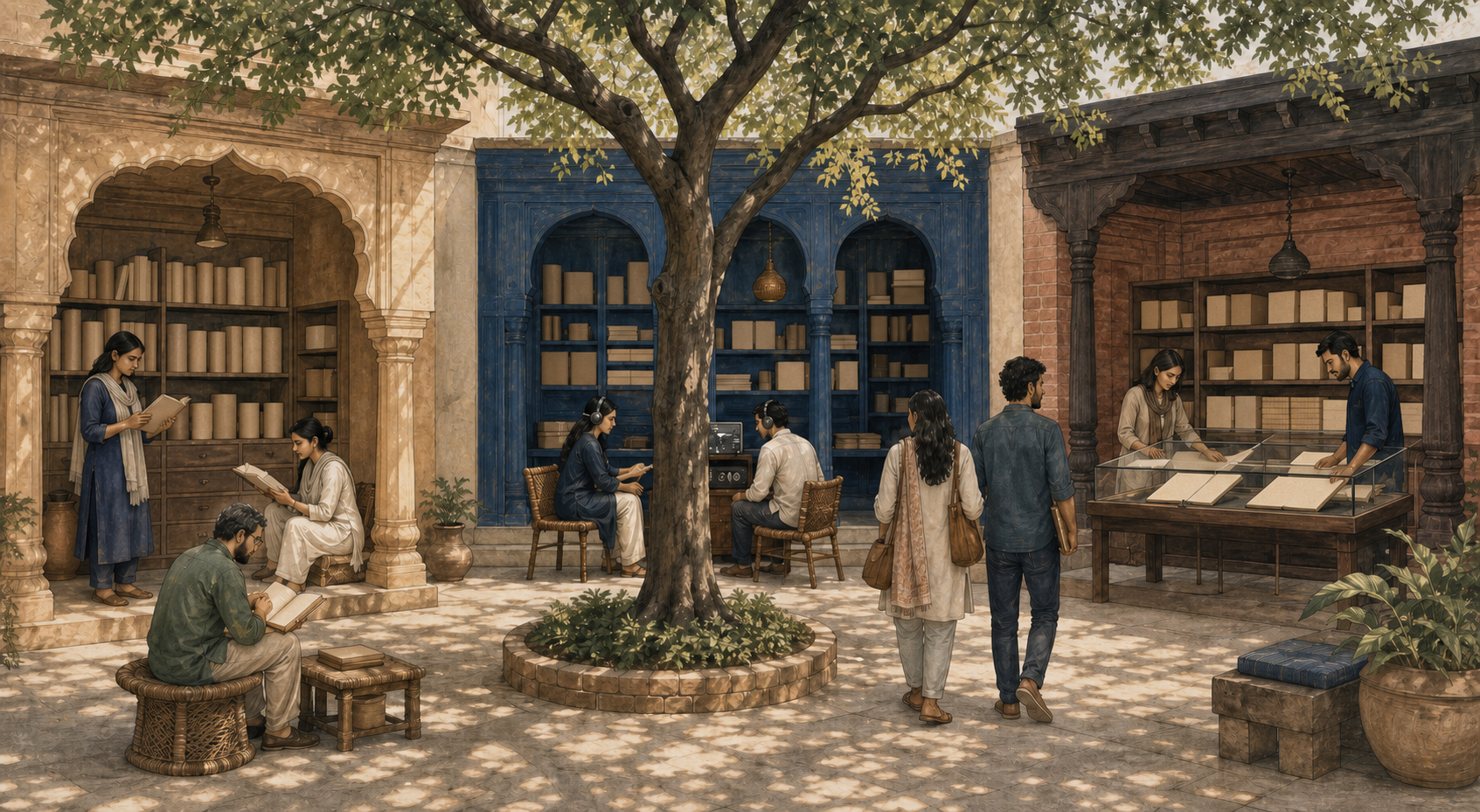
Punjabi literature cannot be handled honestly as the possession of a single community. The Guru Granth Sahib preserves poetry associated with diverse bhaktas and Sufi mystics, while Bulleh Shah and Waris Shah stand within a wider literary current that crosses hard communal boundaries. This plurality is not a decorative message added after reading. It shapes what you must notice in the work.
Plurality also does not mean that every tradition is interchangeable. A Sikh shabad, a Sufi composition, and a narrative qissa may meet around shared moral or poetic concerns without having the same theology, authority, or ritual place. Good reading holds relationship and distinction together.
Use these questions when reading across traditions:
- Who is speaking, and to whom? Distinguish the poetic voice from the historical person associated with the work.
- What kind of work is this? A devotional composition, narrative performance, and spoken-word adaptation invite different expectations.
- Which words carry spiritual or ethical weight? Terms such as seva, karuna, ahimsa, and maitri may create points of contact among Dharmic traditions, but their place within each lineage still deserves attention.
- What becomes clearer when the work is heard? Refrain, cadence, address, and emotional movement may be less visible on a silent page.
- Where does comparison illuminate the work, and where does it erase a real difference? Record both answers.
This method avoids two common failures. Sectarian sorting refuses to see any shared inheritance; vague universalism sees nothing but similarity. The more useful position is dialogic: name the tradition from which a work speaks, listen for its relationships with neighbouring traditions, and resist rewriting either into the other.
That is what unity in diversity should mean in literary practice. Unity is the willingness to read, translate, and converse across boundaries. Diversity is the discipline of preserving names, forms, claims, and disagreements accurately.
Make translation carry poetry, not just information

A translation can communicate the subject of a poem and still lose the poem. Punjabi literature often travels through voice, rhythm, refrain, idiom, and culturally charged images. If English retains only the dictionary meaning, a new reader receives an explanation where the original audience received an experience.
Build a translation bundle rather than asking one version to do every job:
- Original script: preserve the wording and lineation of the Punjabi text you are using.
- Transliteration: give learners a way to attempt the sound without pretending that Roman letters reproduce every feature perfectly.
- Close translation: show the sense of each line with as little interpretive decoration as possible.
- Performable translation: where appropriate, offer a version shaped for recitation, rhythm, or refrain, and label it as an adaptation.
- Context note: explain the image, idiom, form, or spiritual term that cannot travel cleanly inside the translated line.
- Audio or live reading: let participants hear where the voice pauses, gathers force, or returns to a repeated phrase.
Keep the close translation and performable version separate. Otherwise, a reader cannot tell whether a striking phrase belongs to the Punjabi work or to the translator’s craft. Mark uncertainty openly when a word permits more than one reading. A visible ambiguity teaches more than false precision.
English should function as a relay language, not the automatic final destination. Where capacity exists, place Gurmukhi and Shahmukhi versions in conversation. Bidirectional work matters because a translation ecosystem dominated by English can connect Punjabi writing to a global audience while leaving Punjabi readers on opposite sides of a script boundary unable to reach one another directly.
If your group cannot prepare every layer, don’t abandon the method. State what you have. An original with audio and a rough working translation is more honest than an elegant English version presented as complete. The essential habit is to show the reader where interpretation has occurred.
Turn the reading circle into a living archive
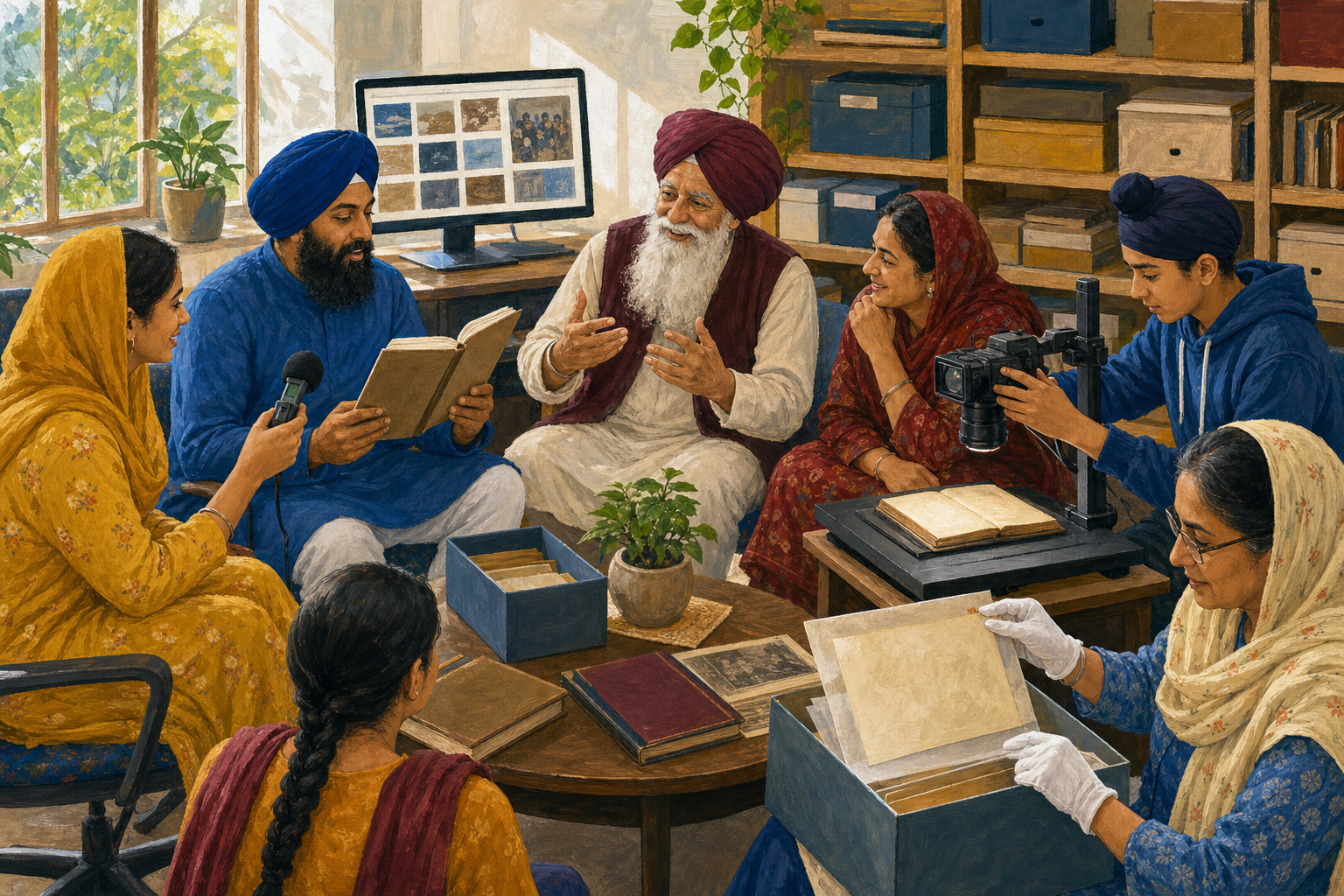
Kirtan, qissa recitation, and poetry gatherings in places such as Amritsar, London, Toronto, and California demonstrate the range through which Punjabi letters circulate. You do not need to imitate the scale of a festival. You need to reproduce the cultural movement that makes such gatherings work: a text passes into a voice, the voice prompts interpretation, and interpretation produces another act of reading or creation.
A useful gathering can follow this sequence:
- Circulate a manageable selection in every script and translation your group can responsibly provide.
- Begin with the Punjabi aloud. Let different readers attempt it so that polished fluency does not become the price of admission.
- Identify the form and immediate context. Give participants enough orientation to read attentively, not so much that explanation replaces encounter.
- Compare wording across scripts or translations. Ask what was preserved, what was changed, and what cannot be carried without a note or performance.
- Discuss one precise image, refrain, ethical question, or shift in voice. A focused conversation gives newcomers a firmer entry than a general invitation to share impressions.
- End with a response: another recitation, a short reflection, a new translation attempt, a musical interpretation, or a question for the next gathering.
Give younger participants consequential roles. They can introduce the work, prepare transliteration, record a family recitation with permission, compare translations, edit audio, or interview an elder about an idiom. Symbolic inclusion leaves them as an audience. Responsibility makes them participants in cultural transmission.
Archive what the community actually uses, not only what looks prestigious on a shelf. Keep the original text, script information, translation, translator or contributor name, performance recording, place, language, contextual note, and any corrections made later. Retain a clean master copy and label adaptations clearly. Searchable text makes later comparison easier, while scans or images preserve evidence of the copy from which the text came.
Oral material needs the same care as written material. Record who performed it, how they describe the work, and whether the recording may remain private, circulate within the group, or be published. Do not treat family memory as ownerless content simply because recording it is easy. Permission is part of preservation because trust determines whether people will keep sharing.
The archive should feed the gathering, and the gathering should improve the archive. A difficult idiom can prompt a better note. A recitation can expose a weak transliteration. A young performer’s adaptation can reveal which emotional movement survived translation. This is how scholarship and creative practice strengthen each other instead of occupying separate institutions.
Key takeaways
- Diagnose whether your real obstacle is script, vocabulary, context, performance, or access before choosing a text or programme.
- Present Punjabi literature as a plural inheritance, while naming the distinct tradition, genre, and authority of each work.
- Pair original text with the strongest available combination of transliteration, close translation, context, and voice.
- Label translation choices and adaptations so that accessibility does not come at the cost of accuracy.
- Give diaspora youth responsibility for producing, interpreting, and preserving culture, not merely attending cultural events.
- Archive readings, corrections, permissions, and performance context so that future users inherit more than isolated files.
Start with one work that someone in your community already cares about. Prepare the clearest text-and-voice bundle you can, gather people around one focused question, and preserve what the encounter teaches you. When that practice becomes repeatable, Punjabi literature no longer travels as a relic of somewhere else. It becomes part of what your community knows how to do where it is.
References
