
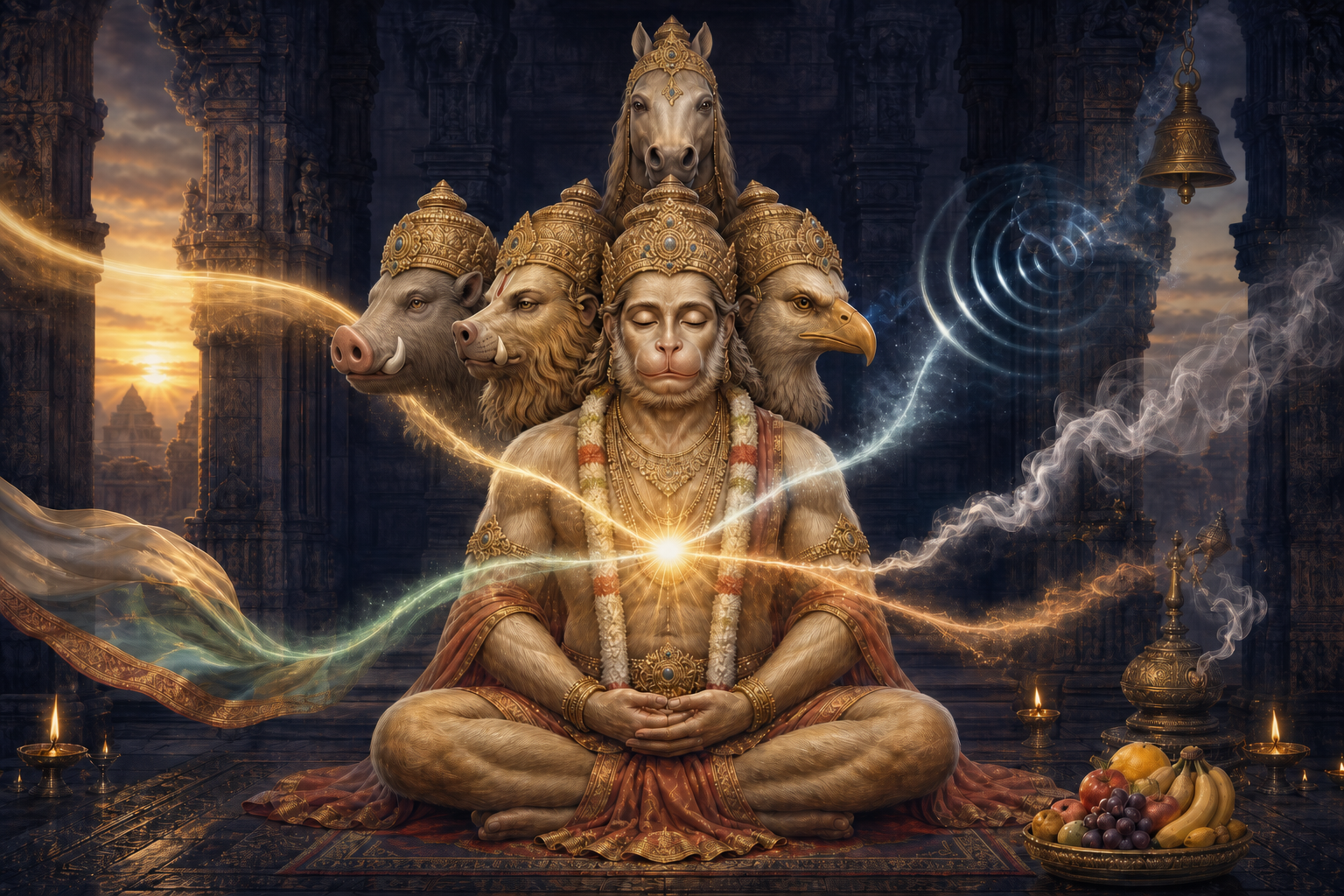
You sit down to complete one task, but a notification pulls your eyes away. A passing remark occupies your ears long after it was spoken. The sight or smell of food becomes an instruction to eat. By the time you notice what happened, attention has already become impulse and impulse has already chosen the next action.
Panchmukhi Hanuman gives you a Dharmic way to interrupt that sequence. The aim is not to stop seeing, hearing, smelling, tasting, or touching. It is to keep sensory contact from becoming an unquestioned command. The five-faced form can serve as an inner council through which devotion, courage, discernment, stability, and knowledge govern what you do with what you perceive.
Sense mastery changes your response, not the existence of sensation

Sense contact is not a spiritual failure. Your eyes register a form, your ears receive a sound, and your tongue encounters a taste. The difficulty begins when awareness becomes so entangled with attraction or aversion that you no longer experience a meaningful space between perception and action.
This is why restraint should not be confused with suppression. Suppression treats the stimulus, the body, or the desire itself as an enemy and tries to force it out of consciousness. Restraint allows you to notice what has appeared, understand its pull, and decide whether following it would serve dharma. The senses remain functional, but they no longer occupy the throne.
Pratyahara is the conscious recollection of attention from its outward scattering. It prepares the mind for dharana, dhyana, and clearer insight. In daily life, this inward turn can begin before formal meditation: you notice that a sight has produced craving, a sound has produced anger, or a touch has produced restlessness, and you decline to act until the mind is steady enough to choose.
You can test where training is needed with a few direct questions. Can you encounter something pleasant without immediately extending the encounter? Can you hear something disagreeable without rehearsing a retaliation? Can you stop consuming an input once its legitimate purpose is complete? Can you distinguish bodily need from habit, boredom, or agitation? A difficult answer is not a reason for shame. It identifies the sense door at which practice should begin.
When a pull first becomes visible, name it precisely. Instead of saying, “I have no discipline,” say, “Sight is asking me to keep scrolling,” or, “Sound has triggered an urge to answer harshly.” Precise language separates the perceiving faculty from the command you have attached to it. That separation is the first usable form of freedom.
Use the five faces as an inner council
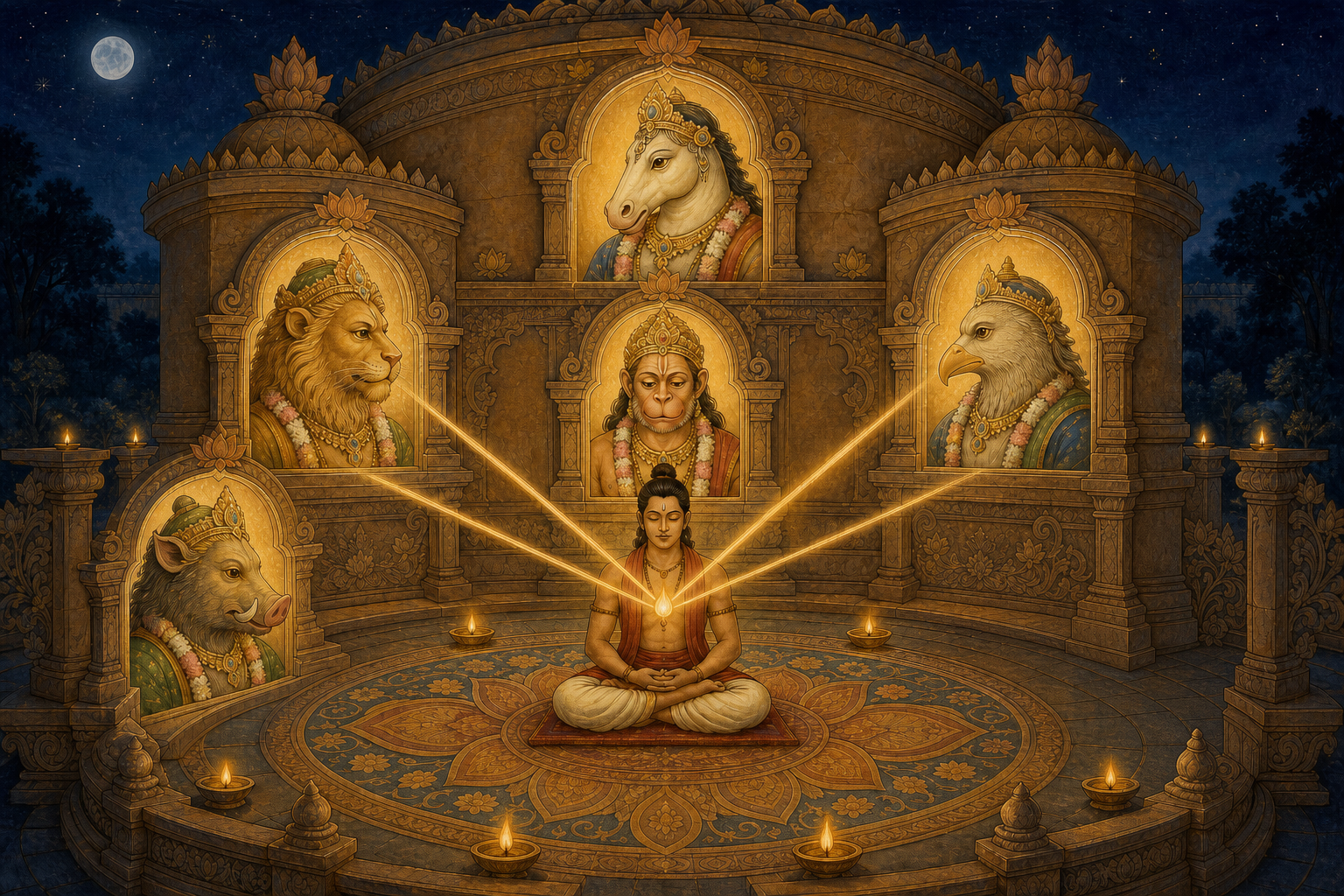
The traditional configuration places Hanuman toward the east, Narasimha toward the south, Garuda toward the west, Varaha toward the north, and Hayagriva upward. Their combined qualities provide more than an image to admire. They offer a sequence of questions for governing attention.
| Face and direction | Governing quality | Question to ask when a sense pulls you |
|---|---|---|
| Hanuman, east | Unwavering service | Which duty deserves my attention now? |
| Narasimha, south | Protective strength | What boundary will prevent this impulse from ruling me? |
| Garuda, west | Vigilant discernment | Is this input true, useful, and worthy of further attention? |
| Varaha, north | Restorative stability | What will return me to firm ground before I act? |
| Hayagriva, upward | Luminous knowledge | What understanding should guide my response? |
The symbolism does not require you to force each face into an exclusive equation with one sense. Sight rarely operates alone. A phone notification combines sound, sight, and touch. Appetite can recruit sight, smell, and taste before the body has made any clear demand. Apply all five governing questions to whichever sense door is active.
Suppose the sight of another serving produces an immediate urge. Hanuman asks whether eating it supports the duty of caring for the body or merely prolongs pleasure. Narasimha supplies the strength to establish a boundary. Garuda distinguishes hunger from habit. Varaha brings you back to steadiness instead of bargaining with the craving. Hayagriva asks what you already know but are tempted to ignore.
The same council works when a hostile remark about dharma appears on a screen. Mastery does not require passivity. Narasimha protects what must be protected, while Garuda checks whether the claim is true and whether engagement will clarify anything. Varaha prevents agitation from composing the response. Hayagriva calls for informed language. Hanuman asks which action actually serves dharma rather than merely satisfying wounded pride.
This balance matters. Strength without discernment becomes aggression. Knowledge without service becomes vanity. Stability without courage becomes avoidance. Devotion without boundaries becomes sentiment. Panchmukhi Hanuman holds these capacities together so that no single reaction can pretend to be the whole of virtue.
Practise the sequence: observe, regulate, redirect

Sense mastery becomes practical when you use the same sequence at the moment of contact. It can be applied during formal sadhana, at work, over a meal, in a family disagreement, or while using a screen.
- Observe the first movement. Identify the active sense and whether it is producing attraction or aversion. Use a simple description such as “sound and anger,” “sight and craving,” or “touch and restlessness.” Do this before building a story about why the feeling is justified.
- Regulate the conditions. Steady your posture and let the breath become even. A gentle lengthening of the exhale and an attentive, unforced pause can reduce reactivity. Add an outer boundary when needed: turn the screen over, put the food aside, leave the stream of argumentative messages, or postpone speech until it can be deliberate. A boundary is not punishment; it protects the interval in which choice becomes possible.
- Redirect the released energy. Choose a named Dharmic action rather than leaving an empty prohibition. Return to the duty you interrupted, study something that corrects confusion, perform seva, remain silent instead of retaliating, or replace careless speech with truthful and compassionate words. Redirection prevents restraint from becoming a sterile contest of willpower.
Breath supports the sequence, but breath is not the goal. Do not turn pranayama into a struggle for dramatic control. The useful breath is the one that helps you see the impulse without immediately serving it. If deliberate regulation becomes uncomfortable, return to natural breathing and continue with observation and an appropriate outer boundary.
Mantra can stabilise the same interval. Use a Hanuman mantra received or practised within your own tradition, recite it with sincerity, and connect it to the ethical decision in front of you. Repetition that merely delays an unchanged reaction has not yet completed its work. Let remembrance alter the next word, click, mouthful, or gesture.
Practise with a recurring situation rather than a vague ambition to “control the senses.” If notifications repeatedly break your concentration, that moment becomes the field of sadhana. Observe the sound and the urge to check. Regulate by creating a boundary around the device. Redirect attention to the duty already chosen. Invoke the five faces through their questions. Repetition turns an inspiring symbol into a dependable response.
Make worship visible in conduct
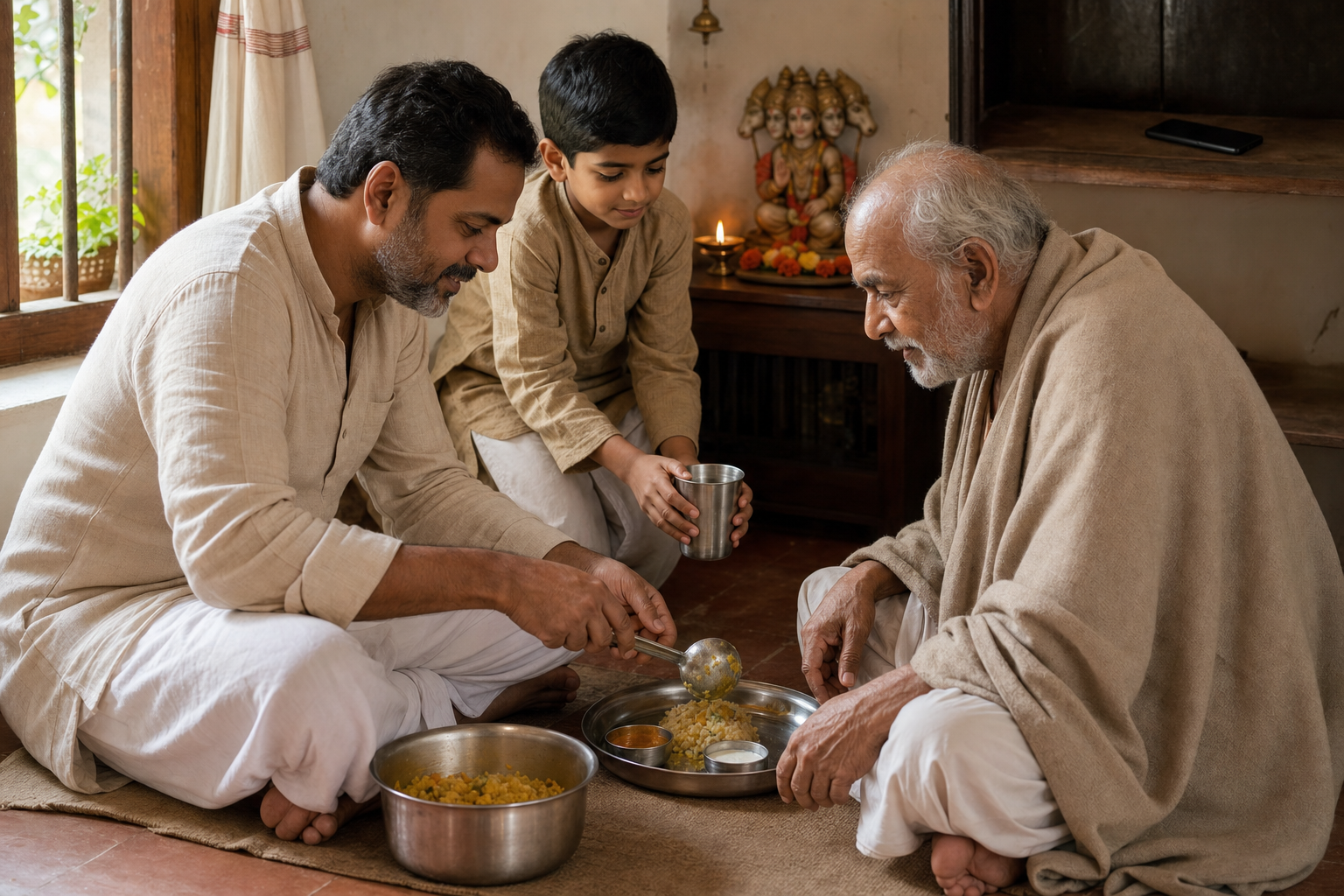
Darshana, simple home worship, and temple observance can deepen this training when you bring an actual struggle into the devotional act. Before worship, recall a specific moment in which a sense carried attention away. As you contemplate the five faces, move through their governing questions. After worship, form a concrete sankalpa tied to the next occurrence: “When this input appears, I will pause, establish this boundary, and return to this duty.”
Bhakti protects sense discipline from becoming a private project of domination. Hanuman’s orientation is seva, not self-display. Humility admits that an impulse has influence without declaring defeat before it. Fearlessness allows you to establish a boundary without hatred. Devotion aligns personal will with a moral centre larger than convenience, appetite, or reputation.
The fruit should therefore be visible outside the shrine. Ask whether your speech is becoming more truthful and compassionate, whether other people can rely on your commitments, whether you can protect a boundary without contempt, and whether you can serve when your mood would prefer distraction. These are harder tests than appearing calm during worship, but they reveal whether the senses are actually learning to serve dharma.
Correct the mistakes that hollow out the practice
- Do not mistake numbness for mastery. The aim is clear perception without compulsion, not an inability to feel beauty, pleasure, grief, or warning.
- Do not confuse protective power with uncontrolled anger. Narasimha represents the strength to defend a boundary; Garuda and Hayagriva still require discernment and knowledge to guide the response.
- Do not use mantra as permission to repeat the same conduct. If remembrance never changes speech or action, connect the devotional practice to a more precise sankalpa.
- Do not make private purity a substitute for seva. Energy withdrawn from distraction should become available for duty, study, care, and constructive action.
- Do not turn restraint into pride. Contempt for people who struggle with different impulses is another form of captivity, now wearing spiritual language.
A useful discipline should make you more capable of responsible action, not merely more preoccupied with your own internal condition. Panchmukhi Hanuman joins inward governance to outward service. That union is what keeps sense restraint within dharma.
Key takeaways: distinct Dharmic paths share a practical concern
- Panchmukhi Hanuman provides an integrated model of service, protective strength, discernment, stability, and knowledge.
- Sense mastery means educating perception and response. It does not mean hating the body or eliminating ordinary sensation.
- Pratyahara begins when you notice sensory attraction or aversion and recollect attention before acting.
- The five faces are most useful as a complete governing council applied to every sense door, not as a forced set of exclusive pairings.
- The working sequence is observe, regulate, and redirect: name the pull, establish steadiness and a boundary, then choose a specific Dharmic action.
- Bhakti completes the practice when mantra and darshana produce humility, ethical speech, reliability, fearlessness, and seva.
This concern for disciplined perception also appears across other Dharmic traditions, though their doctrines and practices should not be flattened into one system. Buddhist indriya-samvara guards the sense faculties; Jain gupti and samiti govern mind, speech, and body; and Sikh teachings confront kama, krodha, lobha, moha, and ahankara through simran and righteous conduct. Their distinct vocabularies converge on a practical civilisational insight: freedom requires attention at the point where perception is becoming intention.
Choose one recurring sensory moment as your field of practice. At its next appearance, name the sense door, steady the breath, bring the impulse before the five governing qualities, and perform the next clear duty. Return to that same field until the pause becomes dependable. This is how Panchmukhi darshana moves from an image before your eyes to an intelligence guiding them.
References
