
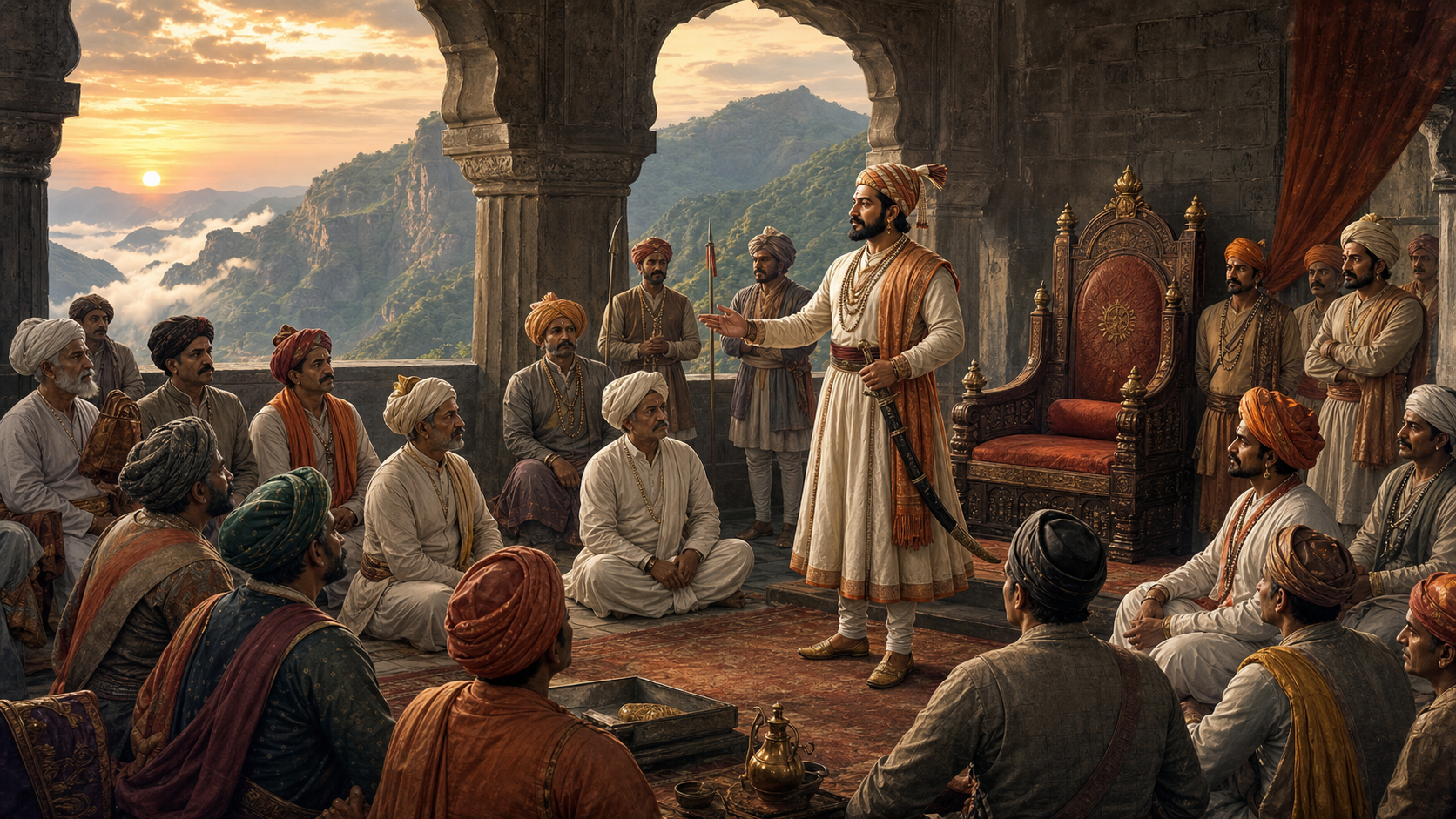
You may admire Chhatrapati Shivaji yet still struggle to explain what made his politics Dharmic. Military success is the wrong place to stop. Conquest can prove capacity; it cannot prove justice.
When a leader or movement invokes Dharma, you need a harder test: What does its power protect? Which methods will it refuse? How does it treat people once it has the advantage? Shivaji’s model helps you judge the conduct of power rather than the sanctity of its slogans.
Start with the good that power is meant to protect

A Dharmic state is not defined merely by the religious identity of its ruler. Its first measure is the purpose for which authority is exercised. In Shivaji’s model, public strength serves the protection of vulnerable people, the dignity of women, sacred places, civilian life, liberty, and plural worship. Power is justified by the order it safeguards, not by the prestige it gives the powerful.
This immediately separates Dharmic statecraft from religious domination. A ruler can display sacred symbols and still act adharmically. Conversely, defending society against oppression does not become illegitimate merely because firmness is required. The decisive question is whether force is directed against harmful conduct or against an entire community by birth or belief.
- Distinguish an aggressor from a population. Responsibility belongs to people and institutions committing or enabling the wrong. It does not automatically pass to everyone who shares an identity with them.
- Distinguish justice from revenge. Justice stops the injury and restores a defensible order. Revenge keeps inflicting pain after the protective purpose has been achieved.
- Distinguish civilizational confidence from collective humiliation. A secure civilization can defend its institutions without needing innocent people to feel degraded.
You can apply these distinctions to any contemporary claim of Dharmic politics. Ask who is being protected, what specific wrong is being stopped, who is held responsible, and what happens to people who are not responsible. If the answers remain vague while hostility toward a whole group becomes explicit, Dharma is being used as a badge rather than a discipline.
Join shakti, yukti, and viveka in the same decision
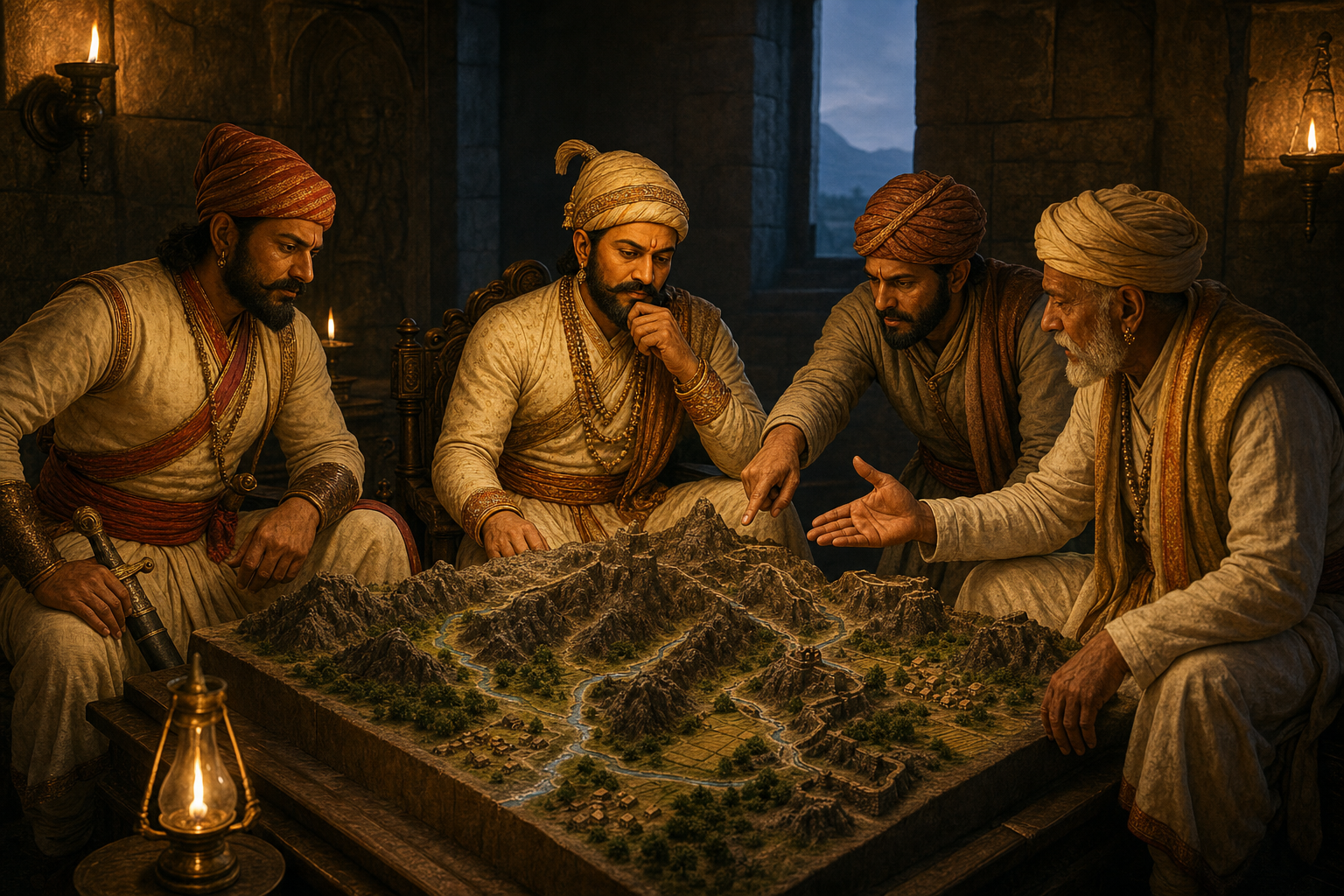
Shivaji’s strategic importance lies in the union of three faculties that political movements often separate. Shakti is the capacity to act. Yukti is the intelligence to choose an effective method. Viveka is the discernment to decide whether the aim and method remain within Dharma.
Each faculty corrects a different failure. Moral intention without shakti leaves people exposed. Shakti without yukti wastes lives and resources in displays of courage that do not improve the position. Shakti and yukti without viveka can produce efficient injustice.
Facing the Mughal Empire under Aurangzeb, Shivaji combined military innovation, strategy, diplomacy, and calibrated force strongly enough to make a formidable imperial system adjust to him. The lesson is not that cleverness licenses every tactic. It is that courage becomes politically useful only when intelligence directs it, while moral judgment sets its boundaries.
This corrects a common misunderstanding of Kshatra Dharma. Valor is indispensable, but heroic sacrifice is not automatically sound statecraft. A leader is responsible not only for personal bravery but also for whether a chosen action protects the realm, preserves future capacity, and serves a just end.
- Name the living threat. Identify the present act, actor, and injury. Do not substitute anger at a defeated past for analysis of the danger in front of you.
- Define the protected good. State whose life, freedom, dignity, institution, or sacred space requires protection.
- Choose a fitting instrument. Consider strategy, diplomacy, preparation, and proportionate force according to what the situation actually demands.
- Set moral limits before acting. Decide in advance what may not be done to civilians, women, worshippers, sacred places, or defeated opponents.
- Define the stopping point. Know what a successful restoration of order looks like so that protection does not drift into vengeance or permanent coercion.
This sequence is useful because pressure reverses ordinary political reasoning. People reach for a preferred instrument first and invent the justification afterward. Shivaji’s synthesis asks you to begin with the actual danger and the duty arising from it, then select the means.
Judge the ruler by the limits observed after victory
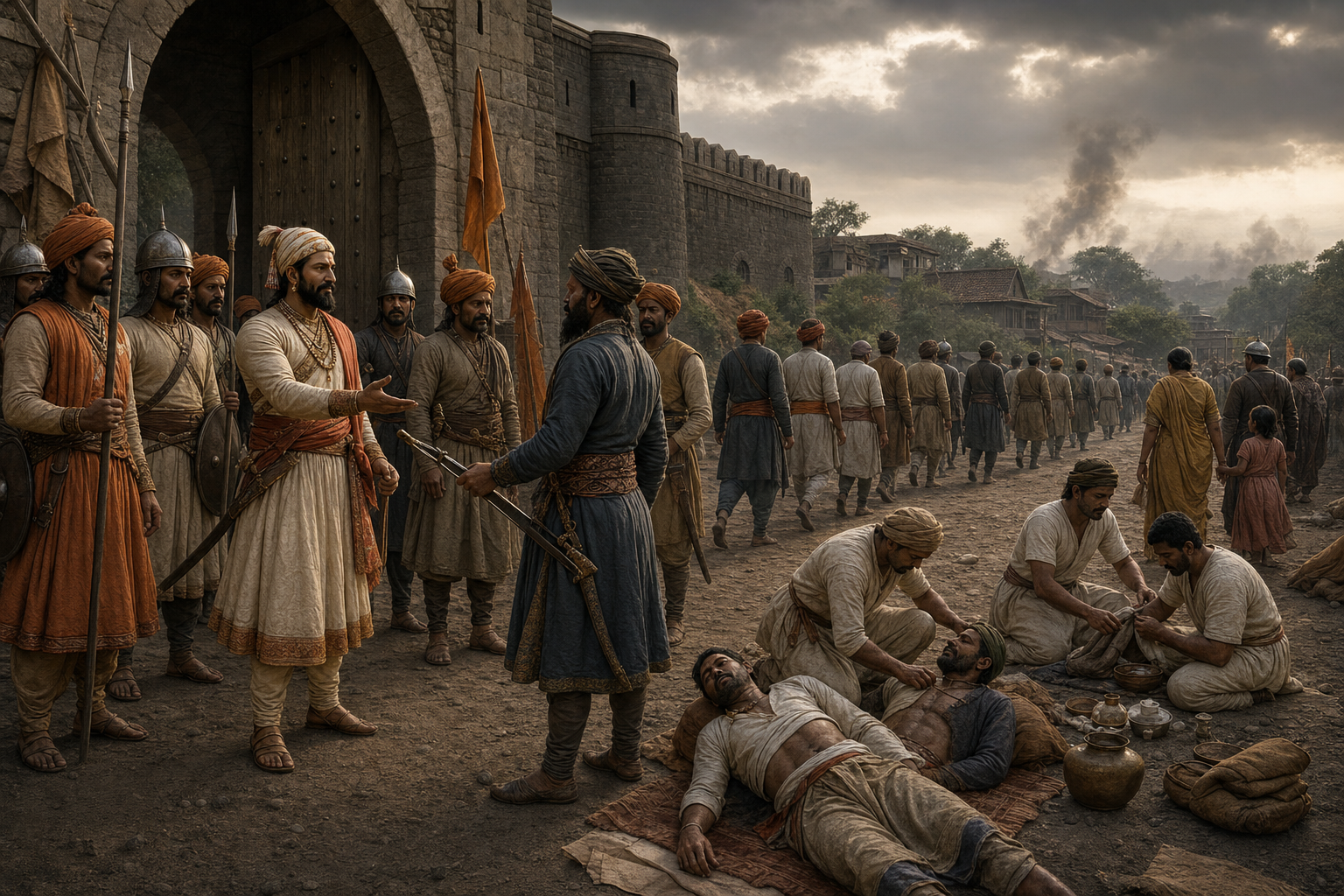
Most political ethics sounds convincing before conflict. The harder test arrives when one side has enough power to ignore restraint. Shivaji’s code placed civilians, women, places of worship, and religious preceptors outside the field of permissible abuse. It rejected cruelty and sacrilege even within the violence of early modern warfare.
These commitments should be read as operating limits, not ornaments attached to a heroic reputation. Civilians cannot be treated as substitutes for an enemy who is difficult to reach. Women cannot become trophies through which one side humiliates another. Sacred places cannot become convenient targets for anger. Victory cannot turn a defeated opponent into an object of limitless cruelty.
Restraint is not weakness in this model. It preserves the distinction between the order being defended and the injustice being resisted. Once that distinction disappears, the victor begins reproducing the very conduct that made resistance necessary.
A modern state cannot depend on the virtue of one exceptional ruler. If you want to carry this principle into contemporary public life, personal restraint must become institutional restraint: clear operational rules, protection for worship, safeguards against gendered violence, review of abuses, and consequences when one’s own side crosses a declared boundary. The historical example supplies the norm; present institutions must make it enforceable.
When assessing a government or political movement, do not stop at its declared values. Look for the mechanism that binds supporters when compliance becomes inconvenient. Who investigates an abuse? Is correction possible without being branded disloyal? Do protections apply to an unpopular civilian as reliably as to a loyal one? A limit that restrains only opponents is not a moral limit.
Protect pluralism without becoming passive before injustice
Pluralism is sometimes mistaken for an obligation to remain neutral between the oppressor and the oppressed. The opposite error treats resistance to a particular aggressor as permission to condemn everyone associated with that aggressor’s religion. Shivaji’s ethics separated tyrannical conduct from religious communities, allowing decisive resistance without making plural worship the enemy.
That distinction gives Dharmic statecraft both its firmness and its breadth. It can oppose violent extremism or totalitarian conduct without granting collective guilt. It can protect religious diversity without pretending that every ideology, institution, or political action is harmless. Tolerance concerns the dignity and freedom of people; it does not require intellectual surrender before coercion.
- Collective blame misidentifies the target. Isolate the actor, network, policy, or institution responsible for the injury.
- Passive neutrality abandons the victim. Name the injustice plainly and use legitimate authority to stop it.
- Revenge politics fights inherited enemies. Direct attention toward the active source of harm rather than keeping society mobilized against a defeated past.
- Unlimited methods corrupt the purpose. Scale the response to protection and restoration, not to the emotional intensity of public anger.
You can often detect the difference by examining political language. Does a speaker identify an actor, an action, the people harmed, and a defensible remedy? Or does the speaker rely on a religious or ethnic noun broad enough to include millions of uninvolved people? Precise language makes accountability possible. Indiscriminate language prepares the ground for indiscriminate power.
This moral grammar can be recognized across the wider Dharmic family. Hindu, Buddhist, Jain, and Sikh traditions are not interchangeable, and they need not be flattened into a single political theology. Yet compassion, dignity, disciplined courage, and space for plural worship provide shared grounds on which public power can be judged.
Make sadhana part of the discipline of leadership
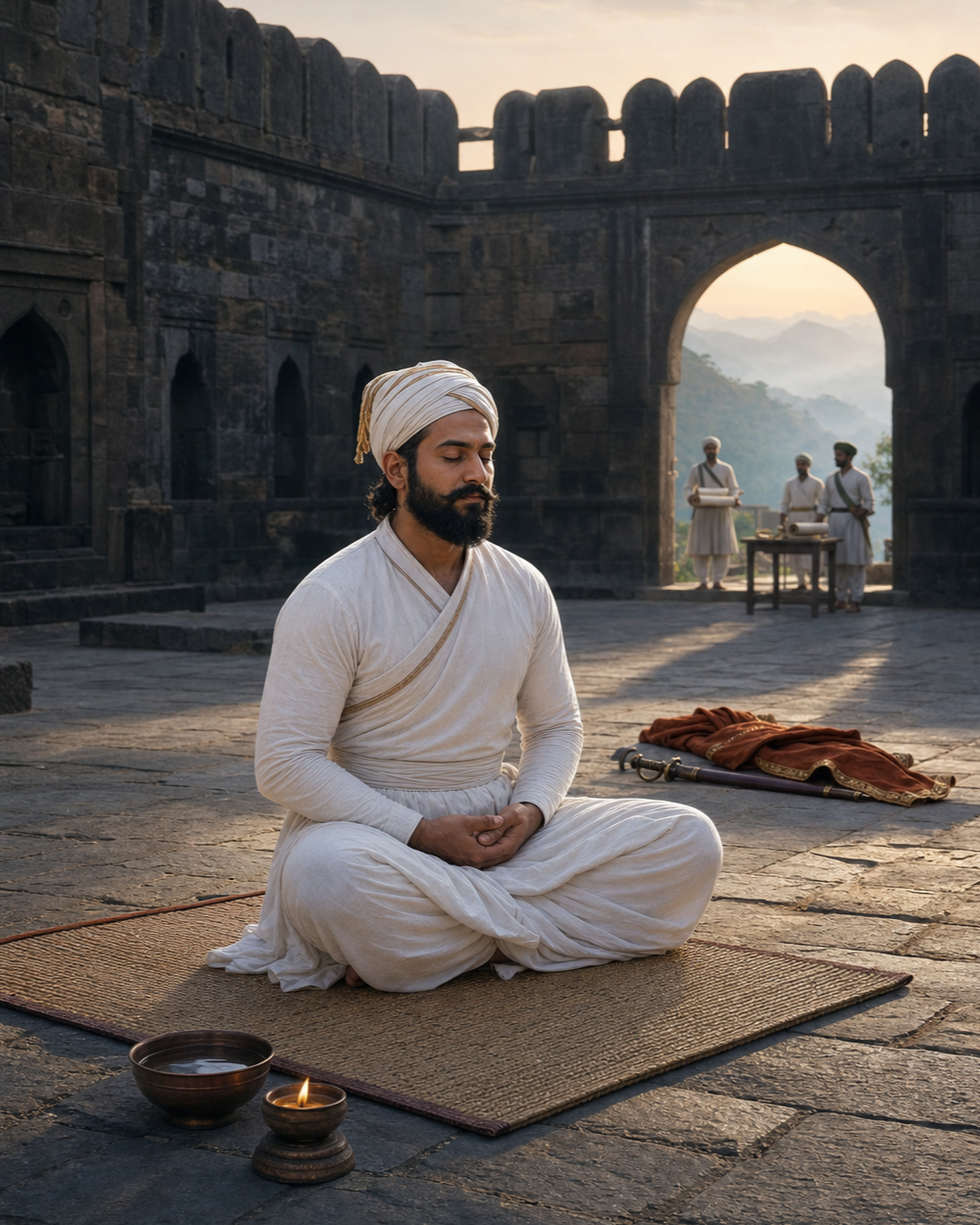
Strategy alone cannot explain why a capable ruler accepts moral limits when violating them appears convenient. Shivaji’s public conduct was grounded in a spiritual formation associated with Jijabai’s guidance, the saints of Maharashtra, devotion to Goddess Bhavani, Saint Tukaram, Samarth Ramdas, and contemplation of kala. The significance of this formation is not ceremonial. Sadhana governs the person who governs others.
Power magnifies ego because success can make personal desire look like public necessity. Inner renunciation interrupts that confusion. It does not require a ruler to abandon authority or action. It requires the ruler to treat authority as a duty rather than private possession, and victory as an occasion for vigilance rather than self-deification.
Modern institutions cannot manufacture spiritual depth, but leaders can build practices that expose ego before it becomes policy:
- Before a major decision, write down the public good being protected and the moral lines that may not be crossed.
- Keep at least one channel of counsel through which a trusted person can challenge the leader’s preferred interpretation without fear.
- After success, examine who bore the cost, whether declared limits were kept, and whether exceptional powers are still necessary.
- Measure public piety by the restraint and service it produces. If religious display grows while accountability shrinks, the display is not doing the ethical work of sadhana.
These practices translate the model’s inner logic into conditions that institutions can support. They do not replace character, but they make self-deception harder and give others a way to detect it.
Key takeaways
- A Dharmic state is identified by what its power protects, not merely by the ruler’s identity or symbolism.
- Shakti supplies capacity, yukti chooses an effective method, and viveka keeps both answerable to Dharma.
- Civilians, women, sacred places, and plural worship reveal whether restraint survives contact with victory.
- Oppose oppressive conduct precisely; do not turn an aggressor’s entire community into the enemy.
- Sadhana matters politically when it produces humility, limits on ego, and accountability in action.
Take one public proposal you currently support and audit it in five lines: the harm it stops, the people it protects, the method it uses, the boundary it will not cross, and the condition under which extraordinary action ends. If you cannot write those lines clearly, admiration has outrun judgment. Shivaji’s example asks you to make power answerable to Dharma before victory, not after the damage is done.
References
