
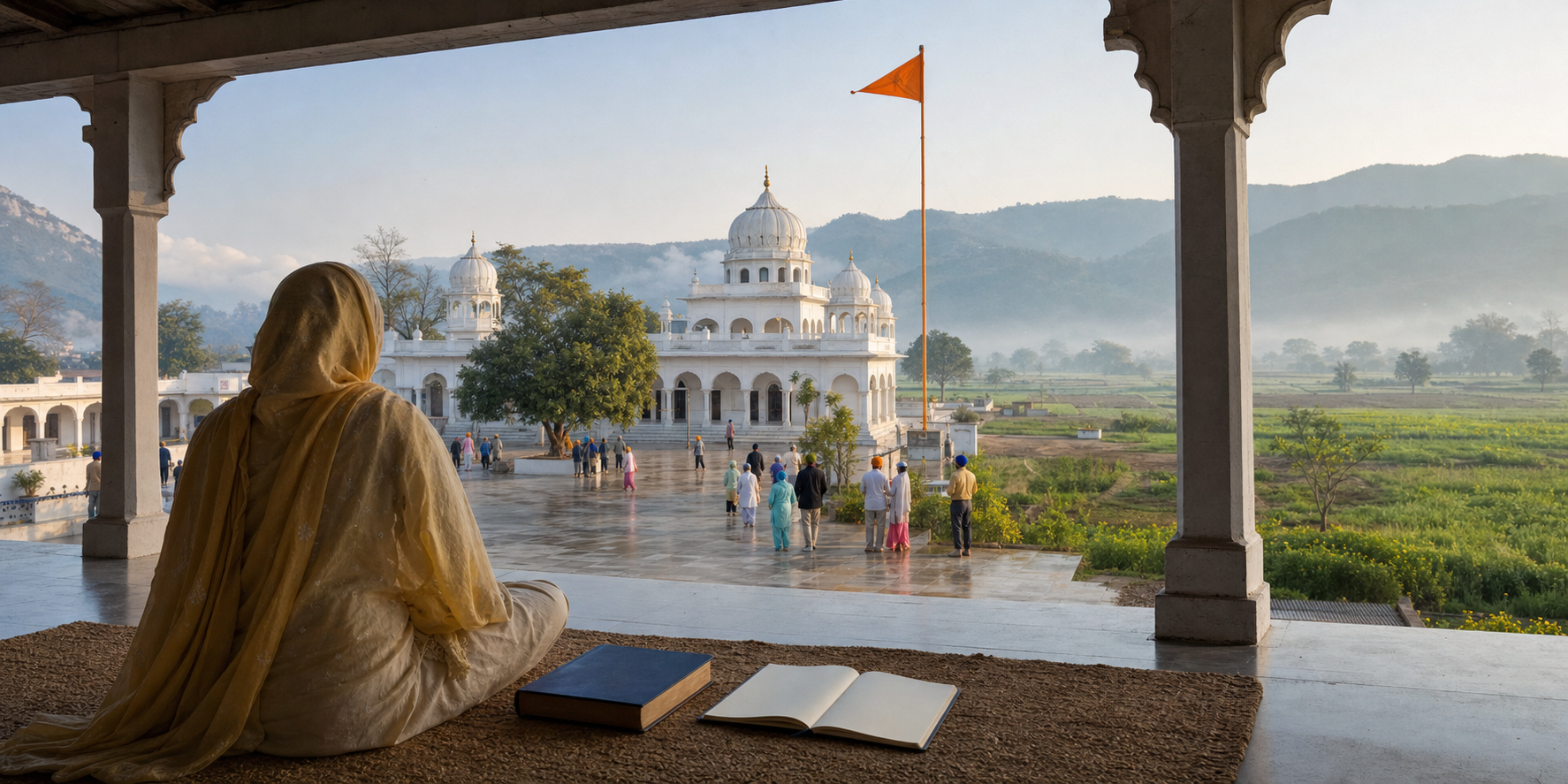
If you want to understand Sikh heritage in Punjab, do not begin by collecting disconnected dates, shrines, and famous names. Begin with the relationship among place, practice, and language. A sacred town becomes intelligible when you notice what the community built and practised there. A literary work comes alive when you ask what kind of person it is trying to form.
A strong starting route runs from Kiratpur Sahib to Anandpur Sahib and then into the writing of Bhai Vir Singh. That route lets you see how Sikh memory travels through institutions, sangat, kirtan, seva, historical continuity, and Punjabi literature rather than through monuments alone.
Key takeaways for reading Sikh heritage
- Read Kiratpur Sahib as a functioning seat of Sikh life, not merely as a collection of old shrines. Sangat, kirtan, communal deliberation, remembrance, and service explain why the place mattered.
- Follow the movement from Kiratpur Sahib to Anandpur Sahib as continuity and expansion. The institutions cultivated at Kiratpur help you understand what later became possible at Anandpur.
- Approach Bhai Vir Singh as more than a celebrated Punjabi writer. His treatment of Naam, seva, courage, restraint, and responsibility shows how literature can carry spiritual formation across generations.
- Recognise the ethical kinship among India’s dharmic traditions without erasing Sikh distinctiveness. Shared commitments such as compassion and disciplined conduct do not make every path interchangeable.
- When you visit, read, teach, or write about this heritage, connect every historical fact to a practice and every spiritual ideal to a demand on conduct.
Read Kiratpur and Anandpur as one connected landscape

Kiratpur Sahib gives you a practical lesson in how sacred geography is made. The town stands near the Sutlej at the Shivalik foothills, but its importance does not come from scenery alone. Founded in 1627 under the guidance of Guru Hargobind, it provided a setting in which spiritual discipline, community organisation, and temporal responsibility could develop together.
Use four layers when you study the town. First, locate it in the landscape: the river, foothills, and relative distance from imperial turbulence helped create room for community consolidation. Second, trace the Gurus associated with it. Third, identify what people did there. Fourth, ask which ethical habits those activities cultivated. This prevents sacred history from becoming a catalogue of buildings.
The lineage is essential. Guru Hargobind’s association places Kiratpur within the working expression of Miri-Piri, in which spiritual authority and responsibility in the temporal world are held together. Under Guru Har Rai, the town developed further as a spiritual and administrative centre. Traditions connected with his leadership emphasise compassion, conservation, disciplined learning, and concern for living beings. Guru Harkrishan’s birth and early years are also linked with Kiratpur, giving the town a role in the formation and continuity of Sikh leadership.
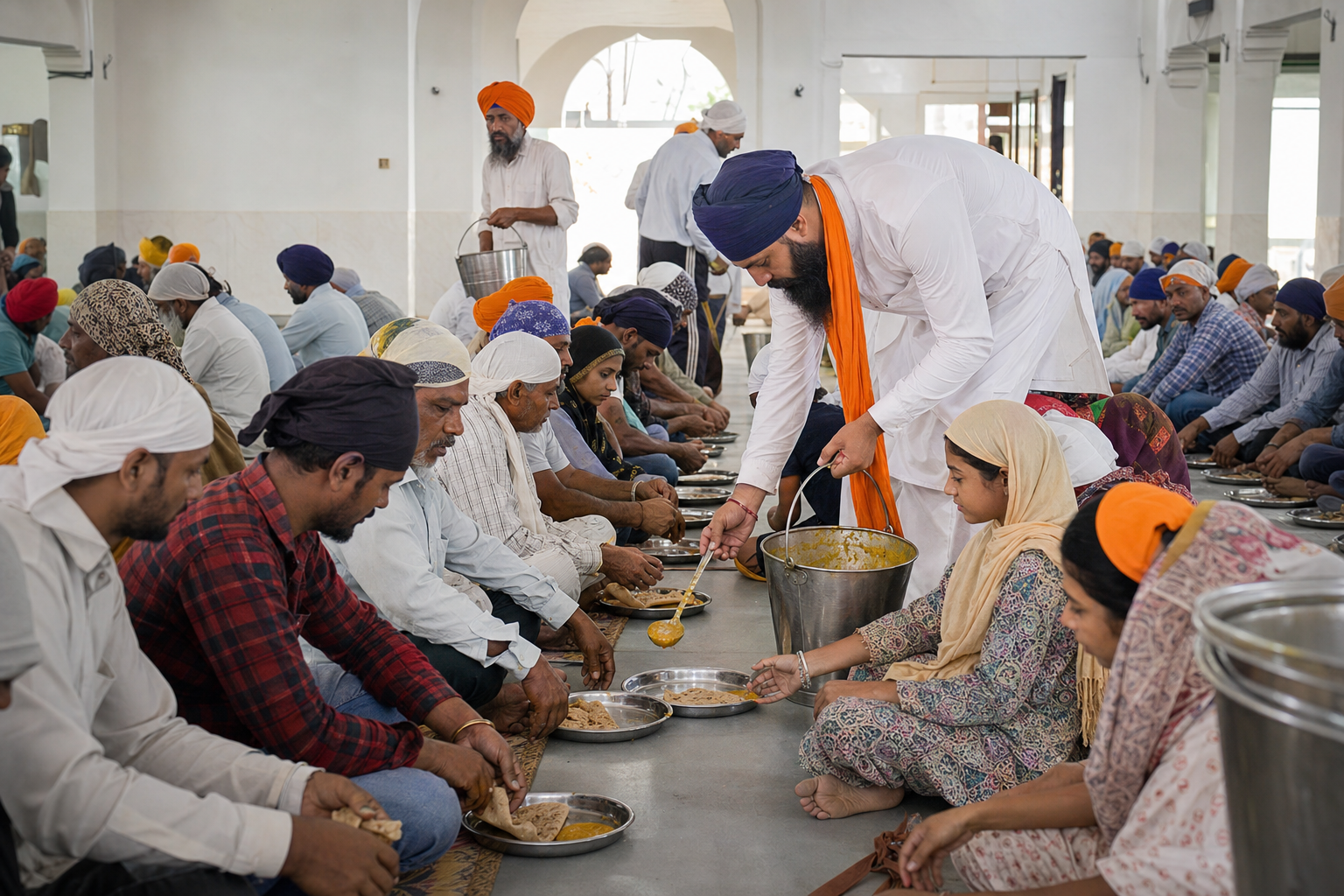
Now turn from lineage to activity. Sangat made spiritual life collective. Kirtan placed the shabad in a shared field of attention. Seva converted reverence into work. Communal deliberation joined belief to decisions affecting the community. When you encounter a shrine or historical marker, ask which of these functions it supported. The answer tells you more than architectural description alone.
The town’s gurdwaras and ghats add further layers of meaning. Gurdwara Patal Puri is associated with the immersion of ashes in the Sutlej, directing attention toward mortality, remembrance, and humility. Other sacred associations connect the area with Guru Nanak and Baba Gurditta. Instead of treating each connection as an isolated fact, ask how remembrance of a person, an event, or death helps a living community orient itself.
The next step is to follow the historical movement toward Anandpur Sahib. The transition began under Guru Tegh Bahadur in the mid-17th century and was expanded under Guru Gobind Singh. Land at Makhowal, which became Anandpur Sahib, was acquired with support from allied hill states. The creation of the Khalsa at Anandpur Sahib in 1699 belongs to this longer arc of institution-building.
That sequence corrects a common misreading. Kiratpur is not simply a quiet preface that can be skipped once Anandpur enters the story. Nor should 1699 be detached from the decades of leadership, teaching, organisation, and community cohesion that preceded it. Build your timeline with three anchors: Kiratpur’s founding in 1627, the mid-17th-century movement toward Makhowal, and the creation of the Khalsa in 1699. Then place practices and institutions beside the dates. You will see development rather than a row of unrelated milestones.
Let Bhai Vir Singh show you what literature preserves
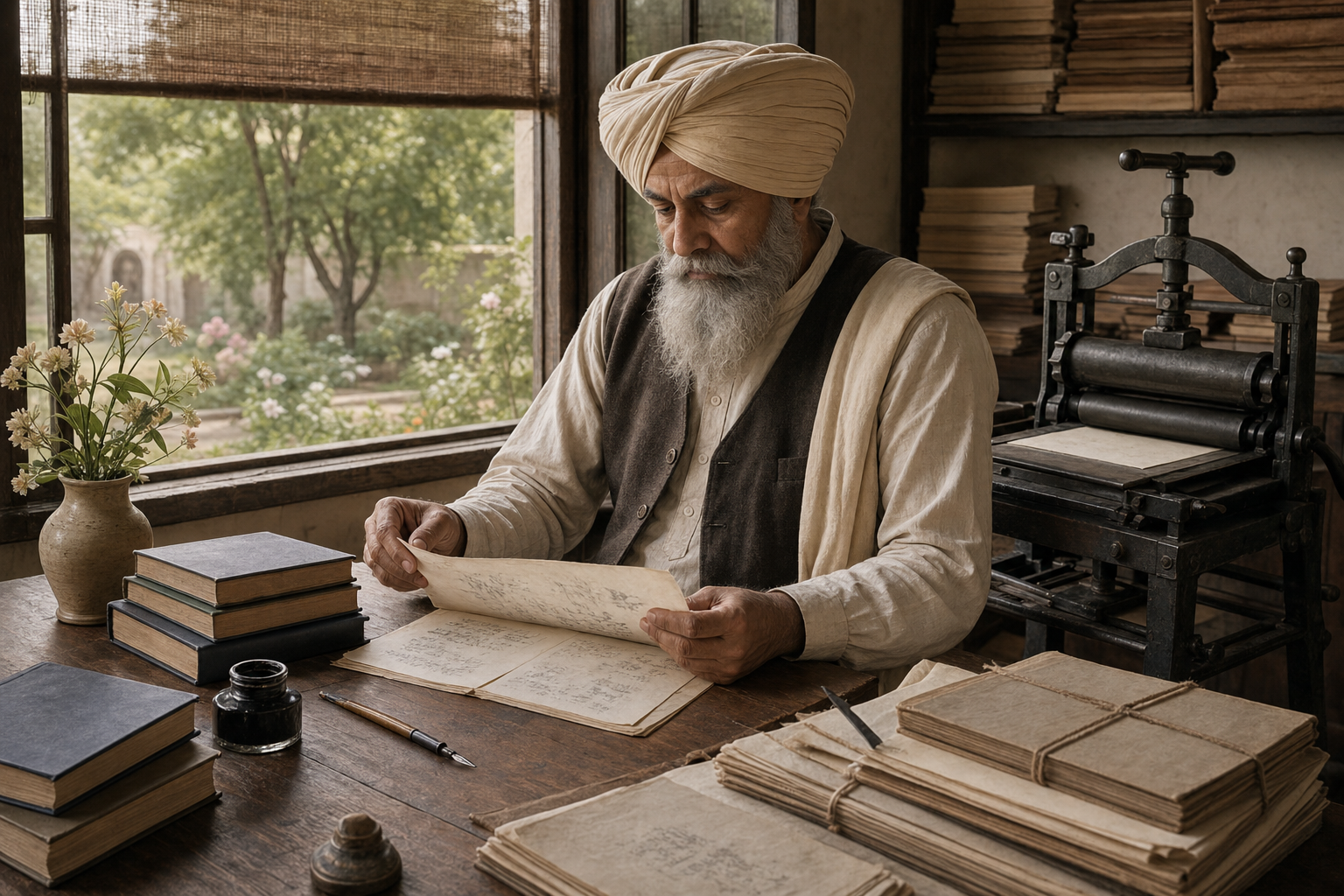
Sacred places preserve memory in a visible landscape. Literature preserves it inside language, imagination, and moral judgement. Bhai Vir Singh, who lived from 1872 to 1957, renewed Punjabi literary expression while maintaining a relationship with classical sensibilities and Sikh spirituality. His importance therefore reaches beyond literary reputation: he helped Punjabi carry cultural memory into a changing age.
Three titles give you concrete entry points: Rana Surat Singh, Sundari, and Satwant Kaur. You do not have to begin by mastering every historical reference or doctrinal term. Choose one work and read it in three passes.
- On the first pass, follow the movement of the work. Notice the central trial, the important choices, and the images or phrases that remain with you.
- On the second pass, mark the ethical vocabulary around Naam, service, courage, humility, self-restraint, truth, and responsibility. Ask which virtue becomes necessary under pressure.
- On the third pass, translate the moral movement into a present question. What would remembrance change in this situation? What does courage protect? When does service require discipline rather than sentiment?
This method matters because Bhai Vir Singh’s writing does not separate inward aspiration from social conduct. Remembrance of Naam and service to others appear as forces that steady people through trial and sustain a just community. The sant-sipahi ideal also helps organise this moral world: spiritual depth is not passivity, while courage is not licence for pride or aggression.
Do not reduce the characters or voices to labels such as brave, devout, or selfless. Those labels tell you the ending before you have examined the struggle. Look instead for the pressure that makes a virtue difficult. Courage becomes meaningful when fear has a real object. Restraint becomes meaningful when retaliation is available. Seva becomes meaningful when it costs time, comfort, or status. This is where literature becomes ethical training rather than decorative heritage.
Language itself is part of that training. Bhai Vir Singh’s renewal of Punjabi enlarged the language’s modern literary possibilities without treating inheritance as an obstacle. That gives you a useful test for any claim of cultural revival: does it merely praise the past, or does it give inherited values a form through which people can think, feel, and act in their own time? His work belongs to the second kind of renewal.
Keep dharmic kinship and Sikh distinctiveness together
Sikh heritage belongs within the wider civilizational life of Bharat, where Hindu, Buddhist, Jain, and Sikh traditions have articulated related concerns about truth, compassion, discipline, self-cultivation, and responsibility toward others. Recognising this kinship can deepen understanding. Flattening the traditions into one generic spirituality cannot.
A careful dharmic reading therefore works on two levels at once. At the shared ethical level, notice the insistence that inward refinement must affect conduct. At the specifically Sikh level, retain the grammar of Guru, Naam, shabad, sangat, seva, Miri-Piri, and sant-sipahi. These are not ornamental terms that can be exchanged for vague equivalents. They show how Sikh teachings organise devotion, community, authority, and action.
Kiratpur Sahib makes this distinction visible. Compassion and disciplined self-cultivation resonate widely across dharmic traditions, but the town’s historical meaning arises through its particular relationship with the Sikh Gurus and the institutions of the Sikh community. Bhai Vir Singh makes the same distinction legible in literature. His ethical themes can speak across traditions while remaining anchored in a Guru-centred path.
Use a three-sentence test when you explain this heritage to someone else. In the first sentence, name the specifically Sikh teaching, institution, person, or practice. In the second, identify the genuinely shared dharmic concern. In the third, explain the conduct that follows. For example: Miri-Piri joins spiritual authority with responsibility in public life. Other dharmic traditions also insist that spiritual discipline should shape ethical action. The practical demand is to resist both spirituality without responsibility and power without moral restraint.
This test protects two truths. Sikh tradition has its own integrity, historical development, and vocabulary. It also participates in a larger Indic conversation about how human beings should discipline desire, serve others, confront injustice, and seek truth. You do not have to sacrifice either truth to preserve the other.
Use this six-step plan for your next visit or reading
- Build a one-page chronological spine. Write 1627, the mid-17th-century transition toward Makhowal, 1699, and 1872-1957. Leave space beneath each anchor for a person, place, practice, and text.
- Pair each place with a function. Beside Kiratpur, record sangat, kirtan, deliberation, leadership, remembrance, and seva. Beside Anandpur, record continuity, expansion, and the formation of the Khalsa. This keeps geography connected to community life.
- Pair each writer with an ethical question. Beside Bhai Vir Singh, write one question you genuinely face: how should courage remain humble, how can remembrance steady action, or when does service demand sacrifice?
- Read one work closely before collecting quotations. Begin with Rana Surat Singh, Sundari, or Satwant Kaur. Record a scene or movement, the virtue under pressure, and the practical demand it places on the reader.
- Separate evidence from interpretation. In your notes, distinguish a historical association, such as Guru Harkrishan’s connection with Kiratpur, from your reflection on what that association means. This makes teaching and cultural advocacy more trustworthy.
- End with one act, not another abstraction. Let the material alter how you practise seva, speak truthfully, exercise restraint, remember the Guru, or care for a shared institution. Heritage remains living when it changes conduct.
You can begin today with a single sheet of paper: one sacred place, one historical transition, one literary work, and one ethical demand. If you keep those four elements connected, Punjab’s Sikh heritage will stop looking like a distant archive and start functioning as it was meant to function – as memory that instructs life.
References
- SikhNet – Bhai Vir Singh: The Sixth River of Punjab and a Bridge Uniting India’s Dharmic Traditions
- SikhNet – Kiratpur Sahib: Sacred Seat of Sikh Gurus before Anandpur Sahib and a Living Dharmic Legacy
