
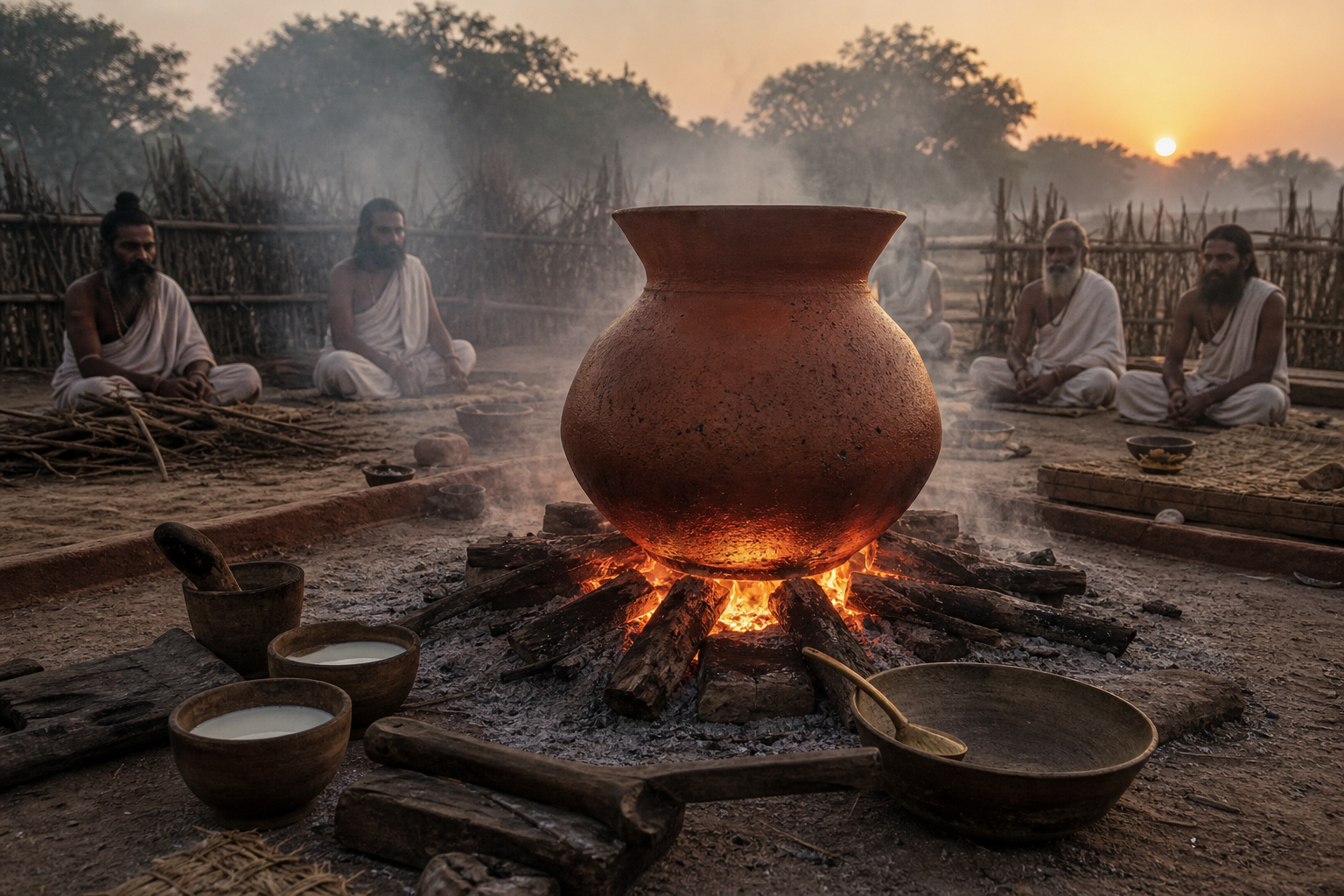
If you came here trying to understand why an earthen pot could carry so much weight in a Vedic sacrifice, the short answer is that the Mahāvīra is never merely a container. Its manufacture, heat, contents, mantras, and ritual identity all work together.
The clearest way to understand it is to follow the vessel through Pravargya. Once you see what is prepared, what happens to it, and what the rite identifies it with, the language of sun, sacrifice, and sacred heat stops looking like a collection of unrelated symbols.
Key takeaways
- The Mahāvīra is a purpose-made and consecrated earthen vessel, not an ordinary pot temporarily borrowed for worship.
- It stands at the center of Pravargya, an ancillary rite performed during the opening phase of the larger Soma sacrifice.
- The vessel is heated intensely before fresh cow’s milk is poured into it and brought to a vigorous boil; the resulting gharmá is then offered in a prescribed sequence with mantras.
- Its ritual identity includes both the sun and the head of Makha, the sacrificial being.
- Its practical function and cosmic meaning cannot be separated without distorting the rite.
- Because Pravargya involves extreme heat and exact ritual disciplines, a descriptive outline should never be treated as instructions for an improvised reenactment.
Follow the Mahāvīra through Pravargya, not in isolation
The Mahāvīra belongs within Pravargya, a highly structured ancillary rite associated with the opening of the Soma yajña. That location in the ritual sequence matters. This is not a standalone household observance, a generic fire ceremony, or a vessel that happens to appear beside the main sacrifice.
Pravargya prepares and vitalizes the larger sacrificial undertaking. The heated milk becomes the blazing gharmá offering, presented with mantras to deities often associated with the Aśvins. The act is understood as transformative and protective: ordinary materials enter a prescribed ritual order and become participants in yajña.
- The prepared Mahāvīra is placed upon a specially arranged hearth.
- The empty vessel is subjected to intense heat until it radiates that heat.
- Fresh cow’s milk is poured into the hot vessel.
- The milk rises into a vigorous boil, producing the gharmá.
- The gharmá is offered with mantras and in a measured sequence.
This order explains why a translation such as milk pot is technically recognizable but spiritually inadequate. The important event is not simply that milk becomes hot. The vessel, hearth, fire, milk, timing, mantra, and offering form one ordered action. Remove that order and you no longer have an intelligible account of Pravargya.
You should therefore resist treating the gharmá as a recipe or the Mahāvīra as ritual cookware. Boiling is the visible mechanism, but consecrated transformation is the ritual point. The movement from common material into sacrificial substance also marks a passage from ordinary time into sacred time.
The vessel becomes sacred before the milk enters it
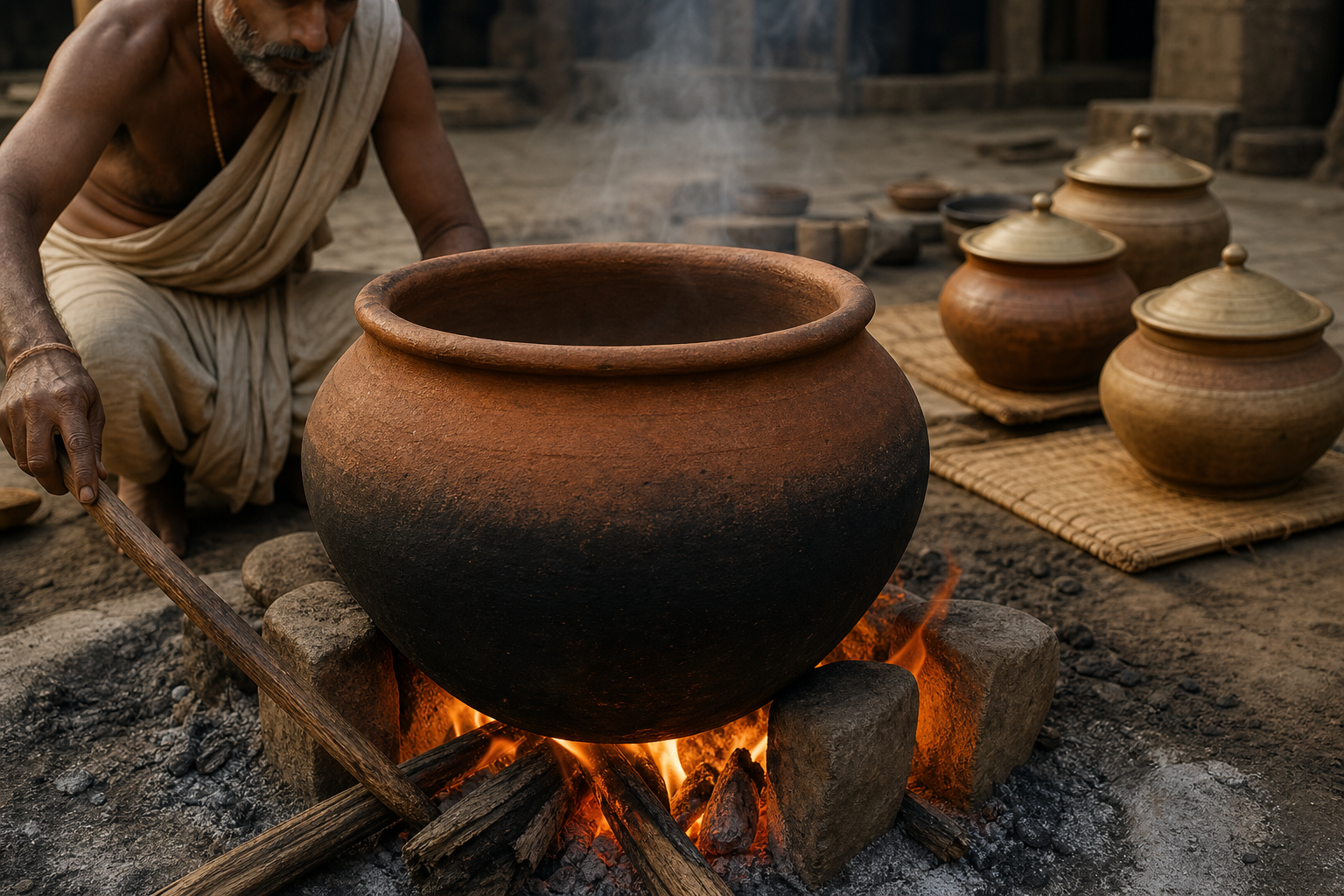
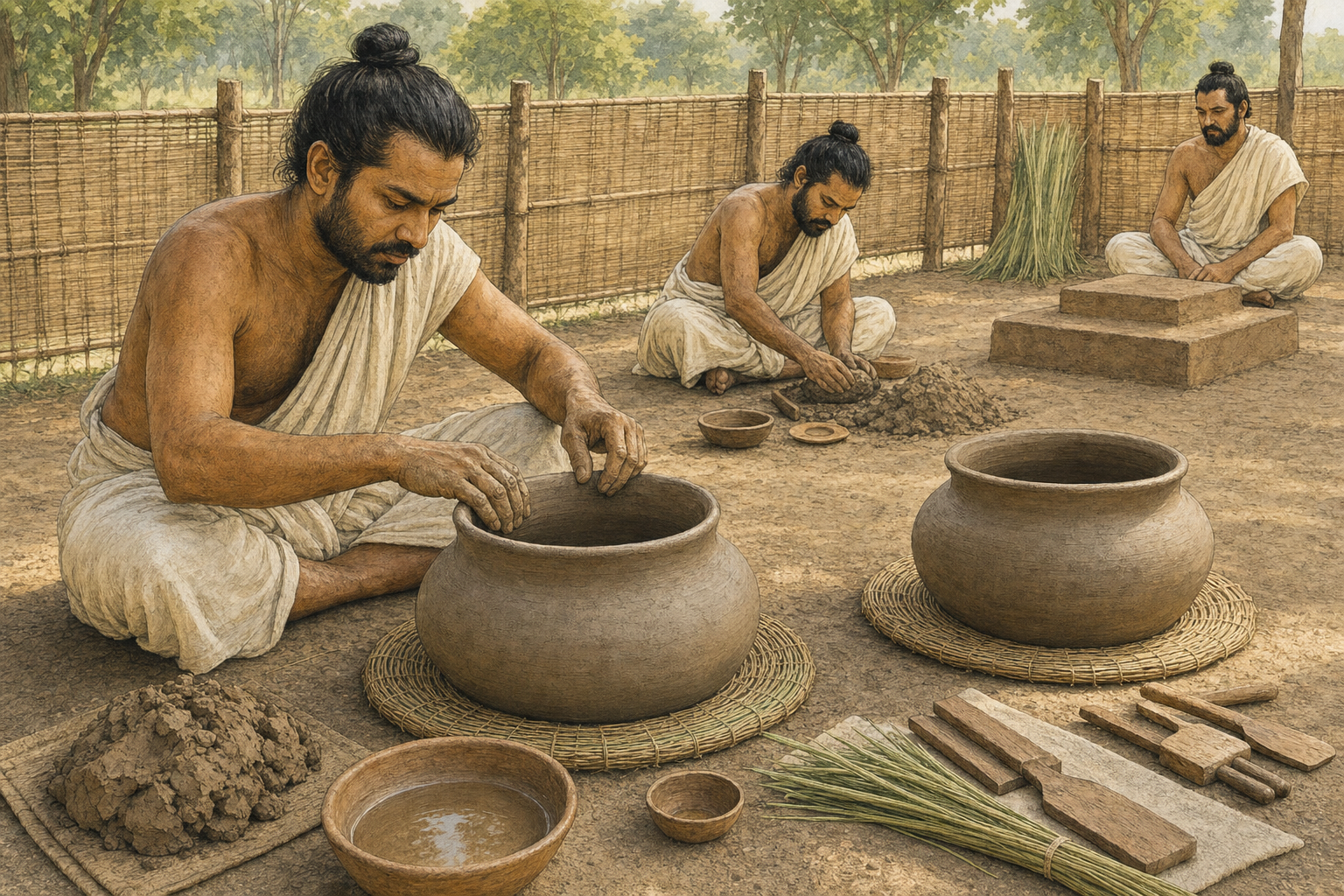
The preparation of the Mahāvīra is entrusted to the adhvaryu, the officiant responsible for carrying out the physical operations of the sacrifice. Clay must be obtained, shaped, dried, fired, and consecrated according to prescriptions preserved in the Śrauta tradition. The vessel’s thickness and form must also enable it to endure exceptional heat.
Material matters. The use of earth does not make the vessel casual or interchangeable. Clay is selected and worked for this sacrificial purpose. An ordinary earthen pot may resemble the Mahāvīra materially, but resemblance alone does not give it the same ritual status.
Form matters. The shape and thickness are not ornamental details. They answer the physical demands of the rite because the pot must withstand extreme heat followed by contact with fresh milk. Ritual precision and technical competence meet in the same object.
Consecration matters. The vessel is set apart and is not redirected to mundane use. Its sacredness does not arise from clay alone. It emerges through the union of prescribed material, correct construction, dedicated function, careful handling, and mantra.
This gives you a useful rule for reading Vedic ritual objects: never ask only what an implement is made from. Ask who prepares it, what prescriptions govern it, where it enters the sequence, what action it makes possible, and whether it may return to ordinary use. Those questions reveal ritual identity more reliably than appearance does.
The Mahāvīra also corrects a common modern separation between practical skill and sacred intention. Its construction must work physically, yet physical performance is not its whole meaning. A badly prepared vessel would threaten the operation; a correctly shaped but unconsecrated vessel would still lack the prescribed ritual status. Vedic precision holds both requirements together.
The sun and the head of Makha are enacted identities
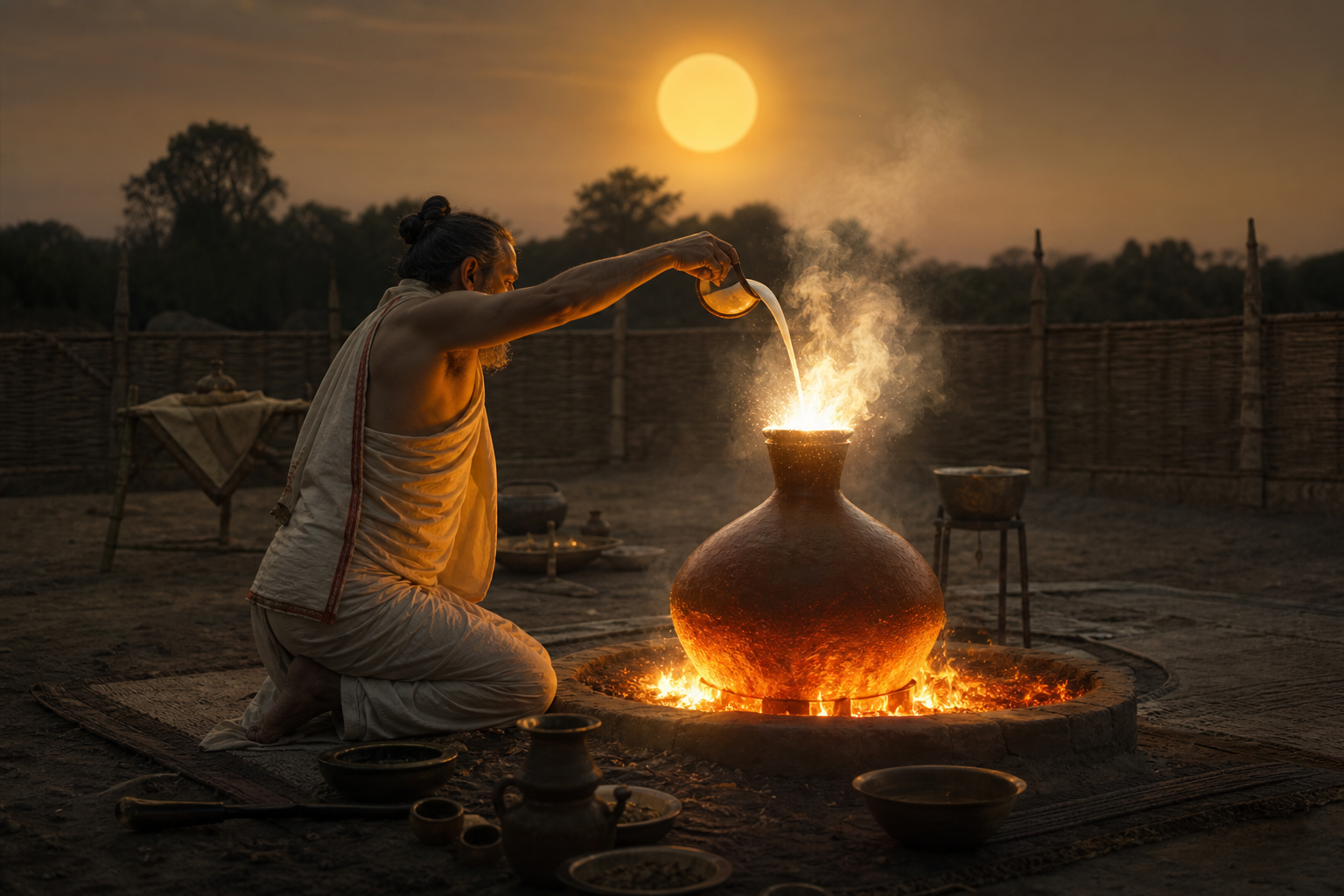
The Mahāvīra is identified with the sun and with the head of Makha, the sacrificial being. These identifications are not decorative interpretations attached after the practical work is complete. The physical behavior of the vessel allows the cosmic meaning to become perceptible.
Its solar character is especially clear. The pot is heated until it radiates fierce warmth. Milk meeting that heat boils forcefully, while sound and steam accompany the action. Luminosity, heat, vitality, and the impression of dawning power converge in one concentrated ritual moment. The vessel does not merely stand beside a verbal comparison with the sun; its carefully produced condition embodies solar force.
The identification with the head of Makha draws the vessel into the sacrificial being itself. You should therefore read the Mahāvīra as more than equipment placed outside the sacrifice. Its status as the head expresses the concentrated potency of an object through which the sacrifice is energized and sanctified.
The two identities reinforce each other. The sun is a source of light, warmth, and life-giving energy; the head belongs organically to the sacrificial being. Together they locate the blazing vessel at the meeting point of cosmic power and the structured body of yajña.
This is why it is misleading to choose between a functional reading and a symbolic one. Function produces the sensory conditions through which the symbolism becomes present. Symbolism, in turn, explains why those physical operations demand purity, timing, and mantra rather than mere efficiency.
When you encounter another elaborate Vedic implement, apply the same test. First notice what physically happens. Then identify the rules that set the object apart. Finally ask what cosmic reality or sacrificial identity the rite activates through it. With the Mahāvīra, the answers are intense heating, consecrated handling, and identification with the sun and the head of Makha.
How to explain the Mahāvīra without flattening the rite
If you are teaching, writing, or simply organizing your own understanding, explain the Mahāvīra on three connected levels. At the object level, it is a specially prepared earthen vessel. At the action level, it receives fresh milk after being intensely heated and enables the gharmá offering. At the cosmological level, it embodies solar vitality and the head of the sacrificial being.
Leaving out any one level creates a predictable distortion. Calling it only a sacred pot conceals what actually happens. Calling it only a boiler strips away consecration and mantra. Calling it only a sun symbol turns a precisely enacted rite into free-floating allegory. A faithful explanation keeps object, operation, and identity in view at the same time.
Use the proper names when they clarify distinct roles. Mahāvīra names the vessel; Pravargya names the rite; gharmá names the blazing offering produced through the heated milk; the Soma yajña is the larger sacrificial setting; the adhvaryu prepares and handles the ritual operations; and the Aśvins are among the deities with whom the offering is associated. These terms belong to one sequence, but they are not interchangeable.
It is equally important to preserve the boundary between a specifically Vedic rite and a broadly Dharmic reflection. Discipline, purity, attentiveness, ethical restraint, and reverence for transformation have resonances across Hindu, Buddhist, Jain, and Sikh traditions. That does not make Pravargya a common rite of all four traditions, nor does it make the Mahāvīra a generic pan-Dharmic object. Civilizational kinship is better honored by recognizing both shared values and genuine differences.
Do not turn the ritual sequence into a home experiment. The Mahāvīra is exposed to extreme heat, and fresh milk is added before a forceful boil. More importantly, Pravargya depends on prescribed roles, preparation, purity, timing, and mantra. If your interest moves from study to actual performance, a descriptive explanation is the wrong instrument; the next step is properly transmitted instruction within the appropriate Śrauta setting.
The next time you meet the Mahāvīra in a ritual description, track those three layers in your notes: vessel, action, and cosmic identity. That simple discipline will let you recognize both the technical intelligence of the rite and the Vedic vision in which carefully ordered human action aligns itself with ṛta.
References
