
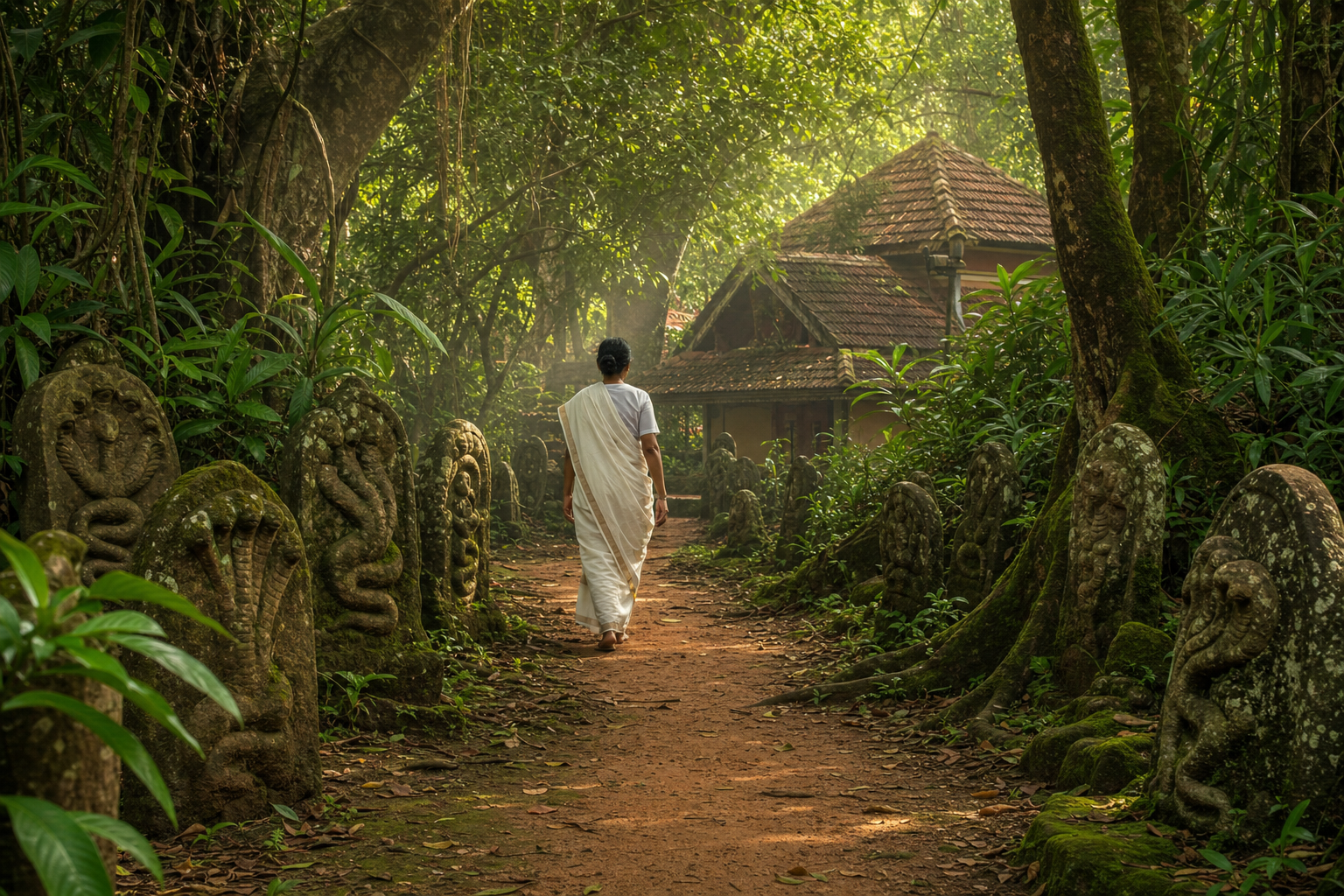
You may arrive at Mannarasala with a simple question: is this mainly a temple for a personal vow, a Naga shrine, or a sacred grove? The most useful answer is that it is all three, and none of the three makes complete sense alone.
At this grove near Haripad in Kerala’s Alappuzha district, the founding legend joins land, penance, serpent grace, fertility, family continuity, and ecological restraint. Once you see that pattern, the temple stops looking like an unusual collection of serpent stones. It becomes a living account of how human beings should inhabit a place they did not create by their power alone.
Key takeaways
- Mannarasala’s founding narrative belongs to Kerala’s sacred memory: Parashurama’s tapas prepares reclaimed land to receive the life-giving blessing of the Naga deities.
- The grove is not scenery around the shrine. Its trees, shaded paths, serpent stones, and sanctums form one sacred landscape.
- Sree Nagaraja and Sarpayakshi are central to the tradition, while the Valia Amma embodies its distinctive matriarchal custodianship.
- Ayilyam in the Malayalam month of Kanni, usually falling across September and October, brings processions, abhishekas, and turmeric offerings into their fullest public expression.
- Devotees pray for fertility, health, and household harmony, but a spiritual vow should accompany responsible action and appropriate medical care, not replace them.
Begin with Parashurama’s unfinished reclamation

Kerala’s sacred geography begins, in this tradition, with Parashurama reclaiming the western coast from the sea. Parashurama is the sixth avatar of Vishnu, but even an avatar’s act of reclamation does not leave the land ready for flourishing. The newly recovered coast remains saline and barren. Possession has been achieved; habitability has not.
That distinction is the key to Mannarasala. Parashurama undertakes intense tapas to cool, purify, and sanctify the land. The Naga deities answer his penance, and the serpent king, often identified in the tradition with Vasuki, blesses the soil with fertility and ecological balance. Mannarasala marks the meeting point between disciplined human effort and a regenerative power that cannot simply be commanded.
This is more than a story about how Kerala became green. It corrects a familiar human error: assuming that the ability to acquire or transform land also confers the wisdom needed to sustain it. Parashurama can cause the coast to emerge, but he still has to approach the powers already associated with water, soil, fertility, and hidden life. His next act is not further conquest. It is penance.
If you are approaching Mannarasala as a devotee, notice the order of the narrative. First comes action, then recognition of its limits, then tapas, then grace, and only afterward abundance. Applied to sadhana, the sequence is demanding: do not ask for fruit while ignoring the conditions that allow life to grow. If you seek household harmony, examine the discipline you bring into the household. If you seek renewal, ask what has to be cooled, restrained, repaired, or made receptive.
Fertility also has a wider meaning here than a single desired outcome. It is first the capacity of damaged or inhospitable ground to sustain life. The later association with prayers for children belongs within that larger field of regeneration, which also includes health, continuity, nourishment, and the flourishing of a household. Reading fertility only as a guaranteed promise of conception makes the tradition smaller than it is.
The sacred episode is placed in Treta Yuga. That placement expresses the temple’s mythic time; it is not a claim that every visible architectural element was constructed in that age. The complex seen by pilgrims likely accumulated in later historical layers, as Kerala temples commonly do. You do not have to choose between reverence for sacred memory and honesty about material history. They answer different questions: one explains the shrine’s meaning, while the other concerns the development of its built form.
Read the grove as part of the temple, not its backdrop
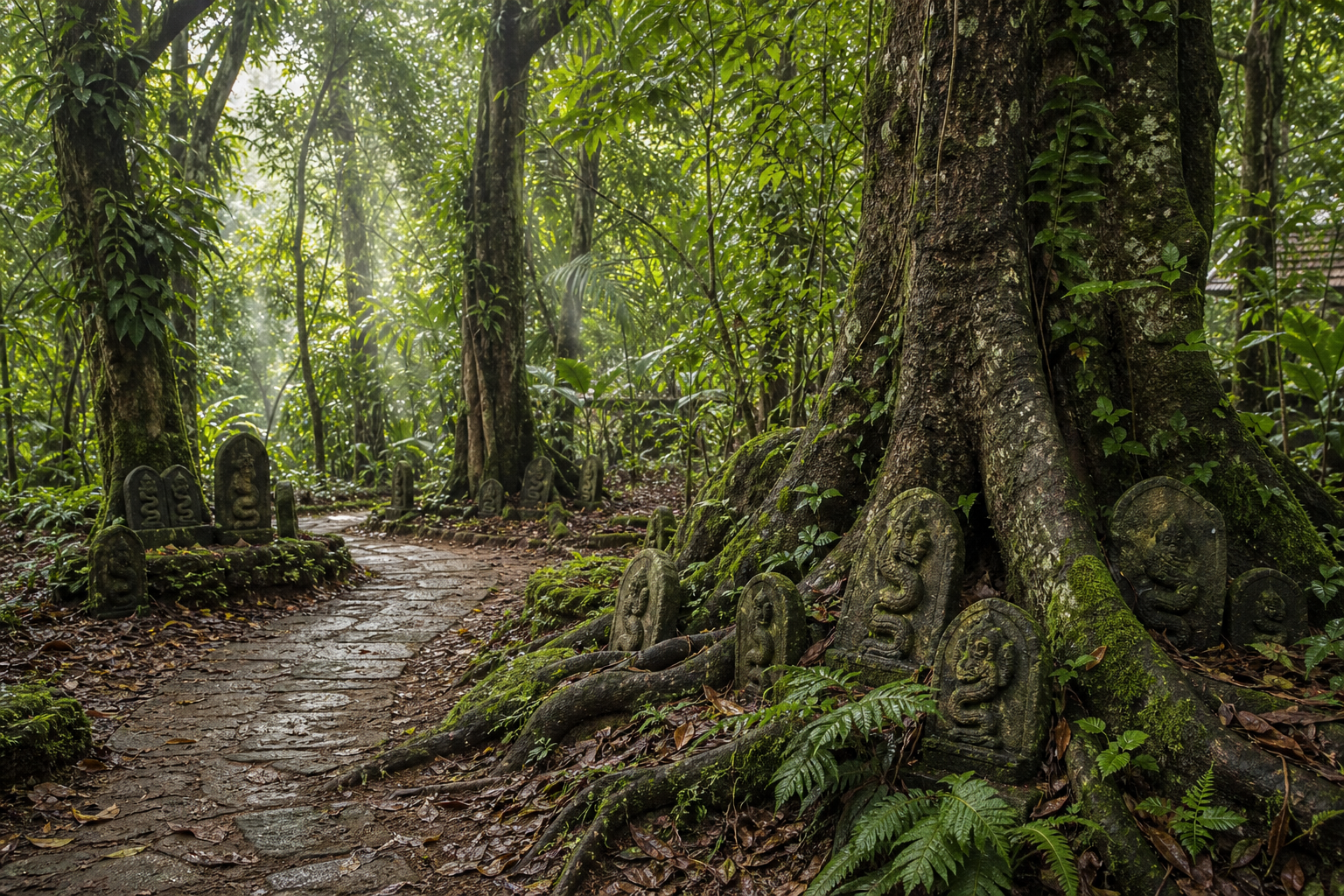
The main devotional focus is Sree Nagaraja, with Sarpayakshi, also called Nagayakshi, venerated within the sacred order of the place. Yet Mannarasala cannot be read through the sanctum alone. Thousands of serpent stones line the shaded paths, extending Naga presence through the grove and turning movement across the precinct into part of the encounter.
A conventional visitor may look for a single focal image, complete darshan, and move on. Mannarasala asks you to widen your attention. The repeated stones matter. The canopy matters. The subdued light and quiet paths matter. Together they resist the idea that holiness is sealed inside one chamber while the surrounding habitat is expendable.
When you walk through the grove, avoid treating the stones as curiosities or the vegetation as a decorative setting for photographs. Slow down enough to notice how shrine and sanctuary depend on each other. Do not move or casually handle sacred objects, pluck vegetation, or improvise a ritual. Follow the temple’s current directions, because local practice determines what is appropriate within a living tradition.
This sacred topography carries a practical ecological lesson. Conservation at Mannarasala is not an optional modern theme pasted onto an ancient shrine. The founding story itself turns on restoring balance to land that human power alone could not make fruitful. Protecting the grove therefore preserves both habitat and theology: damage to one weakens the other.
Why the Valia Amma matters
Mannarasala’s custodianship is distinguished by the Valia Amma, the revered matriarchal spiritual guide associated with the temple’s continuity and disciplined service. Her place in the tradition should not be reduced to that of an administrator attached to an otherwise ordinary institution. The matriarchal form of guidance is part of how Mannarasala understands the transmission of care.
This changes what you should notice. Temple continuity is not carried only by masonry, formal office, or a public festival. It also depends on patient custodianship, remembered obligations, compassionate guidance, and service maintained across generations. The Valia Amma gives those less visible forms of authority a recognisable centre.
That pattern also fits the temple’s larger theology. Power at Mannarasala is not presented mainly as domination. Parashurama bows in tapas; the serpent king restores fertility; the grove shelters many forms of life; and a matriarchal custodian sustains the tradition. Each part directs attention from possession toward relationship.
Approach Ayilyam, offerings, and vows with clear intent
The Ayilyam festival in the Malayalam month of Kanni is Mannarasala’s most concentrated ritual occasion. Kanni falls across September and October, but that span is only a planning window, not a fixed civil date. If you intend to attend the festival, confirm the precise observance and current visitor arrangements locally before making travel commitments.
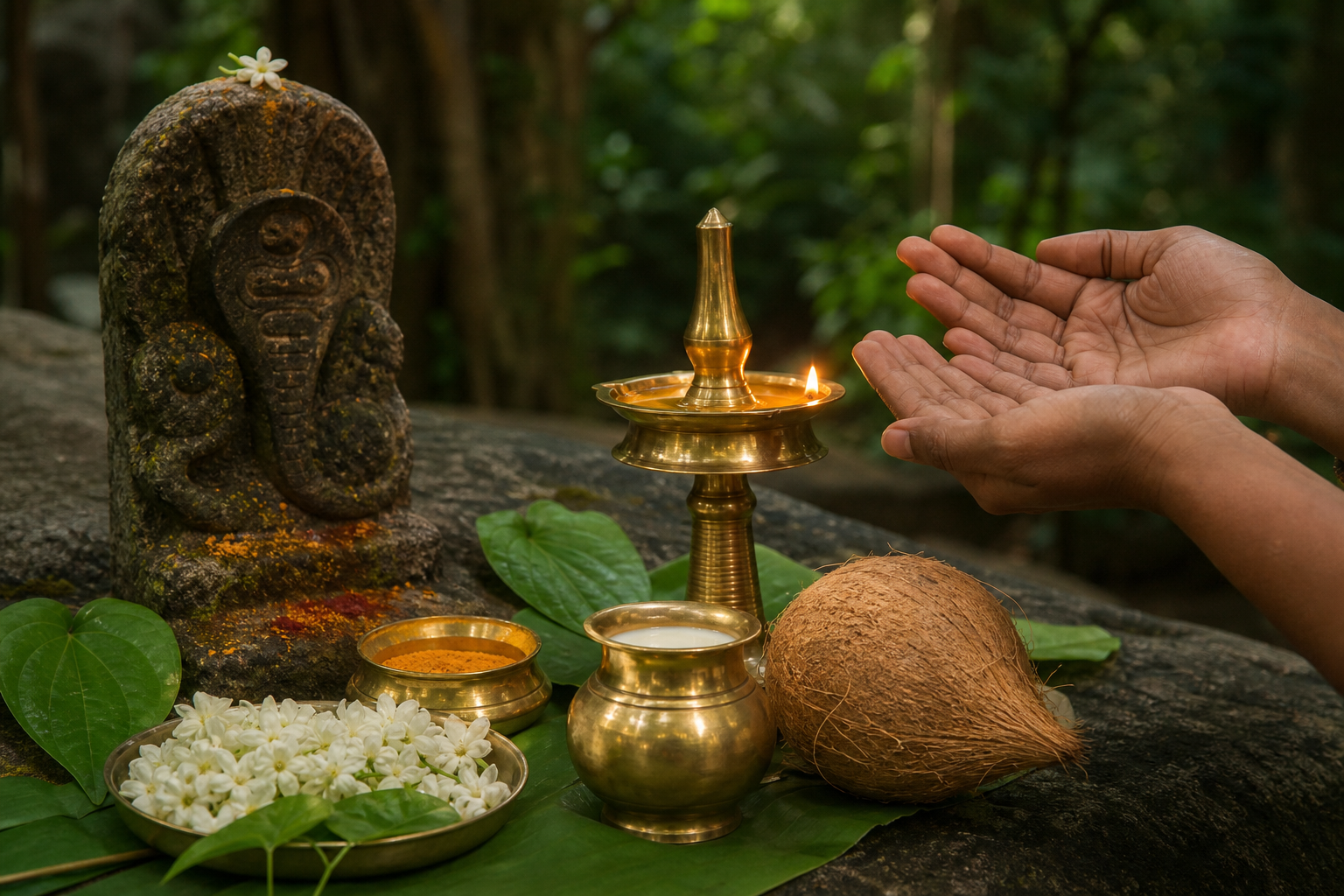
During Ayilyam, processions through the grove, abhishekas, and offerings of turmeric paste bring together deity, community, and sacred landscape. Choose this occasion if your purpose is to encounter the tradition in its fullest public ritual form. Do not assume, however, that the festival is the only meaningful time to understand Mannarasala. The grove, custodianship, sanctums, and serpent stones carry the temple’s teaching beyond a single annual observance.
Devotees commonly approach Nagaraja for blessings connected with fertility, health, and household harmony. Families also return across generations to fulfil vows. This return is significant. A vow is not merely a request made at a moment of distress; it creates an obligation to remember, give thanks, and maintain a relationship after the immediate need has passed.
Before making a vow, name your intention honestly. Are you asking for a specific result, seeking strength to endure uncertainty, expressing gratitude, or repairing a neglected obligation? These are not identical acts. Clarity prevents devotion from collapsing into a bargain in which an offering is imagined to purchase a guaranteed outcome.
If your prayer concerns fertility or health, keep spiritual practice and medical care in their proper domains. Darshan, prayer, abhishekam, and a vow may give religious form to hope, patience, and gratitude. They are not substitutes for qualified medical evaluation or treatment. Delaying care because a desired result has been entrusted to ritual can carry real consequences.
Turmeric, procession, and abhishekam should likewise be understood within the temple’s ritual discipline rather than copied as isolated techniques. The meaning comes from the relationship among deity, place, custodian, vow, and community. If you are uncertain about an offering, ask for or follow local instructions instead of assuming that a practice seen elsewhere applies unchanged at Mannarasala.
Carry the Naga teaching beyond the pilgrimage
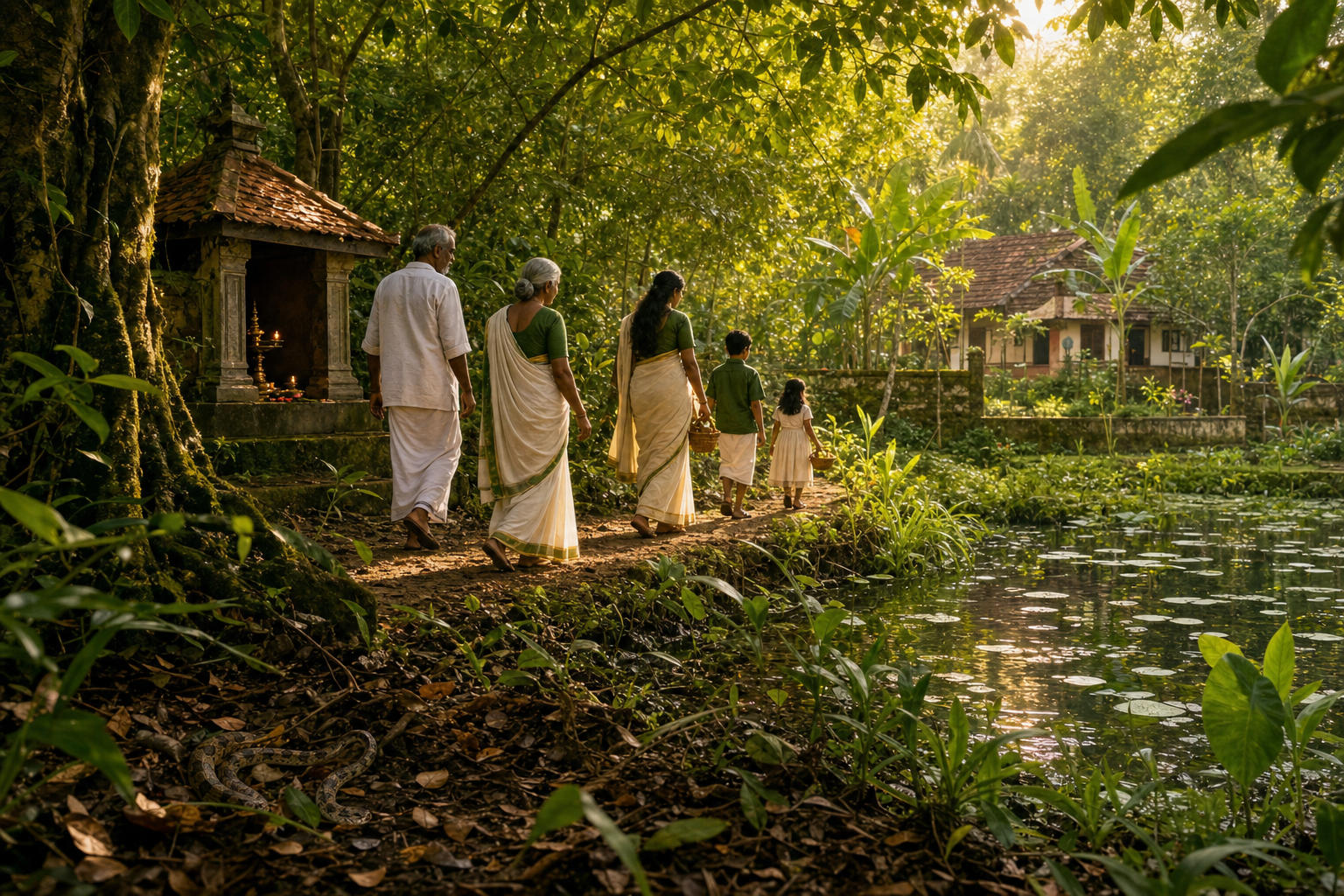
Mannarasala offers a pro-Dharmic ecological vision without turning nature into a vague slogan. The human being has agency, but not absolute entitlement. Land may be reclaimed, yet it must still be made capable of supporting life. Tapas disciplines power; gratitude answers grace; and the protected grove makes reverence visible in the treatment of an actual place.
Let restraint become an offering
The easiest mistake is to seek a blessing for your household while leaving your habits untouched. The more faithful response is to connect prayer with restraint. Protect rather than disturb living habitat. Reduce needless harm. Treat water, soil, plants, and animals as participants in a shared order rather than as disposable material. These actions do not purchase grace; they make your conduct consistent with the world the shrine declares sacred.
Reverence for Nagas also does not mean approaching or handling wild snakes. A sacred symbol does not cancel an animal’s wildness or the risk of injury. Keep a safe distance and use qualified local wildlife assistance when removal is necessary. Protection of life includes avoiding reckless contact with it.
Recognise shared Dharma without flattening differences
Mannarasala is a specifically Hindu shrine rooted in Kerala’s Naga tradition. Its serpent iconography should not be turned into a claim that Hinduism, Buddhism, Jainism, and Sikhism possess an identical theology or identical ritual practice. They do not need to be made interchangeable in order to recognise resonances among them.
The wider Dharmic bridge lies in ethical orientation: reverence for life, restraint, disciplined conduct, humility before a reality larger than the individual, and attention to the consequences of human action. Within Mannarasala, the serpent particularly expresses renewal, wisdom, latent power, and the regenerative capacities of nature. Other Dharmic paths articulate related responsibilities through their own teachings and symbols.
That distinction protects unity from becoming erasure. You can recognise a shared civilisational concern for life and right relationship while allowing Mannarasala to remain fully itself: a Kerala sacred grove centred on Nagaraja, Sarpayakshi, Parashurama’s tapas, matriarchal custodianship, and inherited vows.
Make the pilgrimage produce one visible change
Before you leave Mannarasala, choose one form of restraint or stewardship that will continue after darshan. It might be the protection of a small habitat, more careful treatment of water and soil, the fulfilment of an old promise, or a disciplined change within your household. Keep it specific enough to practise and modest enough to sustain.
That is how the founding sequence remains alive. Recognise the limits of control, undertake the necessary discipline, receive life as grace rather than entitlement, and protect the conditions in which it can flourish.
References
