
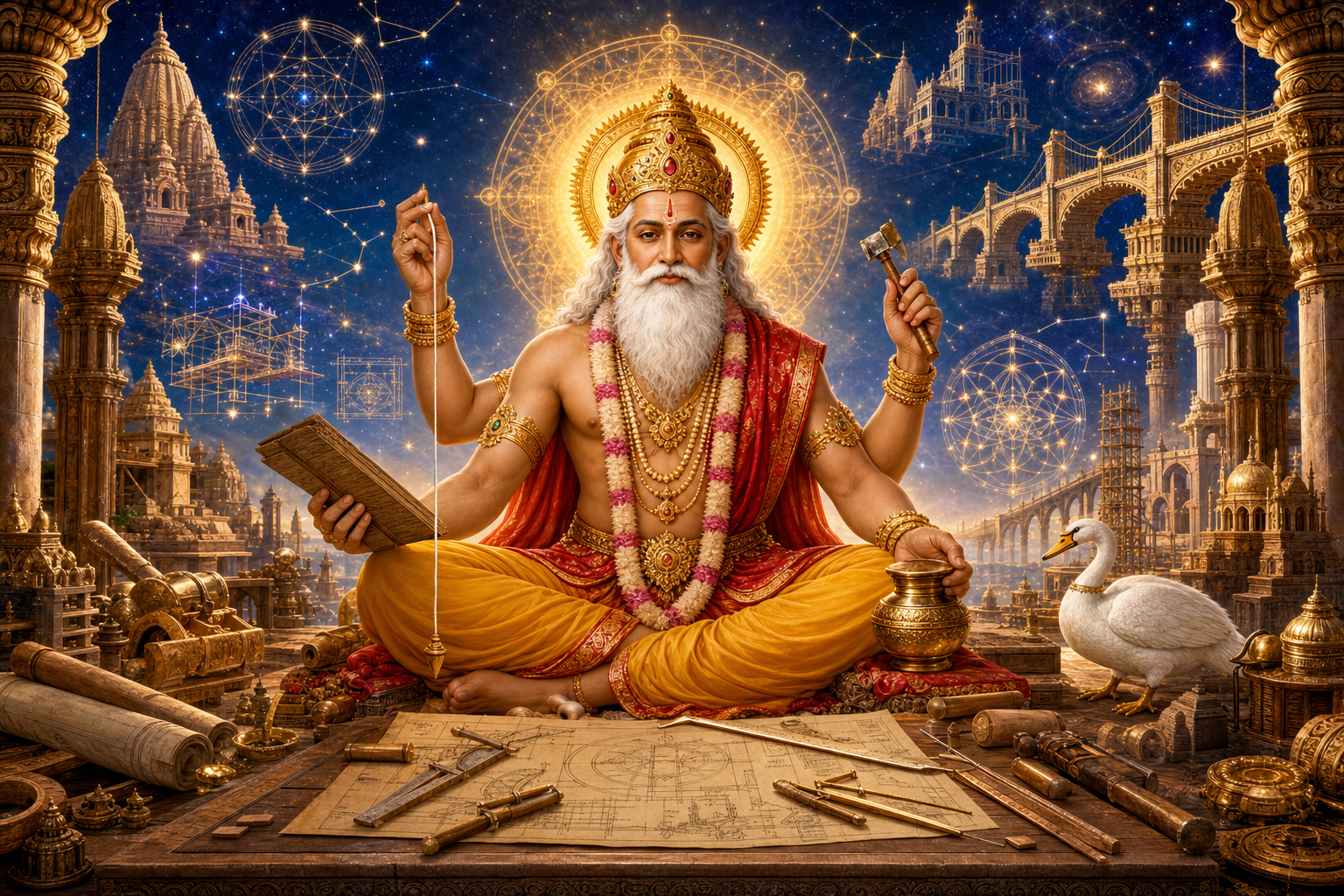
If you know Vishwakarma mainly as the deity honored beside tools and machines, his larger identity can seem difficult to assemble. Why does one figure appear as the shaper of the cosmos, the builder of cities, the maker of divine weapons and the patron of working artisans?
The answer lies in a distinctively dharmic view of creation. Skill is never only the ability to make something impressive. It also carries responsibility for what is made, how it is made and whom it serves. Once you read Vishwakarma through that lens, his many roles form a coherent guide to sacred work.
One name joins cosmic intelligence and the master artisan
At the Vedic level, Visvakarman is a universal shaper associated with order, structure and symmetry in the cosmos. The emphasis is not yet limited to a workshop, a particular material or one marvelous object. The name points toward the intelligence by which an ordered world takes form.
Later Puranic traditions bring that vast principle into a more personal form: Vishwakarma becomes Devashilpi, the divine craftsman who designs dwellings, cities, vehicles, sacred images and weapons for the devas. This is best understood as a change of scale rather than a choice between two unrelated identities. Cosmic order becomes visible through proportion, workmanship and purposeful design.
A later genealogy identifies Vishwakarma as the son of Prabhasa, one of the eight Vasus, and Yogasiddha, the sister of Brihaspati. That lineage situates him within the Puranic sacred world, but it does not exhaust his older significance as the intelligence of making itself.
Names, relationships and attributed creations differ among texts, regions and hereditary lineages. You do not have to resolve that plurality by declaring one retelling the only legitimate Hindu account. A more reliable way to read any Vishwakarma narrative is to ask three questions:
- Is Vishwakarma appearing here as the universal power that gives form, or as the personal master artisan of a later sacred narrative?
- What kind of order does the creation establish: cosmic, civic, protective, ritual or artistic?
- Does the narrative focus on technical excellence alone, or on the moral use of what has been made?
Those questions let you respect variation without turning Hindu plurality into confusion. Different accounts may emphasize different dimensions of the same theological insight: intelligence becomes sacred when it gives appropriate form to a worthy purpose.
His celebrated creations are lessons about responsibility
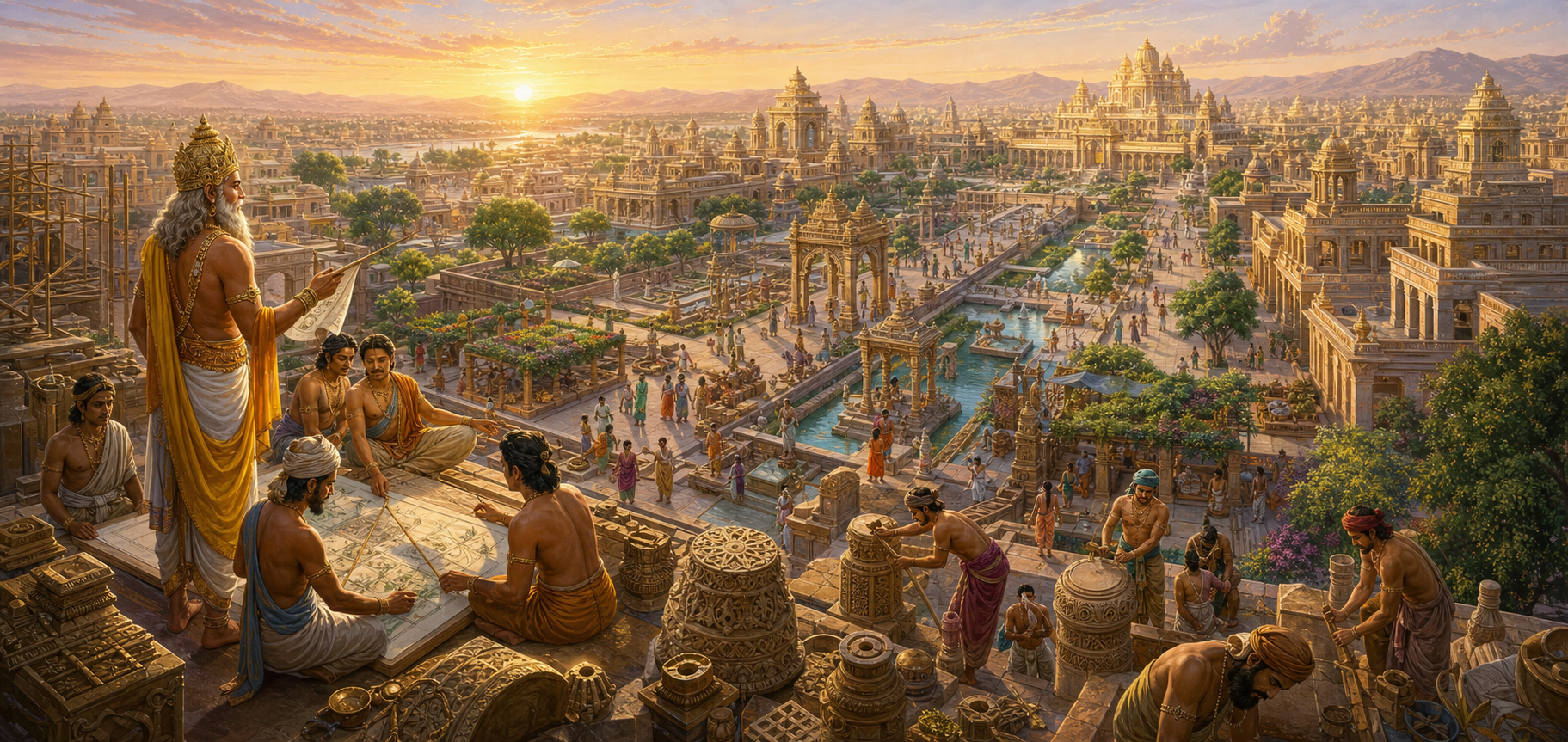
Treating Vishwakarma’s works as a catalogue of supernatural achievements misses their practical force. Each type of creation shows a different relationship between capability, order and responsibility.
- Amaravati: Indra’s celestial abode is frequently attributed to Vishwakarma. Its splendor represents more than decoration; a well-formed dwelling gives order, protection and dignity to the life conducted within it.
- Lanka and Dwaraka: The golden Lanka is connected in different traditions with Kubera or Shiva before it comes under Ravana’s rule. Dwaraka is remembered as Sri Krishna’s fortified maritime city. Read together, the cities make an important distinction: excellent construction can create security and prosperity, but craftsmanship cannot guarantee the virtue of every later ruler or user.
- The divine weapons: Tradition connects Vishwakarma with Indra’s Vajra, fashioned from the bones of the sage Dadhichi. Regional and textual accounts also attribute Vishnu’s Sudarshana Chakra and Shiva’s Trishula to him. Their sacred meaning depends on disciplined protection of dharma, not admiration of force for its own sake.
- Pushpaka Vimana: The celebrated vehicle is associated first with Kubera and then with later events in the Ramayana. Like the cities and weapons, it separates the power of invention from the choices of the person who possesses it.
- The deities of Jagannath at Puri: A cherished legend remembers Vishwakarma carving the sacred forms under a condition of seclusion. Its center is not spectacle but trust in the maker, patience with an exacting process and reverence for work that cannot be rushed merely to satisfy curiosity.
These narratives give you a useful test for any achievement. Ask what order it creates, what it protects, who benefits from it and whether its eventual use honors its intended purpose. That test works for a building, a machine, an institution, an artistic object or any system that changes how other people live.
Lanka supplies the sharpest warning. Beauty, wealth and engineering excellence do not make every use righteous. The maker must care about purpose, but users and rulers also remain accountable for what they do with inherited power. Hindu tradition therefore leaves room for both admiration of craft and moral judgment about its use.
Craft becomes dharma when means and ends agree
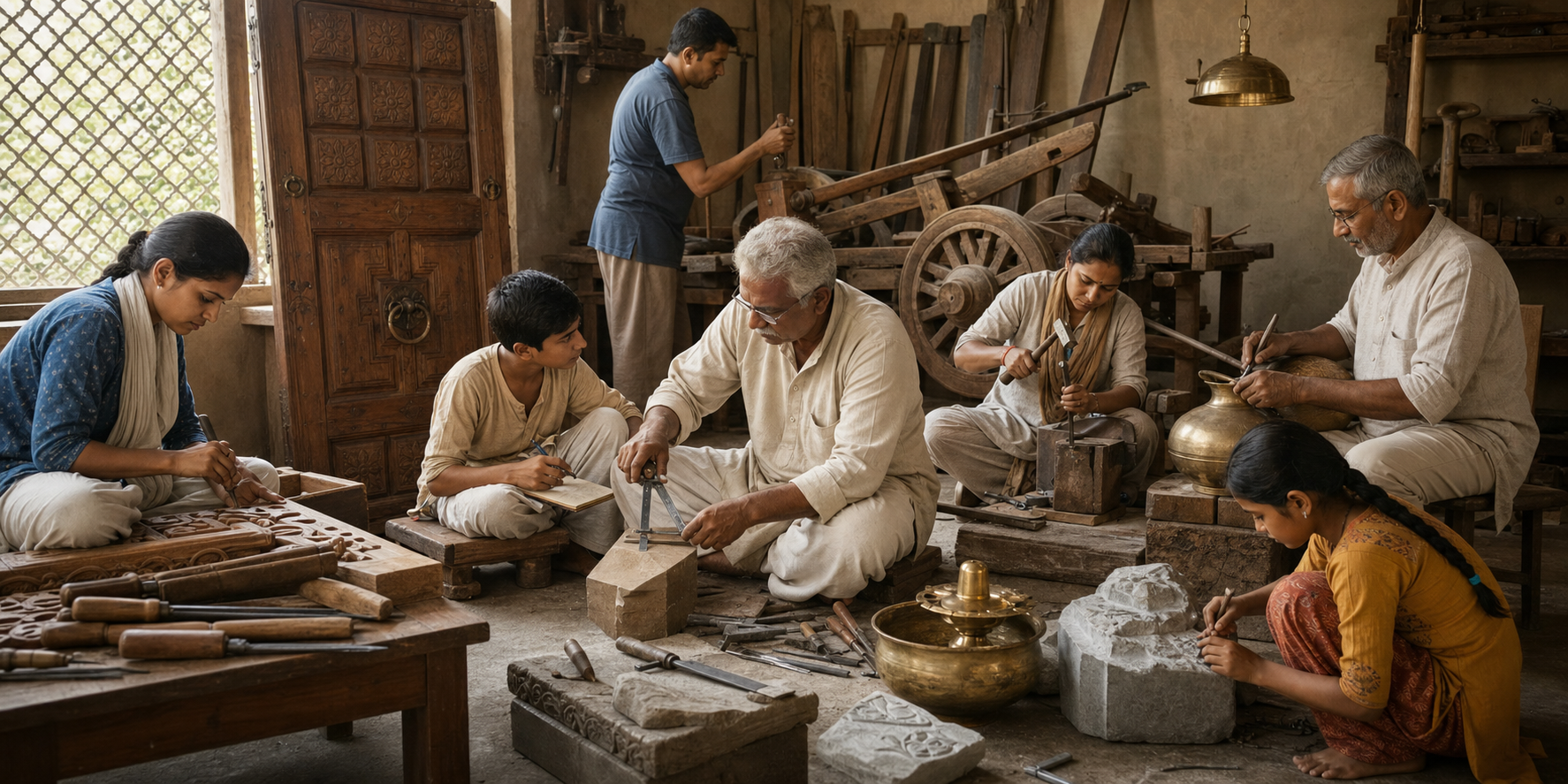
Vishwakarma embodies a theology of making in which the refinement of material is linked with the refinement of character. A precise hand joined to a careless conscience is incomplete. So is a noble intention unsupported by patient training. Sacred craftsmanship holds competence and character together.
You can turn that principle into a five-part audit of your own work:
- Purpose: Name the real human need the work is meant to serve. If you cannot identify one, technical ambition may have displaced purpose.
- Means: Examine the process as closely as the result. Deception, unsafe shortcuts and exploitation do not become dharmic because the finished object looks beautiful.
- Fitness: Make the thing appropriate to its use. Ornament cannot compensate for a structure, tool or system that fails the people who depend on it.
- Stewardship: Consider maintenance, repair and responsible use. Making something is also the beginning of an obligation toward its continued consequences.
- Service: Ask whether the work strengthens life around it. Skill becomes more than self-display when it contributes to protection, knowledge, worship, livelihood or communal well-being.
This ethic explains why artisan lineages invoke Vishwakarma as their patron. Their relationship to Vastu and Shilpa principles is not merely decorative or sentimental. Measurement, material knowledge, inherited technique and disciplined execution become ways of participating in an ordered world.
It is also important not to flatten Vastu and Shilpa into one supposedly universal manual. Technical traditions developed across centuries through multiple schools and communities. If you want to understand a temple, image or inherited craft properly, identify its regional lineage and living practitioners before applying a generalized rule from somewhere else.
Modern professionals can learn from Vishwakarma without displacing the hereditary artisans for whom his worship has a particular communal depth. Anyone whose work gives form to matter, space or a practical system can apply the ethical pattern. But appreciation should include respect for the people who preserve the techniques: acknowledge their knowledge, deal fairly with them and do not reduce sacred craftsmanship to an attractive style detached from its makers.
A related reverence for disciplined making appears across the wider dharmic civilization. Temples, Buddhist stupas, Jain basadis and Sikh gurdwaras all depend upon skilled hands placed in service of a sacred or communal purpose. This does not mean that every tradition worships Vishwakarma or holds an identical theology. It means we can recognize a shared civilizational respect for beauty, knowledge, service and the dignity of labor without erasing real differences.
How to make Vishwakarma Jayanti meaningful at work
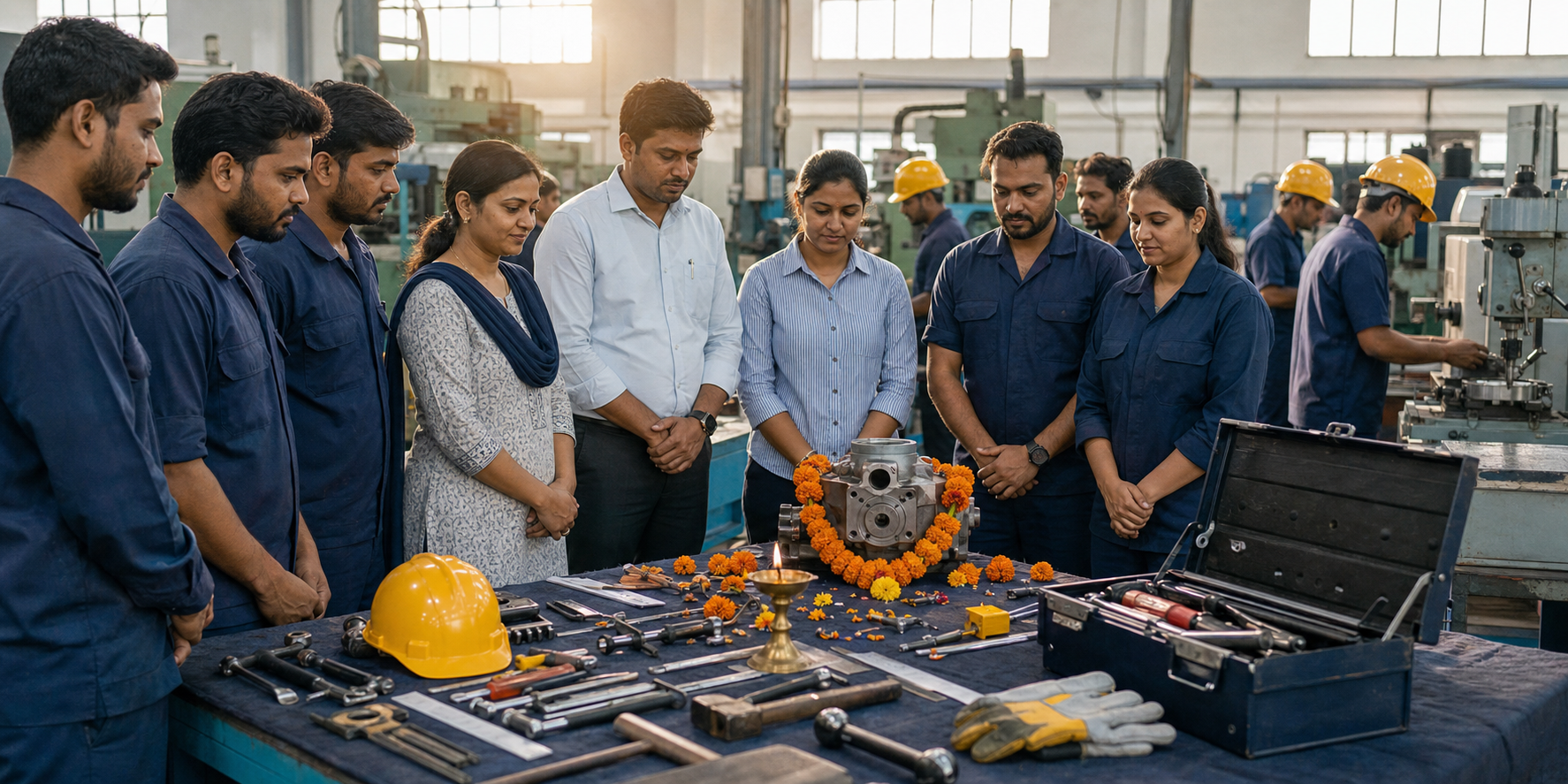
Vishwakarma Jayanti brings households, workshops and occupational communities together to honor tools and workplaces. Regional calendars and ritual forms vary, so your family, temple or guild tradition should guide the puja itself. There is no need to invent one standardized observance for every community.
The ethical meaning of the day, however, can be made concrete. Build the observance around these actions:
- Make the workplace safe before beginning. Power down and secure machinery as required by the equipment and site. Never place flowers, cloth, lamps or offerings near energized equipment, moving parts or other hazards. Devotion is not a reason to bypass established safety procedures.
- Clean and inspect the tools. Treat cleaning as care, not merely presentation. Set aside damaged or unsafe equipment for assessment by a qualified person rather than returning it to use after the ceremony.
- Remember the chain of knowledge. Acknowledge the teachers, artisans, technicians, coworkers and earlier generations whose learning makes your own work possible. No complex craft begins with its current practitioner.
- Review one real decision. Choose a current project and test its purpose, means, fitness, stewardship and service. Record one correction you will make rather than settling for a general promise to work better.
- Renew competence. Identify one technique, maintenance practice or body of knowledge you need to improve. Reverence for a tool includes becoming more worthy of using it.
This approach does not replace puja. It prevents worship from ending at the visible ceremony. A polished machine in an unsafe workplace, an ornate commission produced through unfair treatment or a sacred building made with contempt for artisans contradicts the very dignity being honored.
The workshop can become a place of sadhana when attention, restraint and service shape ordinary labor. Repetition trains the hand, but it can also train patience. Measurement disciplines material, but it can also discipline ego. Maintenance expresses gratitude because it refuses to treat either tools or human skill as disposable.
Key takeaways
- Vishwakarma joins two scales of sacred creation: the Vedic universal shaper and the Puranic Devashilpi who gives particular objects and places their form.
- Differences among texts and regional traditions are not a defect to be hidden. Identify the tradition behind an account before treating its details as universal.
- Amaravati, Lanka, Dwaraka, the divine weapons, Pushpaka and the Jagannath tradition all connect extraordinary skill with questions of purpose, restraint and responsibility.
- Technical excellence becomes dharmic when worthy ends are pursued through honest, safe and disciplined means.
- Honoring Vishwakarma requires more than decorating tools. Care for them, protect the people using them, respect the knowledge behind them and examine what your work contributes to society.
Before your next workday begins, choose one tool or system on which you depend. Care for it properly, name the people whose knowledge made your use of it possible and write down one ethical standard you will not compromise. That modest act lets Vishwakarma’s sacred architecture move from the realm of story into the structure of your conduct.
References
