
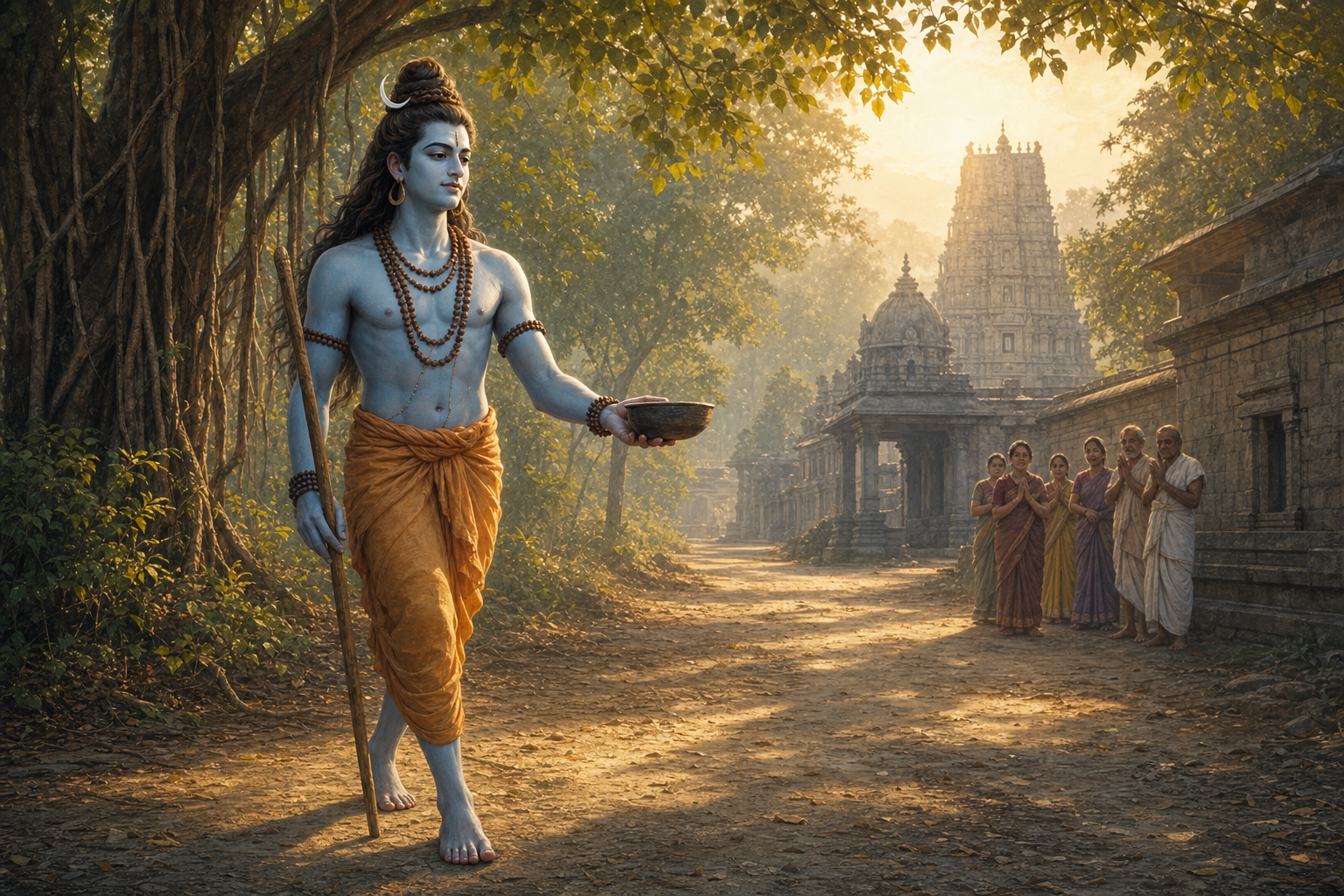
You may have encountered a striking image of Shiva as a youthful wanderer: bare-footed, lightly adorned, carrying a bowl and staff instead of sitting upon a throne. The easy mistake is to read the figure as a glorification of poverty or as an obscure episode from Shaiva mythology.
Bhikshatanamurti asks something more demanding of you. The form overturns the usual rankings of rich and poor, giver and receiver, householder and ascetic. Once you know how to read its visual language, it becomes a practical test of how you possess, give, receive, and serve.
Why the Lord who needs nothing asks for alms
Bhikshatanamurti presents Shiva as the Supreme Mendicant. A mendicant lives without accumulation and depends upon freely offered alms. Yet Shiva does not wander because the divine lacks food, property, or power. His voluntary dependence reveals freedom from the belief that possessions establish worth.
Hold three apparent contradictions together when you contemplate the form. Shiva asks, yet is not needy. He possesses little, yet appears radiant rather than diminished. He receives an offering, yet the encounter gives the donor an opportunity for spiritual refinement. Remove any one of these tensions and the image becomes easier to explain but much less useful.
This is where aparigraha, or non-possession, differs from mere lack. Lack can be imposed by circumstances. Aparigraha is the deliberate refusal to make accumulation the foundation of identity. It does not require every householder to abandon property. It requires you to notice when property, status, or comfort begins to possess the mind that claims to possess it.
Vairagya, or dispassion, adds a second distinction. Dispassion is not indifference to people. Bhikshatana moves among people and turns ordinary encounters into instruction. The form therefore joins inward detachment to outward relationship. You are not asked to care less; you are asked to serve without fastening the ego to what you own or do.
Regional narratives do not always arrange Bhikshatana’s story in exactly the same way. Some connect the form with penance, while others emphasize the humbling of arrogant sages. Do not force every telling into one artificial biography. Ask what the particular narrative is exposing:
- What attachment or claim to superiority has become invisible to the people in the story?
- Why does Shiva approach as a recipient rather than command as a ruler?
- What must be relinquished before the encounter can become an occasion of grace?
Those questions keep attention on ahankara, the ego that turns learning, austerity, wealth, or social position into a claim of spiritual importance. The wandering form does not merely condemn obvious greed. It exposes the subtler desire to own holiness itself.
How to read the bowl, staff, bare feet, and movement
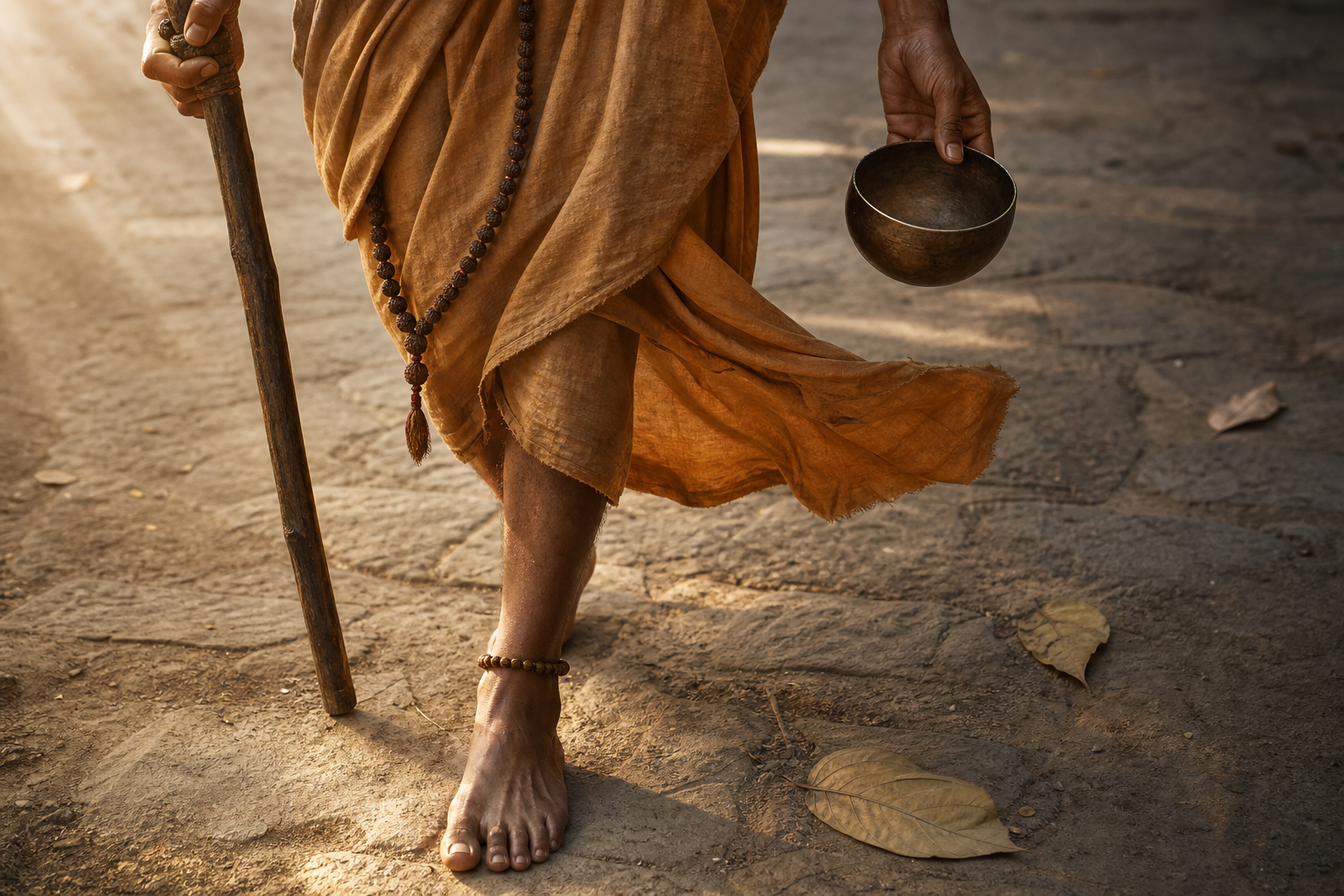
The symbols should be read as a connected visual grammar. A bowl by itself could indicate material need. In Shiva’s hand, beside a disciplined ascetic body, it becomes a challenge to the social hierarchy between the person who gives and the person who receives. The same principle applies to the rest of the image: identify the object, observe how Shiva bears it, and then connect it to the discipline the complete form embodies.
- The begging bowl, or kapala: The bowl is openness made visible. Shiva allows another person to give, so receiving is not treated as humiliation. When you look at it, ask whether you can accept necessary help without shame and offer help without superiority.
- The staff: Renunciation is disciplined, not improvised. The staff points to steadiness, restraint, and a path that must be sustained. Simplicity without discipline can become a passing mood; the staff asks what practice supports your intention.
- Bare feet: Shiva is shown close to the earth and near to the beings he encounters. The image does not place the ascetic behind the distance of a palace. Notice how this groundedness changes your idea of sacred authority: the divine can meet society at the level of an ordinary road and an ordinary offering.
- Minimal adornment: Reduced ornament directs attention away from rank and possession. This is cultivated sufficiency, not carelessness. The practical question is not whether an object is beautiful, but whether your dependence on it has begun to govern your choices.
- Youthfulness and radiance: South Indian representations, including Chola bronzes, often show a youthful and luminous ascetic. That radiance prevents you from equating renunciation with exhaustion, resentment, or lifeless austerity. Inner freedom is presented as fullness rather than defeat.
- The antelope or damaru: Some representations include one of these familiar elements of Shiva’s wider iconography, while others do not. Their absence does not make a murti incomplete. Record what is actually present and consult the temple’s or region’s own tradition before assigning a fixed explanation.
- The suggestion of movement: Bhikshatana is encountered as a wanderer, not merely as a stationary emblem. Movement carries the teaching beyond a secluded ascetic setting and into social life. The road, settlement, donor, and offering all become part of the sacred encounter.
A useful reading sequence is simple. Begin with posture and movement, then identify the objects, and finally ask what relationship the entire composition establishes between Shiva and the people around him. This guards against turning iconography into a catalogue in which every item has one isolated definition. The meaning resides just as much in the encounter as in the objects.
The bowl changes the meaning of dana
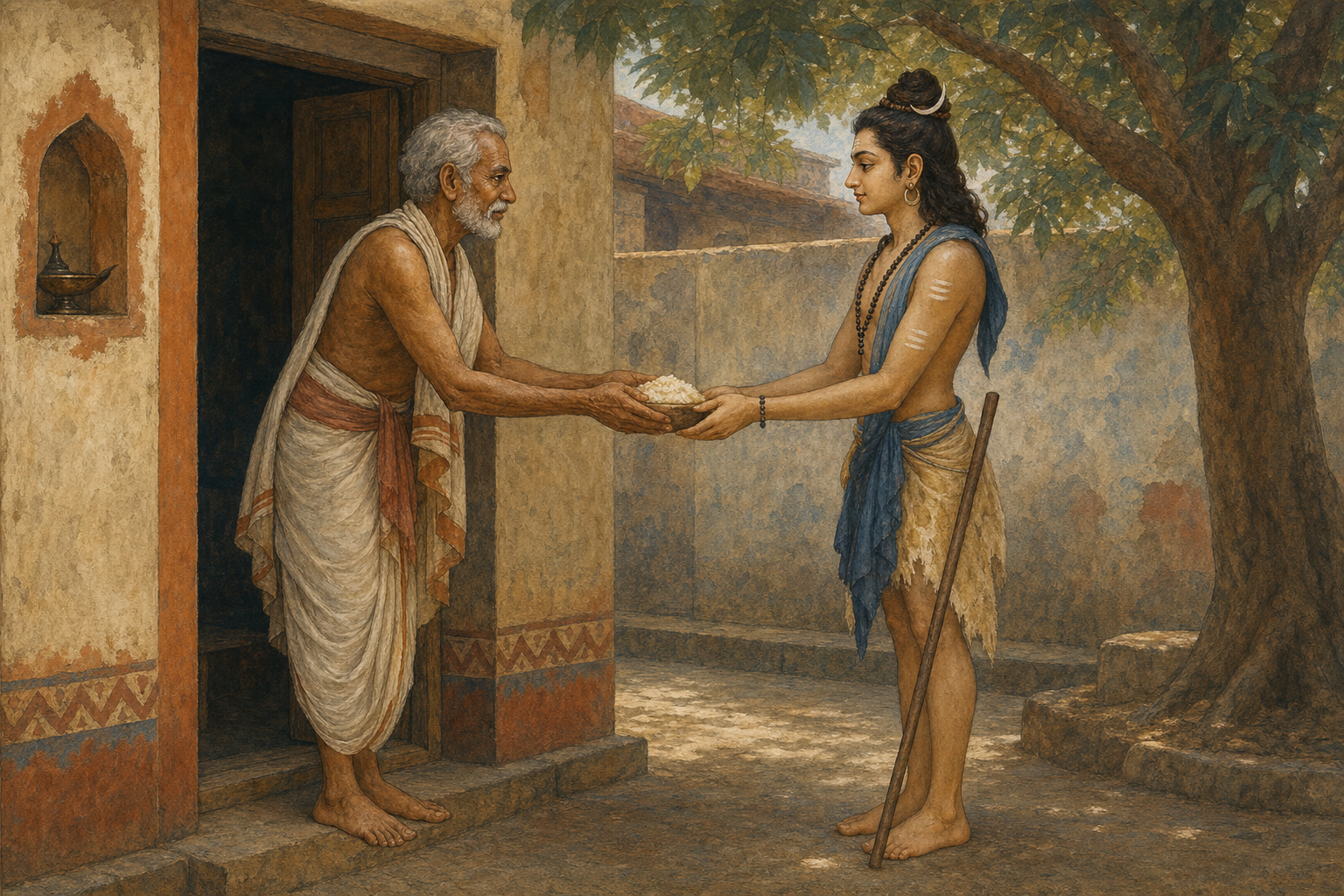
Ordinary charity can preserve a quiet hierarchy: one person possesses enough to act, while another is defined by lack. Bhikshatanamurti disrupts that arrangement. When the recipient is Shiva, the donor cannot plausibly claim spiritual superiority. The offering becomes dana, a sacred exchange in which relinquishment benefits the giver and reception completes the act.
This does not mean giver and receiver perform identical roles. It means neither person’s dignity is cancelled by the role. The giver contributes food, time, attention, or protection. The receiver makes giving possible and prevents generosity from remaining an untested self-image. Each participates in a relationship that can weaken possessiveness.
The distinction also prevents a harmful misreading: chosen ascetic discipline does not make involuntary deprivation desirable. Bhikshatanamurti does not give you permission to romanticize another person’s hunger or hardship. The lesson concerns your attachment and your manner of giving. If an offering is degrading, unusable, controlling, or designed mainly to display the donor’s virtue, it has missed the bowl’s symbolism.
Use four checks whenever you give:
- Dignity: Are you treating the recipient as a person with agency, or merely as evidence of your generosity?
- Usefulness: Does the offering meet an actual need, or are you transferring what you no longer want and calling the disposal dana?
- Freedom: Does the gift create an unstated demand for praise, loyalty, obedience, or public gratitude?
- Inner effect: After giving, has your grip on possession weakened, or has the ego simply acquired a more respectable identity?
Shared Dharma without erasing real differences
The mendicant ideal creates a meaningful point of recognition across the Dharmic family. The Buddhist bhikshu and Jain muni embody disciplined simplicity and restraint. The Sikh practices of seva and langar honor service, shared nourishment, and community dignity. These resonances connect non-possessiveness with compassion and care for the community.
The comparison is strongest at the level of ethical practice, not as a claim that all Dharmic traditions teach identical doctrines. Bhikshatanamurti remains a distinctly Shaiva form. Buddhist and Jain mendicant disciplines retain their own frameworks, while the Sikh resonance lies especially in service and langar rather than in reproducing Shiva’s wandering appearance. Unity becomes credible when it recognizes a shared moral vocabulary without dissolving the traditions that speak it.
Turn contemplation into a discipline you can keep
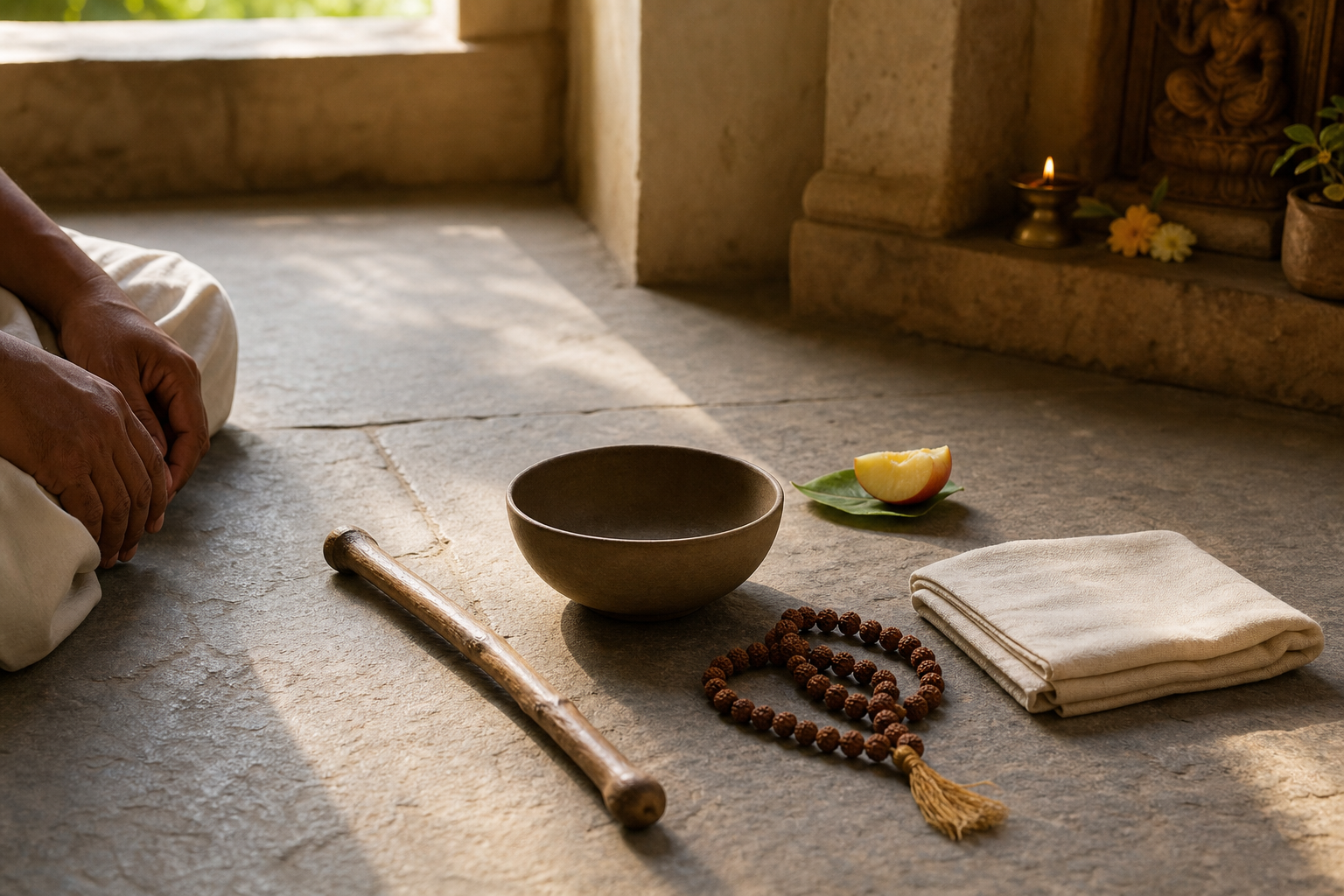
You do not honor Bhikshatanamurti by imitating the outer appearance of homelessness or by neglecting people who depend on you. Non-possession concerns your relationship to goods, comfort, and status. It does not excuse irresponsibility. For a householder, the sharper practice is to meet real obligations while reducing needless accumulation and ego-driven consumption.
Test an acquisition before it becomes an attachment
Before buying or keeping something, ask what work it will actually do. Then ask whether you would still choose it if nobody else could see the brand, price, rarity, or status it conveys. That second question often separates utility from identity.
- What need does this possession meet?
- What maintenance, waste, or ecological burden follows from keeping it?
- Is an underused object being stored because it is useful, or because releasing it feels like losing part of yourself?
- Could the same resources support food, time, protection, or attention for someone who needs them?
- What would sufficiency look like here, apart from both excess and performative deprivation?
This examination keeps aparigraha from becoming a fashionable minimalist aesthetic. A sparse room can still be organized around pride. A well-equipped household can still be guided by stewardship. Count attachment by the control an object exercises over your mind and conduct, not only by the number of objects visible.
Make the next act of giving a sadhana
Annadana and seva make Bhikshatana’s teaching concrete, but the practice need not begin with a grand undertaking. Use the next ordinary opportunity to give as a complete discipline:
- Choose an offering that addresses a real need: food, time, sustained attention, practical assistance, or protection.
- Make it fit to receive. Do not use spiritual language to disguise a careless, unusable, or demeaning gift.
- Notice any wish to be recognized as generous before you act. You do not have to pretend the wish is absent; you do have to stop it from controlling the offering.
- Give without converting assistance into authority over the recipient’s choices.
- If you are the one receiving, accept necessary support without treating your temporary need as proof of lesser worth.
- After the exchange, ask what changed in your attachment. If only the ownership changed while pride increased, the outward gift has not yet completed its inward work.
This is why receiving belongs inside the practice. Many people are willing to serve but resist being served because competence has become part of their self-image. Bhikshatanamurti places divine dignity on the receiving side of the exchange. Allowing trustworthy help can also loosen ahankara.
Key takeaways
- Bhikshatanamurti’s begging does not indicate divine lack; it reveals freedom from possessions as a basis of worth.
- The bowl makes receiving spiritually active and prevents the donor from claiming automatic superiority.
- The staff, bare feet, minimal adornment, youthful radiance, and movement should be read together as a language of disciplined and compassionate detachment.
- Regional stories may emphasize penance or the humbling of pride, but both direct attention toward the dismantling of ahankara.
- Buddhist, Jain, and Sikh resonances reveal shared values of restraint, dignity, and service without making the traditions interchangeable.
- For a householder, aparigraha means responsible sufficiency, ethical consumption, dignified giving, and the ability to receive help without shame.
Bring the image into your next real decision. Before the next purchase, donation, or refusal of help, ask whether you are serving a need or protecting an identity. Then make one choice that leaves less room for possession and more room for dignity. That is where the wandering Shiva ceases to be only an image and begins to shape conduct.
References
