

When you encounter the Mahabharata as opera, or Dandakaranya placed beside a European forest, the first reaction can become unnecessarily binary: celebrate the global recognition or reject the reinterpretation as dilution. Neither response tells you whether the work actually respects dharma.
If you are deciding whether to attend, teach, fund, recommend, or publicly criticise such a work, look beyond its foreign form. Ask what changed, what remained intact, and whether the audience is given a clear route back to the originating tradition. That produces a more demanding standard than either cultural defensiveness or automatic applause.
A new form does not automatically mean a lost tradition
Every global reinterpretation changes a vessel. Language, music, pacing, visual design, and performance conventions may all move. The decisive question is whether the adaptation also replaces the epic’s moral and metaphysical grammar.
Opera Mahabharat places the Indian epic within a multilingual operatic form, using expansive choral writing and character-centred arias to communicate dharma, duty, compassion, and ethical governance. Opera is not indigenous to the Mahabharata, but that fact alone does not make the encounter inauthentic. A new medium can give unfamiliar audiences an intelligible entrance into an old and demanding narrative.
It helps to separate three layers that are often confused:
- The vessel: the language, music, staging, illustrations, costumes, or digital format through which the work reaches you. This layer can change substantially.
- The narrative architecture: the identities of the characters, the sequence and consequences of their choices, and the relationships that make an episode intelligible. Changes here require explanation.
- The dharmic grammar: the concepts through which action acquires meaning, including dharma, adharma, duty, compassion, restraint, truth, and accountability. This layer demands the greatest care.
The farther an adaptation moves from the vessel toward the dharmic grammar, the greater its burden of interpretation. A composer can change an instrument without altering the ethical conflict. A screenwriter who turns dharma into simple obedience has changed something much deeper.
Translating dharma as duty may help a first-time audience, but duty does not exhaust the term. Dharma also concerns right relationship, role, consequence, order, and the difficult discernment required when obligations collide. You should therefore ask whether the production merely uses a familiar English word or allows the story to reveal the larger concept through action.
A five-part dharmic test for any global adaptation

You do not need specialist credentials to evaluate a reinterpretation. Apply five tests to its title, synopsis, programme material, performance, and educational claims.
- Check provenance. Does the work plainly name the Mahabharata, Ramayana, Bharat, and the relevant Hindu or broader Dharmic context? A label such as world mythology may describe circulation, but it should not erase origin. If the audience cannot tell where the narrative comes from, accessibility has become detachment.
- Track the key concepts. Listen for what happens to words such as dharma, adharma, vanvas, ahimsa, seva, and satya. An adaptation need not leave every term untranslated, but it should preserve the distinctions the plot depends upon. Ask whether the translation opens a concept or quietly closes it.
- Protect moral difficulty. Sacred epics endure partly because right action is not always obvious. Be cautious when a production converts a conflict among duties into a simple contest between modern heroes and villains. Simplified casting may make the plot faster while making its instruction poorer.
- Demand honest limits. A comparison should say what is being compared: narrative function, ecological setting, emotional atmosphere, ritual status, or ethical lesson. Similarity on one axis does not establish sameness on every other axis.
- Look for a return path. A responsible work gives the curious audience somewhere to go next. An episode name, glossary, map, reading recommendation, explanation of creative inventions, or discussion with tradition-literate teachers turns exposure into learning.
These tests lead to three useful judgements. You can recommend a work as a respectful interpretation when it identifies its origin, retains the central ethical tension, and acknowledges invention. You can share it with a caveat when the form is illuminating but the framing is incomplete. You should not present it as an educational account of the tradition when it obscures provenance or replaces the tradition’s categories without disclosure.
This approach also protects unity without manufacturing uniformity. Ahimsa, seva, satya, compassion, discipline, and reverence for life can create meaningful conversation among Hindu, Buddhist, Jain, and Sikh communities. They do not make the communities’ scriptures, doctrines, or sacred histories interchangeable. A global reinterpretation should be able to recognise ethical kinship and doctrinal distinction at the same time.
Landscape comparisons must preserve meaningful differences

Comparing sacred landscapes requires even more care than adapting a story. A landscape is not simply an image in a text. It may also be a remembered route, a pilgrimage network, an ecological home, and a place in which communities continue to locate sacred time.
In the Ramayana, Dandakaranya is bound to the period of vanvas and to encounters involving Rama, Sita, Lakshmana, rishis, ashramas, and rakshasas. The forest is therefore more than scenery. It places duty, protection, temptation, violence, hospitality, and restraint within a terrain beyond settled familiarity. Ramayana-linked places such as Chitrakoot and Panchavati continue to connect narrative memory with devotion.
Germany’s Black Forest carries a different inheritance. Located in Baden-Wurttemberg, it is associated with European folklore, regional craft, ecological memory, and the fairy-tale imagination. The Breg and Brigach rise in the region and form the Danube, while other headwaters feed the Neckar. Its dense canopy and changing light readily support stories of uncertainty and transformation. Yet not every Brothers Grimm tale belongs there, and a strong cultural association should not be mistaken for a single, uniform textual history.
The comparison becomes useful at a defined level: both forests can function as thresholds where familiar social space gives way to testing, danger, wonder, and altered perception. It becomes misleading if it implies that the forests have the same sacred status, the same relationship to an epic, or a shared historical origin.
Use a one-similarity, one-boundary rule whenever you compare sacred places. State the shared feature, then immediately state the limit. For example: both Dandakaranya and the Black Forest can stage moral testing, but Dandakaranya’s role here arises from Ramayana-linked sacred geography, while the Black Forest comparison arises primarily from European folklore, regional memory, and ecology.
You can make the comparison more exact by separating four questions:
- Narrative function: What happens when a character enters the landscape, and how does the person change before leaving it?
- Ethical vocabulary: Which duties, prohibitions, virtues, or dangers give those events meaning?
- Lived status: Is the place connected to pilgrimage and continuing devotion, regional folklore and craft, ecological identity, tourism, or some combination of these?
- Material reality: What do the actual rivers, trails, settlements, habitats, and conservation needs prevent you from reducing to metaphor?
This last question matters. Calling a forest sacred while treating it as a decorative setting reproduces the very detachment that sacred geography resists. If you visit a landscape after encountering it through an epic or comparison, learn the local protocol, remain on permitted routes, avoid disturbing wildlife, and distinguish a devotional association from a location chosen merely for visual resemblance.
How to attend, teach, or share a reinterpretation responsibly
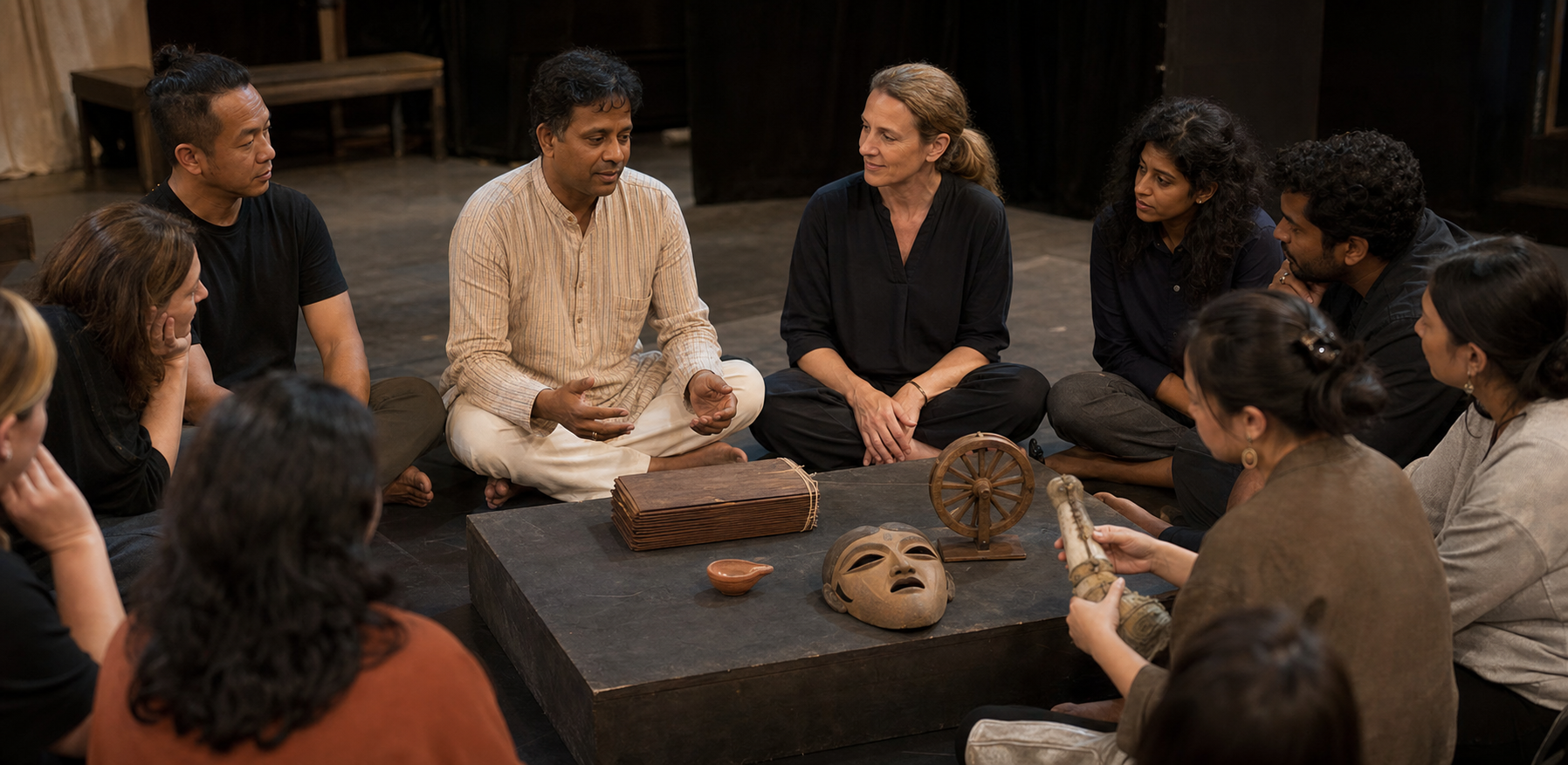
Your role changes the questions you should ask. A viewer is deciding how to understand a work. A teacher is deciding what students may mistake for the tradition itself. A cultural institution is making a public claim about whose heritage is being represented.
Before you attend or watch
- Read the synopsis and identify the exact epic episode or character arc. A work inspired by an entire epic may actually present a narrow selection.
- Mark the unfamiliar form separately from the content. Opera, animation, dance, or contemporary theatre may feel strange without being disrespectful.
- Check whether the creators distinguish inherited narrative elements from new dialogue, reordered events, composite characters, or symbolic scenery.
- Choose one key term to follow. If you track what happens to dharma throughout the performance, you will learn more than you will by counting surface-level Indian motifs.
While you experience the work
Notice what the new medium makes visible. An aria can slow a moment of conscience. A chorus can make communal judgement audible. A vast stage can communicate the public consequences of a private decision. These are genuine interpretive possibilities, not merely foreign decoration.
Then notice the cost. Compression can remove context; emotional immediacy can make one character’s perspective appear final; spectacle can overwhelm ethical ambiguity. Write down one insight the form created and one distinction it obscured. That small discipline keeps admiration and criticism equally precise.
Afterward, return to the tradition
Do not let the adaptation become your only encounter with the epic. Locate the episode in a trusted edition, commentary, teaching lineage, or discussion led by someone who understands its Dharmic context. Compare the consequence of the central choice, not just the costumes or sequence of events. If the adaptation changed your sympathy for a character, ask whether that shift came from the inherited narrative or from a creative decision made for the new medium.
If you teach the work, label three things explicitly: what comes from the epic, what belongs to a recognised interpretive tradition, and what the modern creators invented. Students can then appreciate creativity without confusing it with textual authority.
If you organise or fund such a project, require a concise programme note that names the civilizational origin, identifies the selected episode, defines indispensable terms, discloses major inventions, and offers a route for further study. Involve people who can recognise theological and cultural errors before publicity fixes them in the public imagination.
International collaboration can widen access, strengthen cultural exchange, and give Indian narratives a larger stage. The BRICS-CMF operatic collaboration illustrates that cultural-diplomatic possibility. Reach, however, is not a certificate of fidelity. Evaluate artistic scale and civilizational integrity as separate achievements.
Respond to distortion with precision, not reflex
Not every weakness amounts to hostility, and not every attractive production deserves endorsement. Precision gives cultural advocacy more credibility. Name the layer in which the problem occurs.
- If the problem is an unfamiliar aesthetic, explain why the form does or does not serve the episode.
- If the problem is missing provenance, ask for clear identification of the Indian and Dharmic origin.
- If a key concept has been flattened, identify the lost distinction and show how it changes a character’s decision.
- If two landscapes have been treated as equivalents, retain the useful comparison while restoring their different histories and lived statuses.
- If promotional material claims to represent the whole tradition, ask that it use the more accurate phrase inspired by or an interpretation of.
This is firmer than issuing a vague accusation of appropriation because it identifies a repair. It also allows you to defend a worthy experiment when criticism rests only on the foreignness of its medium. Dharmic traditions have enough intellectual depth to travel; what they require is not confinement but accountable translation.
Key takeaways
- Judge a reinterpretation by what it does to provenance, narrative consequence, and dharmic concepts, not by whether its artistic form originated in Bharat.
- Give creators freedom with the vessel and demand increasing accountability as changes approach the story’s ethical and sacred grammar.
- Treat shared themes as an opening for comparison, never as proof that traditions or landscapes are interchangeable.
- For every landscape similarity, state one clear boundary involving sacred status, textual role, history, or present-day community.
- Attend with curiosity, teach with labels, advocate with specific corrections, and always give the audience a route back to the living tradition.
At your next encounter with a global epic or sacred-landscape comparison, spend ten minutes checking the origin, key terms, moral tension, limits of the analogy, and route for further study. Then respond accurately: welcome what carries dharma with integrity, correct what obscures it, and guide interested people toward the tradition rather than leaving them at the adaptation.
References
- DharmaRenaissance Blog – Opera Mahabharat: BRICS-CMF’s Grand Collaboration Elevating Dharmic Heritage and Global Arts
- DharmaRenaissance Blog – Dandakaranya and Germany’s Black Forest: Unraveling Sacred Myths, Memory, and Nature’s Power
