
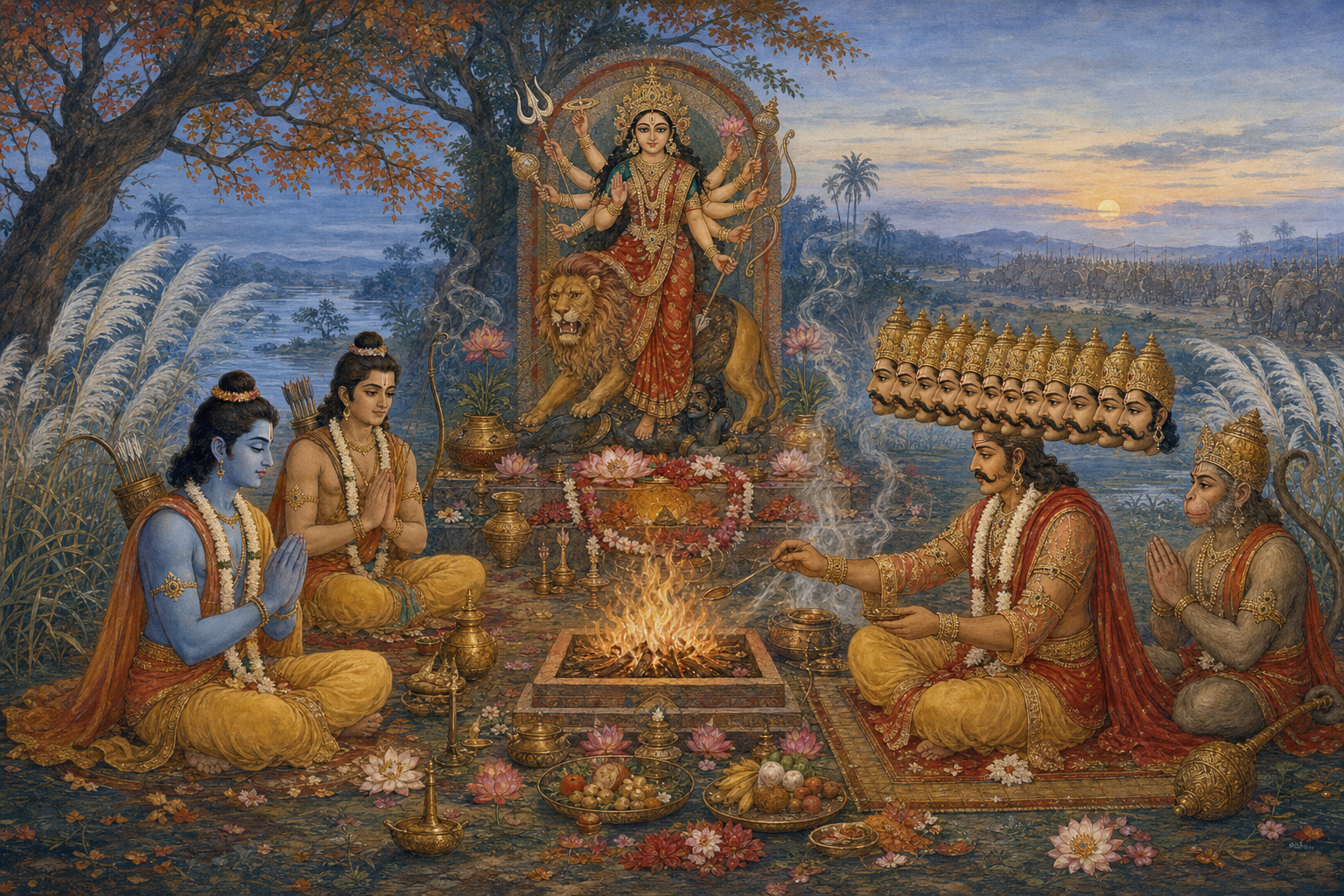
If you have heard that Ravana served as Rama’s priest before the final battle, your first question is probably whether this episode is actually in the Ramayana. The precise answer is that it belongs to the Bengali Krittivasi tradition, not to Valmiki’s account, and its details vary across recensions and performances.
That distinction does not make the episode less authentic within Bengali religious life. It tells you how to approach it: identify the tradition, preserve its internal meaning, and do not force every regional Ramayana into a single textual mould. Once you do that, Ravana’s priestly role becomes a demanding reflection on ritual competence, moral responsibility, devotion, and the place of Shakti in Rama’s victory.
Name the Ramayana tradition before making the claim
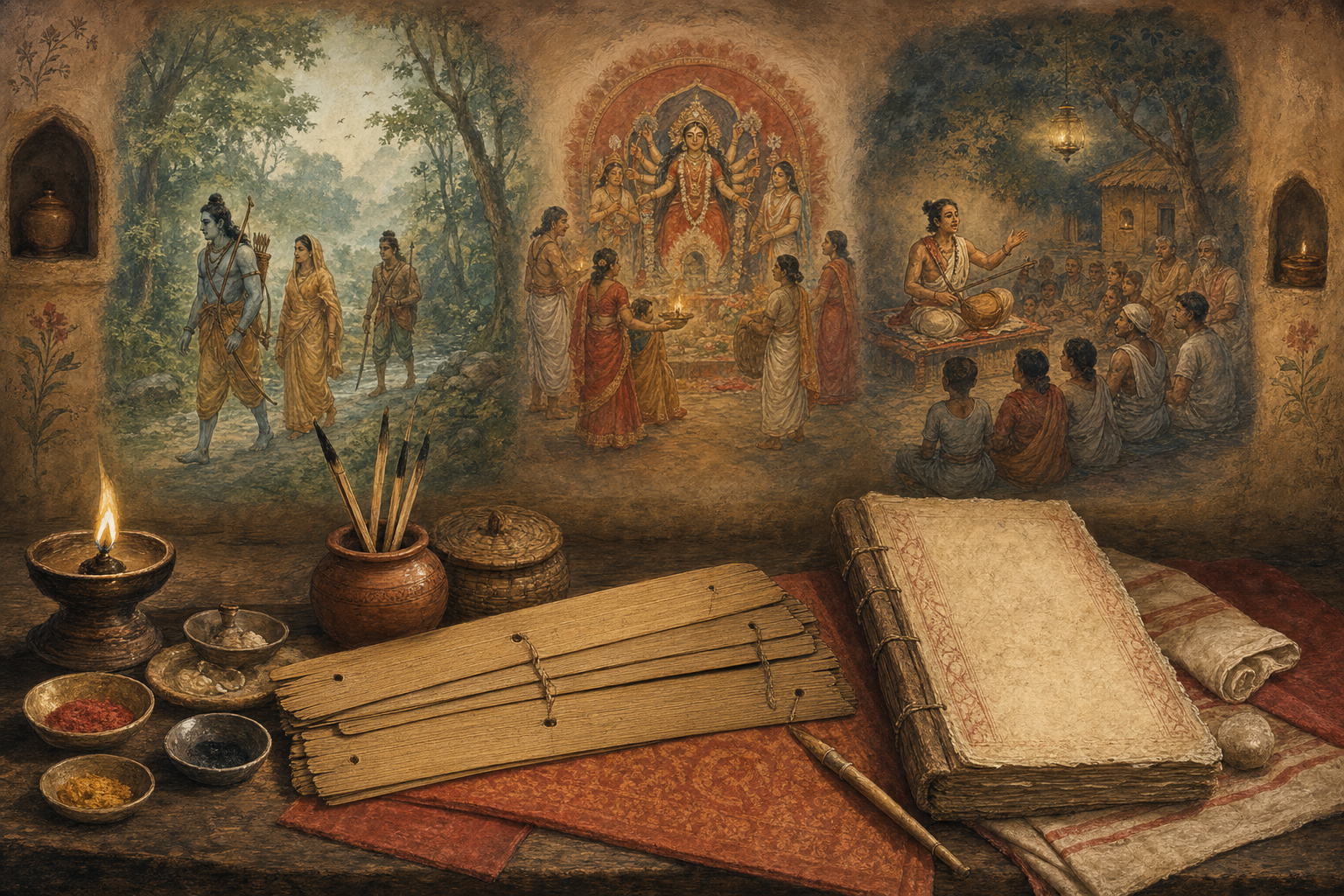
In Valmiki’s pre-battle sequence, Rama turns toward the Surya-centred Aditya Hridayam. The scene in which Rama invokes Durga and receives ritual assistance from Ravana is absent there. Medieval Bengal gave the epic a different devotional setting through the Krittivasi Ramayan and its performance traditions, placing Durga at the centre of the preparation for battle.
This is the first distinction to keep clear when you hear the story told as a startling piece of Ramayana history. It is accurate to say, “In the Bengali Krittivasi tradition, Ravana assists with or officiates Rama’s worship of Durga.” It is inaccurate to say, “Valmiki tells us that Ravana was Rama’s priest.” The difference is not pedantry. It protects the integrity of both traditions.
There is a second qualification. The Krittivasi Ramayan reached communities through manuscript transmission, retelling, recitation, and oral performance. Consequently, Ravana’s role is not identical in every version. In some recensions he acts as the officiating purohit. In others he supplies essential instructions or safeguards a crucial part of the procedure. You should therefore verify the recension before insisting on the most dramatic form of the scene.
A simple three-question test will keep any discussion grounded:
- Which Ramayana? Distinguish Valmiki’s Sanskrit account from the Bengali Krittivasi tradition.
- Which version within that tradition? Ask whether Ravana officiates throughout, gives instructions, or supplies decisive ritual knowledge.
- What kind of truth is being claimed? A living sacred tradition can convey theological and ethical truth without pretending that every detail occurs in every earlier text.
This method also avoids two unhelpful reactions. One is to insert the episode into Valmiki merely because it is beloved in Bengal. The other is to dismiss it as an illegitimate addition because it is regional. Vernacular Ramayanas did not survive by behaving like mechanical copies. They carried the epic into local language, worship, music, seasonal memory, and theological reflection while retaining its central struggle between dharma and adharma.
Akalbodhan joins Rama’s urgency to Bengal’s autumn
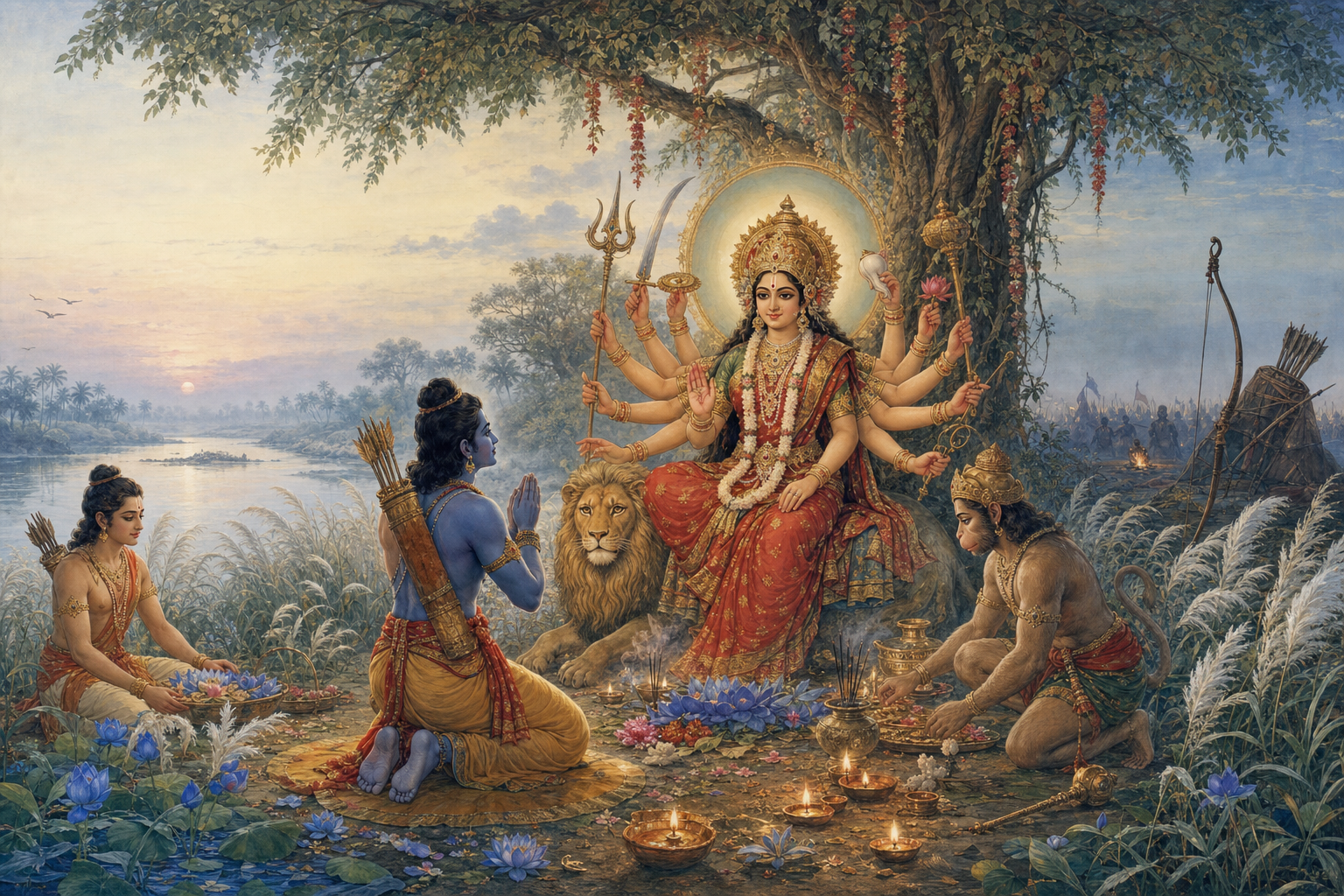
Akalbodhan is the invocation of the Goddess at an unusual time. The relevant contrast is between the traditional vernal worship associated with Basanti Durga and Rama’s urgent autumnal invocation before confronting Ravana. The timing is exceptional; the worship is not careless or spiritually inferior.
This point matters because “untimely” can sound in English like “improper.” The Bengali understanding moves in the opposite direction. Rama’s need is immediate, and Durga’s grace is not imprisoned within an ordinary seasonal expectation. The exceptional timing reveals the Goddess as responsive while still requiring disciplined worship.
Akalbodhan consequently supplies Bengal’s Sharadiya Durga Puja with an epic frame. Autumn is no longer merely the date on which a regional festival happens. It becomes the moment when Rama seeks Shakti before acting against adharma. Worship, courage, and righteous purpose meet within the same sacred season.
You should nevertheless keep mythic meaning and social history distinct. The sacred story gives autumnal worship a charter in epic time. The public, community-facing form of Sharadiya Durga Puja developed historically in early modern Bengal through courtly patronage, regional literary culture, and later urban associations. The first explains what the season means to devotees; the second explains how particular public forms grew. Neither needs to be used to cancel the other.
It helps to notice three kinds of time operating together:
- Epic time: Rama requires divine empowerment before the decisive battle.
- Liturgical time: Durga is invoked in autumn, outside the customary vernal setting associated with Basanti worship.
- Community time: Bengal renews this memory through an annual festival that joins household devotion, public worship, art, recitation, and collective identity.
During Durga Puja, you can see the surrounding ritual world in the pre-dawn atmosphere of Mahalaya, the cadence of Chandi Path, Sandhi Puja at the Ashtami-Navami junction with 108 lamps, and the consecration of the Nabapatrika, popularly associated with the Kola Bou. These practices resonate with Akalbodhan’s concerns: correct invocation, ritual attention, Shakti’s presence, and the transformation of seasonal time into sacred time.
Resonance is not the same as claiming that one literary episode created every Puja observance. If you are explaining the festival to someone new, say that the Bengali Ramayana helps give Sharadiya worship its epic meaning. Do not reduce the festival’s entire ritual system to a single origin story.
Ravana’s priesthood recognizes competence, not innocence
The apparent scandal of the scene is straightforward: why would the adversary whose conduct has produced the war be entrusted with a sacred rite intended to precede his own defeat?
The answer begins with distinctions that modern retellings often flatten. Ravana is a rakshasa monarch and Rama’s formidable enemy, but he is also descended through Pulastya and Vishrava, learned in sacred matters, strengthened by tapas, and devoted to Shiva and the Goddess. Those attainments make his ritual role intelligible. They do not make his abduction of Sita, his misuse of power, or his refusal to return to dharma acceptable.
| What the episode recognizes | What it does not imply |
|---|---|
| Ravana’s lineage through Pulastya and Vishrava | That ancestry automatically makes his conduct righteous |
| His learning, tapas, and ritual ability | That knowledge erases the consequences of its misuse |
| His devotion to Shiva and the Goddess | That devotion excuses pride or adharma |
| His correct action within a sacred interval | That one correct act acquits his reign as a whole |
This is moral precision, not moral relativism. A person can possess genuine knowledge and still make ruinous choices. The wrong choices do not turn knowledge into ignorance, just as knowledge does not convert wrongdoing into righteousness. The Bengali telling asks you to hold both truths without weakening either.
Ritual makes the test especially exacting. Mantra-shuddhi, the purity and correctness of sacred utterance, and kriya-sampatti, the proper completion of the required acts, cannot be made subordinate to battlefield hostility. Within the episode, Ravana’s ritual eligibility rests on competence, discipline, and attainment rather than partisan loyalty. When he assumes the priestly function, the integrity of that function governs his conduct.
The distinction between svadharma and sadharana dharma helps clarify the scene. Svadharma concerns the obligations of a particular role; sadharana dharma points toward virtues that hold across roles. For a sacred interval, Ravana performs the duty attached to ritual knowledge and protects the correctness of worship. He does not thereby escape the moral consequences awaiting him as ruler and aggressor.
This gives you a better way to teach Ravana than labelling him either a one-dimensional monster or a misunderstood hero. Ask three separate questions: What does he know? What does he choose? What consequences follow from those choices? His learning explains why he can serve at the rite. His conduct explains why the war remains necessary. Dharma requires you to make both judgements.
There is also a difficult civic lesson here. Recognizing competence in an opponent is not surrender, and receiving a right action from that opponent is not approval of everything else he has done. The episode imagines a boundary strong enough to preserve the sacred even in the presence of enmity. That restraint is possible precisely because Rama’s cause does not depend upon falsifying Ravana’s abilities.
The missing lotus reveals how bhakti completes ritual
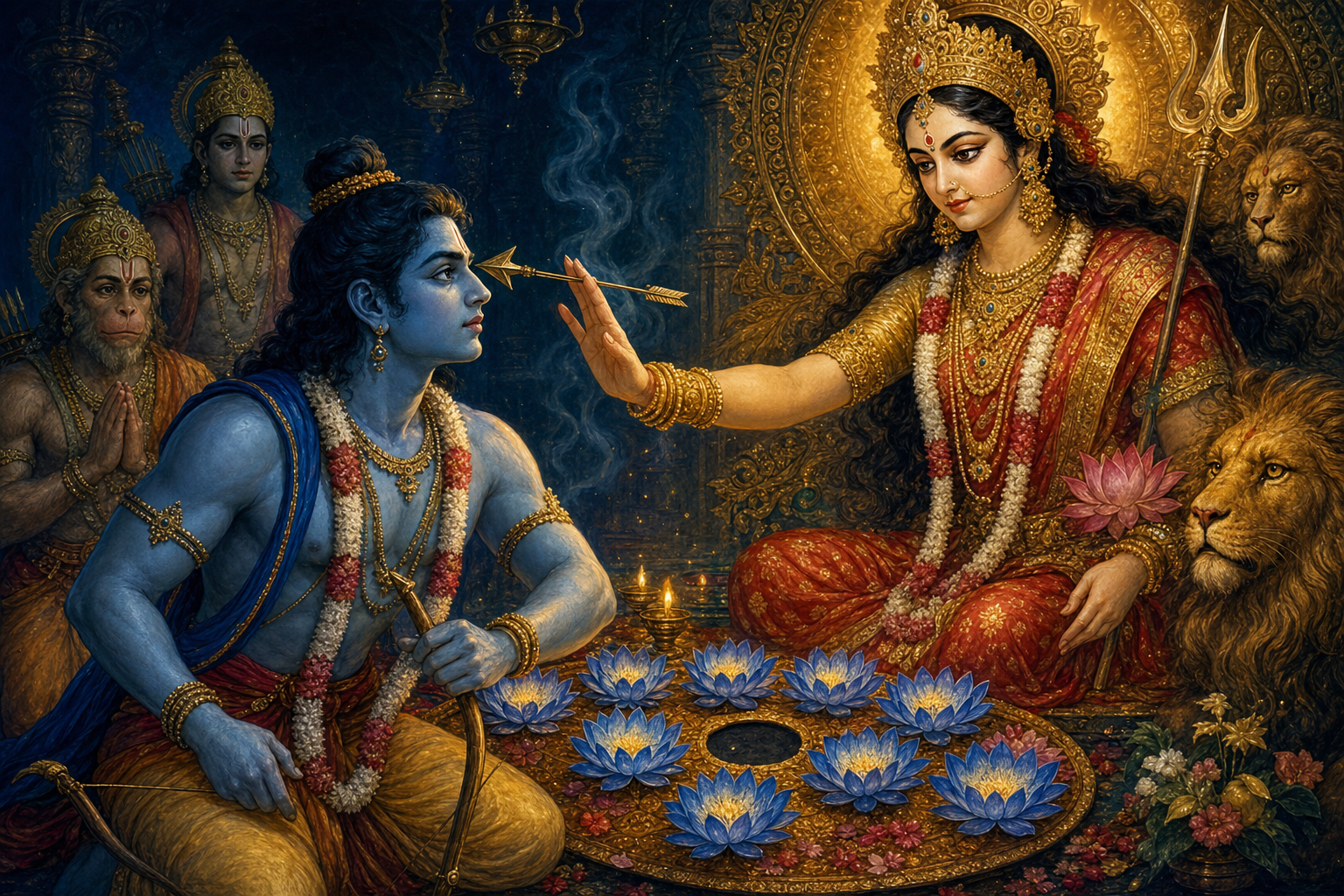
The best-known companion motif begins with 108 lotuses offered to Durga. When Rama finds the count short by one, he prepares to substitute his own eye because he is Kamalnayan, the lotus-eyed one. Durga stops the act. The shortage has exposed the depth and concentration of his devotion; physical self-injury is not required.
Do not use this moment to oppose devotion and ritual form. Rama does not begin by treating the prescribed count as irrelevant. He gathers the lotuses, confronts the deficiency, and then offers his own being rather than abandoning the worship. The sequence holds precision and surrender together. Bhakti completes ritual because the devotee’s inward state matches the outward offering, not because feeling makes discipline unnecessary.
The symbolism is unusually compact. The lotus evokes purity arising from the world’s mire. The eye represents sight, truth, and the capacity to perceive. When the external lotus is missing, Rama is ready to make perception itself the offering. Ekagrata, one-pointed attention, ceases to be an abstract virtue and becomes a visible willingness to withhold nothing.
Some tellings connect Ravana to the missing lotus or make him part of the test; others do not give him that role. Unless you have a particular recension in front of you, keep the claim conditional. The stable theological centre is Rama’s resolve and Durga’s recognition of it, not a single explanation for how the flower disappeared.
The scene also prevents a sectarian reading of divine power. Rama, understood as Vishnu’s avatara, seeks Durga’s Shakti. Ravana’s qualifications draw upon Brahmanical learning as well as devotion to Shiva and the Goddess. Durga grants the grace necessary for victory, yet Rama must still act, fight, and uphold dharma. Vaishnava purpose and Shakta power are not staged as competitors. They form a complete circuit of righteous intention, divine energy, disciplined action, and just consequence.
Valmiki’s Surya-centred pre-battle consecration and Bengal’s Durga-centred Akalbodhan therefore need not be turned into rival claims about which deity matters. They show how a pan-Bharatiya epic can retain its moral axis while entering different devotional landscapes. The variation is meaningful because the traditions remain identifiable; unity does not require sameness.
Readers from other Dharmic paths may recognize related habits of thought: Jain anekantavada cautions against treating one angle as the whole; Buddhist upaya values means suited to a particular circumstance; Sikh ideals bring selfless service into relationship with courage. These are illuminating parallels, not claims that the traditions teach an identical doctrine or that one episode originated them. The responsible comparison preserves difference while noticing a shared refusal to separate disciplined action from ethical purpose.
Key takeaways
- Place Ravana’s priestly role in the Bengali Krittivasi Ramayana tradition, not in Valmiki’s account.
- Allow for variants: Ravana may officiate, instruct, or provide decisive procedural knowledge, depending on the recension or performance.
- Understand Akalbodhan as Rama’s exceptional autumnal invocation of Durga, set against the customary vernal association of Basanti worship.
- Distinguish Ravana’s genuine learning and ritual competence from his moral record. Recognition is not acquittal.
- Read the 108-lotus episode as a union of exact ritual effort and one-pointed bhakti, not as permission to neglect form.
- Treat Shakta and Vaishnava elements as complementary within the episode while preserving the differences between regional Ramayana traditions.
The next time someone asks whether Ravana really became Rama’s priest, give the precise answer first: he does so, or provides the necessary priestly knowledge, within Bengali Krittivasi tradition, with details that vary by version. Then let the story pose its harder question. Can you recognize knowledge in an adversary without excusing adharma, honour a regional tradition without rewriting another text, and seek the right power before taking decisive action?
Carry that question into the next Durga Puja, Ramayana recitation, or family discussion. Akalbodhan is most alive when it sharpens how you judge, worship, and act.
References
