
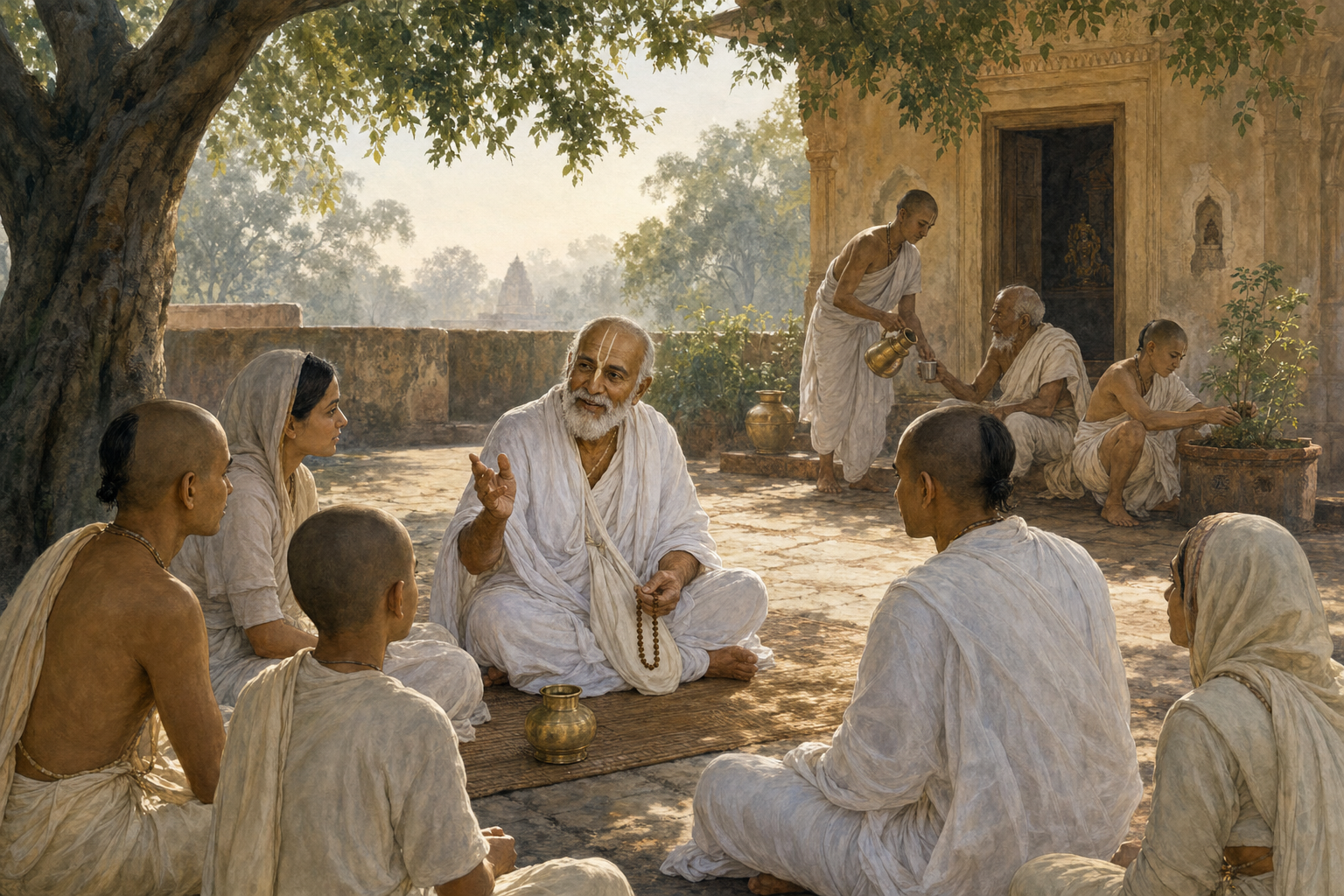
If you are trying to decide whether a Gaudiya Vaishnava babaji or a claimed lineage deserves your trust, robes and a long spiritual genealogy will not settle the matter. The practical question is whether the lineage transmits a recognizable discipline of nama, sound teaching, truthful conduct, humility, and service.
This distinction protects you from two opposite mistakes. You need not romanticize every solitary ascetic, and you need not dismiss a saint because he stood outside a large institution. Gaudiya history contains secluded bhajana-saints, public acharyas, householders, scholars, pilgrims, and organizers. Sacred lineage can connect these different forms of service without making them identical.
A babaji vow is a discipline, not a costume
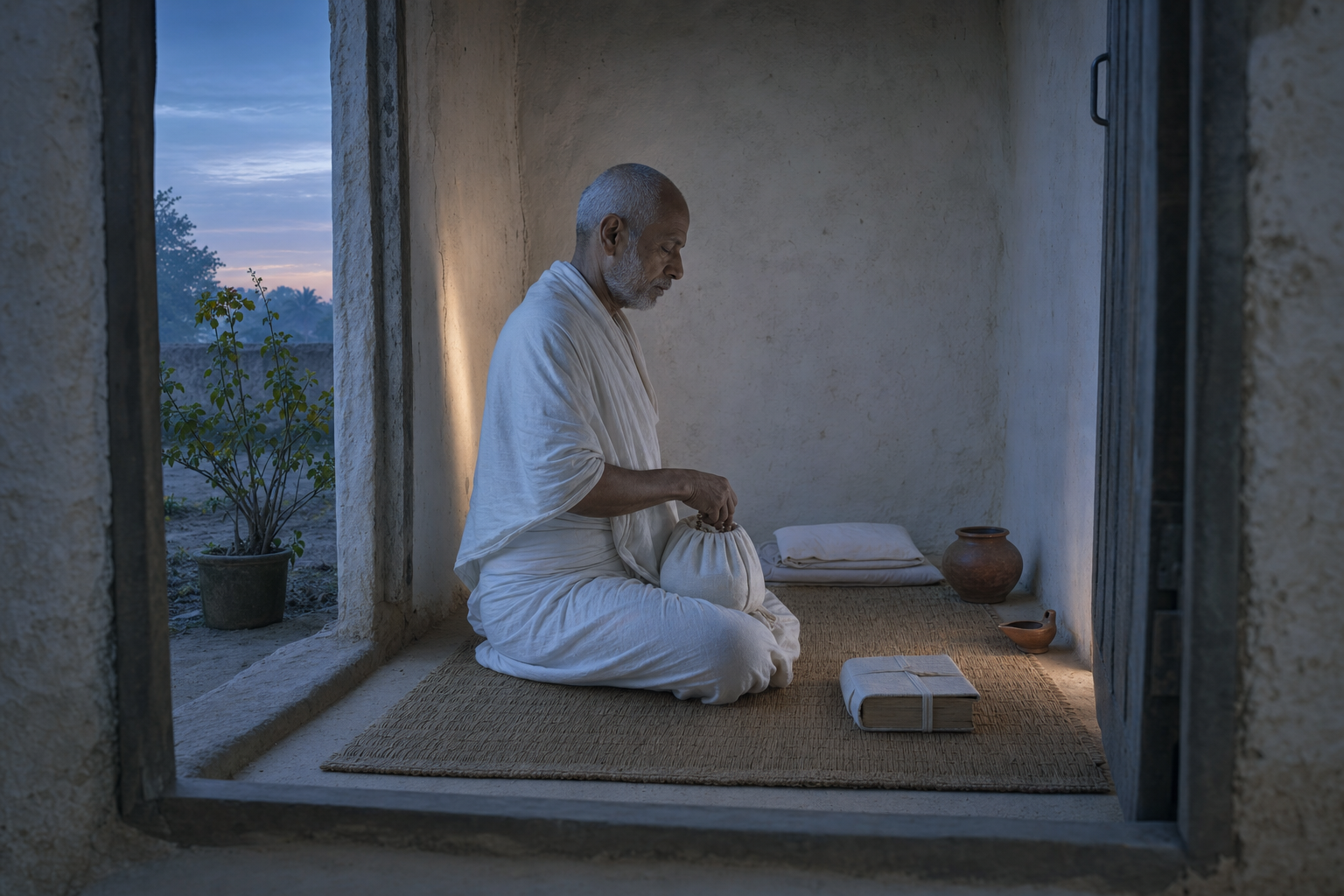
In the setting of Gaudiya Vaishnavism, babaji commonly points to a renounced practitioner whose life is organized around bhajana: sustained remembrance, chanting, worship, study, and service to Krishna. It does not name a separate denomination, and it does not automatically certify realization. External simplicity is meaningful when it protects an inward commitment; by itself, it proves very little.
Srila Gaura-Kisora Dasa Babaji offers an unusually rigorous example. His possessions were remembered as little more than Tulasi beads for his neck and japa, together with devotional works such as Narottama Dasa Thakura’s Prarthana and Prema Bhakti Chandrika. His practice centered on nama-japa, kirtana, remembrance, and deliberate avoidance of public honor.
His refusal to accept personal service should not be turned into a general doctrine that service is spiritually suspect. Seva remains central to bhakti. His choice was a severe personal safeguard against dependence, praise, possession, and the subtle pleasure of becoming important to others. It expressed niskincana-bhava, the disposition of having no material claim or shelter, through a form of renunciation suited to his own absorption.
This is where imitation becomes dangerous. A householder who neglects dependants, abandons honest obligations, or performs poverty for admiration has not reproduced the substance of a babaji’s renunciation. The transferable principle is simpler: remove what repeatedly competes with remembrance, and stop using spiritual life to enlarge your social identity.
You can apply that principle without changing your clothing or residence. Keep one place associated with japa. Put the device that fragments your attention out of reach during that period. Study a small amount deeply enough that it changes your conduct. Notice whether praise makes your service more energetic and obscurity makes it collapse. These tests reveal more about vairagya than an impressive external austerity does.
Sacred lineage is tested by what it actually transmits
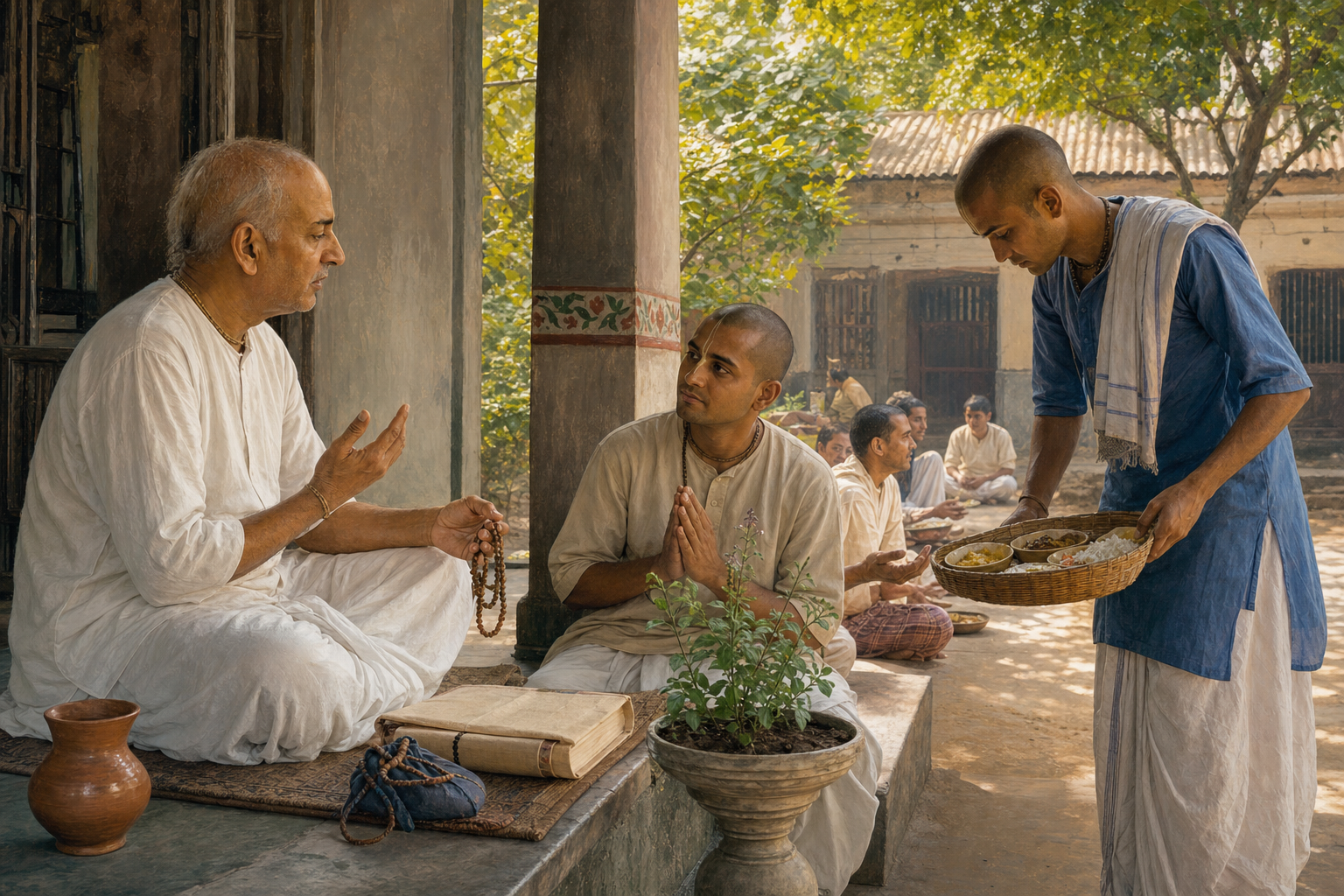
Parampara is often presented as a succession of names. The names matter, but a sacred lineage is more than a pedigree. It is a chain of relationship and responsibility through which mantra, theological understanding, devotional discipline, standards of conduct, and a disposition of service are carried forward.
A useful examination therefore has three layers:
- Lineage identity: Who received initiation or instruction from whom? Which connection is being claimed, and is it described precisely?
- Lineage content: What practice and understanding crossed that connection? A name on a chart is weak evidence if no one can explain what the relationship transmitted.
- Lineage fruit: What does the transmission produce in the present claimant? Look for constancy in nama, fidelity to siddhanta, truthful conduct, humility, and responsibility toward those who seek guidance.
Do not allow a lineage chart to merge different kinds of connection into one ambiguous arrow. Initiation, sustained instruction, institutional office, affectionate association, and later reverence are not interchangeable claims. If a chart includes several kinds of succession, ask that each link be labeled. This is not hostility toward tradition; it is respect for the actual relationships that formed it.
Diksha is spiritually consequential, but the claim of diksha should remain concrete. Gaudiya tradition holds that Gaura-Kisora Dasa Babaji gave mantra-diksha to Bhaktisiddhanta Sarasvati Thakura. The disciple later developed a far-reaching public mission that influenced multiple Gaudiya institutions and lineages connected with the emergence of ISKCON. That movement from a fiercely private saint to a public acharya shows why solitary bhajana and organized preaching should not be treated as rival proofs of authenticity.
It also shows why lineage is not mere replication. Bhaktisiddhanta Sarasvati Thakura did not have to reproduce every outward circumstance of his guru’s life for the relationship to bear fruit. What had to continue was fidelity to the devotional center. Form may change when service changes; the governing object of service must not.
The reverse caution is equally important. Descent from a respected succession does not make every later representative wise, realized, or safe. Parampara establishes a serious inheritance; it does not cancel personal accountability. A claimant should be evaluated both by the lineage invoked and by the way that inheritance is embodied.
Two babajis show how spiritual authority can serve differently
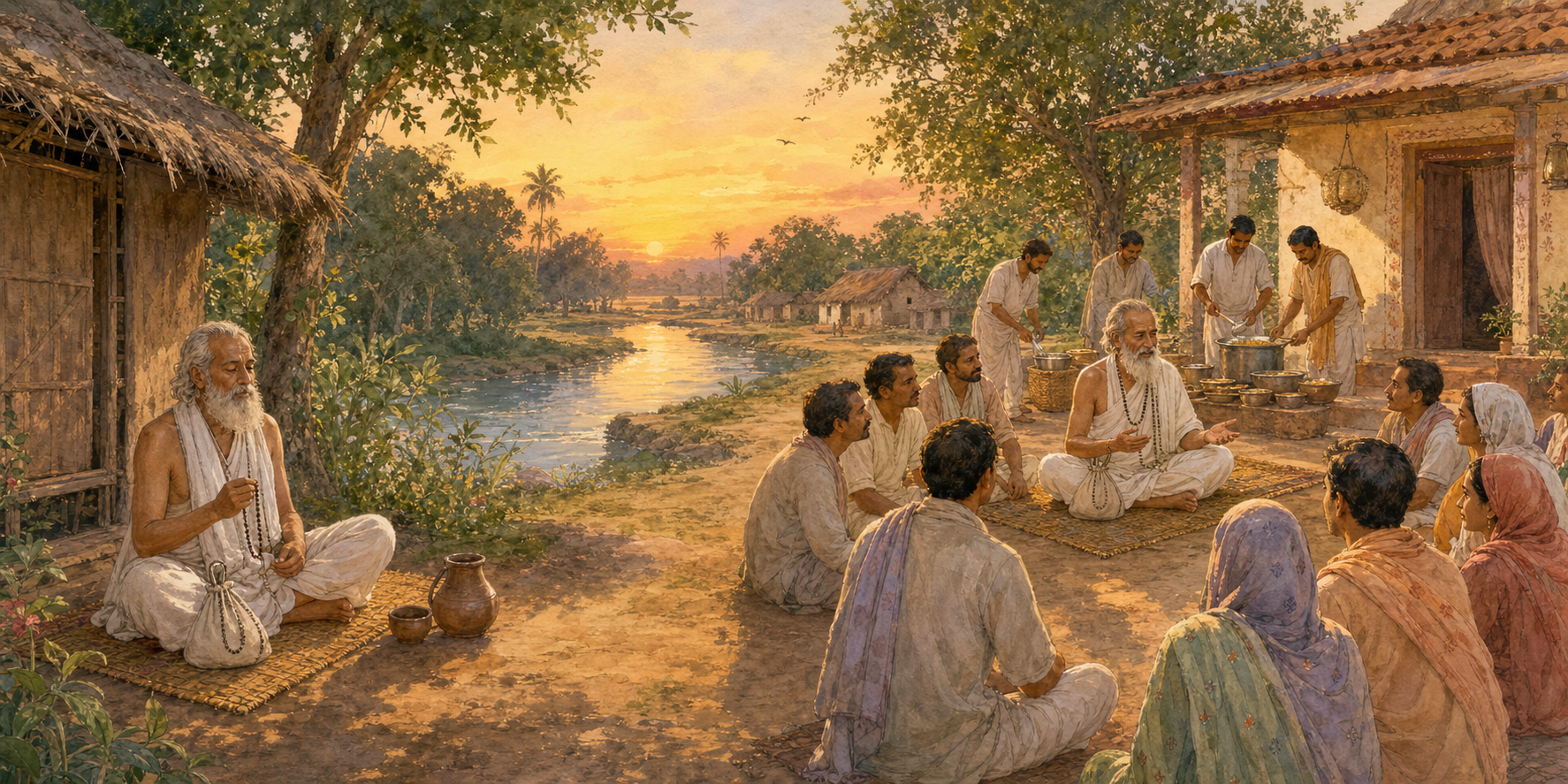
Gaura-Kisora Dasa Babaji: guarding the source
Gaura-Kisora Dasa Babaji protected his attention by reducing possessions, social entanglement, and opportunities for prestige. Tulasi remained close to his body and practice: mala at the neck as a sign of Vaishnava commitment, beads in the hand for japa, and the Holy Name at the center of his day. His reliance on a small number of devotional texts likewise favored assimilation over accumulation.
This gives you a direct test for spiritual environments. After spending time around a teacher, what becomes larger in your awareness: Krishna’s name and service, or the teacher’s exclusivity, personality, possessions, enemies, and status? Reverence for guru is intrinsic to the tradition, but authentic reverence should deepen the disciple’s devotional responsibility rather than replace Krishna with fascination about spiritual rank.
His severe boundaries also clarify the difference between receiving service and cultivating entitlement. A teacher may legitimately accept practical support for worship, teaching, pilgrimage, or community responsibilities. The warning sign is not the mere presence of resources. It is a culture in which proximity, praise, gifts, or dependence become the main currency of spiritual recognition.
Jagannatha Dasa Babaji: serving memory and sacred place
Srila Jagannatha Dasa Babaji is remembered as Vaisnava Sarvabhauma, chief among Vaishnavas, and as an exceptionally long-lived renunciate associated with Vrindavan and Navadvipa. Exact biographical dates vary, so false chronological precision would add nothing to his significance. The stable features of his remembrance are disciplined nama-sankirtana, simplicity, humility, reverence for maha-prasada, and moral authority among practitioners.
His best-known connection with sacred geography concerns the identification of Sri Caitanya Mahaprabhu’s birthplace at the Yoga Pitha in Mayapur. Gaudiya tradition remembers the aged and blind saint being carried to a mound suspected to be the site and responding there with extraordinary devotional joy. The identification belonged to a convergence of scriptural description, local memory, the changing riverine landscape, physical location, and saintly recognition.
You need not force that remembrance into a choice between uncritical literalism and reflexive dismissal. A devotional tradition is expressing what it believes saintly perception can recognize. A historical inquiry can separately examine texts, oral testimony, geography, and changes in the course of the Ganga. Keeping those questions distinct allows faith and careful reasoning to meet without pretending they use identical methods.
Jagannatha Dasa Babaji’s role also corrects the idea that a renunciate must be detached from communal memory or place. His authority served a sacred landscape and helped later generations approach Mayapur as more than real estate or a monument. A tirtha is encountered through remembrance, conduct, worship, and responsibility. Pilgrimage that leaves noise, waste, contempt for residents, or damage to the riverbank has missed that lesson even if every shrine was visited.
The contrast between these two saints is instructive. Gaura-Kisora Dasa Babaji guarded bhajana from public attention; Jagannatha Dasa Babaji’s recognition helped safeguard a place central to public pilgrimage. One form of authority protected interior absorption. The other also served collective memory. Both were credible because their outward actions remained subordinate to nama and seva.
How to examine a lineage claim before giving trust
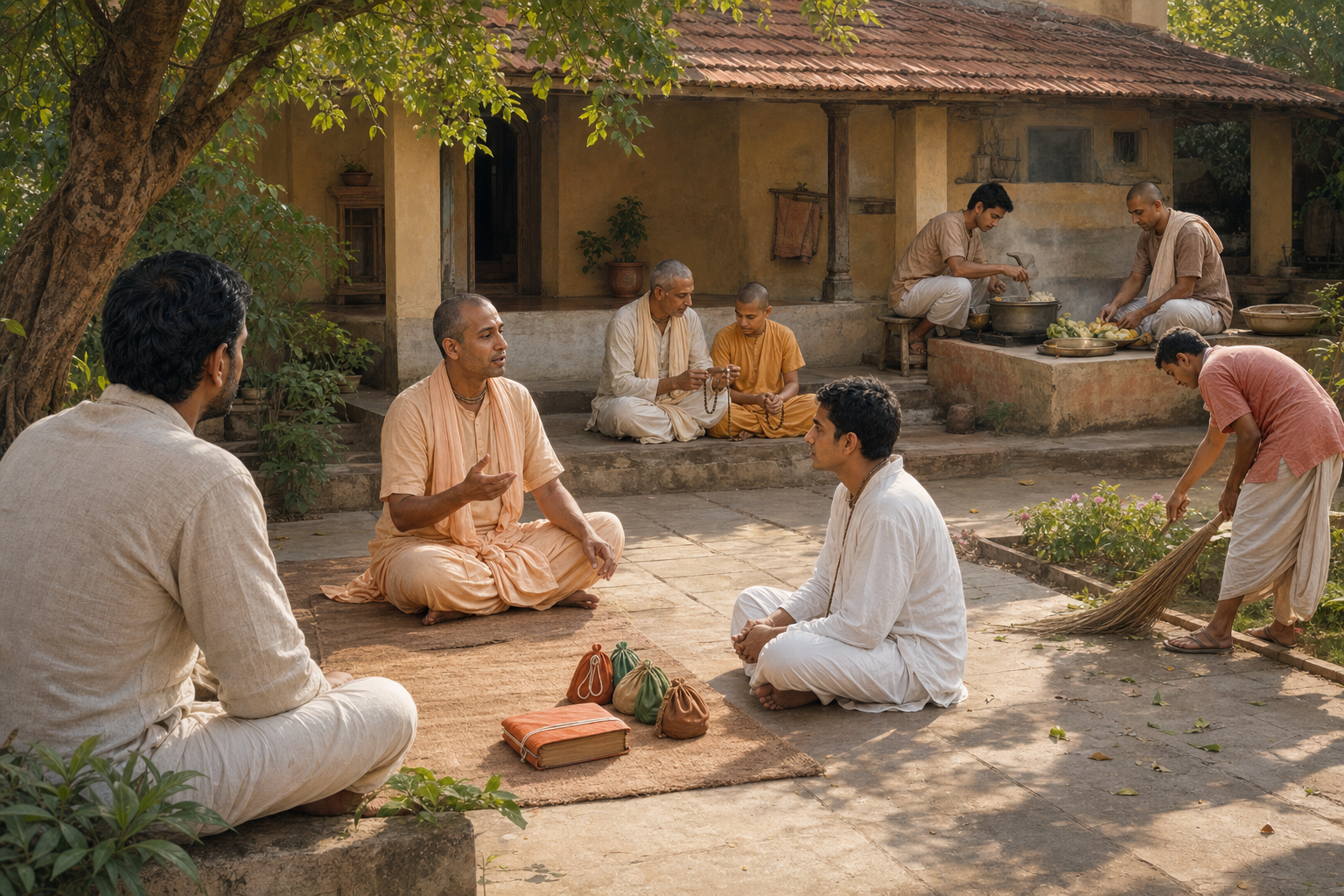
Spiritual trust should grow in proportion to what you can responsibly know. You do not need to demand laboratory proof of realization, which no lineage can supply. You should require clarity wherever a claimant makes historical, relational, financial, or institutional claims.
- Ask what is actually being claimed. Is babaji a personal form of address, a renounced status, or a title conferred by a community? Is the lineage connection based on diksha, sustained instruction, institutional succession, or reverence for an earlier saint? Precise nouns prevent borrowed prestige.
- Request a clear succession. A serious explanation should be able to name the relevant teachers and describe the kind of relationship at each important link. Mystery may belong to realization, but vagueness is not a virtue when the claim itself is historical.
- Identify the devotional center. Listen for what is repeated in teaching and enacted in community life. Nama, Krishna-bhakti, disciplined sadhana, service, and humility should be more than ceremonial vocabulary surrounding the leader’s personality.
- Observe the treatment of honor and resources. Poverty is not automatic proof, and organized fundraising is not automatic disproof. Coercion, concealed financial expectations, purchased access, retaliatory shaming, and claims that spiritual status removes accountability are reasons to pause.
- Compare teaching with conduct. A person may speak accurately about renunciation while building dependence around himself. Look at how questions are received, how weaker members are treated, whether mistakes can be acknowledged, and whether standards apply near the center as well as at the edge.
- Distinguish an advanced saint’s example from your own instruction. Extreme solitude, refusal of assistance, or radical material simplicity may protect a particular person’s absorption. They do not automatically authorize you to abandon family dharma, debts, health needs, or lawful obligations.
- Seek independent confirmation before an irreversible commitment. Do not surrender money, legal control, intimate access, or ordinary relationships merely because a lineage chart is impressive. Consult mature practitioners who are not dependent on the claimant, and obtain independent professional advice for legal or financial decisions.
- Allow consistency to become visible. Charisma appears quickly; character is disclosed when praise is absent, correction is necessary, and service becomes inconvenient. There is no need to manufacture suspicion, but there is also no devotional duty to hurry trust.
Secrecy requires particular care. A tradition may reserve a mantra, intimate devotional subject, or advanced practice for qualified instruction. That kind of discretion is not the same as forbidding basic questions about authority, conduct, money, or personal boundaries. Sacred confidentiality protects practice; manipulative secrecy protects a person from scrutiny.
You should also notice how doubt is handled. A trustworthy guide may correct a mistaken assumption firmly, but should not need to turn every request for clarity into an offense against guru. The Guru-Shishya Tradition involves surrender, yet meaningful surrender is directed toward truth and Bhagavan. It is not a device for making falsehood immune to examination.
Carry the principle without copying the extremity
The most faithful response to a great babaji is not theatrical imitation. It is to identify the spiritual function of his choices and build an honest equivalent within your own dharma. Gaura-Kisora Dasa Babaji reduced sensory and social competition so the Holy Name could remain central. You can begin by protecting one repeatable period of nama from notifications, casual conversation, and unnecessary switching.
His use of Narottama Dasa Thakura’s Prarthana and Prema Bhakti Chandrika offers another practical correction. Reading many books can create familiarity without formation. Choose a trusted devotional text, return to it, and identify the instruction that exposes a habit in your own life. The point is not merely to finish the text; it is to let humility, longing, repentance, and the aspiration for service become more exact.
You can also conduct a simple service audit. Name one seva you continue when nobody notices and one that becomes attractive mainly when it brings recognition. Keep the first steady. Rework the second until the beneficiary, Krishna, or the community’s genuine need becomes more important than your visibility.
If you visit Mayapur, Vrindavan, or another sacred place, carry the same discipline into pilgrimage. Learn what the place remembers. Chant and listen before trying to capture it. Respect residents, prasada, temple standards, paths, water, and riverbanks. Sacred geography is preserved through the conduct of pilgrims as well as through shrines and commemorations.
Key takeaways
- A babaji’s external renunciation is credible when it protects remembrance and service; clothing and austerity alone do not establish realization.
- A sacred lineage should be examined at three levels: the relationships it claims, the teaching and practice it transmits, and the character it produces.
- Private bhajana and public organization are not natural enemies. The connection between Gaura-Kisora Dasa Babaji and Bhaktisiddhanta Sarasvati Thakura shows that the same devotional current can support different forms of service.
- Hagiographical remembrance and historical investigation ask different questions. You can honor saintly recognition while still distinguishing tradition, geography, testimony, and chronology.
- Do not imitate an advanced renunciate by neglecting your own dharma. Translate the principle into protected nama, deeper study, reduced distraction, accountable conduct, and service without entitlement.
- Lineage deserves reverence, but reverence does not remove the need for clear claims, personal boundaries, financial caution, and patient observation.
Your next step can be modest and exact. Write the lineage claim you are considering in one sentence, then write the practice and responsibility it is asking you to receive. If either sentence remains vague, keep asking before you commit. If both are clear, begin with the practice rather than the prestige. Sacred lineage is honored when its gift becomes disciplined remembrance, truthful conduct, and service in your own life.
References
- Dandavats – Srila Gaura-Kisora Dasa Babaji: Austerity, Bhakti, and a Timeless Blueprint for Inner Freedom
- Dandavats – Vaisnava Sarvabhauma Srila Jagannatha Dasa Babaji: Disappearance Day and Sacred Yoga Pitha Legacy
