
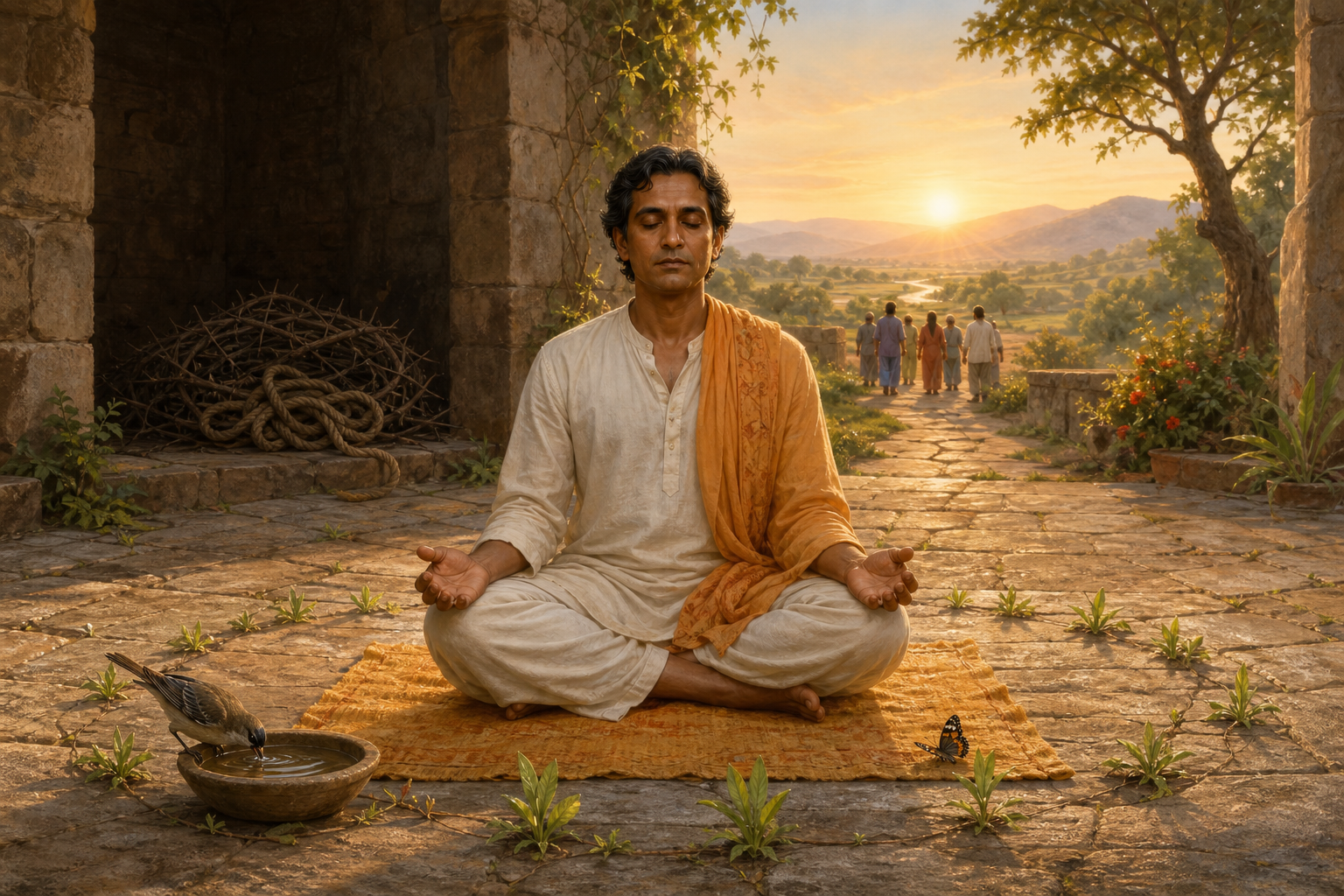
If you have begun to equate spiritual seriousness with how much pain you can withstand, stop and test that assumption. A practice can be difficult and still be dharmic. It can also wear sacred language while training fear, pride, dependence, or submission.
The question is not whether your sadhana feels comfortable. It is whether it weakens avidya, ahankara, and possessiveness while making you steadier, kinder, and freer. Ahimsa is not a concession for people who lack discipline. It is one of the clearest ways to tell whether discipline is moving toward authentic liberation.
Austerity needs a liberating mechanism
Moksha is not a reward for accumulating suffering. It is freedom from the ignorance and karma that sustain bondage. Advaita Vedānta describes that freedom through recognition of the identity of Atman and Brahman. Vishishtadvaita and Dvaita preserve a real distinction between the individual and the Supreme, framing liberation through loving relation and service to Ishvara. Their metaphysical accounts differ, yet knowledge, devotion, righteous conduct, and disciplined contemplation remain means of liberation; pain does not become an independent path simply because it feels intense.
This gives you an important distinction. Duhkha-nivritti is the cessation of suffering; ananda-prapti is the recognition or attainment of intrinsic bliss. Neither means chasing pleasant feelings. Avoidance can temporarily reduce discomfort without removing ignorance, while a punishing practice can increase discomfort without producing wisdom. The right question is causal: what knot of attachment, delusion, or egoic ownership does this discipline actually loosen?
The Bhagavad Gita draws a boundary that should not be blurred. In 17.5–6, it censures severe practices undertaken from delusion that torment the body and disregard sound guidance. This is a rejection of self-mortification masquerading as tapas, not an endorsement of laziness or indulgence. Your body is part of the field in which dharma, service, meditation, and realization become possible. Despising it is not transcendence.
Sound tapas can still create friction. Holding your speech when anger wants immediate discharge, performing a duty without applause, sitting with a restless mind, and releasing your claim over an outcome can all be uncomfortable. The discomfort arises because a habit is being denied its usual fuel. It is incidental to the retraining of attention and intention; it is not an offering of pain demanded by the Divine.
Run any austerity through these questions
- What confusion, attachment, or harmful habit is the practice intended to expose or weaken?
- Which faculty should it strengthen: discernment, attention, restraint, devotion, courage, or compassionate action?
- Is its difficulty connected to that purpose, or is suffering itself being treated as evidence of holiness?
- Does the practice preserve your capacity for duty, clear thought, and care for living beings?
- Are its visible fruits humility and steadiness, or fear, secrecy, contempt, spiritual pride, and dependence?
If the purpose cannot be explained without glorifying pain, pause the practice. If its results contradict its stated purpose, modify it or stop. Seek guidance grounded in guru, shastra, and viveka, but remember that a teacher’s prestige cannot convert injury into liberation. We would use a blunt test: intensity is not depth unless it produces a discernible movement from bondage toward freedom.
The wider Dharmic family reinforces this distinction without erasing differences among traditions. Buddhism places liberation between indulgence and extreme mortification through the Middle Way. Jainism joins exacting self-discipline to ahimsa and the pursuit of kevala-jnana. Sikh practice centers Naam-simran, seva, trust in hukam, and grace. Hindu paths coordinate jnana, karma, bhakti, and dhyana. These are not interchangeable systems, but they direct discipline toward knowledge, ethical purification, compassion, and freedom rather than cruelty as a final good.
The altar-to-street test exposes false progress

Austerity is not the only place spiritual life can go wrong. Ritual may be exact while conduct remains harsh. A person can offer flowers with concentration and then humiliate a family member, dismiss a worker, deride an opponent, or treat an animal as if sacred presence ended at the temple door.
In Srimad-Bhagavatam 3.29.21–27, Lord Kapila gives Devahūti a demanding measure of mature devotion: reverence for the Deity must open into recognition of Paramātman within living beings. Worship that ignores, envies, or degrades them remains incomplete. The same sequence identifies ahimsa, dayā, and equal vision as consequences of genuine devotion.
An altar is therefore a school of perception. Arcā-vigraha focuses the senses and affection upon Bhagavān; that training reaches its purpose when remembrance becomes portable. The person before you may not be admirable, agreeable, or safe, but the jīva is not reducible to the behavior presently appearing through a conditioned body and mind.
This expands ahimsa beyond the narrow rule of avoiding physical assault:
- Bodily non-harm means refusing needless injury to another being or to yourself.
- Verbal non-harm means correcting what is wrong without using contempt, derision, or humiliation as a weapon.
- Relational non-harm means refusing to reduce a person to an obstacle, instrument, stereotype, or enemy identity.
- Dayā adds an active obligation: listen, assist, serve, or protect where you genuinely can.
- Inner non-harm means noticing when resentment rehearses injury long after an outward conflict has ended.
Equal vision does not mean equal judgment of all actions. Bhagavad Gita 5.18 and 6.29 direct attention toward the spiritual equality and interconnectedness of beings, not toward moral relativism. Sama-darshana can coexist with clear discernment, consequences, and resistance to injustice. The same person can possess irreducible spiritual dignity and perform an act that must be stopped.
This matters when someone uses religious language to pressure you into tolerating abuse. Seeing the Divine presence within a harmful person does not require remaining within that person’s reach. You may refuse, leave, seek protection, report misconduct, or impose a firm boundary without cultivating hatred. Preventing further injury can itself be an expression of ahimsa. If you are in immediate danger or cannot keep yourself safe, prioritize safety and contact appropriate emergency, medical, mental-health, or safeguarding support.
Use your next irritation as a diagnostic
- Pause before replying. The purpose is not to manufacture affection; it is to interrupt the reflex that turns a person into an enemy object.
- Name the conduct precisely. Replace a totalizing label about the person with a clear description of what was said or done.
- Choose the response that protects dharma without adding gratuitous humiliation: a question, correction, refusal, boundary, consequence, or offer of help.
- Afterward, examine your motive. Were you trying to correct harm, or did you want the pleasure of domination?
This small exercise shows whether devotion survives contact with inconvenience. Temple peace is valuable, but the impatient queue, tense family exchange, hostile message, and disputed decision reveal what your worship has trained you to see.
Build ahimsa into the main engines of sadhana

Ahimsa can become passive avoidance if it is separated from the rest of spiritual discipline. Integrated sadhana prevents that distortion. Jnana clarifies what the self is. Karma yoga turns insight into responsible action. Bhakti warms and redirects the heart. Raja yoga stabilizes attention. Each addresses a different route by which the ego converts religion into self-protection.
Jnana: question the identity that feels threatened
The classical rhythm of shravana, manana, and nididhyasana moves from receiving a teaching to reasoning through it and then contemplating it deeply. Use that rhythm on a recurring conflict. First recall the teaching that the self is not exhausted by the body-mind identity. Then ask which role, possession, reputation, or expectation felt threatened. Finally, sit with the possibility that awareness is larger than the defensive story now occupying the mind.
This is not a way to deny material facts. It is a way to stop ahankara from disguising retaliation as righteousness. A useful journal entry is concrete: identify what happened, what meaning you added, which outcome you believed you owned, and which response remains dharmic when that ownership is relaxed.
Karma yoga: act fully without feeding possessiveness
Karma yoga is not detachment from responsibility. It is responsible action without an egoic claim over the fruit. Choose a duty that regularly triggers anxiety, resentment, or hunger for recognition. Before beginning, frame it as service. Perform it carefully. When it is complete, identify the next responsible action instead of mentally rehearsing praise, blame, victory, or disappointment.
This changes the mechanism that produces harm. When every result must validate you, other people become instruments or obstructions. When action is aligned with dharma and loka-sangraha, the cohesion and welfare of the world, you can be firm without making another person’s defeat the source of your identity. Relinquishing ownership of outcomes purifies intention and reduces the inner residue of action.
Bhakti: make remembrance survive the temple threshold
Japa, kirtana, smarana, and surrender gather scattered affection around the Divine. Their ethical test comes immediately afterward. Before leaving puja or ending japa, bring to mind one person you find difficult. Do not pretend that harmful conduct is harmless. Simply acknowledge that the same Paramātman accompanies that being.
Then treat your first difficult encounter as a continuation of worship. Listen without preparing an insult. Speak truth without making degradation your method. If a boundary is required, state it cleanly. Deity worship becomes continuous when reverence in the sanctum matures into dignity, non-harm, and practical compassion outside it.
Raja yoga: discipline attention without declaring war on the body
Kriya Yoga coordinates tapas, svadhyaya, and Ishvara-pranidhana. Tapas keeps the appointment with practice when novelty fades. Svadhyaya examines the motives and patterns brought into that practice. Ishvara-pranidhana releases the vanity that tries to possess spiritual progress.
Used together, these elements prevent two opposite errors. Discipline keeps self-study from becoming endless analysis; self-study keeps discipline from becoming mechanical punishment; surrender keeps both from becoming an achievement displayed by the ego. If a method is causing injury, severe disorientation, or an inability to perform ordinary responsibilities, do not rename the damage tapas. Stop and obtain appropriately qualified guidance.
Measure transformation instead of spiritual theatre
Do not measure progress only by the length of a ritual, the severity of a restraint, or the number of practices you can describe. Look for changes that appear when nobody is admiring you:
- You notice contempt earlier, before it becomes speech or action.
- Your criticism becomes more precise and less interested in humiliating the person being corrected.
- You set necessary boundaries before resentment grows into revenge.
- You repair harm without turning the apology into a performance of your own guilt.
- You serve with less dependence on recognition and less hostility when results differ from your preference.
- Your devotion widens the circle of beings whose dignity you can perceive.
These changes are not moksha by themselves. They are practical signs that sadhana is weakening the habits that conceal freedom instead of giving those habits a religious costume.
When suffering arrives, learn from it without worshipping it

Ahimsa does not promise a life without grief, disappointment, conflict, or exhaustion. It changes what you do with them. Pain can expose attachment, mistaken identity, and a life out of alignment. When met through satsanga, svadhyaya, japa, meditation, service, and wise counsel, it may become material for insight. Its value is instrumental, not sacred in itself: you learn from suffering so that its causes can be understood and transcended.
Grief illustrates the difference. The Bhagavad Gita’s teaching on the imperishable Self can provide orientation when bodily loss overwhelms the field of attention. Bhakti gives continuing love a sacred direction. Seva places private sorrow within a wider field of care. None of these requires pretending that bereavement does not hurt, and none makes the intensity of grief a measure of spiritual worth.
Moral exhaustion requires a related shift. Karma yoga separates responsibility from total ownership. You still do the work that belongs to your dharma, but you stop demanding that your individual will control the whole field of causes, other people, and results. Bhakti replenishes relationship with the Divine; meditation steadies attention; jnana prevents the temporary condition of the mind from becoming your entire identity.
Distinguish the kind of difficulty in front of you
- When pain is unavoidable, meet it with care, truthful acknowledgment, supportive community, and titiksha rather than denial.
- When harm is preventable, remove or reduce its cause. Endurance is not a duty when it merely allows injury to continue.
- When difficulty is deliberately chosen as discipline, define its purpose, limits, and method before beginning. Keep it answerable to ahimsa, shastra, and competent guidance.
- When there is physical injury, risk of self-harm, inability to stay safe, or serious loss of ordinary functioning, seek qualified help. Japa, meditation, or counsel from a spiritual community must not be used as substitutes for necessary medical or mental-health care.
Treat commands to injure the body, refuse necessary care, conceal abuse, or accept degradation as proof of surrender as stop signs. Spiritual language does not neutralize their danger. The Gita’s criticism of deluded self-torment and Kapila’s insistence on non-harm point in the same practical direction: a means that entrenches cruelty contradicts the liberation it claims to serve.
Key takeaways
- Moksha comes through the removal of ignorance and bondage, not through pain accumulated as spiritual merit.
- Tapas is disciplined refinement. Its difficulty should have a clear purpose and should not require contempt for the body.
- Ahimsa includes bodily restraint, careful speech, non-dehumanizing relationships, and active dayā toward others and yourself.
- Equal vision preserves the spiritual dignity of every jīva without excusing adharma or abolishing protective boundaries.
- Jnana, karma yoga, bhakti, and raja yoga make non-harm active by clarifying identity, purifying action, widening devotion, and stabilizing attention.
- Suffering may reveal what needs transformation, but it is information to work with, not currency with which liberation is purchased.
Take one practice you already perform and give it an ahimsa test today. Name the bondage it is meant to weaken, the faculty it should strengthen, the harm it must not cause, and the behavior that would show real change. If you cannot answer those questions, revise the practice before intensifying it. Then carry its intention into the next person you meet; that is where spiritual discipline begins to prove what it has made of you.
References
- DharmaRenaissance Blog — Moksha Without Martyrdom: Why Hinduism Teaches Liberation Through Knowledge, Not Pain
- DharmaRenaissance Blog — Beyond Temple Worship: Kapila on Seeing the Supersoul in All (Bhagavatam 3.29.21–27)
