

When someone sets Tipu Sultan against Savarkar, you are rarely being offered two isolated facts. You are being asked to accept a moral verdict: one man died fighting the British, while the other petitioned the British from prison. The contrast sounds decisive because it compares the most dramatic moment in one life with the most vulnerable moment in another.
If you want to know what the comparison actually proves, slow it down. Separate event from interpretation, place each action inside its own institution, and judge each man’s complete record independently. That method won’t remove disagreement, but it will stop a slogan from doing the work of history.
First, separate the historical facts from the moral verdicts

Two basic facts should be conceded without evasive language.
- Tipu Sultan fell during the British storming of Seringapatam on 4 May 1799, in the Fourth Anglo-Mysore War. Saying that he died fighting the British is historically sound.
- Vinayak Damodar Savarkar submitted clemency petitions while imprisoned under the British. Their existence is not a rumour or an invention.
Neither fact completes the judgment attached to it. Calling Tipu a martyr does more than describe how he died. It declares his cause just and his sacrifice worthy of collective honour. That may be a sincerely held conclusion, but it is a moral and political conclusion rather than another name for battlefield death.
The phrase mercy petition works in the opposite direction. It can make the use of a recognised colonial clemency procedure sound like proof of cowardice before you have examined the prisoner’s circumstances, the petition’s language, its purpose, or its result. Savarkar’s petitions did not produce immediate and unconditional freedom. He remained incarcerated for years and later lived under restrictions, including internment in Ratnagiri.
This gives you the first rule for contested history: identify the smallest claim that the evidence can actually establish. Died in battle is an event. Martyr is a verdict. Submitted a petition is an event. Surrendered his convictions is an interpretation that requires further evidence.
The comparison collapses two different kinds of struggle
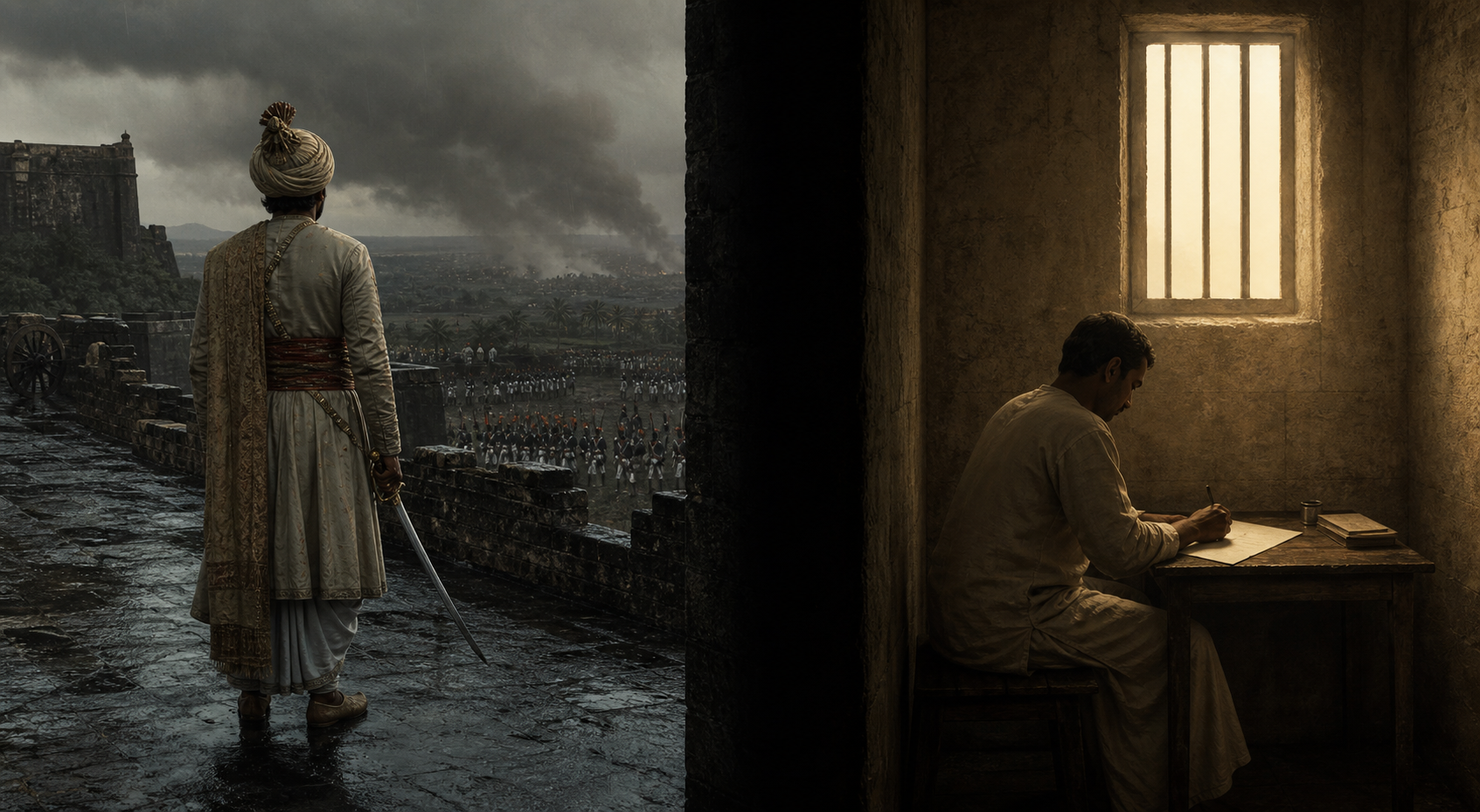
Tipu and Savarkar confronted British power in different centuries, from opposite institutional positions. A ruler commanding a state at war had choices that a political prisoner inside a punitive colonial system did not have. That difference does not settle who deserves admiration. It tells you why one dramatic contrast cannot settle the question.
| Historical question | Tipu Sultan | V.D. Savarkar |
|---|---|---|
| Period and position | Late eighteenth-century ruler of Mysore | Early twentieth-century revolutionary prisoner and later political ideologue |
| Form of British power confronted | Military expansion by the East India Company | Colonial arrest, imprisonment, labour, isolation, surveillance, and restrictions |
| Action used in the slogan | His last stand during the assault on Seringapatam | His submission of clemency petitions while incarcerated |
| Immediate result | Death in battle and the defeat of Mysore | No immediate, unconditional release; imprisonment and restrictions continued |
| Question still requiring judgment | Does anti-British resistance justify calling his whole career righteous? | Did the petitions represent capitulation, tactical survival, or some combination that changed over time? |
Tipu inherited a militarily formidable state from Hyder Ali. Mysore employed innovations including rockets, undertook administrative initiatives in areas such as revenue and coinage, and resisted the East India Company’s expansion. Its diplomacy operated amid rivalry involving the British, the French, the Marathas, the Nizam of Hyderabad, and other regional interests. British advancement was not a simple encounter between a unified India and an external army; alliances among competing powers helped determine the outcome.
That complexity should prevent an eighteenth-century war from being rewritten as a simple referendum between present-day religious communities. It should not become an excuse for avoiding hard questions about Tipu’s government either. His policies in particular regions remain disputed, including claims of harsh treatment. Test those claims individually. Ask for the place, affected community, act, date, and evidence. A universal declaration that Tipu was either tolerant or persecutory is too broad to replace that examination.
A ruler can resist foreign expansion and still be answerable for injustice toward subjects. If coercion or injury is established in a particular case, bravery against the British does not cancel it. By the same standard, a disputed accusation should not become settled merely because it fits a contemporary communal narrative.
Savarkar’s situation demands a different inquiry. He had written about the 1857 uprising, participated in revolutionary activity, been arrested, and been transported to the Cellular Jail. Clemency was a procedural route available within the colonial penal order. Some readers therefore understand his petitions as an attempt to leave an environment designed to incapacitate political prisoners and regain room for public action. Others treat their language as evidence of retreat or accommodation.
Neither interpretation should be smuggled in as though the bare existence of the petitions proves it. To call the petitions tactical, you need evidence connecting the language to Savarkar’s constraints, intentions, subsequent conditions, and later conduct. To call them definitive capitulation, you must explain why that conclusion fits the full sequence, including the failure to obtain immediate freedom. Context is relevant evidence, but it is not an automatic acquittal.
You do not need to make the two men morally equivalent. You need to stop judging either one by analogy with the other. Tipu’s death cannot decide what Savarkar should have done in prison, and Savarkar’s petitions cannot decide whether every aspect of Tipu’s rule deserves honour.
Use this six-step test on any historical slogan

A reliable way to handle contested memory is to turn a sweeping statement into a series of answerable questions. You can apply this process to a speech, social-media graphic, classroom claim, or family argument.
- Rewrite the claim as neutral factual clauses. Replace praise and accusation with observable actions. For this debate: Tipu died during a British assault in 1799; Savarkar submitted petitions during colonial imprisonment. If the claim loses most of its force when the labels disappear, the force was rhetorical rather than evidentiary.
- Fix the chronology before discussing motives. Put each event in its own century, sequence, and political structure. Tipu was a ruler engaged in war against an expanding corporation-state. Savarkar was a prisoner inside an established colonial penal regime. Chronology exposes false equivalence before it hardens into judgment.
- Name the institution shaping the available choices. A battlefield, prison, royal court, colonial court, and internment order create different options and risks. Ask what power the person possessed, what constraints operated, and what alternatives were realistically available. Do not infer identical duties from radically different situations.
- Separate descriptive language from honour or blame. Circle terms such as martyr, traitor, coward, patriot, and tyrant. For each term, state the standard being used. If nobody can provide a standard that would also apply to a favoured figure, the label is functioning as allegiance rather than analysis.
- Inspect words, consequences, and later conduct together. For a petition, examine its actual language, recipient, requested terms, official response, restrictions imposed, and what followed. For a military last stand, examine the campaign, alliances, political aims, treatment of subjects, and consequences of rule. One isolated act should not impersonate an entire biography.
- Triangulate before reaching a confidence level. Colonial dispatches and court papers may preserve indispensable facts while carrying imperial assumptions. Nationalist celebrations can retain neglected memory while becoming hagiographic. Compare institutional records with Indian-language chronicles, correspondence, regional memory, and accounts written from opposing positions. Mark your conclusion as established, probable, disputed, or unsupported rather than forcing every claim into true or false.
A simple worksheet helps. Write five lines: the precise claim, the evidence offered, the institutional context, the important fact omitted, and your confidence level. This makes selective framing visible. It also lets you change one conclusion without feeling that you have betrayed an entire political identity.
A Dharmic memory is truthful without becoming vindictive

A Dharmic approach does not require bland neutrality, equal admiration for every historical figure, or the suppression of painful memory. It requires disciplined judgment. Four principles are especially useful here.
- Satya: concede a verified fact even when a political opponent uses it. Denying Savarkar’s petitions or Tipu’s battlefield death weakens your credibility and makes serious evaluation harder.
- Viveka: distinguish an event from its interpretation, a constrained tactic from a settled conviction, and one episode from a whole career.
- Dharma: judge power through duties and consequences. Resistance to colonial expansion is morally relevant, but it cannot erase proven wrongdoing by a ruler. Survival under imprisonment is morally relevant, but it cannot by itself establish the purpose or sincerity of a political declaration.
- Ahimsa and civic restraint: do not transfer the alleged acts of a dead ruler to a living religious community. Historical accountability belongs to the people and institutions whose conduct is being examined, not to neighbours who share a label centuries later.
This matters for a pro-Hindu reading of history. We should neither erase credible evidence of wrongs against Hindus nor treat communal suspicion as proof that those wrongs occurred in every disputed case. Specificity protects memory. Name the affected people, policy, location, evidence, and degree of certainty. Generalised anger does not honour victims; it makes their experiences easier to dismiss as polemic.
Dharmic unity also does not demand that you celebrate Tipu Sultan, Savarkar, or any other contested personality. It asks you to use standards capable of surviving disagreement. A Hindu, Muslim, Sikh, Buddhist, or Jain reader may reach a different final evaluation while still sharing the same commitment to dates, context, consistent criteria, and freedom from inherited collective guilt.
Inter-community trust built by suppressing history is brittle. Trust built through honest specificity is stronger. It permits you to acknowledge Tipu’s resistance to British expansion, investigate contested conduct under his rule, recognise Savarkar’s revolutionary background, and scrutinise the meaning of his petitions without turning any one finding into a weapon against present-day citizens.
Key takeaways
- Tipu Sultan died fighting a British assault in 1799; whether that makes him a martyr is a moral judgment, not an additional historical fact.
- Savarkar submitted clemency petitions, but they did not secure immediate and unconditional freedom; their meaning must be assessed through language, constraints, results, and later conduct.
- A sovereign ruler’s battlefield decision and a prisoner’s procedural strategy are not comparable without accounting for their different institutions and available choices.
- Anti-colonial resistance does not erase proven misconduct, while a clemency petition does not automatically erase an entire revolutionary career.
- Dharmic unity requires truthful memory, consistent standards, and refusal to assign historical guilt to living communities.
What to say when the slogan appears again
You do not need a counter-slogan. A measured reply can be direct: Tipu died resisting a British assault, and Savarkar submitted petitions in colonial prison. Both facts are real. One concerns a ruler’s last battle; the other concerns a prisoner’s strategy under a penal system. Judge each man’s complete conduct before turning those different acts into a moral ranking.
Then ask three questions that reveal what kind of conversation you are having:
- Are we trying to verify a particular event, or pronounce on an entire legacy?
- Would we apply the same standard to a historical figure favoured by our own side?
- What evidence could make us revise the conclusion?
If no evidence could change the answer, the dispute is about identity rather than history. You can decline its terms without abandoning conviction. Before forwarding the next graphic or repeating the next speech line, write down its factual core, remove its honourifics and insults, and restore the missing institutional context. Keep the judgment only if it survives that test.
References
