
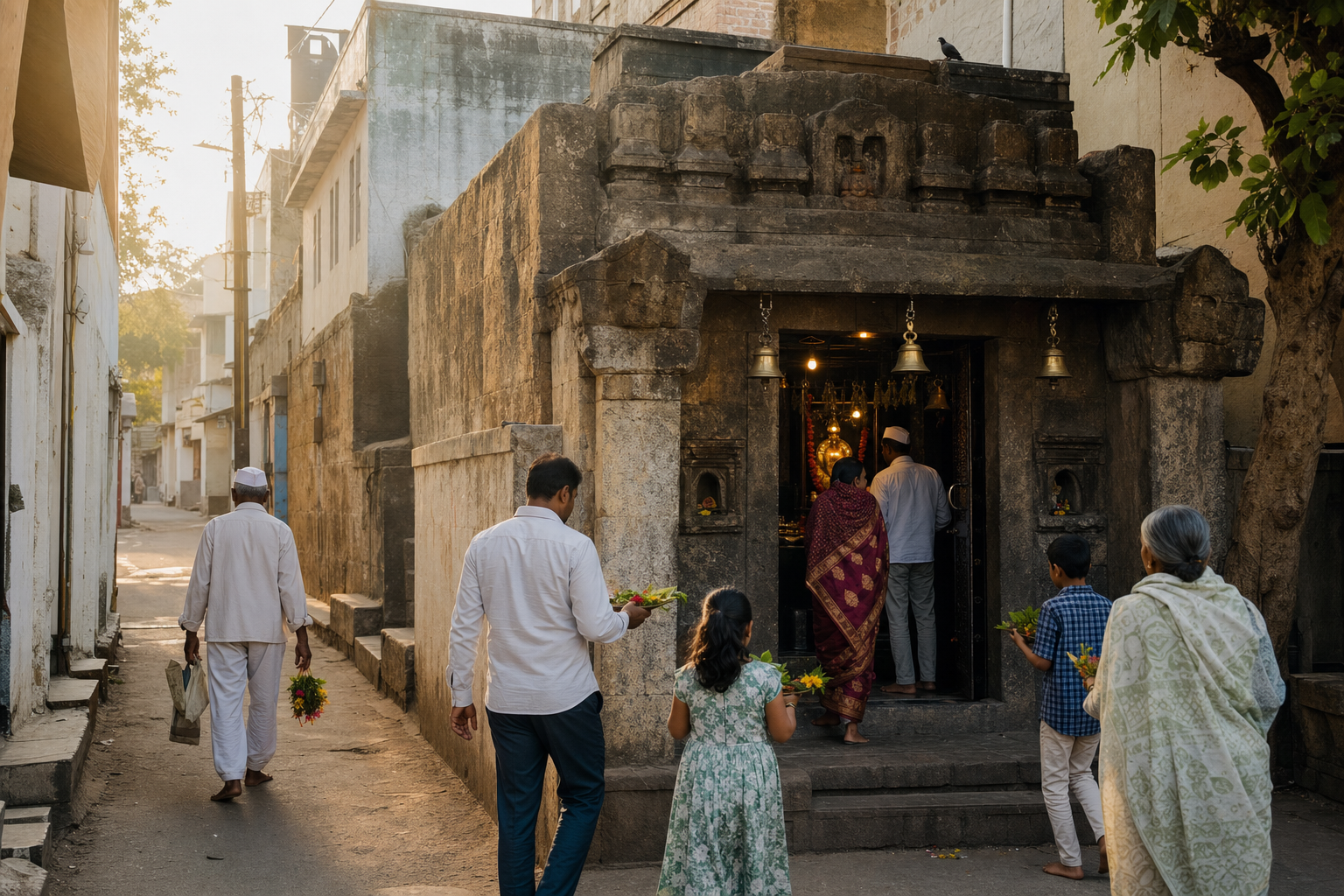
If you are deciding whether Saswad’s Bhairavnath temple deserves a dedicated heritage visit, do not begin by assigning it a dynasty or a century. The shrine’s precise foundation history still needs archival and epigraphic study, so a confident date would promise more certainty than the available record supports.
Begin with what you can responsibly encounter: an active Shaiva shrine, a guardian deity rooted in the sacred geography of Saswad, a devotional culture shaped by Nath traditions, and a community whose worship gives the place continuity. Go for darshan, but also learn to notice how architecture, ritual, memory, service, and restraint work together.
Its heritage value does not depend on an unproved date
A living temple carries several kinds of heritage at once. Its material fabric is one layer, but not the only one. Saswad Bhairavnath Mandir also holds ritual knowledge, relationships between households and deity, seasonal observances, oral memories, and an inherited understanding of protection. These layers may be older than a particular repaired wall and can survive changes to the visible structure.
That distinction matters because later repairs do not automatically make an active shrine inauthentic. A temple must continue to serve worshippers. Roofs need attention, gathering spaces change, and additions may blend architectural periods. The honest heritage question is therefore not simply, “Is every stone original?” It is, “Which elements belong to which period, which practices have continued, and what evidence supports each conclusion?”
For Saswad, the sound position is clear: the exact foundation history has not yet been securely established. Until inscriptions, dated records, or careful architectural analysis supply firmer evidence, avoid attaching an unsupported ruler, dynasty, or century to the temple. Uncertainty is not a defect in the story. It identifies the next work that historians and the local community can do.
If you keep notes during a heritage visit, separate them into four labels:
- Observed: what you personally saw, such as masonry, a lamp-tower, an image, or a ritual movement.
- Locally remembered: what a priest, hereditary participant, devotee, or resident told you.
- Documented: what can be tied to an inscription, record, dated photograph, or catalogued object.
- Interpreted: what you think a feature means or when you think it was made.
This simple discipline prevents oral tradition from being dismissed, but it also prevents interpretation from being repeated as established history.
Key takeaways
- Saswad Bhairavnath Mandir is best understood as living Shaiva heritage, not merely as an old structure awaiting a date.
- Bhairavnath’s central role is guardianship: of place, community, moral order, and the devotee’s inner boundaries.
- Nath influence is most usefully sought in disciplines such as tapas, ascetic memory, sacred-fire traditions, and an inward understanding of Shiva, not in labels alone.
- Morning worship, evening ārati, Mondays, monthly Kṛṣṇa Pakṣa Aṣṭamī, and Kalabhairav Jayanti offer different ways to encounter the shrine, but local timings must be confirmed.
- Respectful documentation, oral-history work, clear signage, responsible maintenance, and careful visitor conduct are practical forms of heritage protection.
Read Bhairavnath through place, threshold, and time
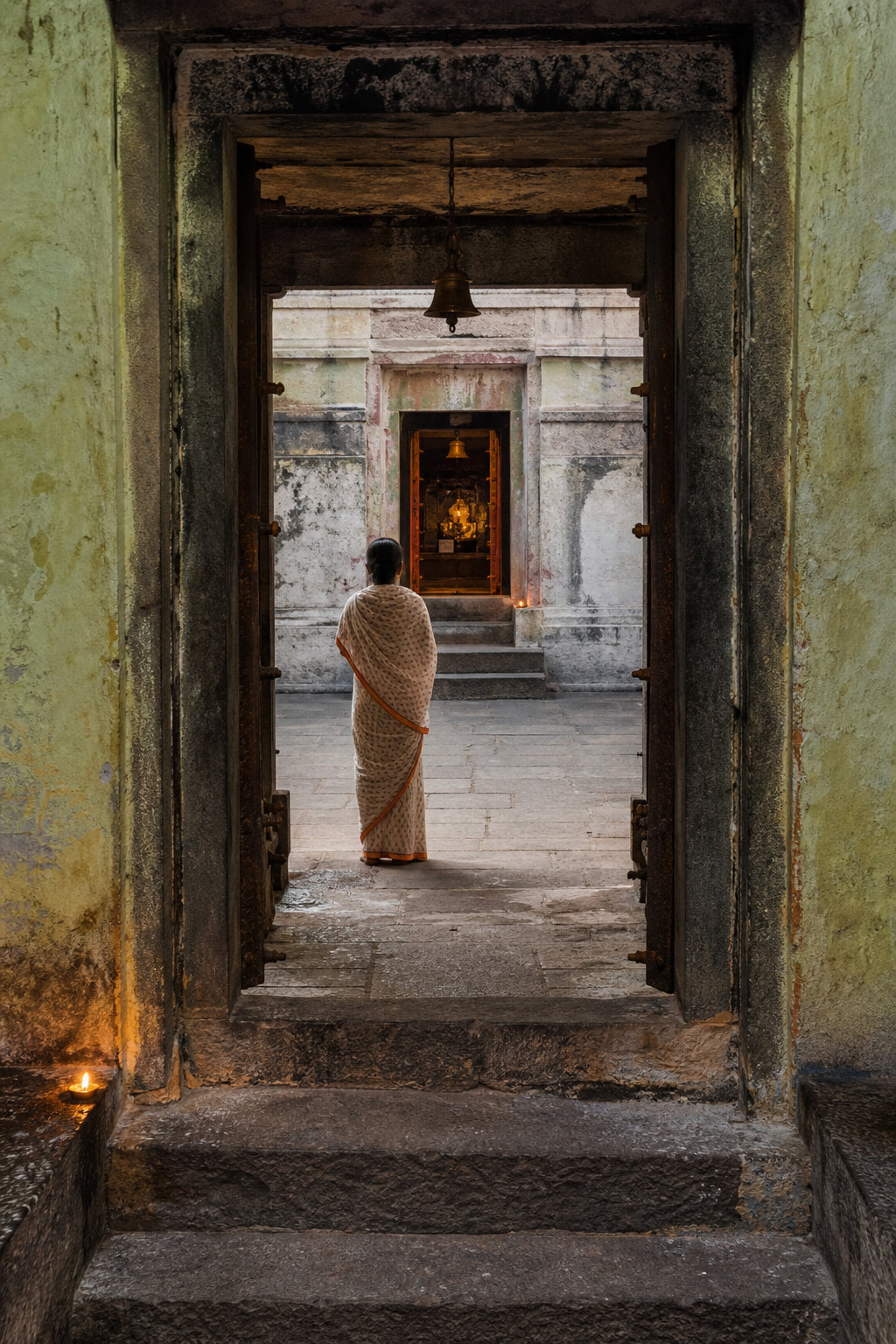
Kal Bhairav is Shiva in a fierce protective form. Fierce, in this setting, should not be confused with uncontrolled anger. Bhairava confronts fear, disorder, ego, and the inescapability of kāla, or time. The honorific “Bhairavnath” brings that formidable presence into a relationship of nearness: the deity is guardian, lord, and protector of a particular community.
The Sanskrit term kṣetrapāla means guardian of a field, territory, or sacred place. It helps explain why Bhairava shrines are so often intelligible at boundaries: village edges, gates, routes, and other points where one condition gives way to another. The Skanda Purana and related Tantric traditions place Bhairava in this world of thresholds, obstacle removal, and the purification of liminal spaces.
Saswad gives that theology a concrete landscape. The town stands on the historic Pune–Saswad corridor, approached from Pune through the Hadapsar and Dive Ghat direction and situated amid routes, cultivated land, settlements, and the wider fort country of the district. In a place shaped by journeys and agrarian cycles, a guardian deity addresses practical concerns: safe movement, timely rain, harvest, household well-being, and collective order. The shrine’s relationship to this moving, worked, and remembered landscape is part of its heritage even when it cannot be measured in stone.
Iconography gives you another way to read the tradition. Bhairava may be associated with a dog as vāhana, a garland of skulls, and implements such as the triśūla, ḍamaru, khaḍga, and kapāla. These are not decorative curiosities. Within Shaiva interpretation, they can point toward discernment, the rhythm of awakened practice, the cutting of bondage, the stripping away of ego, and the reality of mortality. Look carefully at what is actually present in the shrine before applying a general iconographic checklist; regional forms do not have to display every attribute.
The same care is needed with the temple’s warrior ethos. Maharashtra’s memory of Bhairavnath connects protective power with kṣātra dharma, but kṣātra dharma is not a devotional excuse for aggression. Its measure is disciplined strength used to safeguard community and order. Seva and moral restraint keep strength aligned with dharma. If courage produces cruelty, self-display, or contempt for the vulnerable, it has already departed from the ethic the guardian is meant to embody.
You can notice resonances across the wider Dharmic world without pretending that different traditions teach the same doctrine. Vajrayana Buddhism has Vajrabhairava, or Yamāntaka, as a form associated with overcoming death and fear. Jain sacred geographies can include protective yakṣas and yakṣīs. Some Sikh lineages practise shastar-pūjā as disciplined reverence for instruments of protection. The rituals and theologies remain distinct. The useful point of contact is narrower: power is answerable to sacred duty, and protection is judged by what it serves.
For a personal contemplation that does not interfere with temple ritual, pause before crossing the threshold and name one boundary you have failed to guard well: speech, attention, duty, anger, or fear. After darshan, choose one concrete act of disciplined protection. It might be keeping a promise, ending a harmful habit, defending someone without humiliation, or setting a necessary limit. Treat this as your own reflection, not as a substitute for the shrine’s established worship.
Ritual reveals what a wall survey cannot
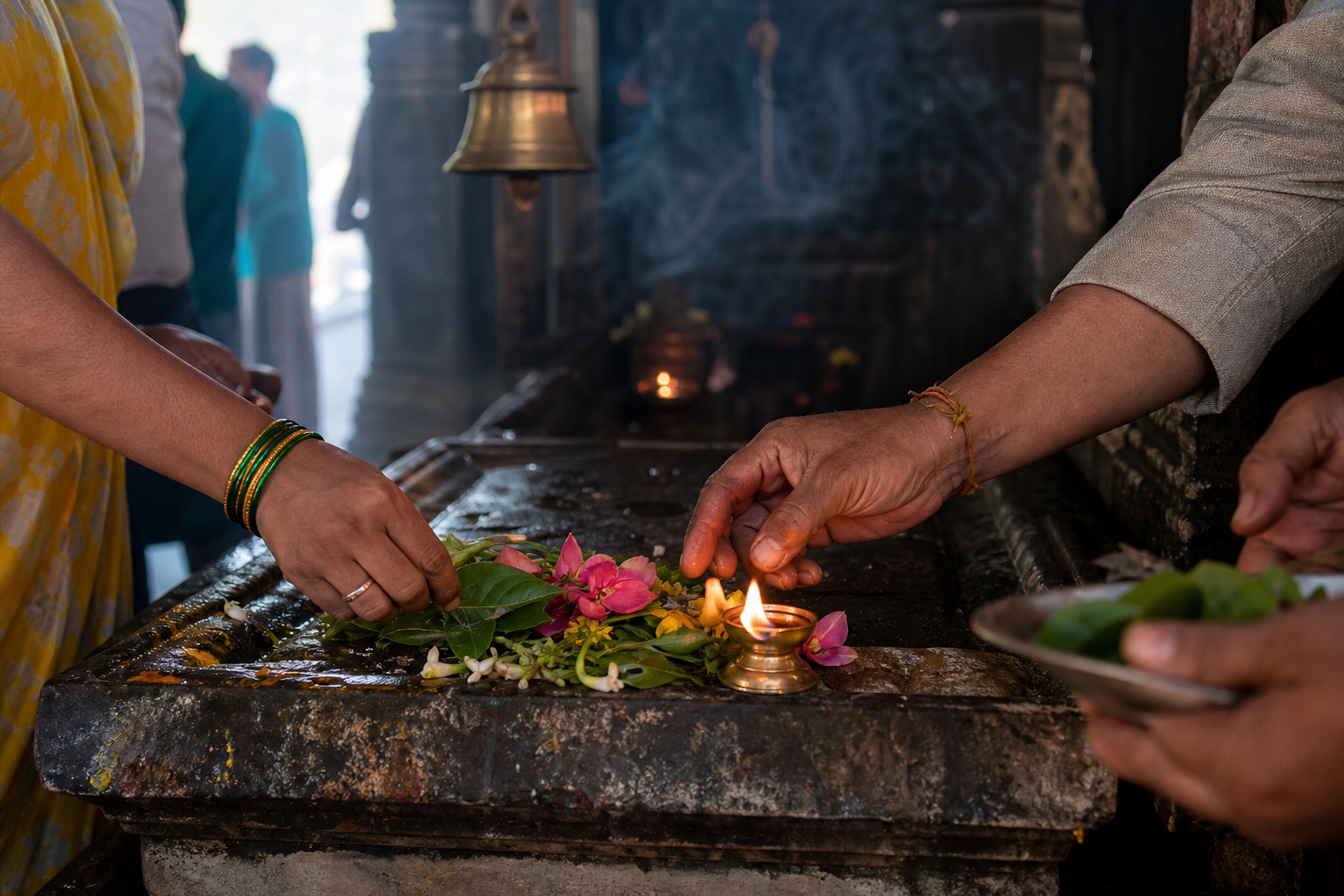
If you visit only to photograph the exterior, you will miss much of the temple’s inheritance. Living heritage appears in repeated actions: who opens the shrine, how abhiṣekam is performed, where devotees wait, which offerings are accepted, how the bell and ārati organize attention, and how the community gathers on significant days.
The temple’s usual devotional rhythm includes morning abhiṣekam, forms of pañcopacāra or ṣoḍaśopacāra pūjā, and evening ārati. Fruits, milk, bilva leaves, incense, and lamps belong to the locally grounded, sāttvika pattern of worship described for the shrine. These are typical practices rather than a guaranteed timetable for every day. Confirm the current schedule locally instead of arriving with an internet-era assumption that ritual life runs like a fixed attraction.
Mondays, because of their Shaiva association, and the monthly Kṛṣṇa Pakṣa Aṣṭamī can bring more worshippers and extended recitation. The principal annual observance is Kalabhairav Jayanti, or Bhairav Ashtami, on Kṛṣṇa Pakṣa Aṣṭamī of the month of Margashirsha. Vrata, stotra and kavacha recitation, collective ārati, annadāna, and worship after dark give that observance its distinctive form. Night here is not merely a dramatic backdrop. It is a temporal threshold, matching Bhairava’s guardianship of boundaries in space.
The Nath Panth adds another layer. Deccan Nath lineages associated with Matsyendranath and Gorakhnath have treated Bhairava as a guardian of sacred space and an image of yogic resolve. Their inheritance emphasizes tapas, ascetic discipline, dhooni or sacred-fire traditions, and Shiva understood inwardly as the witnessing consciousness that supports sādhana. Do not assume that every general Nath custom is currently practised at this particular temple. Ask whether a dhooni, ascetic seat, lineage observance, or remembered association is active, historical, or no longer present.
You can learn more from a short, respectful conversation than from speculative dating. Ask permission first, wait until worship duties are finished, and keep each question narrow. Useful questions include:
- Which families or community groups carry responsibilities during the annual festival?
- Which parts of the present structure were repaired, and what do elders remember about the earlier form?
- Are there old photographs, donation records, ritual objects, manuscripts, or inscriptions connected with the shrine?
- Has the route of a procession or the pattern of annadāna changed over time?
- Which offerings and vows are considered customary here, rather than merely common at Bhairava temples elsewhere?
- How is the temple’s connection with Nath practitioners understood locally?
Record the speaker’s name only with consent. Add the date, place, language, and circumstances of the conversation. Preserve the original wording separately from your translation or interpretation. An unattributed sentence posted online can quickly harden into folklore; a contextualized oral account remains useful evidence for future comparison.
Plan darshan around worship, not the other way around
A respectful heritage visit is easier when you decide in advance whether your priority is quiet darshan, observation of a regular ritual, or participation in a major festival. Each choice gives you a different experience.
- Confirm the day’s timings locally. Seasonal routines and festival arrangements may change. This is especially important on Mondays, Kṛṣṇa Pakṣa Aṣṭamī, and Kalabhairav Jayanti, when attendance can increase.
- Allow flexibility on the Pune–Saswad journey. The common road approach runs through Hadapsar and Dive Ghat, with bus and private-transport options. Check current transport information separately; a heritage description is not a live timetable.
- Choose clothing for an active shrine. Wear modest, practical attire. Follow on-site practice for footwear and entry rather than assuming that visitor convenience takes priority.
- Let the ritual determine your movement. Keep the sanctum quiet, do not cross barriers, and avoid obstructing the line of sight during pūjā or ārati. Complete pradakṣiṇā only along the route permitted on site.
- Ask before presenting an offering. Fruit, milk, bilva leaves, and lamps fit the shrine’s sāttvika devotional setting, but current temple practice decides what can be accepted and where it should be placed.
- Seek explicit permission for photography or video. Consent for the courtyard does not automatically include the sanctum, a ritual in progress, ascetics, priests, children, or other devotees. If the answer is no, put the device away without negotiation.
- Leave the precinct lighter than you found it. Carry a reusable water bottle, avoid single-use plastic, and remove your own waste. Alcohol and non-vegetarian food are inappropriate within the temple precincts.
Feeding dogs can be a meaningful act of seva because the dog is associated with Bhairava’s vāhana. Do it responsibly: use appropriate food, follow local guidance, keep away from moving vehicles and crowded entrances, do not force an animal to approach, and leave no packaging behind. The point is care for a being at the edge of human attention, not a photograph proving that the act occurred.
If you combine the temple with nearby heritage places or hill-fort country, protect enough time for the shrine itself. A hurried stop between sightseeing targets encourages exactly the wrong habits: rushed photography, impatience with worship, and little attention to local context. One unhurried temple visit will teach you more than several entrances treated as boxes to tick.
Preserve a living shrine without turning it into a museum
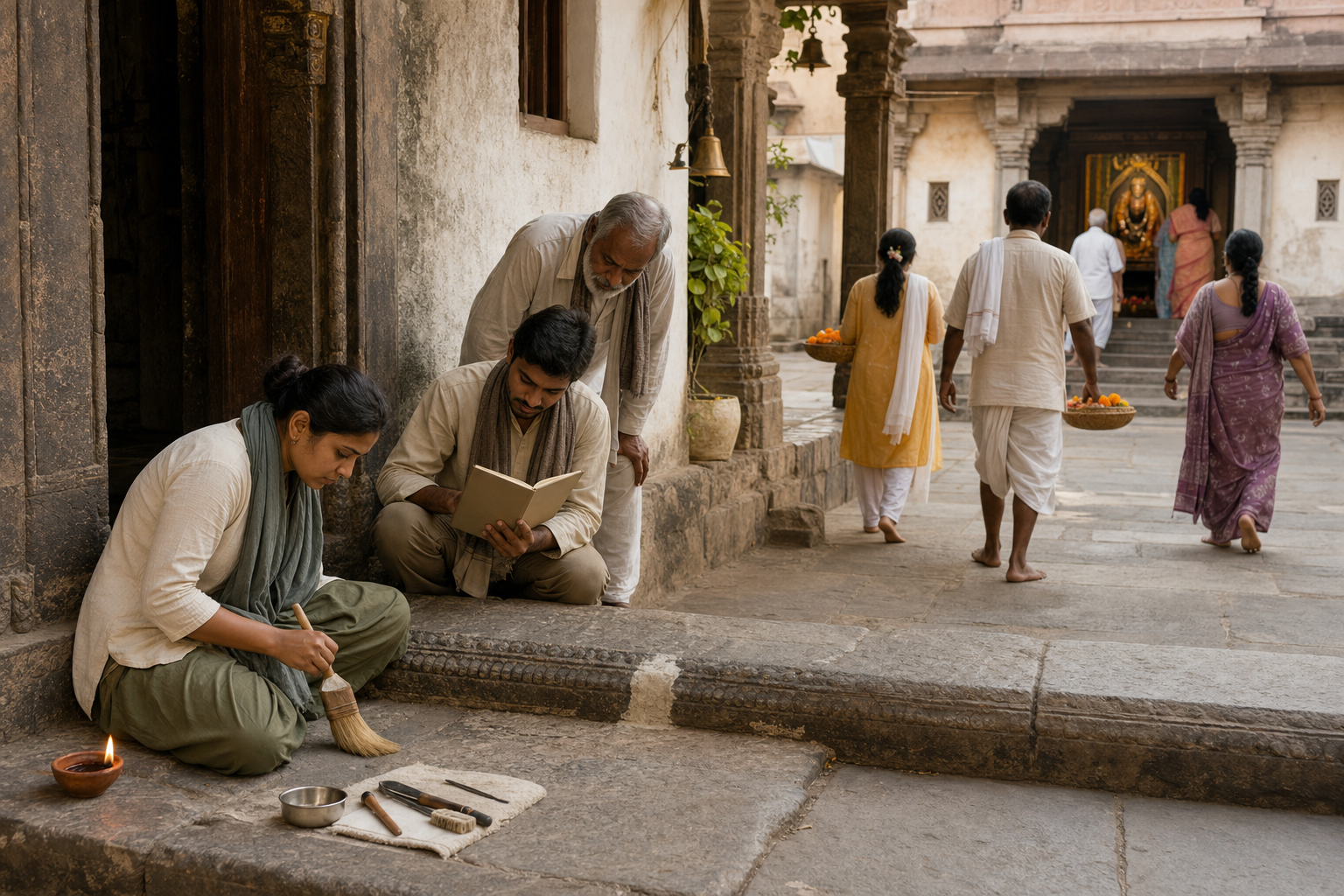
Heritage protection at Saswad must hold two truths together. The temple needs continuity of worship, and changes to historically significant fabric should not occur without careful documentation and appropriate guidance. Freezing the shrine would deny its living purpose. Casual alterations made without a record could erase evidence that future study needs.
Architecture should therefore be read as a sequence rather than a single moment. Deccan temples of this broad milieu often use a compact garbhagṛha, an antarāla, and a maṇḍapa arranged for movement toward the deity and gathering during worship. Basalt masonry is common in the region, while a deepmālā, dhvaja-stambha, and subsidiary niches may organize the court. These are regional expectations, not proof that every visible element at Saswad belongs to one construction campaign. Examine joints, materials, alignments, repairs, and ritual use, then seek specialist assessment before assigning dates.
Community-led preservation can begin with work that does not require a grand project:
- Create an oral-history register. Record priests, festival organizers, artisans, long-term residents, women who sustain household vows, and others whose knowledge may otherwise remain invisible.
- Digitize the ritual calendar. Publish verified timings, festival dates, contact procedures, and visitor etiquette, while making clear that schedules can change.
- Prepare bilingual interpretation. Explain Bhairava’s iconography, the meaning of kṣetrapāla, Nath associations, appropriate conduct, and the limits of current historical knowledge in languages useful to local devotees and visitors.
- Build a dated visual record. Photograph architectural elements systematically with permission, retain original files, identify viewpoints, and repeat the same views after significant repairs.
- Document maintenance before work begins. Record the condition, purpose, materials, responsible parties, and completed result. Where older fabric may be affected, seek heritage-sensitive technical guidance rather than relying on visual preference alone.
- Return copies to the community. Interviews, photographs, transcriptions, and calendars should not disappear into a private device. Store them in more than one place and make an accessible copy available to temple custodians or an agreed local archive.
Visitors also shape the future of the shrine. An unsupported caption can spread a false date. An intrusive image can violate trust. Waste left after a festival becomes a burden for the same community whose heritage attracted the visitor. By contrast, a dated photograph taken with consent, a carefully attributed memory, or support for an authorized community initiative can retain value long after the visit.
Saswad Bhairavnath Mandir asks you to approach heritage as a duty of attention. On your next visit, carry fewer assumptions and better questions. Receive darshan first, note only what you can support, and leave one useful record or act of seva in trustworthy hands. That is how reverence becomes continuity.
References
