

You sit for japa with sincere intention, but hunger, an old worry, a notification, or a desired outcome soon takes command. It is tempting to conclude that your mind is simply bad at meditation. More often, the disturbance has been misdiagnosed: bodily strain, anxious thought, confused judgment, and sensory restlessness do not all need the same first response.
Yogic equanimity develops when you learn to recognize the active disturbance, respond without indulgence or suppression, and return attention to the Divine. The return is the practice. You do not have to manufacture a permanently tranquil state before this discipline can change how you meet an ordinary day.
Key takeaways
- Equanimity is not emotional numbness. It is the ability to remain inwardly oriented while responding appropriately to pleasure, pain, pressure, and uncertainty.
- Before treating every difficulty as a spiritual failure, identify whether it begins in the body, life-force, mind, intelligence, or senses.
- Choose one primary contemplative anchor – a Divine Name, form, or quality – and return to it consistently instead of changing methods whenever restlessness appears.
- Use morning practice, a recollection during the day, and evening hearing or reflection to make remembrance continuous enough to influence conduct.
- Measure progress by clearer judgment, shorter periods of reactivity, greater patience, and more compassionate action – not by an absence of difficult feelings.
Diagnose the disturbance before trying to transcend it

Śrīmad-Bhāgavatam 11.2.49 identifies affliction across deha, prāṇa, manas, buddhi, and indriyāṇi: body, life-force, mind, intelligence, and senses. These are not five isolated compartments. A disturbance in one can quickly recruit the others. Hunger can become irritability, irritability can distort judgment, and distorted judgment can send the senses searching for quick relief.
| Layer | What to notice | Useful first response |
|---|---|---|
| Deha: body | Pain, illness, fatigue, aging, or a posture that is becoming unsustainable | Adjust the posture, rest when needed, and stop interpreting every bodily limit as a failure of will. |
| Prāṇa: life-force | Hunger, thirst, hurried breathing, or a sense of being physiologically driven | Meet a legitimate need simply. Use gentle, unforced breathing to settle before asking the mind for concentration. |
| Manas: mind | Repeated rehearsal of a feared future, emotional contraction, or rapid movement between thoughts | Return attention to your chosen Name or sacred form, then identify the next action that is actually available now. |
| Buddhi: intelligence | Fixation on an unattainable result, rationalization, or confusion between desire and duty | Test the goal against truth, present capacity, and dharma. Revise the demand without abandoning responsible effort. |
| Indriyāṇi: senses | Compulsive checking, novelty-seeking, overstimulation, or exhaustion from continuous input | Reduce incoming stimuli and redirect sight and hearing toward sacred sound, darśana, contemplative art, or nature. |
This diagnostic prevents two opposite mistakes. The first is indulgence: assuming that every impulse must be obeyed. The second is spiritual bypassing: using prayer to avoid sleep, nourishment, an honest decision, or a necessary boundary. Meeting hunger does not resolve every anxiety, but demanding concentration from a depleted body creates avoidable friction. Likewise, bodily comfort alone cannot answer a mind organized around fear or a buddhi attached to an impossible outcome.
Once the immediate layer has been addressed, remembrance gives the whole person a stable orientation. The body may still hurt. The difficult conversation may still be necessary. The desired outcome may remain uncertain. Smaraṇa changes which reality becomes central while you face those conditions: not the passing disturbance, but your relationship with Bhagavān and the dharma appropriate to the moment.
This is why equanimity should not be confused with passivity. A steady practitioner can grieve, object, protect another person, or act firmly against adharma. The distinction is whether the action is governed by clarity and duty or seized by fear, resentment, and compulsion.
Turn remembrance into a repeatable daily rhythm

Divine contemplation remains fragile when it depends on mood. The practical alternative is abhyāsa: a modest pattern repeated until remembrance becomes easier to recover under pressure. Sporadic intensity can produce memorable experiences, but consistency is what places a sacred reference point inside an ordinary workday.
- Select one primary anchor. Choose a Divine Name, form, or quality already rooted in your sampradāya. If your mantra was received through a lineage, follow its guidance rather than improvising syllables or combining practices indiscriminately.
- Establish it in the morning. Sit in a posture you can sustain without strain. Let the breath become natural, perform japa or prayer, and briefly recall the quality you intend to embody. If you contemplate compassion, decide where compassion will be required that day.
- Attach remembrance to a daytime transition. Use an event that already occurs – beginning work, eating, entering your home, or preparing for a difficult meeting. Pause, remember the Name, and ask: What is my immediate dharma here?
- Return through hearing in the evening. Śravaṇa can be a passage of śāstra, a teaching from your tradition, or sacred recitation. Then review one moment of agitation: which layer became active, and where could remembrance have entered sooner?
- Give contemplation hands through seva. Perform one available duty as an offering. Service interrupts self-preoccupation and tests whether devotion is becoming conduct rather than remaining a private state.
The demanding 41-day Sabarimala vrata of simplicity, restraint, brahmacarya, and mantra-japa displays the formative power of a disciplined container. You need not copy a vrata outside its proper context to understand its practical lesson: repeated choices prepare the body-mind to receive what a sacred form teaches.
Sat-saṅga protects this rhythm from becoming self-designed spirituality with no correction. Seek association that makes devotion sober, joyful, and accountable. A good spiritual community should help you become more truthful and serviceable, not merely more attached to the feeling of belonging.
Dharmic traditions do not all explain the ultimate reality in identical terms, so their practices should not be flattened into interchangeable techniques. Yet they offer a recognizable family of disciplines for loosening reactivity: Hindu bhakti cultivates smaraṇa of Bhagavān; Buddhism joins mindfulness with upekkhā; Jain samayik settles the practitioner into non-attachment and witness-consciousness; and Sikh practice centers Naam Simran and the poise of sahaj. If you belong to one of these paths, deepen its own grammar rather than assembling a spiritual mixture whenever novelty beckons.
Let sacred form teach your body how to settle

Divine contemplation need not begin as abstract thought. Sacred iconography can teach through posture, gaze, gesture, and proportion. Dharma Śāstā in Ayyappa’s yogapattāsana presents stillness as disciplined, alert, and compassionate. The raised knees are supported by a yogapatta, the torso remains composed, and the partly inward gaze suggests neither withdrawal from the world nor captivity to it.
The form can be read as an embodied progression through yoga. Restraint and observance establish the container. A stable seat reduces unnecessary movement. The breath settles. The senses stop chasing every object. Attention gathers, contemplation deepens, and stillness becomes sovereign rather than dull. Regional icons and lineage interpretations vary, so contemplate the form actually honored in your tradition instead of insisting that every image carry identical details.
- Make the seat honest. Ground the pelvis and allow the chest to remain open without stiffness. Do not force your knees upward or bind your legs to imitate the icon. The symbol is intelligent stability, not bodily punishment.
- Create one yogapatta-like boundary. Put the phone beyond reach, close unnecessary tabs, or tell others that you are unavailable for the practice period. Restraint works when it protects attention for a worthy purpose.
- Soften the gaze. Look at the sacred form without scanning every detail. Let attention rest on one feature until visual seeing begins to support inward recollection.
- Contemplate knowledge and grace together. Where jñāna-mudrā is present, remember the relationship between the individual self and supreme reality. Where varada-mudrā appears, remember that insight should ripen as generosity and protection.
- Carry the image into one action. Repeat your mantra, then decide what composed compassion requires from you after you rise.
A sacred image is not merely a relaxation aid. Darśana is relational: you behold the Divine and allow yourself to be morally addressed. If contemplation leaves you calmer but no more honest, patient, or responsible, you have received only part of the instruction.
Use disturbance as the cue, then measure the return
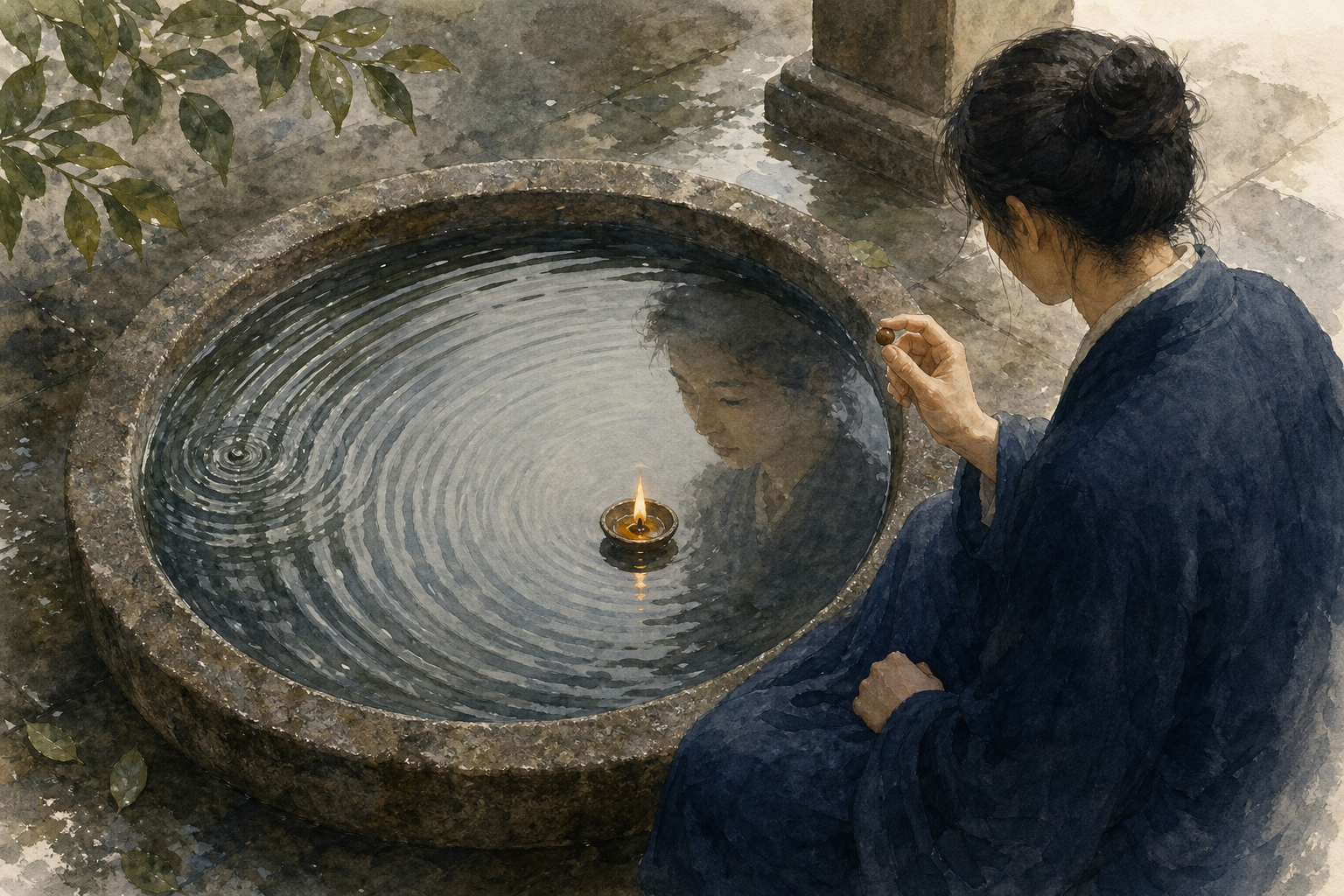
At the moment equanimity breaks
The most revealing practice period may occur after meditation, when a delay, insult, craving, or fear activates the entire body-mind. Do not demand instant transcendence. Use a short sequence that preserves both realism and devotion.
- Interrupt the escalation. If a decision can safely wait, do not send the message, make the accusation, or commit to an outcome at the peak of agitation.
- Name the leading layer. Ask whether the disturbance is primarily bodily, energetic, mental, intellectual, or sensory. More than one may be involved, but identify where intervention can begin.
- Meet the legitimate need. Change an unsustainable posture, eat or drink appropriately, reduce sensory input, or write down the feared outcome so it is no longer circulating without definition.
- Remember the Divine deliberately. Return to the same Name, form, or quality used in your regular sādhana. Restlessness is not the time to shop for a more exciting technique.
- Choose the next dharmic act. Ask what is truthful, non-harming, responsible, and actually within your control. Then do that much without demanding control over the result.
Gentle breathing can support this return, but it should never be forced. If breath regulation produces dizziness, pain, or distress, return to natural breathing and seek qualified instruction before attempting more demanding prāṇāyāma.
Afterward, look for changes in conduct
Do not grade the practice by asking whether you remained peaceful every moment. That standard encourages performance and concealment. Look instead for observable changes:
- You notice hunger or fatigue before turning it into anger at another person.
- You recover from an imagined future and identify the duty that belongs to the present.
- You can distinguish a worthy aspiration from a demand that reality obey your preference.
- You reach for sensory novelty less automatically and can stop after noticing the impulse.
- You become more patient without becoming evasive, and firmer without enjoying another person’s humiliation.
- Your remembrance returns as service, gratitude, courage, or care for another being.
Equanimity matures through repeated recovery. The interval between disturbance and remembrance may initially feel long; the meaningful change is that you begin to recognize the interval at all. Each honest return weakens the assumption that a passing bodily signal, thought, or desire has the authority to define you.
Contemplative practice is not a substitute for medical or psychological care. If anxiety, panic, sleeplessness, or another condition is persistently disrupting daily function, seek appropriate professional help and treat sādhana as spiritual support rather than a reason to postpone care.
At the next difficult moment, begin simply: identify the active layer, meet its legitimate need, remember your chosen Divine anchor, and take the next dharmic step. Equanimity is built in that movement from capture to recollection, repeated until returning to the Divine becomes more familiar than being carried away.
References
- Dandavats – Unshakable Equanimity in Srimad Bhagavatam 11.2.49: Suffering, Divine Memory, and Practice
- DharmaRenaissance Blog – Unveiling Dharma Sastha: Profound Yogic Symbolism in Ayyappa’s Idol for Deep Meditation
