
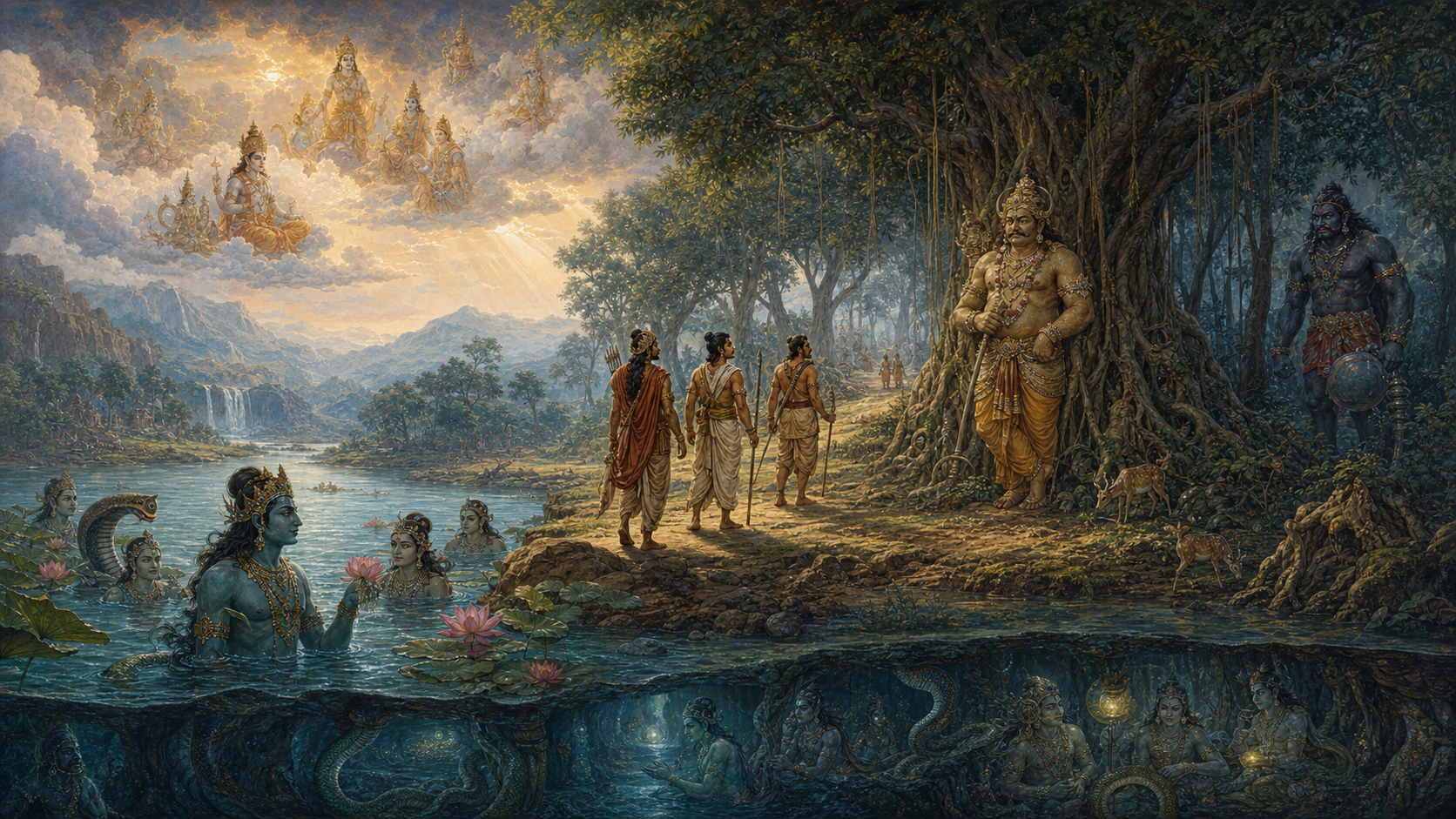
If you have wondered whether a deva, naga, yaksha or rakshasa should be read as a god, spirit, species, community, metaphor or some combination of these, you have encountered a problem created partly by modern categories. English words such as “god,” “demon” and “monster” can flatten distinctions the Mahabharata expects you to notice.
A better approach is to ask what kind of being has entered the story, what obligations govern the encounter and what the human characters do in response. The Mahabharata places humanity within a much larger community of visible and invisible beings. Once you treat those beings as participants in dharma rather than as fantasy decoration, many episodes become easier to understand.
Non-human is a category of being, not a moral verdict
The first mistake to avoid is placing every character on a simple human-versus-monster axis. In the Mahabharata, the distinction between human and non-human does not automatically correspond to the distinction between good and evil.
Celestial beings can be jealous, strategic or constrained. Rakshasas can enter human families and honor kinship. Nagas can appear as adversaries, allies or relatives. An animal form can conceal a divine examiner. A frightening appearance may signal danger, but it does not by itself settle the character’s moral standing.
This matters whenever a translation supplies a familiar English label. If you read “rakshasa” as “demon” and stop there, you may miss differences among predation, loyalty, vengeance, hospitality and sacrifice. If you read every deva as an all-powerful deity, you may miss the limits under which celestial powers operate. Retain the Sanskrit class name when you can, then judge the individual by conduct, relationships and consequences.
Use a simple test: temporarily remove the being’s appearance from the scene. What does the character ask, promise, protect, threaten or surrender? The answer usually tells you more about the episode’s dharmic argument than the label “monster” or “spirit” ever could.
A working field guide to the epic’s principal beings
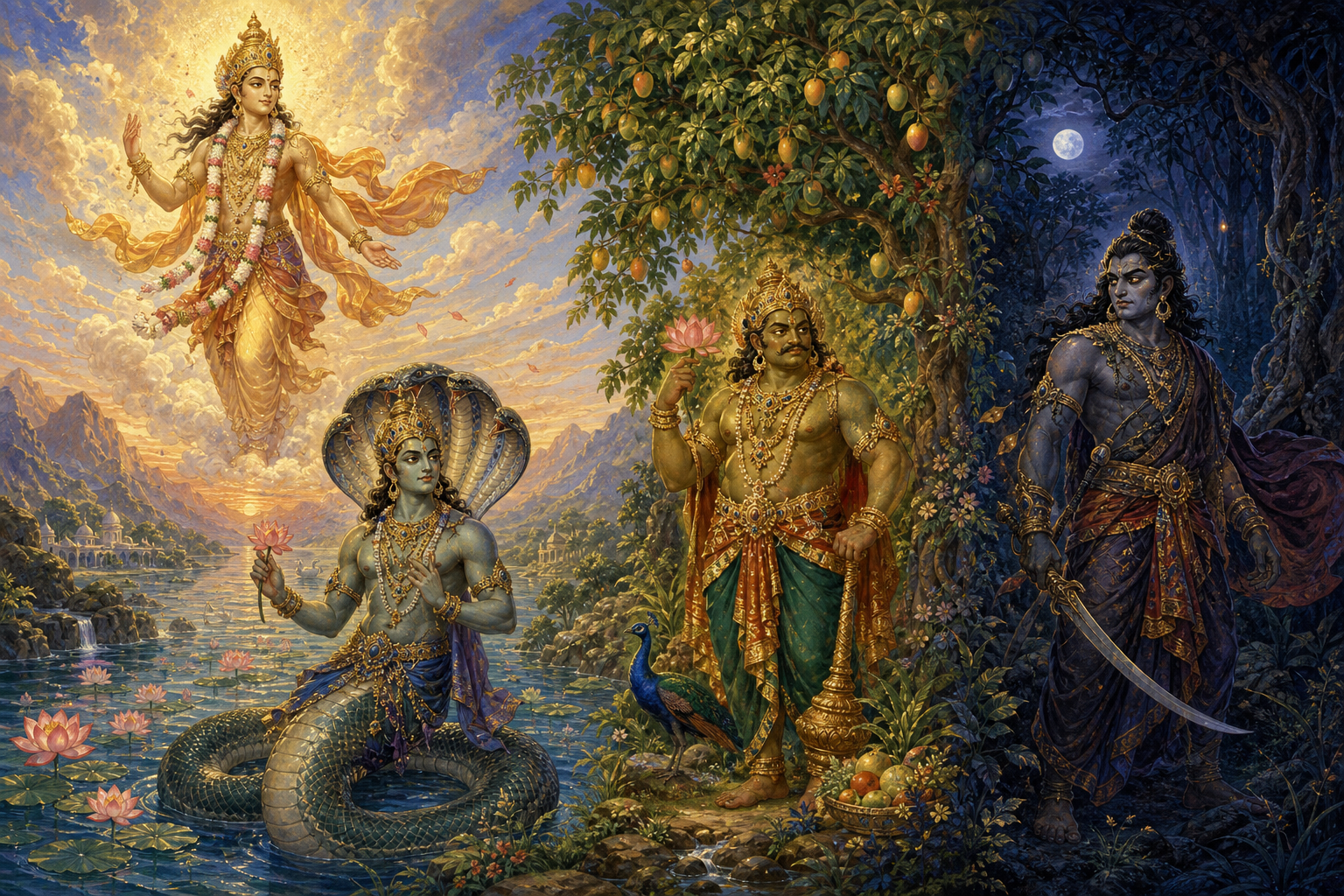
The Mahabharata does not present a modern biological taxonomy. Its categories can overlap through ancestry, transformation, divine manifestation and marriage. The following guide is therefore a reading aid, not a claim that every member of a class behaves identically.
| Class of being | What to notice | Common misreading |
|---|---|---|
| Devas | Cosmic functions, divine parentage, boons, obligations and limited interventions in human affairs | Treating every deva as omnipotent or morally infallible |
| Asuras, daityas and danavas | Lineage, allegiance, austerity, acquired power and rivalry with devas or humans | Collapsing several distinct classes into a single idea of absolute evil |
| Gandharvas and apsaras | Music, beauty, desire, courtly culture, self-control and movement between celestial and human settings | Seeing them as ornamental figures who do not affect moral decisions |
| Yakshas | Guardianship, permission, ownership, wilderness, thresholds and questions that test judgment | Reducing every yaksha to a generic ghost or nature spirit |
| Rakshasas | Shape-changing power, appetite, forest settings, warfare, kinship and the individual’s actual choices | Assuming that birth determines conduct |
| Nagas | Serpent form or association, distinct communities and lineages, marriage, inherited injury and collective conflict | Reading them only as ordinary snakes or only as metaphors |
| Animals and beings in animal form | Unusual speech, faithful companionship, warnings, moral tests and eventual disclosures of identity | Dismissing the encounter as a detachable fable |
Whenever one of these beings appears, record three things before deciding what the episode means: where the encounter happens, what relationship already exists and who sets the terms. A being met at a forest lake may function differently from one appearing in a royal court, even when both belong to the same broad class.
Non-human encounters expose the boundaries of human dharma
These characters are most useful to the epic when ordinary social rules become uncertain. The encounter may happen outside a kingdom, across lineages, between realms or under a concealed identity. Human characters must then decide whether dharma extends beyond familiar people and institutions.
Kinship crosses the human boundary
The Pandavas themselves cannot be understood without divine parentage. Bhima’s union with Hidimbi connects the Kuru family to a rakshasa lineage through their son Ghatotkacha. Arjuna’s marriage to the naga woman Ulupi creates another bond across kinds of being. These relationships are not incidental curiosities. They produce duties, descendants, alliances and claims that later affect the human world.
When reading such an episode, draw the family relationship before evaluating the supernatural element. Ask who owes protection to whom, whether consent is respected, which parent or community raises the child and when the bond is remembered. The epic repeatedly makes kinship more expansive than a closed human pedigree.
A concealed identity makes the human choice decisive
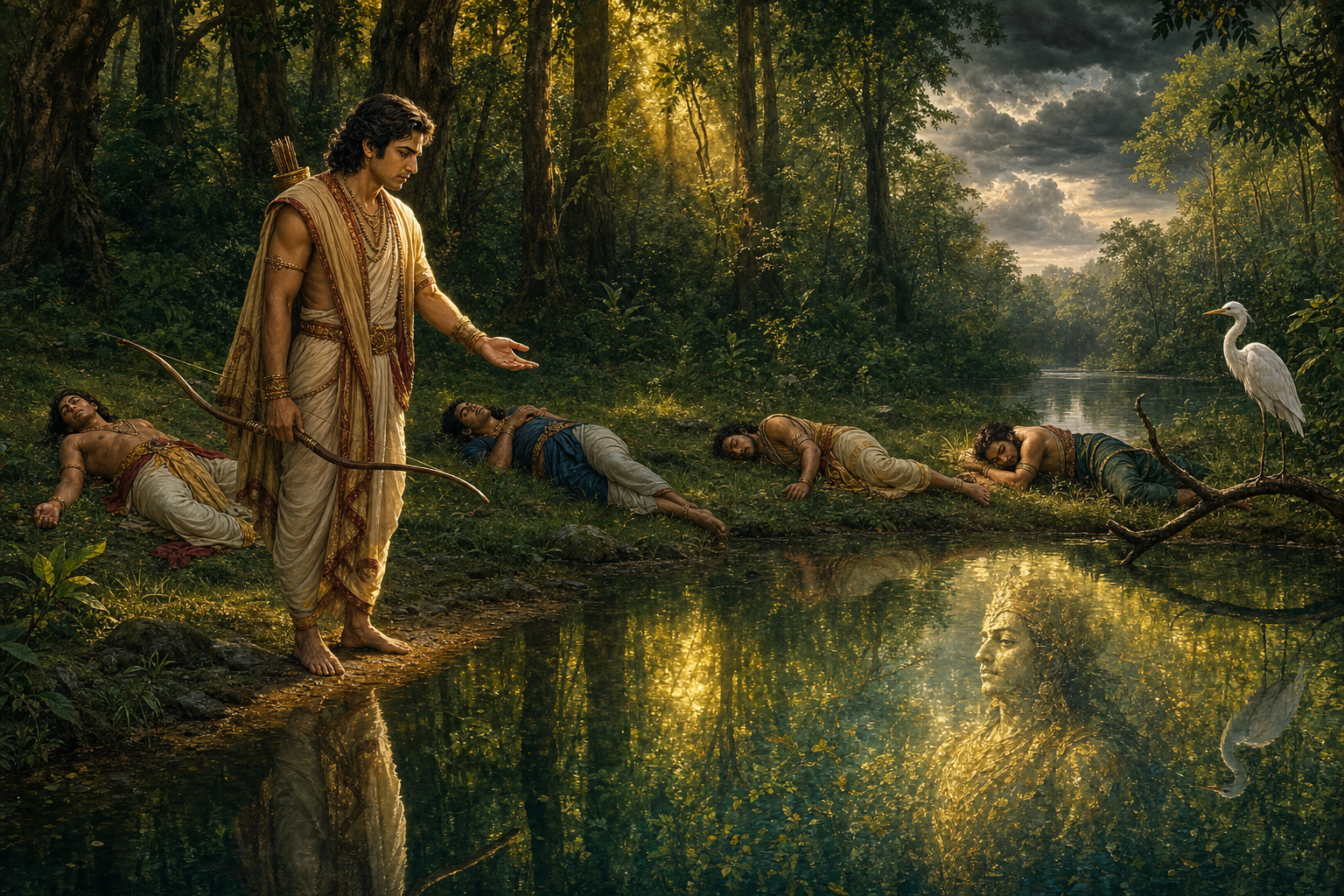
In the celebrated questioning at the lake, Yudhishthira must answer a yaksha before he can recover what has been lost. Near the end of his journey, he refuses to abandon a dog merely to secure his own admission to heaven; only afterward is the companion’s deeper identity disclosed. In both patterns, the moral decision comes before the full revelation.
That sequence tells you how to read the test. Do not make the later disclosure the sole reason the human acted correctly. Yudhishthira’s conduct matters because he responds to the being before him under incomplete knowledge. Dharma would be shallow if compassion or restraint applied only after a vulnerable creature proved to be divine.
Collective vengeance becomes morally visible
The setting of Janamejaya’s serpent sacrifice places conflict with the nagas close to the narrative frame of the Mahabharata. A king’s grief and anger expand into punishment directed at an entire class of beings, while Astika’s intervention interrupts that destructive momentum. The episode asks a question larger than whether one dangerous naga deserves punishment: can injury justify vengeance against a whole community?
This is why “hero kills monsters” is an inadequate reading template. Track the transition from an individual’s deed to collective retaliation. Then look for the figure who restores discrimination between guilt and lineage. The same habit is useful throughout the epic, where inherited hostility often pressures characters to treat birth as destiny.
Use three lenses without forcing the epic into one
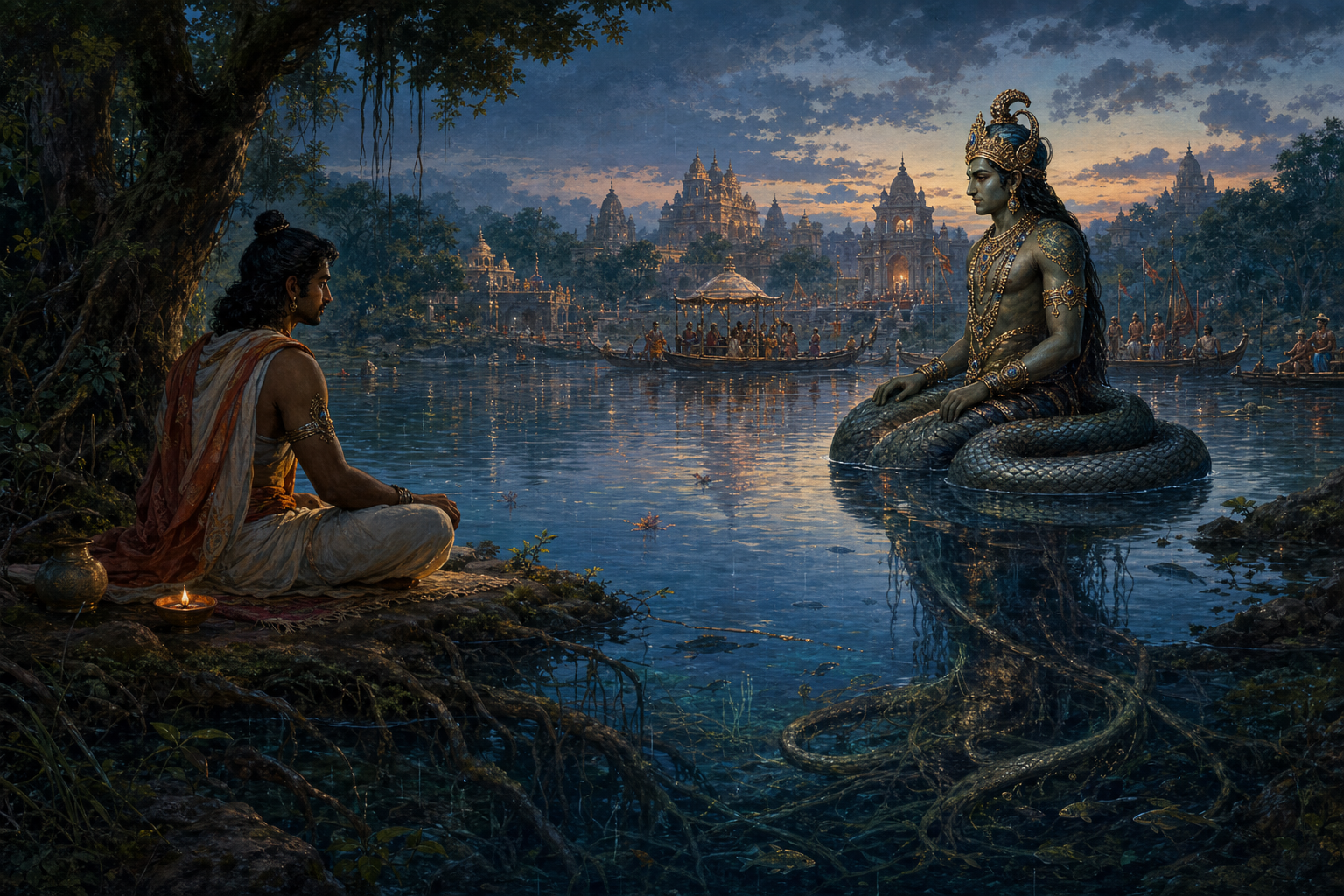
Readers often feel compelled to choose between a completely literal and a completely symbolic interpretation. That choice is unnecessary. The more disciplined method is to separate three questions and answer them in order.
- What happens within the narrated world? Begin by accepting the episode’s own terms. Identify the being, realm, relationship, power and stated motive. Do not replace the narrative with an explanation before you have understood it.
- What ethical work does the encounter perform? Ask which human attachment is being tested: fear, appetite, pride, loyalty, hospitality, vengeance or compassion. A symbolic meaning is strongest when it grows from the being’s actual words and actions.
- What cultural or historical interpretation is being proposed? Claims that nagas, rakshasas or other beings are simply coded names for particular human populations require evidence beyond resemblance. Treat such proposals as interpretations, not automatic translations of the epic’s ontology.
You can hold devotional, philosophical, literary and historical readings together, but they should not be confused. “This is how the narrated world presents the event” differs from “this is what the event teaches” and from “this may preserve a memory of social encounter.” Stating which claim you are making prevents a suggestive interpretation from masquerading as a textual fact.
This layered method also protects the Mahabharata from two opposite reductions. One reduction treats its beings as primitive mistakes that a modern reader must explain away. The other treats every detail as a code with one fixed allegorical solution. Both approaches silence the characters before hearing what they do.
Key takeaways for your next reading
- Keep the Sanskrit class name in view; “god,” “demon,” “spirit” and “monster” are often too broad.
- Do not infer moral alignment from species, lineage, appearance or realm. Judge the individual through conduct and consequence.
- Track kinship. Marriages, births and shared parentage connect non-human communities directly to the epic’s political and ethical world.
- Notice when identity is disclosed only after a choice. The test usually concerns conduct under uncertainty, not obedience to visible power.
- Separate what the narrative depicts, what the episode may symbolize and what a historical interpretation proposes.
- Ask whether the encounter expands or contracts the circle of beings to whom dharma is owed.
For the next non-human encounter you read, make a six-line note: class of being, location, kinship, demand, human response and outcome. If your interpretation cannot account for all six, revise it. That small discipline will show you that the Mahabharata’s cosmos is not scenery around a human war. It is the larger moral field in which human claims to righteousness are tested.
References
