
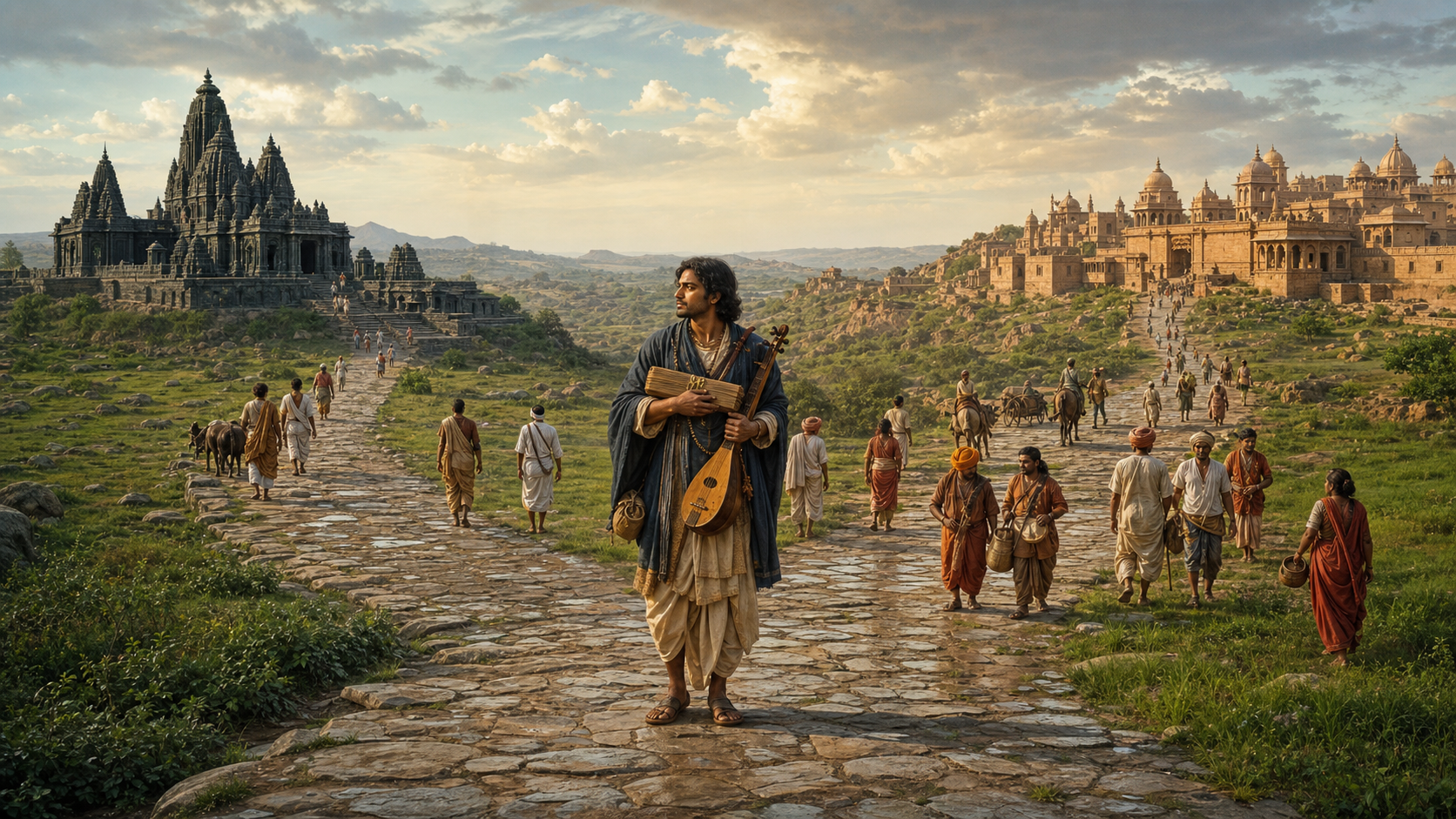
You may have learned to place Nannaya inside the Telugu canon and Pampa inside the Kannada canon. Those labels are correct, but they are not complete. They tell you where an achievement crystallized; they do not reveal every route by which poets, patrons, metres, devotional practices and stories moved.
If you are trying to decide whether the Kannada–Telugu literary continuum is a historical reality or merely a civilizational slogan, use a demanding standard. Look for identifiable mechanisms of exchange while preserving the distinct voice of each language. The result is more interesting than either linguistic isolation or vague claims of unity.
What the continuum does – and does not – mean
A literary continuum is not a claim that Kannada and Telugu are interchangeable. It describes repeated circulation between two literary environments that remained recognizably their own. A poem can be thoroughly Kannada while its author, patronage network, genre or intellectual setting reaches into the Telugu cultural sphere. The reverse can be true as well.
Test any claim of continuity at four levels:
- People: Did a poet compose in both languages, live across cultural zones or belong to a community active on both sides?
- Institutions: Did courts, dynasties, temples or scholarly networks support work across linguistic boundaries?
- Forms: Do the traditions employ related metres, mixed prose-and-verse structures or shared performance disciplines?
- Purposes: Do compositions participate in a common devotional, philosophical or epic world while giving it a local voice?
One resemblance proves little. A persuasive case appears when several levels coincide. Palkuriki Somanatha, for example, is more than a poet with a disputed regional label: he wrote across Kannada and Telugu and carried related prosodic and metaphysical concerns through both. Authorship, language and thought meet in the same figure.
This standard protects you from two opposite mistakes. The first projects present-day linguistic compartments backward and treats every tradition as self-contained. The second dissolves real differences into an undefined idea of South Indian culture. The continuum lies between them: durable exchange without erasure.
Key takeaways
- Read Kannada and Telugu as distinct literary traditions with a long history of traffic between them.
- Give the most weight to identifiable poets, patrons, forms and institutions rather than superficial verbal resemblance.
- Treat a modern translation as a continuation of the relationship, not as proof of every historical claim about it.
- Ask what changed during transmission. Local adaptation is evidence of a living continuum, not a defect in it.
Follow movement through poets, courts and centuries
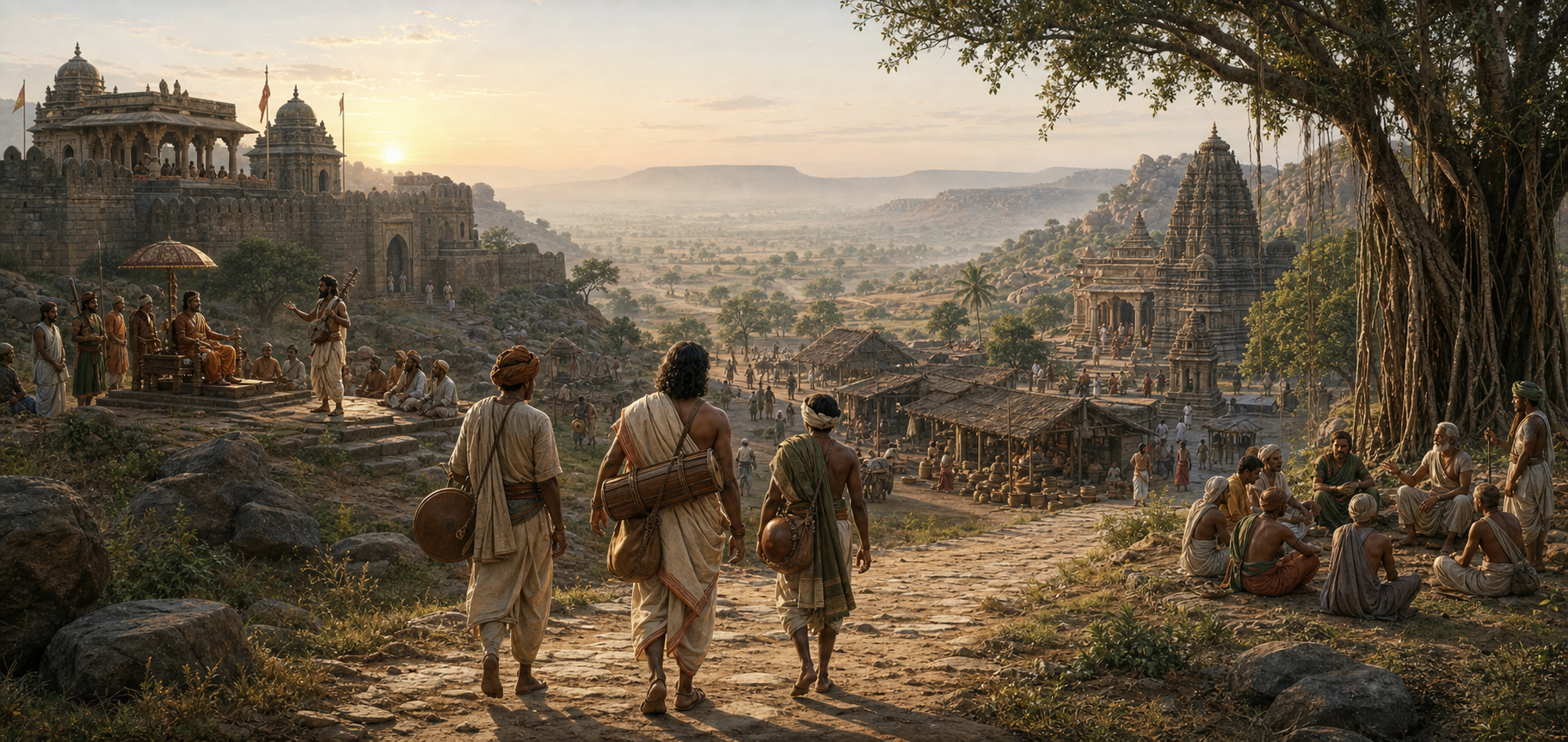
The most reliable way to see the continuum is to build a chronological map. From the Satavahana period onward, inscriptions, courtly patronage and bilingual composition disclose recurring exchange. This does not mean that every century produced the same kind of relationship. Political support, personal mobility, formal borrowing and devotional circulation each left a different kind of trace.
Begin with Nannaya Bhatta, the eleventh-century poet conventionally treated as the first great translator of the Mahabharata into Telugu. His work received support from the Vengi Chalukyas, a branch connected with Karnataka’s Chalukyan lineage. The political connection does not make Nannaya’s achievement Kannada. It shows that a foundational Telugu work emerged within a regional world whose dynastic and cultural relationships exceeded a modern language boundary.
Then reverse your direction of travel. Adikavi Pampa stands at the foundation of Kannada epic literature while retaining strong roots in the Telugu cultural sphere. Placing Nannaya and Pampa beside each other corrects a common reading habit: literary identity cannot always be reconstructed by assigning one poet, one court and one territory to one sealed linguistic box.
Palkuriki Somanatha gives you a still clearer bridge because composition itself crosses the boundary. When a writer works in both languages, do not stop at the biographical curiosity. Compare what the poet does with metre, theological vocabulary, address and narrative scale in each linguistic setting. The valuable question is not, “Who owns this poet?” It is, “What could this poet make each language do?”
The Vijayanagara world enlarges the pattern. Annamacharya in Telugu and Purandaradasa in Kannada belonged to different linguistic settings, yet their compositions met within a shared bhakti horizon shaped by poetry, music and liturgical life. Their local idioms matter. Shared devotion did not require the same diction, melody or poetic personality.
A useful comparison therefore begins with function rather than a hunt for identical phrases. Ask who speaks in a composition, how the divine is addressed, what role repetition plays, where musical performance enters and how the chosen language makes intimacy or majesty audible. You will see common devotional purposes alongside different literary solutions.
The Telugu Kavitrayamu supplies another chronological discipline. Nannaya completed the Adi and Sabha portions of the Mahabharata and entered the Aranya Parva before his death. Tikkana Somayaji, in the thirteenth century, composed the fifteen parvas from Virata through Svargarohana. Errana, in the fourteenth century, completed Aranya and composed the Harivamsa. Their collective labour established a classical norm for Telugu grammar, diction, prosody and narrative balance.
That achievement is not Kannada literature, and it should not be relabelled as such. Its relevance to the continuum lies in its regional setting, its long afterlife and its later re-imagination in historical fiction that has itself crossed into Kannada. The chain is more useful than a claim of ownership: Sanskrit epic, Telugu classical formation, Telugu historical novel and Kannada literary re-voicing.
Srinatha adds a further warning against stationary maps. The fifteenth-century poet helped move Telugu literature from the comparatively direct Purana mode toward the crafted sophistication of Prabandha. He also travelled among several royal centres rather than remaining confined to one court. His mobility alone does not prove a Kannada–Telugu connection, but it reminds you to map routes and patronage networks before treating a literary culture as territorially fixed.
Read form as evidence, not merely subject matter
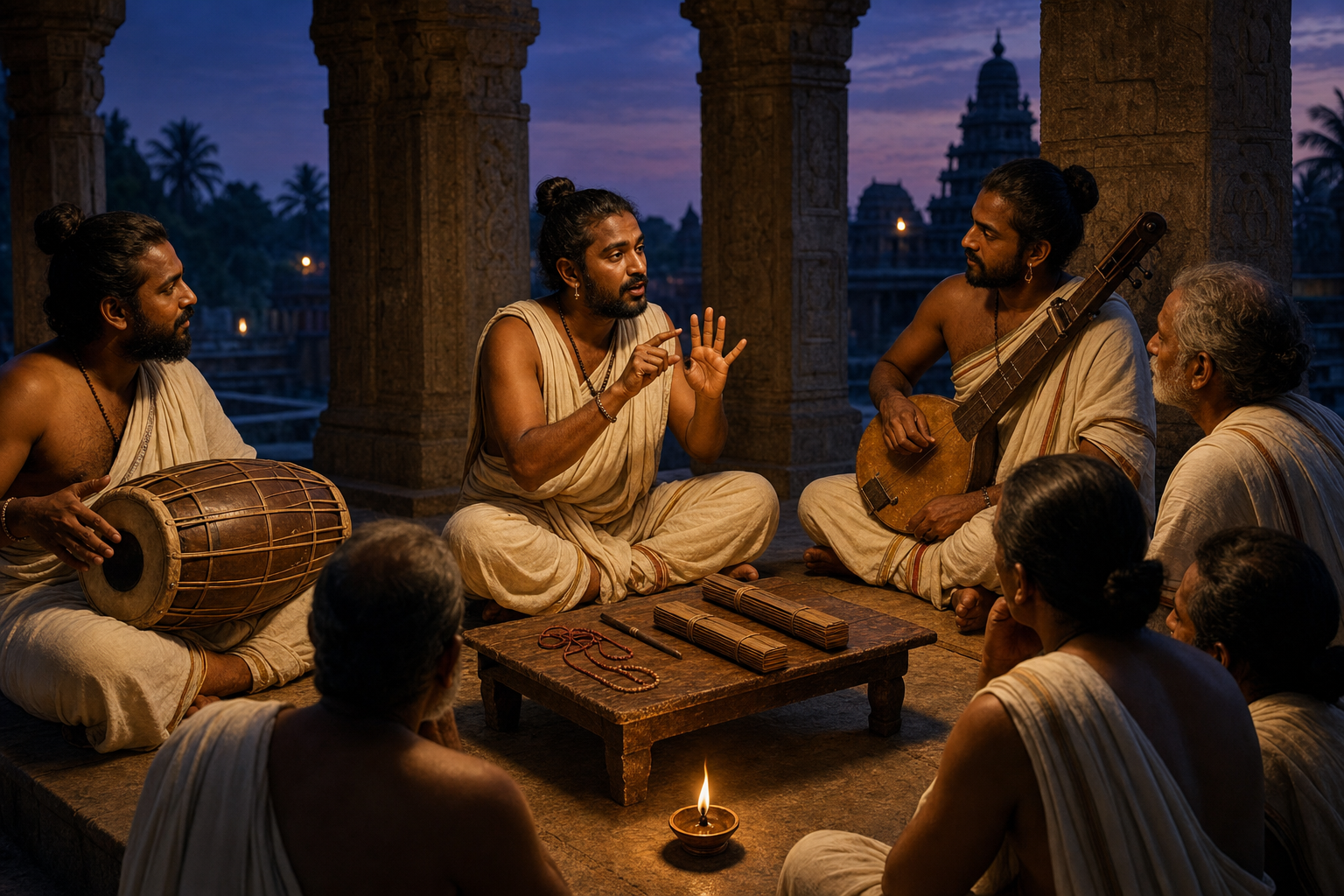
Shared stories are easy to notice. Shared literary technology is often more revealing. Kannada and Telugu writers worked with a repertoire that included Ragaḷe, akkara, kanda, sīsa and vṛtta. The recurrence of these formal currencies tells you that exchange operated below the level of plot.
Do not assume that a shared name guarantees identical use in every work. Treat it as a lead. Examine the length and movement of the stanza, the pressure it places on syntax, the kind of scene it carries and whether it invites recitation, exposition, praise or dramatic acceleration. Form becomes historical evidence when you can show what a poet did with it.
Champu deserves particular attention because it joins prose and verse within one compositional body. A prose passage can advance action or establish circumstance; verse can intensify description, reflection or aesthetic concentration. When Champu travels, the important continuity is not simply the presence of two modes. It is the trained ability to shift between them without breaking the work’s integrity.
Avadhāna reveals a related performance culture. It requires extemporaneous composition, memory and attention to several simultaneous demands. Its flourishing in both Kannada and Telugu indicates more than the brilliance of individual performers. It also points to audiences capable of recognizing prosodic precision, verbal ingenuity and disciplined improvisation as they occurred.
Use three passes when you study a passage or hear a performance:
- Map the architecture. Mark every movement between prose and verse, narration and address, description and argument.
- Identify the formal demand. Record the named metre or performance constraint when it is known. If it is not known, describe what you can actually hear or see instead of guessing.
- Ask what the form accomplishes. Does it heighten devotion, display virtuosity, slow the narrative, preserve a teaching or make a courtly audience part of the event?
This method prevents a translation from becoming your only evidence. A prose rendering may communicate an event accurately while concealing the original metre, sonic texture or change of register. Read the translation for meaning, but keep a separate note for formal features that it cannot carry.
Treat translation as a test of the living relationship
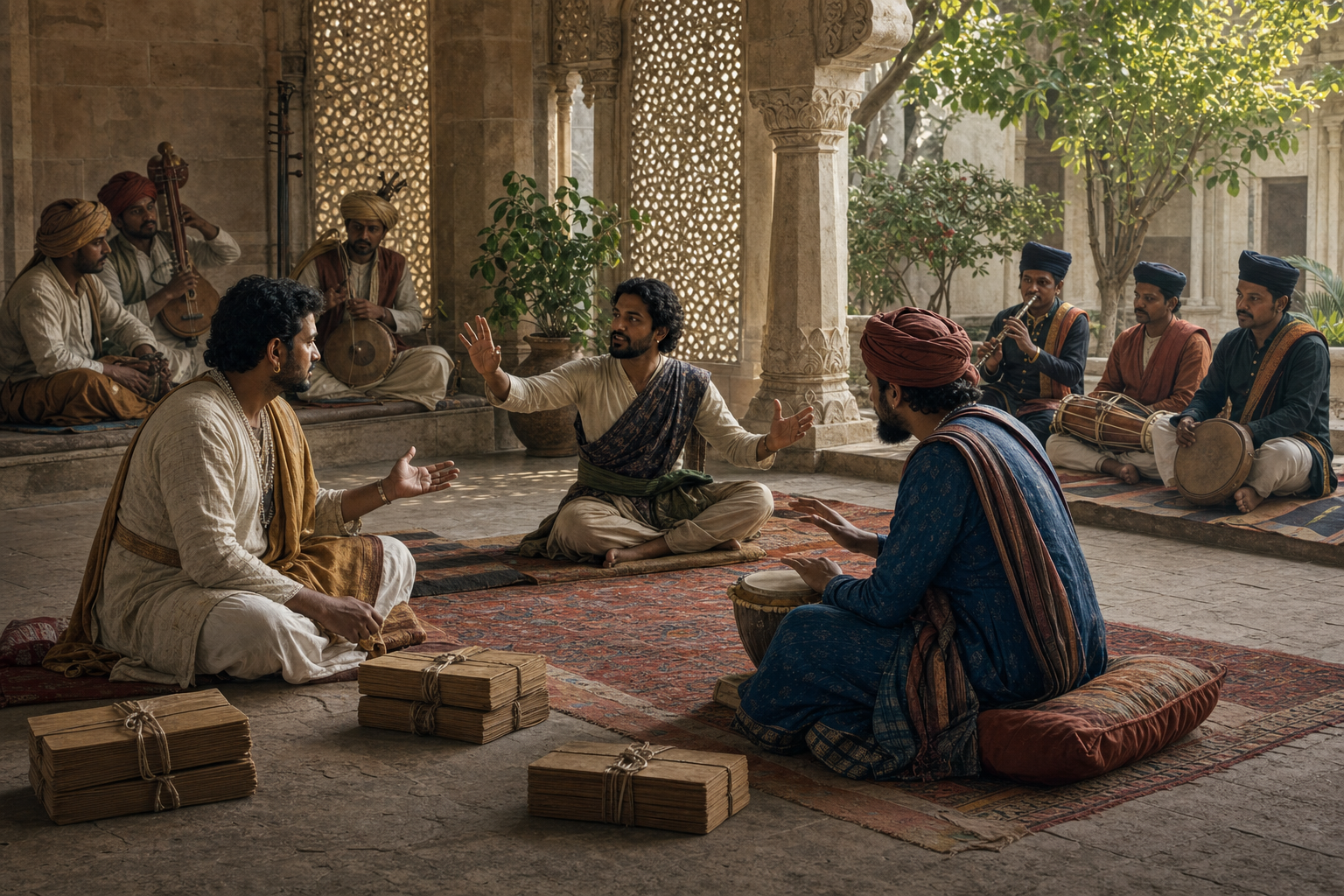
The Kannada rendering of Nori Narasimha Sastry’s Kavisārvabhaomuḍu by Shatavadhani Dr. R. Ganesh gives the continuum a modern, concrete form. Nori, who lived from 1900 to 1978, combined legal training with wide literary and sastric interests. His historical fiction does not use the past as decorative scenery. Social systems, commerce, jurisprudence, administration, ritual and aesthetic culture help generate the action.
That density makes the translation a harder task than transferring plot. Ganesh preserves the original’s mature and dignified register while allowing Kannada to sound idiomatic. In well over 95 percent of the work, the sentence architecture and stylistic contour remain close to the Telugu. Yet fidelity does not become mechanical imitation: Sanskrit shlokas and Telugu verses embedded in the narrative are rendered as Kannada prose, while footnotes are used selectively.
This gives you a practical translation audit:
- Register: Does the Kannada convey the social and aesthetic dignity of the Telugu prose, or only its dictionary meaning?
- Sentence movement: Does the translated syntax preserve the pace and contour of the original without becoming unnatural Kannada?
- Mode changes: Are passages converted from verse to prose identifiable, so that you do not mistake narrative access for formal equivalence?
- Explanatory burden: Do notes clarify indispensable context without turning the reading experience into a commentary apparatus?
A strong translation therefore balances two obligations. It should remain answerable to the source text’s design, and it should live as literature in the receiving language. Literal correspondence alone cannot achieve both. Conversely, fluent Kannada that removes ritual logic, formal alternation or historical texture may transport the story without transporting its literary world.
The crossing is not an isolated event. Nori’s Narayana Bhattu had already been translated into Kannada by Raghusuta, and Rudramadevi by K. Venkataramappa. Support from Kuvempu Bhasha Bharati for the Kannada Kavisārvabhaomuḍu gives institutional form to an ongoing interest in this shared archive. Together, these translations let Kannada readers follow Nori’s reconstruction of Telugu literary history without pretending that translation eliminates the need to encounter Telugu form.
Nori’s method also shows what historically responsible fiction asks of a translator. His novel Waghira, set around the Ajanta caves during the reign of Pulakeshin II, anchors invention in murals, inscriptions and ritual sequences. Elsewhere, his initiation into Srividya informs the narrative role of Srichakra worship. These are structural elements, not detachable ornaments. A translator who notices them can preserve the causal logic of the imagined world rather than merely reproducing its sequence of events.
Build a reading practice that can support real claims
You do not need equal mastery of Kannada and Telugu before beginning. You do need to distinguish what you can verify from what you are inferring. A modest, well-supported observation about one metre or one bilingual poet is worth more than a sweeping assertion about cultural unity.
A five-step route through the continuum
- Start with a bridge you can name. Palkuriki Somanatha is the clearest authorial starting point because his work crosses both languages. Nannaya and Pampa offer a complementary study of patronage, geography and cultural affiliation.
- Create a small evidence sheet. For each poet or text, record period, language, court or region, genre, metre, devotional or philosophical setting and later translation. Leave a field blank when the evidence is unavailable.
- Compare one formal feature at a time. Follow a named metre, Champu architecture or Avadhāna practice before attempting a general history of influence. Narrow comparison makes direction, adaptation and uncertainty easier to see.
- Separate meaning from medium. When using a translation, note which passages were verse in the earlier text, where syntax has been closely preserved and where the receiving language has required a new solution.
- Write a calibrated conclusion. Say whether your evidence shows shared patronage, bilingual composition, formal circulation, devotional convergence or modern reception. Do not call every connection mutual influence when the direction of travel is unknown.
Read poets as civilizational workers, not compulsory activists
The continuum also changes how you assess a poet’s public importance. A poet need not lead a political movement or occupy the machinery of state to shape a civilization’s moral and aesthetic compass. The Kavitrayamu did something more enduring than courtly publicity: its members established standards of Telugu expression that continued to teach later poets after their political settings had passed.
Nori’s historical design places the Mahabharata at moments of intense debate and disruption in Andhra. Within that interpretation, Buddhist and Jain traditions participate in the Dharmic field of intellectual contestation, while poets return to Vyasa’s epic as a moral grammar through which Sanatana Dharma can be renewed. You need not convert this literary interpretation into a total theory of history. Use it to ask sharper questions: What kind of disorder is the epic answering? Which ethical vocabulary is being restored? What can poetry preserve that administration cannot?
This is where the Kannada–Telugu continuum has a wider Dharmic significance. It offers evidence of reciprocity without demanding uniformity. Shared epic memory, bhakti, formal discipline and scholarly culture could cross linguistic borders precisely because each language was capable of receiving them in its own cadence.
Begin with one page rather than a slogan. Put a Telugu passage beside its Kannada rendering, mark every shift between prose and verse, and identify one historical route by which the work travelled. Once you can point to the mechanism, the continuum will no longer be an abstraction; it will be something you can read.
References
