

If every conversation about medieval invasions ends in one of two places – either nothing serious happened, or people living now must answer for what happened centuries ago – you do not have to accept that choice. You can honour the dead, teach the record of resistance, and refuse collective hatred at the same time.
The workable path requires discipline. Name what happened precisely. Admit what cannot be quantified. Keep medieval rulers distinct from present-day communities. Then turn memory into preservation, education, and cooperation among Hindus, Buddhists, Jains, and Sikhs.
Reject the false choice between denial and inherited blame
Muslim presence in the subcontinent did not have a single doorway. It grew through peaceful maritime commerce and Sufi networks as well as military campaigns associated with Ghaznavid, Ghurid, and later sultanate powers. The claim that Islam came only through the sword therefore fails. So does the claim that conquest, coercion, and political domination played no serious role.
The historical record includes temple desecration, jizya regimes, mass enslavement during certain campaigns, punitive expeditions, and the movement of captives toward places such as Ghazni, Herat, and Baghdad. It also includes administrative cooperation, political alliances, cultural exchange, and ordinary coexistence. These facts do not cancel one another. Cooperation in one court does not erase captives taken in another campaign; an atrocity committed by one ruler does not make every place and every generation identical.
That distinction is especially important when discussing Mahmud of Ghazni, Muhammad of Ghor, certain Khalji and Tughluq rulers, or Timur. Severe destruction and suffering can be acknowledged in particular invasions without pretending that one policy governed the entire subcontinent for many centuries. Say which ruler, campaign, place, and action you mean. Precision protects the truth from both denial and exaggeration.
Grand casualty totals require even more care. Popular estimates running into tens of millions remain deeply contested because continuous demographic evidence does not exist for the whole period. That uncertainty does not mean that no mass violence occurred. It means an exact cumulative total should not be presented as settled when the evidence supports documented episodes more strongly than a single number covering many centuries.
This is not a concession to historical amnesia. A dramatic but undefendable number gives a sceptic an easy way to dismiss well-attested destruction, enslavement, and displacement along with it. Lead with the strongest evidence. State the human consequence. Label the remaining uncertainty. You lose nothing by refusing false precision.
The thousand-year-slavery slogan fails for a different reason. It treats Bharat as though every region passed through the same political condition at the same time. Rajput polities, the Ahoms, Vijayanagara, the Marathas, and later Sikh confederacies preserved or recovered sovereignty in different regions and periods. Dharmic institutions also survived, adapted, and rebuilt under changing political conditions.
Replace the slogan with better questions: Where did sovereignty contract? Where did it endure? Which institutions were damaged? Which communities rebuilt them? What forms did military, intellectual, devotional, and social resistance take? Those questions restore agency to the people of Bharat. They also reveal why Dharmic civilisation survived as a living inheritance rather than as an archaeological memory.
Use a five-part test before repeating a historical claim
A claim about medieval history should earn your confidence before it earns your anger. Run it through this test whether it supports your existing view or challenges it.
- Name the actor. Was the decision made by a ruler, commander, dynasty, army, official, local ally, or religious institution? Do not substitute an entire religion for an identifiable historical agent.
- Name the action. Looting, temple desecration, enslavement, taxation, forced movement, conversion, alliance, patronage, and administrative incorporation are different actions. Do not bundle them into a vague word such as oppression when the evidence permits a precise description.
- Bound the claim. State the campaign, reign, region, or institution involved. Evidence from one punitive expedition does not automatically establish an unchanging policy across the subcontinent.
- Grade the evidence. Distinguish a documented episode from a plausible interpretation, a contested estimate, and an unsupported slogan. Persianate chronicles, Sanskrit and vernacular inscriptions, travel accounts, and court histories can preserve valuable evidence, but each must be read for purpose, genre, and context.
- Test the modern inference. Ask whether the historical fact actually supports the present conclusion attached to it. A ruler’s crime may justify remembrance and study. It does not establish hereditary guilt in a neighbour who shares neither the ruler’s power nor responsibility.
Apply the test in both directions. A single example of courtly cooperation cannot erase a violent campaign. A single campaign cannot prove that every encounter was violent. If you reject overgeneralisation only when it comes from the other side, you are defending a camp rather than seeking truth.
Conversion demands the same discipline. Religious change in territories that later became Afghanistan, Pakistan, and Bangladesh had multiple mechanisms: political economy, opportunities for mobility, tax incentives, Sufi influence, local devotion, intermarriage, and coercion in particular episodes. The existence of voluntary conversion does not disprove coercion. The existence of coercion does not prove that every conversion followed the same path.
A family or locality could also encounter several pressures at once. Political advantage, devotional conviction, fear, marriage, and economic necessity are not mutually exclusive categories. Present-day demography cannot by itself recover the motive of every ancestor. Where the record is incomplete, say so. Uncertainty is more honourable than turning millions of distinct lives into one formula.
The Romani story offers a useful check on this habit. Linguistic and genetic evidence supports origins in northwestern India and migration beginning around the first millennium CE, while conflict and enslavement remain among several proposed drivers. Multiple waves involving displaced people, artisans, and performers are also plausible. The origin can therefore be better established than a single cause. Keep those two levels of confidence separate.
Use four labels in your notes: documented episode, supported interpretation, contested estimate, and unsupported slogan. That small habit makes a discussion much harder to manipulate.
Build unity that is strong enough to preserve differences
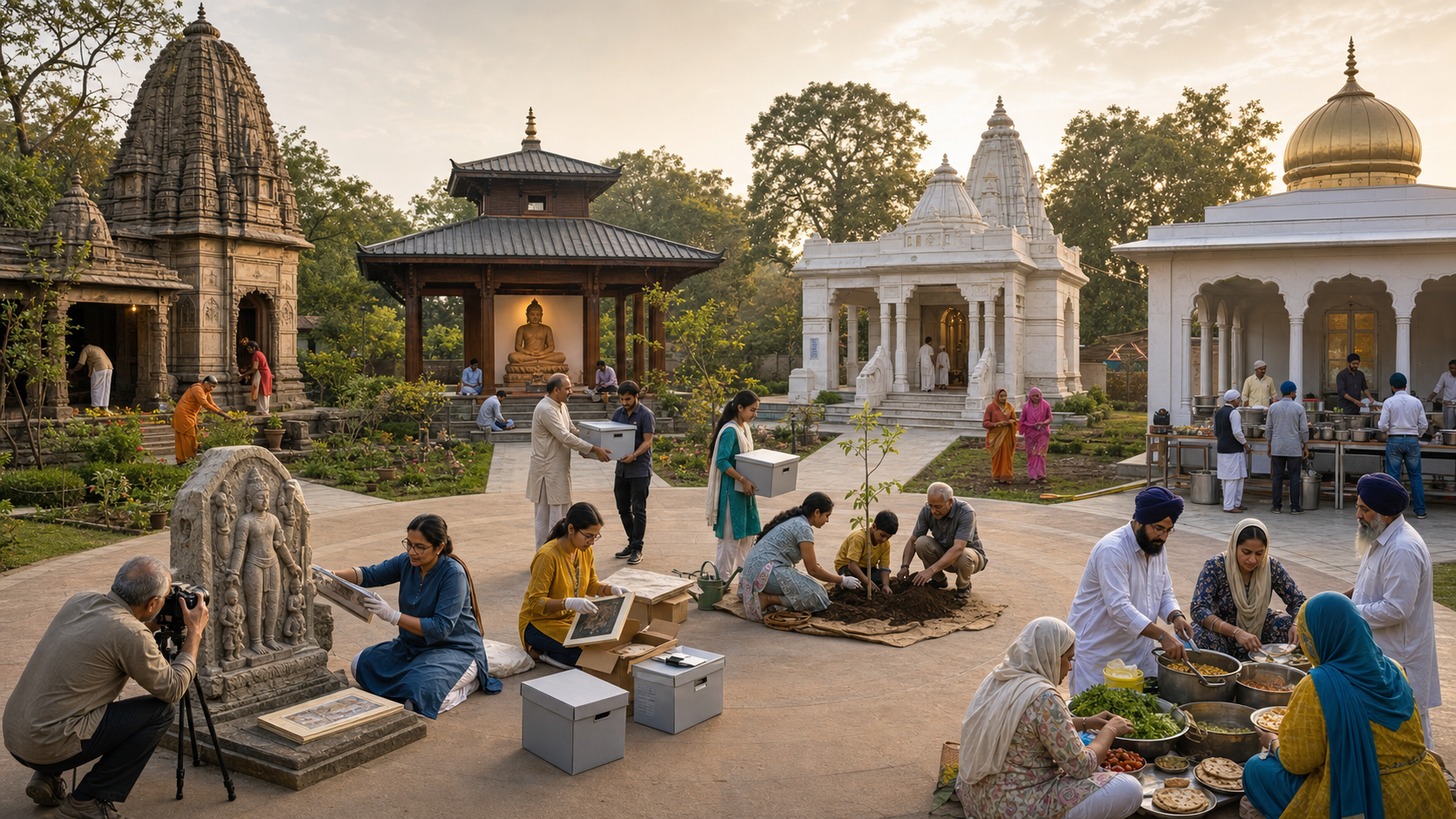
Dharmic unity does not require Hinduism, Buddhism, Jainism, and Sikhism to become interchangeable. Their philosophies, institutions, disciplines, and historical experiences remain distinct. Unity means that these traditions can recognise a shared civilisational field, defend one another’s dignity, and cooperate without demanding theological sameness.
- Practise satya through restraint. State no more than the evidence can carry. A qualified truth is stronger than an inflated claim.
- Practise ahimsa in speech. Condemn an atrocity without using ancestry, dress, surname, or present religious identity as a licence to demean a living person.
- Recover kshatra without cultivating rage. Teach courage, defence, and the rebuilding of institutions. Do not confuse martial memory with uncontrolled hostility.
- Protect plurality. Let each Dharmic community name its own losses and exemplars while building common projects around archives, education, sacred places, language, and service.
Ahimsa does not require silence about enslavement or desecration. Kshatra does not require hatred. Satya does not require reducing a long and varied period to a catalogue of injuries. These disciplines correct one another: courage prevents appeasement, non-violence prevents dehumanisation, and truth prevents mythology from replacing history.
Shared inheritance can also cross today’s religious and national boundaries. The Ramayana and Mahabharata have continued to attract audiences in Pakistan and Bangladesh because their ethical, dramatic, and aesthetic worlds exceed a single political border. That does not turn every viewer into a Hindu or erase present differences. It shows that civilisational memory can remain recognisable even when confessional identities change.
Ancestry is similarly layered. Hindus, Muslims, Buddhists, Jains, and Sikhs across South Asia often have deeply intertwined family histories. A community’s tradition of Arab or Central Asian descent may matter to its self-understanding, but it should not be treated as a population-wide account of origin. Nor should deep local ancestry be used to pressure someone into a religious identity they have not freely chosen.
This gives Dharmic unity a clear boundary: no person inherits criminal liability from a medieval ruler. Present-day individuals are responsible for what they affirm, deny, excuse, repair, or do now. You may reasonably ask someone not to glorify atrocities. You may not assign guilt merely because that person shares a religious label with a conqueror.
Reconciliation therefore does not mean amnesia. It means remembering victims without manufacturing new targets. It means inviting honest acknowledgement while refusing humiliation. A unity built on denial will fracture as soon as suppressed memory returns; a unity built on collective blame will reproduce the moral failure it claims to oppose.
Turn historical memory into a community practice
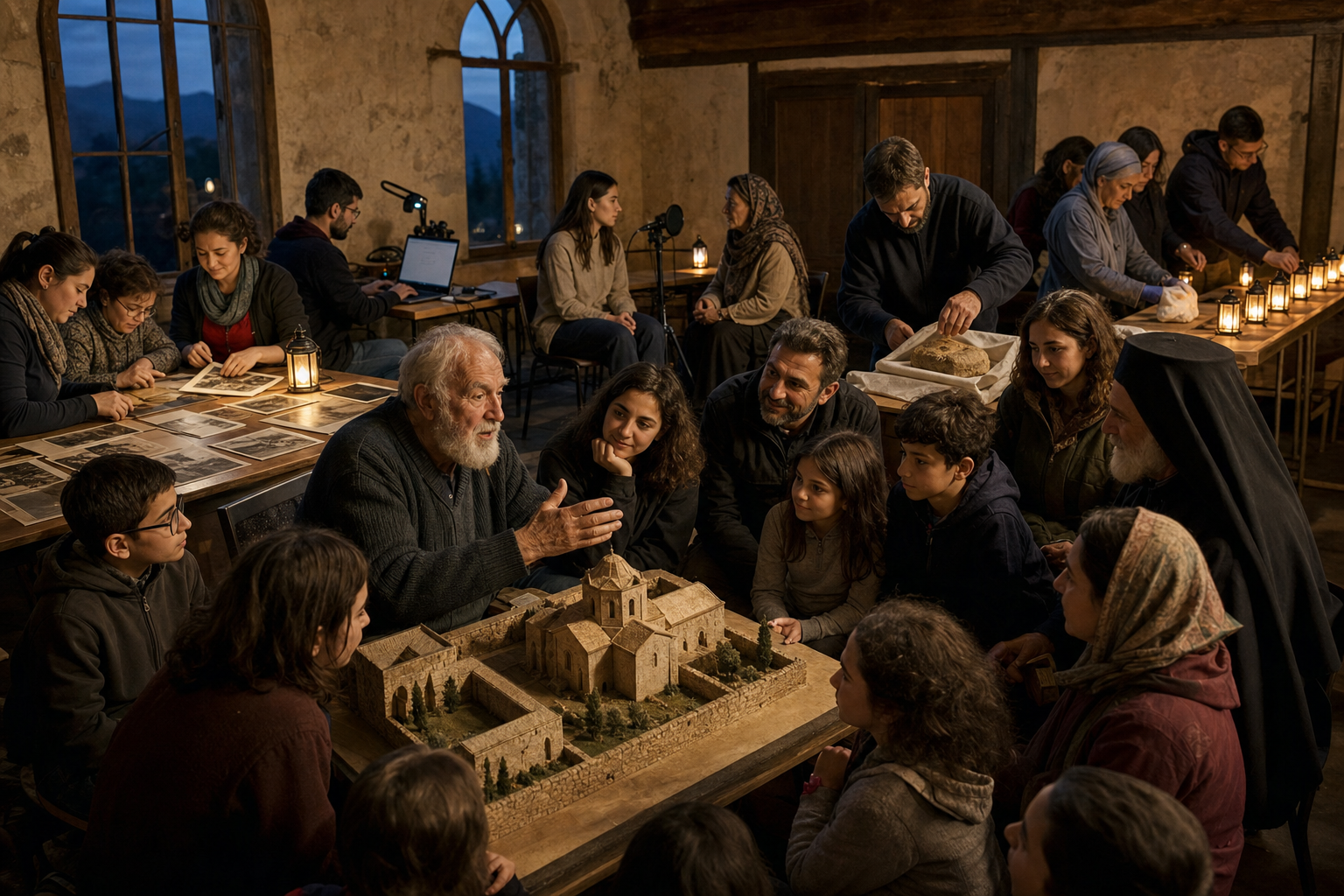
For a family or study circle
Do not begin with the entire medieval period. Choose one claim and make it answerable. A useful discussion follows this sequence:
- Write the claim exactly as people repeat it.
- Identify the actor, action, place, and historical scope.
- List the evidence type and anything the evidence cannot establish.
- Add the record of resistance, survival, or rebuilding relevant to the same setting.
- Give the claim a confidence label and rewrite it in a form you would be willing to teach a child.
- End with one constructive act: further reading, preservation, language study, support for an institution, or respectful dialogue.
Consider the claim that Hindus were enslaved for one thousand years. The evidence-based revision is more demanding: Dharmic communities faced conquest, discriminatory taxation, desecration, enslavement in particular campaigns, and loss of sovereignty in many settings, while regional states, sacred institutions, and social networks also survived, resisted, and rebuilt. The revision preserves suffering and restores agency. The slogan does only the first, and does it imprecisely.
For a school, temple, monastery, gurdwara, or Jain institution
Build a two-track timeline. One track should record invasion, coercive policy, institutional destruction, enslavement, and displacement. The other should record resistance, autonomous rule, reconstruction, philosophical work, devotional continuity, and cultural transmission. A timeline containing only defeat teaches helplessness. One containing only glory teaches evasion.
Use a regional map alongside the timeline. Delhi-centred political history can make changes at one court look like the condition of the whole subcontinent. Mark the settings associated with Rajput resistance, the Ahoms, Vijayanagara, the Marathas, and Sikh power. Then ask what kind of control existed in each setting: a raid, an occupation, a tributary relationship, an alliance, or durable administration. Those categories should not be collapsed.
Teach vocabulary before moral judgement. Students should be able to distinguish invasion, iconoclasm, enslavement, jizya, conversion, accommodation, patronage, alliance, and syncretic practice. Once different mechanisms have names, denial becomes harder and indiscriminate blame becomes less tempting.
Keep British colonialism in its own analytical frame. The idea that colonial rule rescued Bharat from an undifferentiated medieval darkness erases extraction, disruption of indigenous institutions, and the imperial use of historical narratives. Medieval complexity and colonial exploitation can both be recognised without making either one an excuse for the other.
For public remembrance
A responsible commemoration should do four things. Name the harmed community and the responsible historical agent where evidence permits. State what remains uncertain. Explicitly reject retaliation or collective guilt. Pair remembrance with civilisational continuity.
Continuity can be made tangible. Support the preservation of manuscripts, sacred architecture, oral traditions, regional languages, pilgrimage routes, music, and local histories. Host readings that place accounts of destruction beside evidence of rebuilding. Fund education or service in the name of those who suffered. Memory becomes Dharmic when it protects life and inheritance rather than merely circulating anger.
Handle personal religious change with particular care. Reconnecting with an ancestral tradition can bring dignity to one person and serious family strain to another. Do not turn someone’s spiritual decision into propaganda, and do not use medieval suffering to pressure conversion or re-affiliation. Patient dialogue and free conscience are not obstacles to civilisational renewal; they are evidence that renewal is governed by dharma.
Key takeaways
- Temple desecration, punitive taxation, enslavement, displacement, and severe violence occurred in documented medieval campaigns; a precise cumulative death toll across many centuries remains contested.
- Name the ruler, campaign, action, region, evidence type, and degree of certainty. Avoid treating a religion as though it were a single historical actor.
- The survival of autonomous and resurgent polities makes the thousand-year-slavery slogan historically inadequate.
- Conversion followed several pathways. Voluntary change, social and economic incentives, devotional influence, intermarriage, and coercion in specific episodes must not be reduced to one universal explanation.
- Dharmic unity should preserve the distinctiveness of Hindu, Buddhist, Jain, and Sikh traditions while organising practical cooperation around memory, education, sacred heritage, and service.
- Living people do not inherit guilt from medieval rulers. They remain accountable for whether they glorify atrocity, deny suffering, demean others, or help build an honest peace now.
Take the loudest medieval-history claim in your family, classroom, or community and run it through the five-part test. If it cannot name an actor, action, scope, evidence level, and defensible present meaning, rewrite it before repeating it. That is a small act, but it is how historical pain becomes disciplined memory – and how disciplined memory becomes Dharmic strength.
References
