
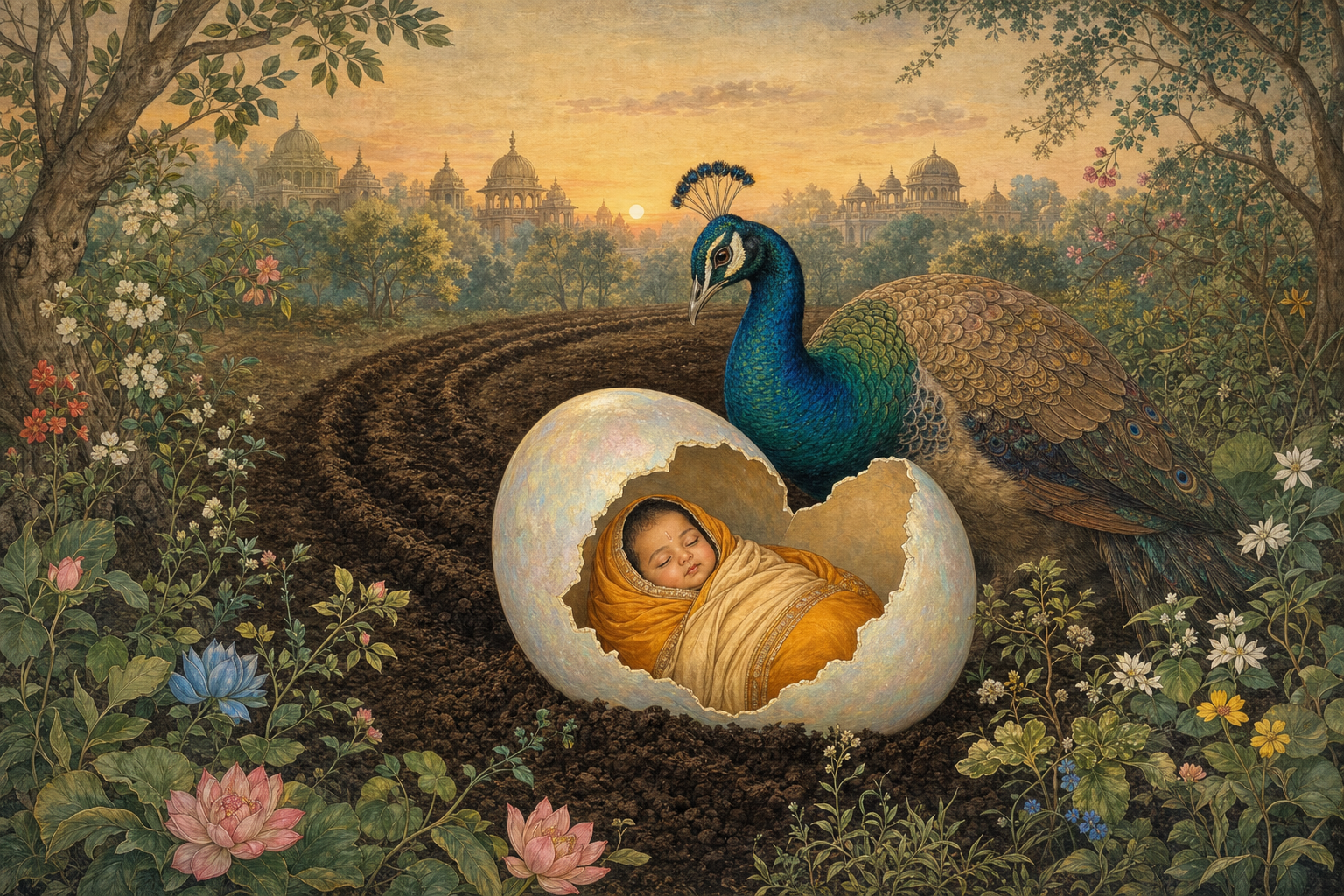
If you have heard that Sita was born from a peahen’s egg, you may be wondering whether this is an authentic Ramayana tradition or a fanciful corruption of the familiar story. The careful answer is that it belongs to a lesser-known folk strand, not to the birth account in the Valmiki Ramayana. That distinction matters, but it does not make the folk telling meaningless.
You can understand the variant without forcing a choice between blind acceptance and instant dismissal. First identify the narrative tradition. Then ask which truth about Sita the unusual image is trying to preserve. In this case, the furrow and the egg use different forms to affirm the same central idea: Sita enters the world outside ordinary human maternity and already belongs to the order of dharma.
Start with the textual distinction, then find the common core
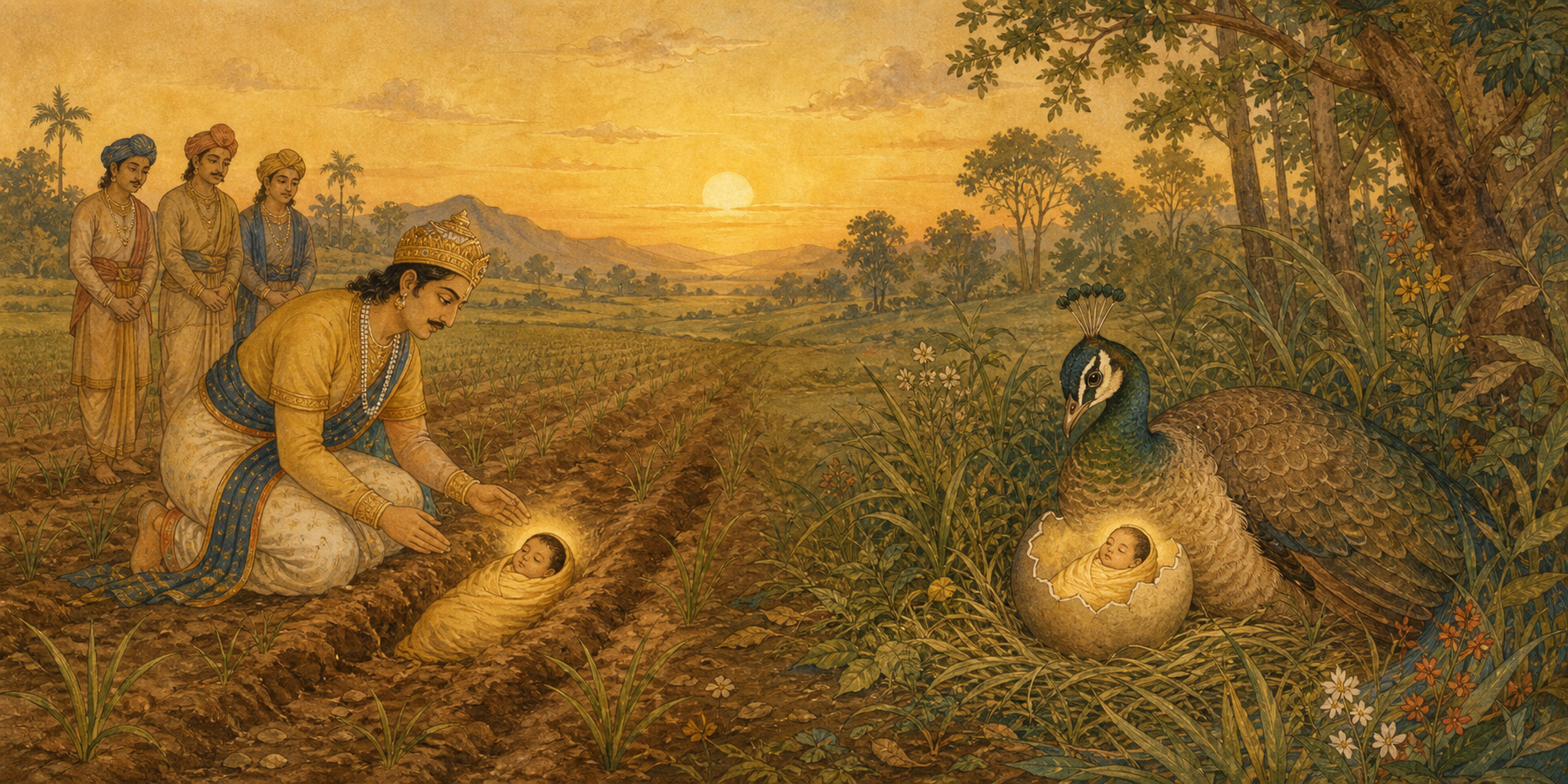
The best-known account is precise: King Janaka discovers Sita while ritually ploughing a field. She comes from the earth rather than a human womb and is therefore described as ayonija. The ploughed furrow is not incidental scenery. It connects her appearance with Bhumi, fertility, sacred kingship and the ruler’s responsibility toward cultivated land.
The peahen-egg telling changes the immediate event. An extraordinary egg appears in a sacred grove, near a field or at the border between cultivated and uncultivated land. Depending on the telling, ascetics, farmers or members of Janaka’s household discover and protect it. When it opens, the child Sita is revealed.
Do not describe this as the original account, the universal folk account or a forgotten chapter of Valmiki. None of those claims is warranted. Call it what it is: a regional or oral birth variant that relocates Sita’s manifestation while retaining her extraordinary status. This wording respects both textual difference and living tradition.
The classical vocabulary of birth helps clarify what has changed. Jarayuja refers to placental birth, andaja to birth from an egg, svedaja to birth associated with moisture, and udbhijja to sprouting or breaking forth. Sita’s emergence from the earth carries udbhijja imagery; the peahen’s egg carries andaja imagery. Yet both stories keep her ayonija, outside birth from a human womb. The category changes, but the theological center does not.
| Question | Furrow birth | Peahen-egg birth |
|---|---|---|
| Where does Sita appear? | In ritually ploughed earth | In an extraordinary egg near a grove or cultivated land |
| Which birth image is emphasized? | Udbhijja, emergence or sprouting | Andaja, emergence from an egg |
| What human activity surrounds her? | Janaka’s ritual ploughing | Discovery, protection and incubation |
| What receives the strongest emphasis? | Earth, fertility and royal stewardship | Latency, guardianship and auspicious timing |
| What remains unchanged? | Sita is ayonija, sacred in origin and not defined by ordinary human lineage | |
This comparison gives you a practical rule for reading folk Ramayanas: separate the stable claim from the variable image. If you look only at the changed image, every variation appears to be a contradiction. If you look only at the stable claim, you erase the distinctive insight carried by the variation. A responsible reading holds both together.
Read the peahen and the egg as theology, not zoology
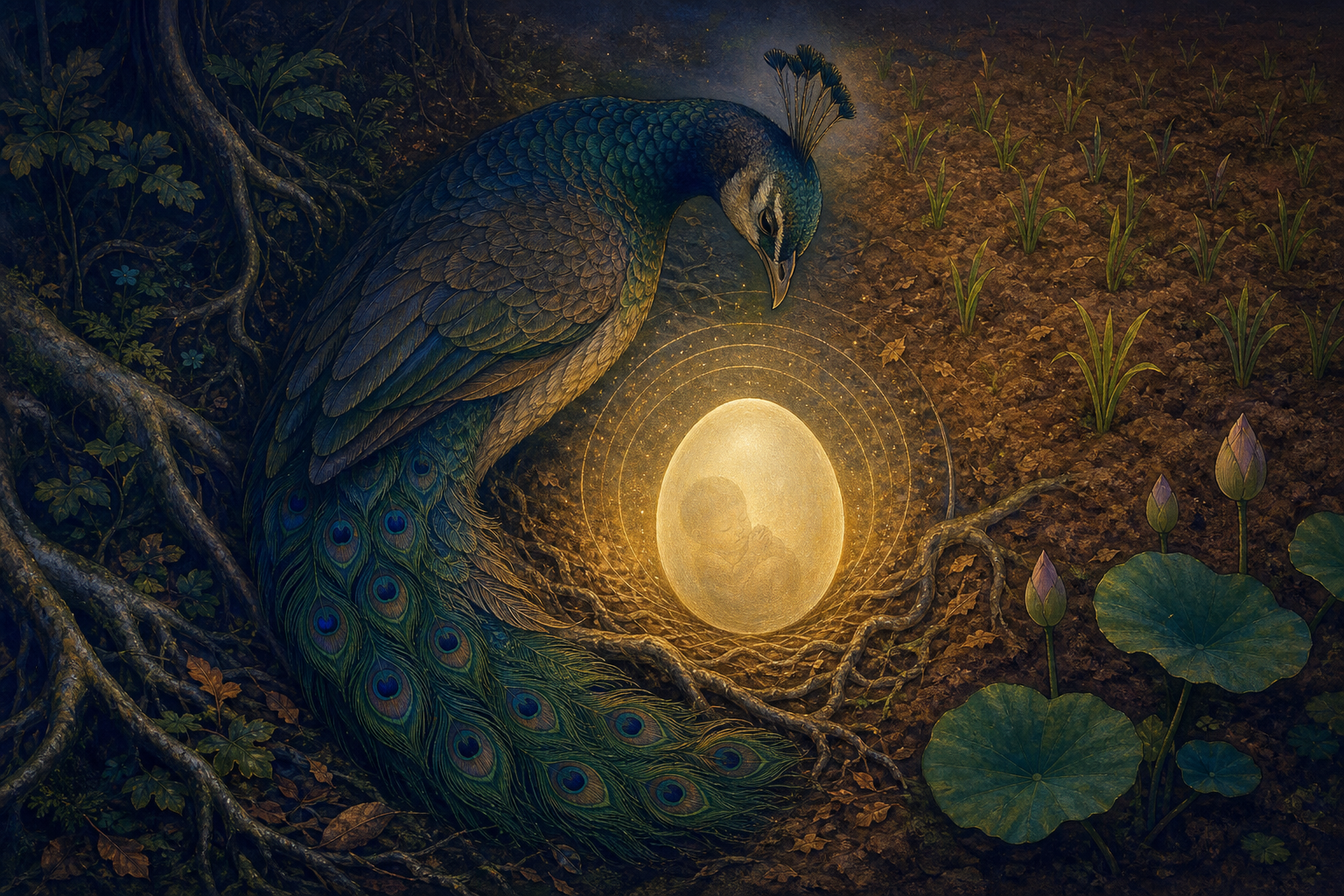
The peahen’s egg is a poetic sign. It should not be defended as a statement about how peafowl reproduce. Premodern lore sometimes imagined that a peahen could conceive without mating, through such agencies as a peacock’s tears or the sound of thunder. That belief is empirically false. Its narrative function, however, is easy to recognize: it gave storytellers a familiar way to imagine an untouched, non-human-womb birth.
This distinction protects the tradition from two unhelpful reactions. Literalizing the lore turns symbolic language into bad natural history. Mocking it as failed science misses why the image entered sacred storytelling. Ask what the motif enables the audience to see. Here it makes Sita’s ayonija identity visible through an object that can be found, sheltered, watched and finally opened.
The peafowl also carries a broad field of Dharmic associations. The peacock is the vahana of Subrahmanya, also known as Kartikeya or Murugan, and evokes beauty, valor and guardianship. Krishna’s peacock feather brings the bird into a Vaishnava setting. In agrarian imagination, peafowl are associated with the monsoon and the renewal that rain brings to field and forest. A peahen’s nest at the edge of cultivation can therefore join grace, protection, fertility and seasonal renewal in a single scene.
The choice of a peahen, rather than merely the more visually celebrated peacock, sharpens the meaning. The peacock dazzles; the peahen shelters. Her egg directs attention toward hidden development and quiet guardianship. Sita’s first manifestation becomes an event that must be protected before it can be publicly recognized.
The egg contributes another layer. The image of Hiranyagarbha, the cosmic or golden germ often rendered as an egg, presents creation as radiance held within a containing form. The folk motif does not require you to identify Sita’s egg directly with a single philosophical doctrine. It does invite you to notice a related imaginative structure: sacred life remains concealed, matures according to an unseen order and appears when its time is ripe.
When you hear the peahen-egg episode performed, attend to the verbs as much as the object. Who finds the egg? Who believes it is worth protecting? Who keeps watch? Who recognizes the child? Those actions tell you whether the performance is emphasizing divine manifestation, communal care, royal recognition or all three.
Notice the ethical claim beneath the miraculous birth
Sita’s birth stories are also stories about possession. A child appears without an ordinary genealogy that could make her the property of a human lineage. Janaka receives her as a gift and a responsibility. The land discloses her; the king does not manufacture her. In the egg variant, the discoverers likewise protect something they did not create.
That difference between receiving and owning is politically significant. Janaka’s ritual ploughing places sovereign authority in direct relation to the soil. Kingship is shown as stewardship rather than mere control. Fertility and abundance arrive as trusts that demand right conduct. The peahen-egg setting usually keeps this agrarian frame but moves Sita toward a boundary: grove and field, wilderness and settlement, hidden life and public order.
Use that boundary to interpret the scene. Sita does not initially arise from a palace, court pedigree or dynastic negotiation. Dharma appears at the edge of established arrangements and asks whether society can recognize it. The practical test faced by the characters is not whether they can explain the marvel. It is whether they respond with attention, protection and reverence.
The incubation motif makes care itself part of the sacred event. An egg must be kept safe before anyone can see what it contains. Folk performance can turn that interval into suspense, but it also teaches patience: value may be present before status, beauty or destiny becomes visible. The humble acts of tending are not decorative preliminaries. They are the conditions under which the revelation can occur.
Sita’s purity should be read with similar care. Here purity is not merely a verdict imposed on a woman’s conduct. It is an ontological assertion: her being is aligned with rita, cosmic order, from the beginning. Her non-ordinary origin places her beyond competing claims of caste pedigree, faction and biological possession. If purity is reduced to sexual suspicion alone, the birth motif’s larger claim about sacred identity disappears.
This does not erase the difficult questions raised by Sita’s later trials. It gives you a firmer basis for asking them. A tradition that presents Sita as earth-born, divinely ordered or cosmically radiant cannot coherently treat her as a minor object in someone else’s moral drama. Her birth establishes her own sacred stature before her relationships with Rama, Janaka or any kingdom are considered.
Use five questions when you encounter another Sita-birth variant
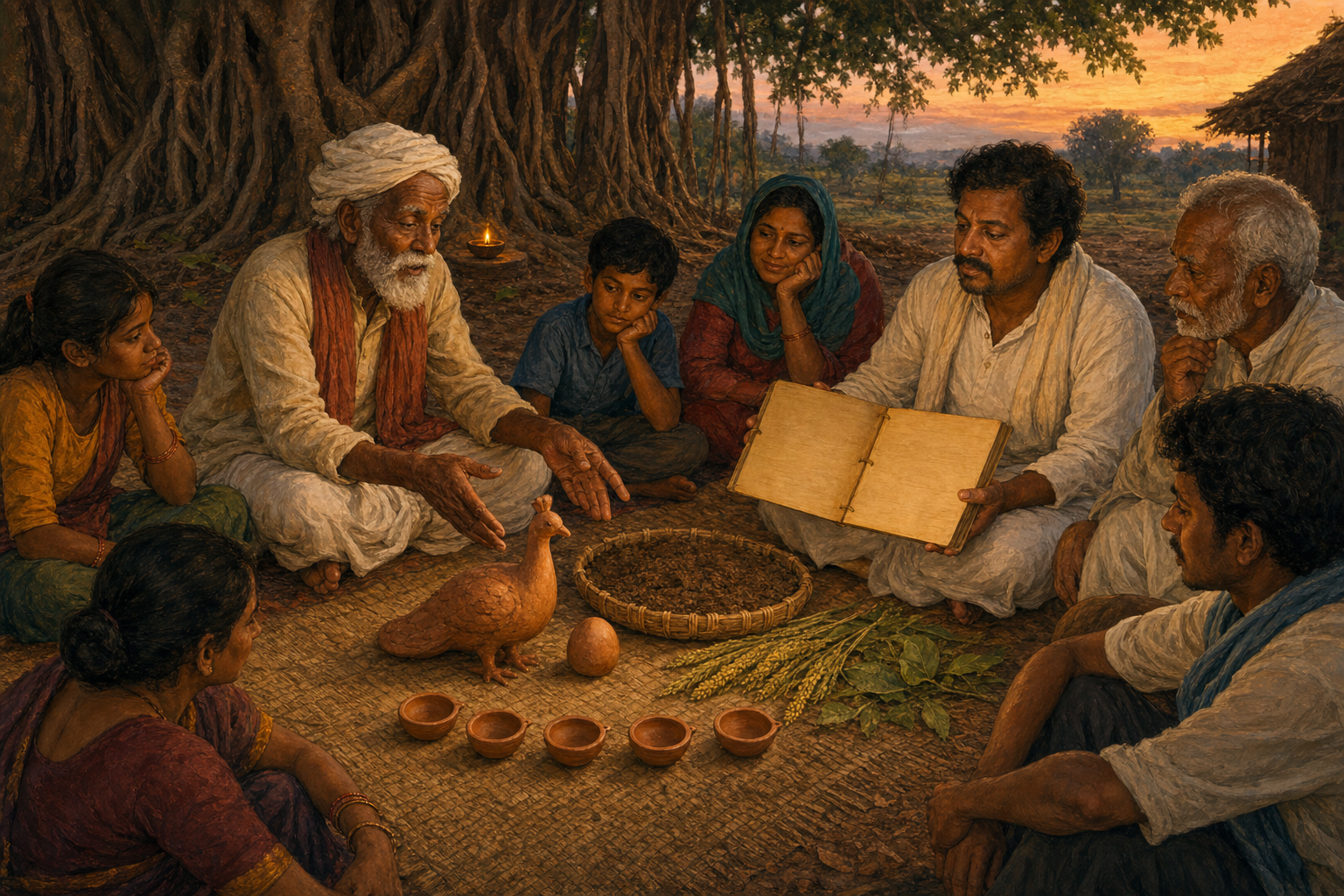
Folk Ramayanas do not come with one centralized catalogue of authorized differences. Some retellings connect Sita for a time with an antagonistic lineage before abandonment and discovery. Some Jain tellings reshape her genealogy within their own narrative world. The Adbhuta Ramayana heightens her cosmic identity as Mahamaya, while another stream understands her as Vedavati reborn. You can approach such accounts without either flattening them into sameness or declaring every difference equally authoritative.
- Name the narrative setting. Is the claim from the Valmiki Ramayana, another written Ramayana, a Jain retelling, an oral narrative or a staged performance? Do not move a detail from one setting into another without saying so.
- Locate the invariant. Ask what remains recognizable as Sita’s identity: sacred origin, steadfastness, relation to earth, cosmic power or commitment to truth. This reveals why the story still functions as a Sita narrative.
- Identify the local symbol. A furrow speaks through agriculture; an egg speaks through incubation; a grove speaks through the meeting of settlement and wilderness. Interpret the symbol in the life-world where it would have been heard.
- Trace the ethical work. Notice what the new beginning asks its audience to value. The peahen-egg motif places unusual weight on guardianship, patience and receiving life without a possessive claim.
- Preserve doctrinal boundaries. Similar birth motifs across Dharmic traditions can illuminate a shared pattern without proving that all traditions teach the same doctrine.
The final question is especially important in a pan-Dharmic reading. Queen Maya’s dream of a white elephant marks the Buddha’s conception as extraordinary. Queen Trishala’s auspicious dreams and the descent of a Tirthankara’s jiva ceremonialize a world-changing Jain birth. Sikh teaching places birth within Hukam, divine order. These are not interchangeable versions of Sita’s story. They show a comparable narrative intuition: an exceptional life may be announced through signs that exceed ordinary expectation.
Comparison is useful when it clarifies function. It becomes careless when resemblance is treated as identity. Ask, “What does the extraordinary sign establish in this tradition?” rather than, “Which traditions copied the same event?” That change of question lets you notice a shared Dharmic sensitivity to auspicious manifestation while respecting real theological differences.
Key takeaways
- Sita’s peahen-egg birth belongs to a lesser-known folk strand; it is not the birth account of the Valmiki Ramayana.
- The furrow changes to an egg, but Sita remains ayonija: she is not born from a human womb.
- The egg is symbolic language for concealed sacred life, protective care and emergence at the right time, not a claim about peafowl biology.
- The peahen shifts attention from display to guardianship, while the agrarian setting links Sita with land, renewal and responsible kingship.
- A good reading names the tradition, identifies what remains constant, interprets the local symbol and asks what ethical work the variation performs.
The next time you encounter an unfamiliar Ramayana episode, do not begin by asking whether it should replace the version you know. Write down the precise scene, its narrative setting, its central symbol and the quality of dharma it brings into focus. For the peahen’s egg, that quality is clear: what is sacred may arrive quietly, remain hidden for a time and depend upon faithful guardians before the world recognizes it.
References
