
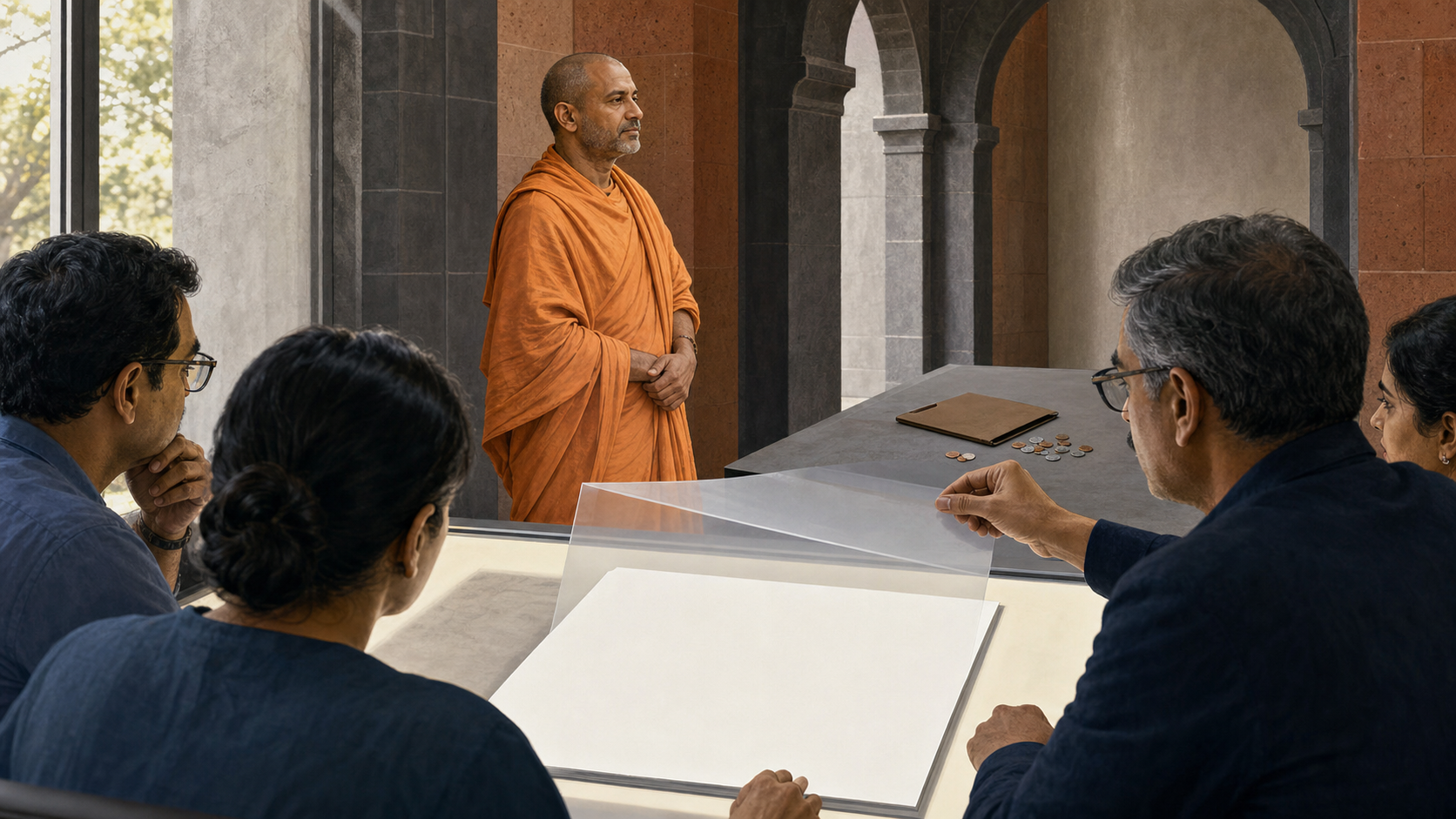
If you saw a government advertisement use a Hindu sadhu as visual shorthand for fraud, you may be wondering whether its withdrawal settled the matter. It settled the immediate question of circulation. It did not answer the larger question: how did a sacred identity become a substitute for evidence of wrongdoing in official communication?
The useful response is neither to dismiss the depiction as harmless creativity nor to treat every insensitive image as a criminal case. You can examine exactly what the advertisement communicated, ask for proportionate redress, and press for an approval system that catches religious stereotyping before public money puts it into circulation.
Withdrawal removes the image, not the institutional weakness

In the Maharashtra incident, the Social Justice Ministry withdrew the advertisement after public concern and a demand for action from Hindu Janajagruti Samiti. Withdrawal was the necessary first correction because it stopped the state from continuing to circulate the caricature. But a complete response must also identify why the creative concept passed review.
The central problem is not simply that a sadhu appeared in an unfavourable scene. Religious figures are not exempt from criticism, and religious clothing cannot shield actual misconduct from scrutiny. The problem arises when the clothing, appearance, or sacred role does the argumentative work. If viewers are expected to recognise a fraudster because the person resembles an ascetic, the campaign has replaced a description of fraudulent conduct with a stereotype.
That distinction matters. An advertisement about an identified impersonation method may have a legitimate reason to show how the impersonation occurs. It should then name the deception, explain the warning signs, and make clear that the wrongful act is impersonation or fraud. A generic anti-fraud campaign has no such need. It can show a forged document, a demand for an advance payment, a false identity, or a neutral figure concealing information without borrowing the authority of a religious archetype.
A sadhu is also more than a convenient costume. Hindu sadhus and sants, Buddhist bhikshus, Jain munis, and Sikh saintly exemplars belong to distinct traditions, disciplines, and communities, but each can embody renunciation, ethical restraint, teaching, or service. Treating one ascetic identity as a ready-made sign of dishonesty damages cultural meaning shared across much of the Dharmic world.
The standard should be especially demanding for state speech. A private cartoonist expresses an individual viewpoint. A government advertisement carries institutional authority, uses public resources, and addresses citizens in the name of the state. Its obligation is not merely to avoid an obvious insult. It must communicate public information without assigning suspicion to a religious vocation or community.
Constitutional language helps clarify the principle without turning every dispute into litigation. Article 25 protects freedom of conscience and the freedom to profess, practise, and propagate religion. Article 51A(f) asks citizens to value and preserve the heritage of India’s composite culture. These provisions support a strong expectation of religious dignity in public administration, but they do not make every insensitive design an automatic criminal offence. If you are considering legal action rather than an administrative complaint, obtain advice from a qualified lawyer who can assess the image, its context, the required legal elements, and the law currently in force.
Use five questions to detect a religious stereotype

You do not need to guess what the designer intended. Start with what an ordinary viewer must infer from the finished advertisement. These five questions separate a legitimate depiction from identity-based visual shorthand.
<!– wp:list {