
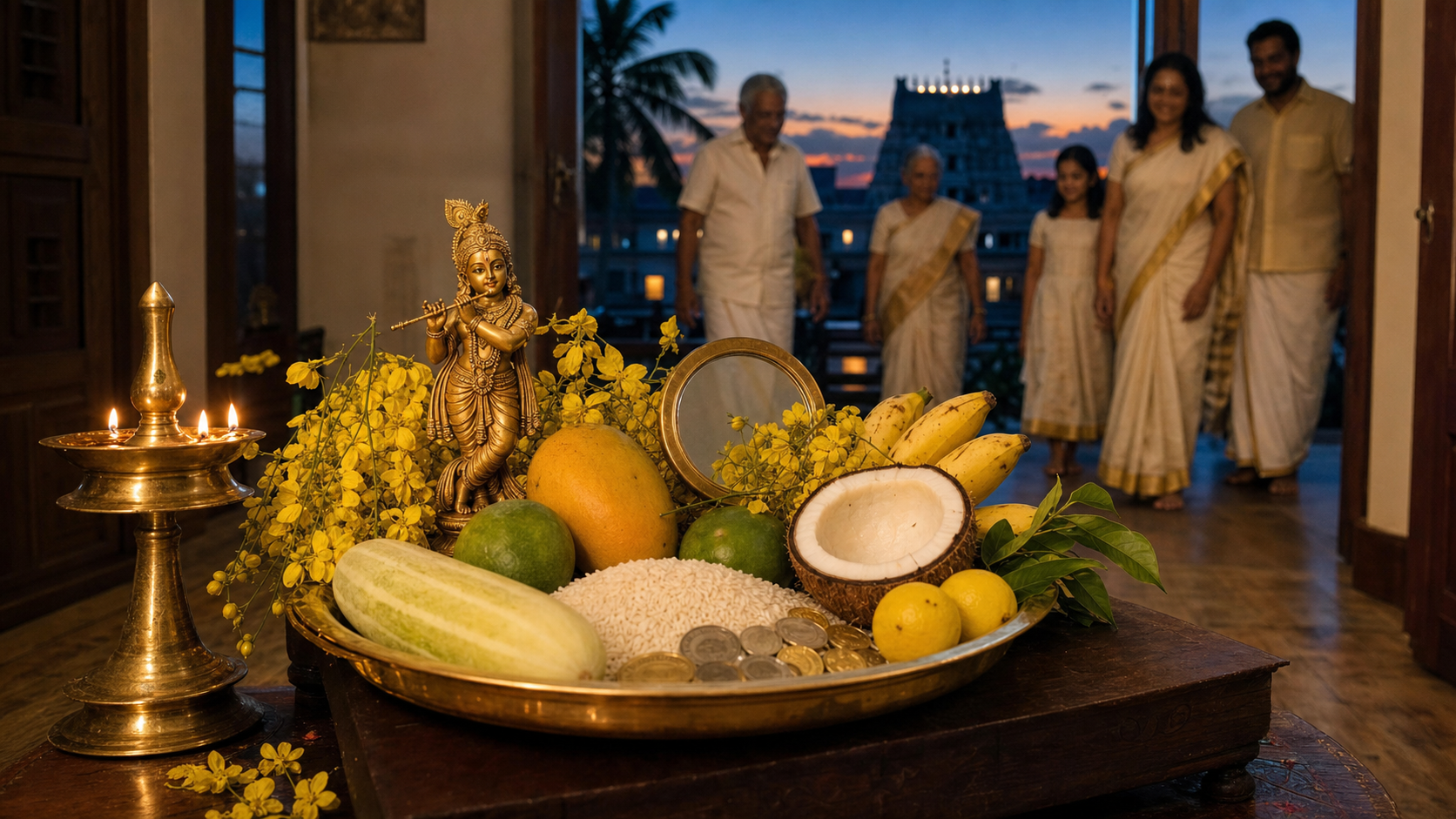
If you are planning Vishu in Chennai, the important question is not simply which temple is biggest. It is where your household will take its first auspicious sight of the year: at a Kerala-style Vishukkani before sunrise, at a familiar Chennai kshetra for New Year darshan, or before a kani you arrange at home.
Make that decision before choosing transport. Vishu is Medam 1 in the Malayalam calendar, and its timing follows Surya’s ingress into sidereal Aries, or Mesha Sankramana. It usually falls on 14 or 15 April and often coincides with Tamil Puthandu, but the applicable date, sunrise, temple opening, and special-puja window must be confirmed afresh each year.
Key takeaways
- Choose Sri Ayyappan-Guruvayurappan Temple in Mahalingapuram, Sree Ayyappa Temple in R.A. Puram, or Sri Anantha Padmanabha Swamy Temple in Adyar when an arranged Kerala-style Vishukkani is your priority.
- Do not assume that every major temple offering New Year abhishekam or archana will also display a Vishukkani.
- Confirm four separate details: the locally observed Vishu date, Chennai sunrise, the temple’s opening time, and the actual Vishukkani darshan window.
- For an advertised pre-dawn opening, arriving 30 to 45 minutes early is a sensible queue strategy.
- If elders, young children, uncertain accessibility, or cross-city travel make the first rush difficult, see the kani at home and visit the temple after the opening surge.
- Complete the observance with Vishu kaineettam, sadya, and one specific commitment to dana, seva, ahimsa, or satya.
Choose the darshan first, then choose the temple
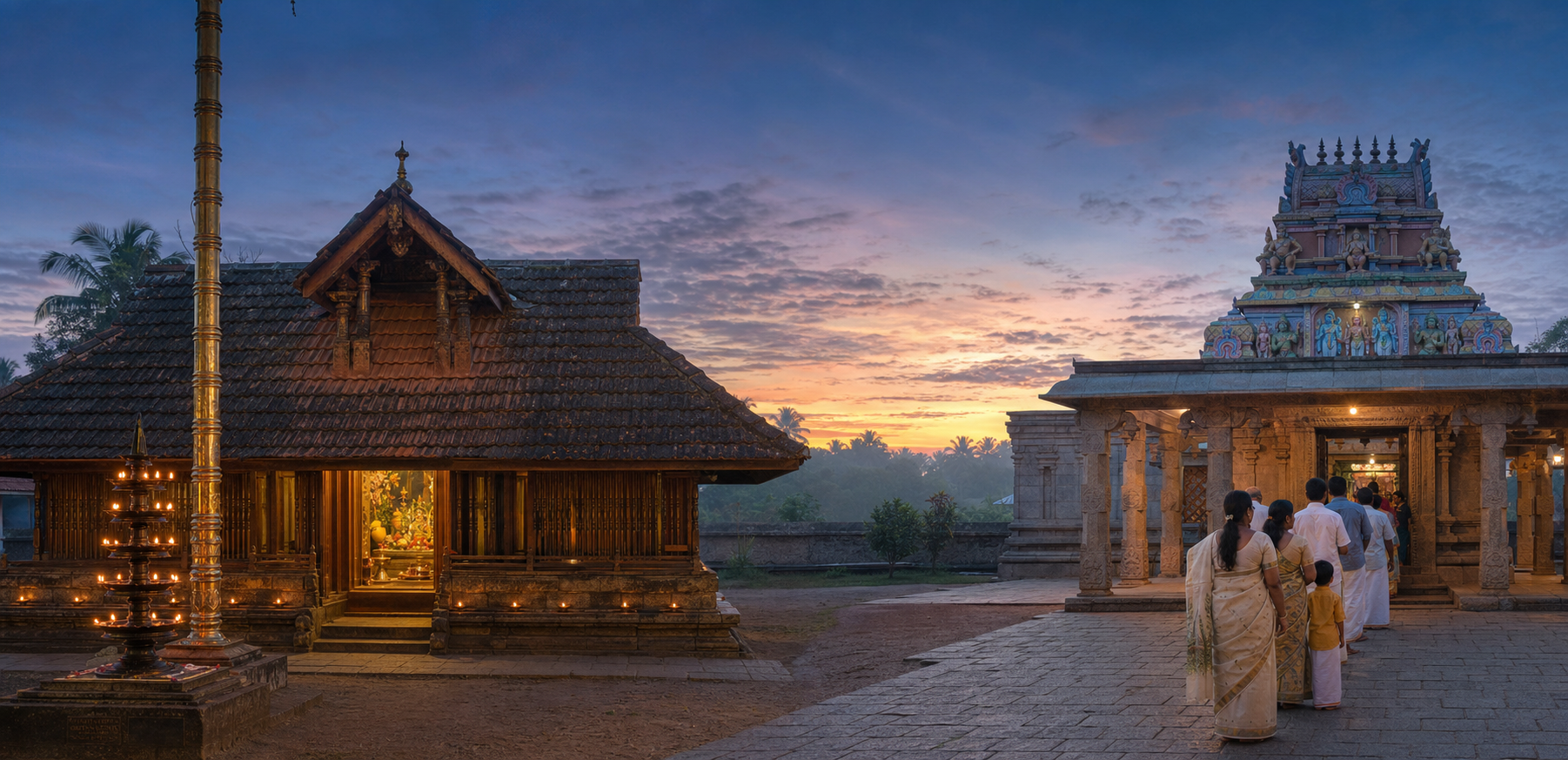
Chennai offers two legitimate but different festival experiences. One centres on the Kerala-style kani placed before Vishnu, Krishna, Ayyappa, or Bhagavathi. The other is the wider Vishu-Puthandu practice of beginning the solar year with abhishekam, archana, sankalpa, or darshan at a familiar kshetra. Treating these experiences as interchangeable is how a family reaches a beloved temple and discovers that it does not offer the ritual they came to see.
For an unmistakably Kerala-style Vishukkani
A small group of Chennai temples is especially associated with Kerala-style observance:
- Sri Ayyappan-Guruvayurappan Temple, Mahalingapuram: This is a strong first choice when the visual fullness of the kani matters. The customary arrangement includes konna flowers, a nilavilakku, grains in an uruli, a mirror, fruits, and other auspicious objects before Sree Guruvayurappan and Sree Ayyappa. Usha Pooja, alankaram, and deeparadhana commonly form part of the morning. Expect substantial early footfall.
- Sree Ayyappa Temple, R.A. Puram: This suits households seeking a Kerala temple atmosphere within a large Malayali community. Vishukkani, family kaineettam after darshan, and, in some years, chenda percussion shape the morning. The precise opening depends on the year’s Sankramana-aligned programme.
- Sri Anantha Padmanabha Swamy Temple, Adyar: Choose this when you want the kani within a distinctly Vaishnava setting. The arrangement generally places grains, fruits, a mirror, and sacred texts before Mahavishnu, with special alankaram and deeparadhana around the sunrise period.
- Neighbourhood Ayyappa and Bhagavathi shrines: West Mambalam, Ashok Nagar, KK Nagar, Adambakkam, and Madipakkam often have locally coordinated Vishukkani arrangements. These can save a difficult pre-dawn journey, but participation varies annually, so confirmation is essential.
If the tableau itself is non-negotiable, ask the temple a precise question: “Will there be Vishukkani darshan, and during which time window?” Asking only whether there is a special puja is not enough. A temple may conduct an elaborate New Year abhishekam without arranging the mirror, lamp, grain, fruit, flowers, and sacred objects that constitute the kani you are expecting.
For New Year darshan at a major Chennai kshetra
If your purpose is to begin the solar year with your ishta-devata or family temple, Chennai’s larger kshetras offer several clear choices. Select by devotional focus and travel practicality, not by a vague ranking of importance.
| Temple and area | Choose it when your focus is | Likely New Year emphasis |
|---|---|---|
| Kapaleeshwarar Temple, Mylapore | A Shaiva family observance | Morning abhishekam, archana, and darshan |
| Parthasarathy Temple, Triplicane | Krishna and Vaishnava worship at a Divya Desam | Early suprabhata seva, archana, and strong morning queues |
| Ashtalakshmi Temple, Besant Nagar | Lakshmi, household sustenance, and prosperity | Lamp offerings and worship of the eight forms of Lakshmi |
| Vadapalani Andavar Temple, Vadapalani | Sankalpa or the beginning of a vrata | Special archana and continuous New Year crowds |
| Sri Anjaneyar Temple, Nanganallur | Courage, clarity, and steadfastness | Disciplined queue-based darshan and archana |
| Marundeeswarar Temple, Thiruvanmiyur | Prayers concerning health and family well-being | Morning abhishekam and prasadam |
| Thyagaraja Temple, Thiruvottiyur | An ancient Shaiva setting and traditional circumambulation | Morning puja and bilva offerings |
Each is a meaningful Vishu-Puthandu destination, but New Year darshan does not automatically mean Kerala-style Vishukkani. If you want both, see the kani at home or at a Kerala-style shrine first, then visit your family kshetra later in the morning.
Build the morning backward from sunrise
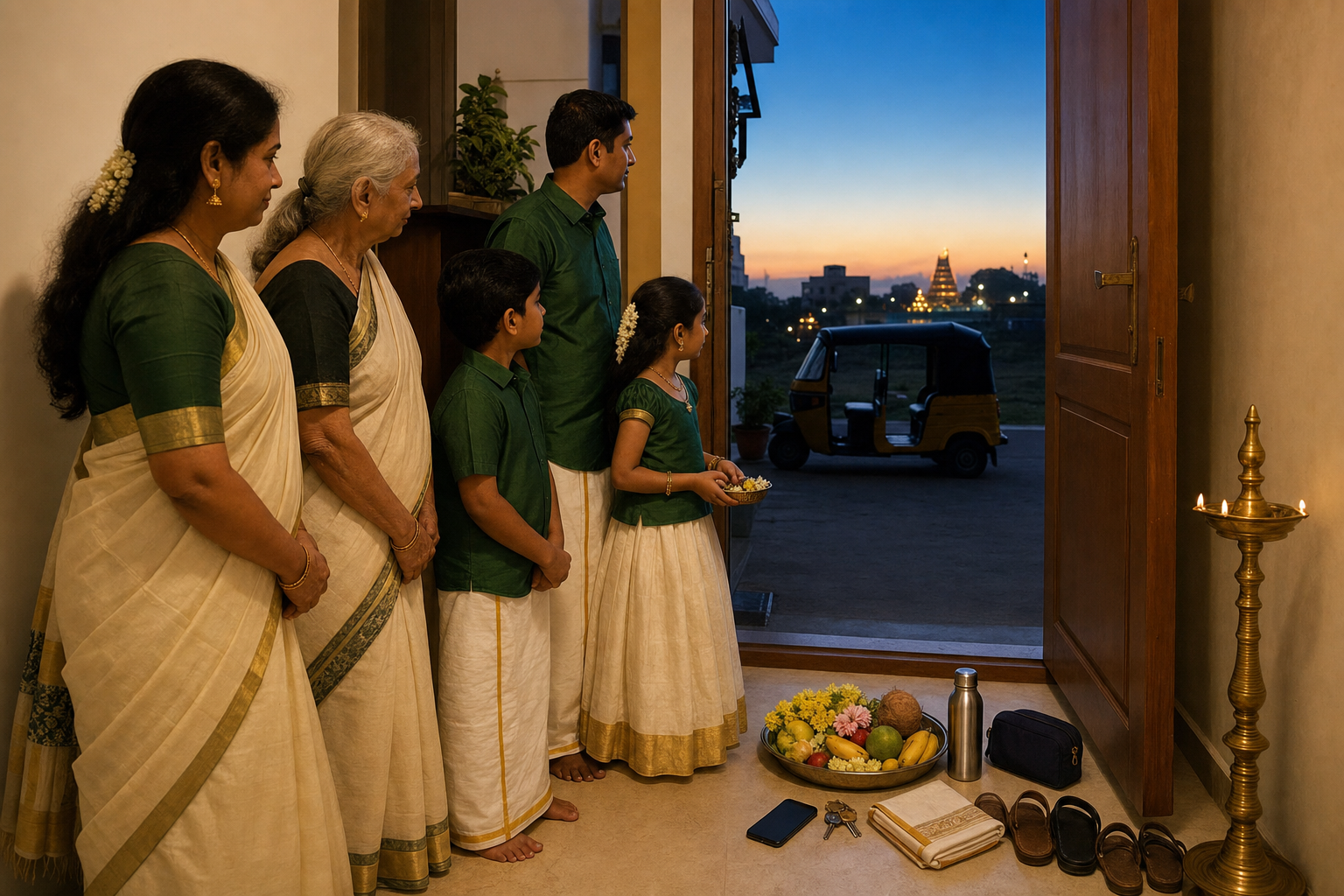
The most common planning error is to settle on a temple and leave every other decision until the previous night. Vishukkani is tied to the day’s first auspicious sight, while temple access is governed by an administrative schedule. Those clocks may be close, but they are not the same thing.
- Verify the date through the panchangam your household follows. Then confirm the temple’s own date and programme. When a Sankramana occurs near a calendrical boundary, regional calculations and observance conventions can place emphasis on different civil dates.
- Check Chennai sunrise and the stated darshan window separately. Many Vishu programmes begin between 4:00 and 5:00 a.m., but an early opening does not tell you when a particular puja, deeparadhana, or kani viewing begins.
- Decide where the first sight will happen. If the household kani is primary, there is no need to race across Chennai before dawn. Complete it at home and visit the temple afterward. If the temple’s kani is the centre of your observance, treat its confirmed opening as the fixed point around which the rest of the morning is arranged.
- Set an arrival target 30 to 45 minutes before opening. If a temple advertises a 4:30 a.m. opening, a practical target is 3:45 to 4:00 a.m. This gives you time for the approach, footwear deposit, security checks, and the queue without assuming that the published opening is the time to leave home.
- Arrange pre-dawn transport rather than hoping to find it. Pre-book an app cab or a known driver when travelling before regular public-transport service. If you intend to use Metro, MRTS, or suburban rail later, check the first service rather than relying on the fact that a line serves the general corridor. Parking around inner-city temples is limited and becomes harder as Puthandu crowds gather.
- Choose a second window for anyone who should avoid the first rush. Families with elders or young children can either enter immediately after opening or perform the kani at home and attend in mid-morning, when the initial pressure may have eased. Confirm that the later visit still includes the puja or prasadam you value.
Three workable family plans
- Temple-first plan: Confirm the Vishukkani window, pre-book transport, reach 30 to 45 minutes before opening, take darshan, return for kaineettam and sadya.
- Home-first plan: Arrange the kani the previous evening, see it at dawn, give kaineettam, and visit the chosen temple after the opening surge. This is usually the calmer option when accessibility or travel is uncertain.
- Neighbourhood plan: Confirm a nearby Ayyappa or Bhagavathi shrine rather than crossing the city. A smaller local observance can preserve the dawn rhythm more successfully than an ambitious journey dominated by traffic and queues.
Do not turn the first sight into a test of logistical endurance. The point is to begin with ordered attention. A rushed family argument in a parking queue defeats more of the morning’s purpose than seeing the kani at home and reaching the temple later.
Keep the temple visit light, quiet, and accessible
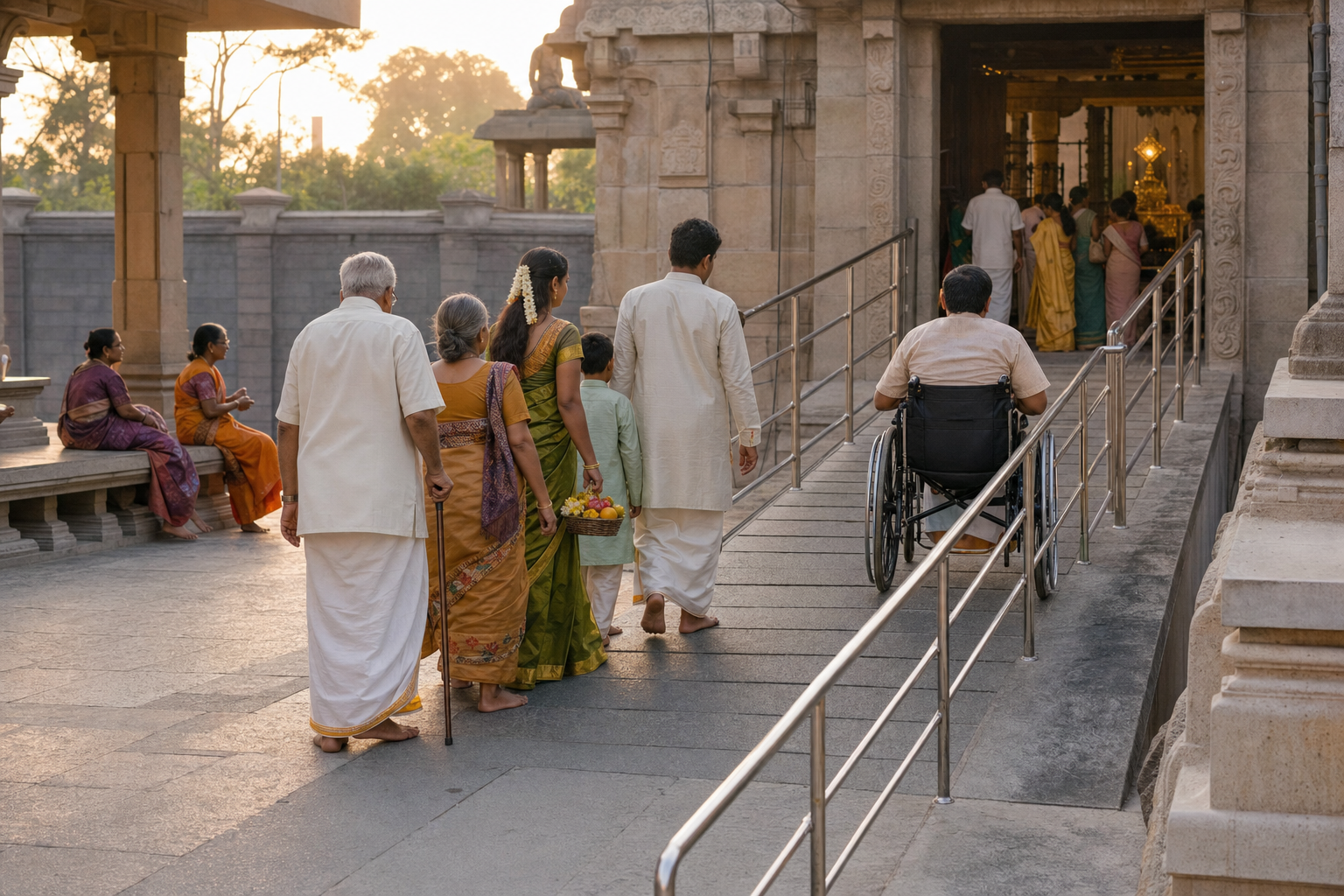
A festival queue moves best when each household brings only what the temple can receive. Pack for darshan, not for a day out.
What to carry and what to leave behind
- Wear traditional or otherwise modest clothing that lets you stand and walk comfortably.
- Carry a small quantity of flowers, coconuts, bananas, or betel leaves only after checking the temple’s current offering rules.
- Obtain archana tickets from the designated counter. Cashless payment availability varies by shrine, so do not make the morning depend on one payment method.
- Keep your phone silent and packed away near the sanctum. Photography restrictions differ, and a visible kani is not an invitation to photograph it.
- Carry minimal valuables. A smaller bag makes security screening, circumambulation, and prasadam collection easier.
- Note the footwear counter or token before joining the queue. After darshan, follow the designated exit rather than trying to return against one-way movement.
Prasadam is normally collected from a separate counter, not while standing in the main darshan flow. Follow volunteer directions and dispose of cups or plates only in the marked place. Avoiding single-use plastic where the temple permits alternatives is a small but fitting extension of the day’s concern with right conduct.
Plan accessibility before the queue forms
Volunteer help for seniors is common, but step-free access is not uniform. Heritage structures can have narrow passages, thresholds, or circulation patterns that limit wheelchair movement. Contact the temple before committing to the busiest window, ask about the actual entrance to use, and find out whether an accompanying family member may remain with the devotee.
Keep elders and children hydrated, but check what containers are allowed inside. Identify drinking-water points, toilets, the exit, and a family meeting place before entering the line. If someone cannot comfortably tolerate a long queue, a home kani followed by later darshan is a complete observance, not a lesser substitute.
Make a complete Vishukkani at home when timing does not fit
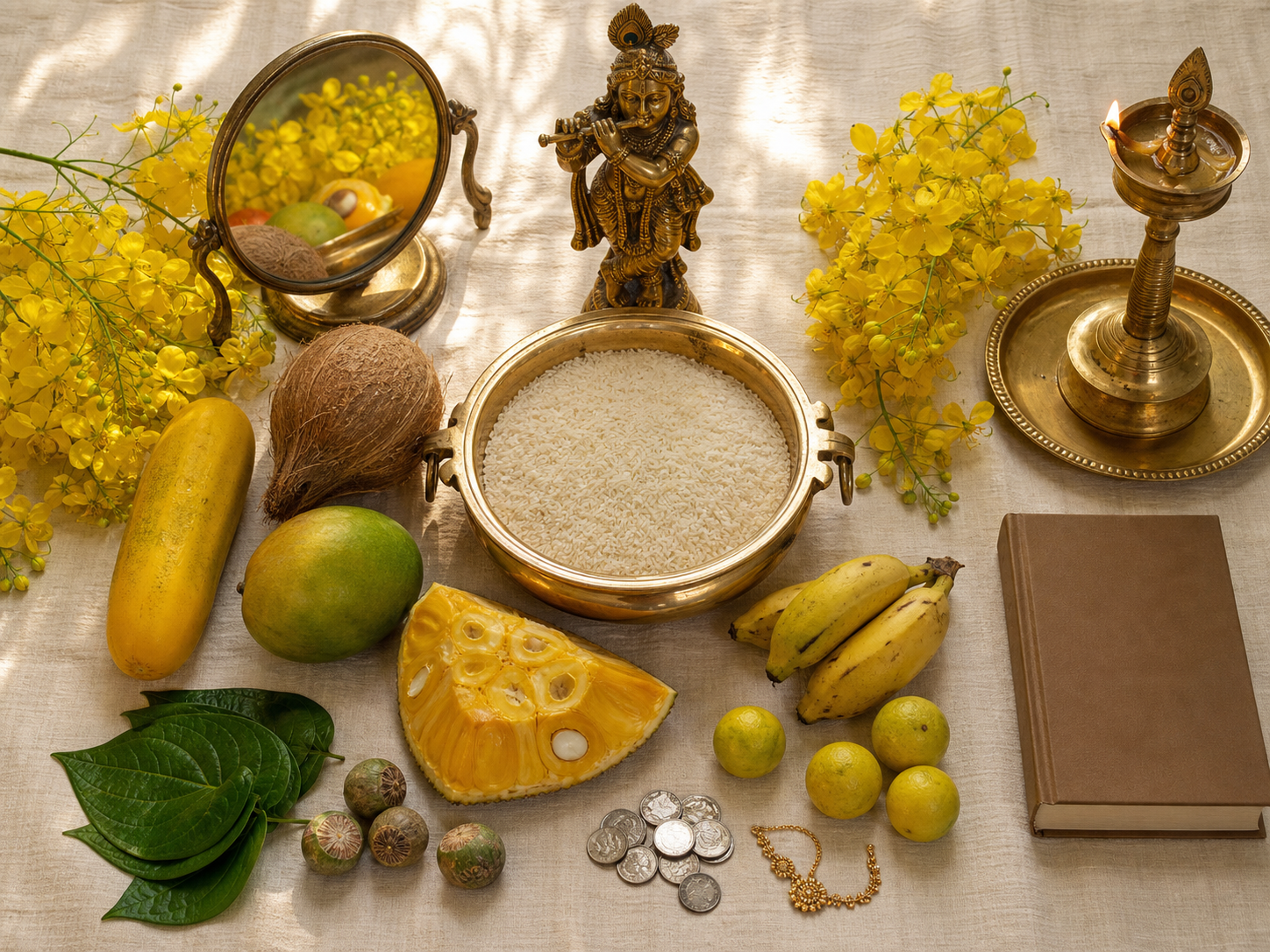
An at-home kani is the cleanest way to preserve the first-sight practice when temple timing, distance, crowds, or accessibility do not suit your household. The arrangement does not require a large display. It requires recognisable symbols, careful placement, and a morning that begins without distraction.
Arrange it the evening before
- Establish the sacred focus. Place an image of Vishnu or Krishna where it can be seen as part of the completed arrangement.
- Prepare the uruli. Fill it with raw rice or other grains. The grain makes nourishment, fertility, and stored abundance visible.
- Add the signs of household plenty. Arrange fresh fruits and vegetables, betel leaves, areca nuts, and gold or coins. The gold or money can be symbolic; the kani is not a competition in display.
- Include learning and dharma. Place a copy of the Bhagavad Gita or Ramayana within view.
- Position the mirror and nilavilakku. Arrange them so that the lamp, sacred image, and offerings form one coherent first sight. Put the lamp on a stable, heat-resistant surface, light it only when someone is present, and never leave the flame unattended overnight.
- Add flowers. Kani konna, the golden blossom associated with Vishu, is ideal. If it is not available in Chennai, use marigold or jasmine without treating the substitution as a failure of the observance.
At dawn, begin with the kani before turning to messages, news, or routine tasks. Allow enough stillness to see the whole arrangement rather than mechanically glancing at it. Offer your prayer, receive or give blessings, and then perform Vishu kaineettam, in which elders give coins to younger family members. A festive sadya can follow later in the day.
Let the first sight produce a first action
Vishukkani is sometimes reduced to a promise that auspicious objects will somehow manufacture a prosperous year. Its more demanding value lies in training perception. The lamp, grain, fruit, sacred text, deity, and money place illumination, sustenance, wisdom, devotion, and generosity within the same field of attention. The real question is what you will do after seeing them.
- For dana, decide who will receive your first deliberate gift of the new cycle.
- For seva, name the service and put a date against it before the intention dissolves into busyness.
- For ahimsa, identify one avoidable harm in your habits and stop feeding it.
- For satya, correct one neglected promise, conversation, or obligation.
The overlap of Vishu and Puthandu gives Malayali and Tamil households in Chennai an unusual opportunity to share temple space without erasing the distinct forms of either tradition. The same generosity also resonates across the wider Dharmic family. Shared values do not require identical rituals; they require that devotion make us more truthful, restrained, helpful, and considerate toward the people around us.
On the evening before Vishu, finish three things: verify the temple window, decide where the first sight will happen, and prepare the transport or home arrangement. Then dawn belongs to darshan rather than improvisation. Let one concrete act of generosity follow before the day becomes busy.
References
