

You have a quotation from a Sultanate court in front of you. It describes a defeated Hindu ruler in chains, a temple destroyed, or a military victory as proof of divine favour. One reader treats every word as literal fact. Another calls it propaganda and throws it away. Neither response gives you reliable history.
You do not have to choose between belief and dismissal. A disciplined reading can preserve four things at once: the event being claimed, the ideology used to interpret it, the political purpose behind the telling, and the limits of what one courtly voice can establish. That method lets you confront conquest rhetoric without laundering it or turning it into a verdict on every Muslim of the period.
Read every passage on three separate levels
Begin by separating what happened, how it was morally framed, and why a court wanted it remembered. Write these as three distinct entries in your notes:
- Event claim: What act does the named chronicler claim occurred? Strip away the praise and abuse. Record the ruler, opponent, place, action, and any stated result.
- Rhetorical frame: Which labels, metaphors, religious judgements, casualty figures, or claims of total victory turn the act into a moral drama?
- Political function: What does that drama do for the sovereign? It may advertise invincibility, frighten opponents, justify coercion, sanctify an accession, or make a setback look voluntary.
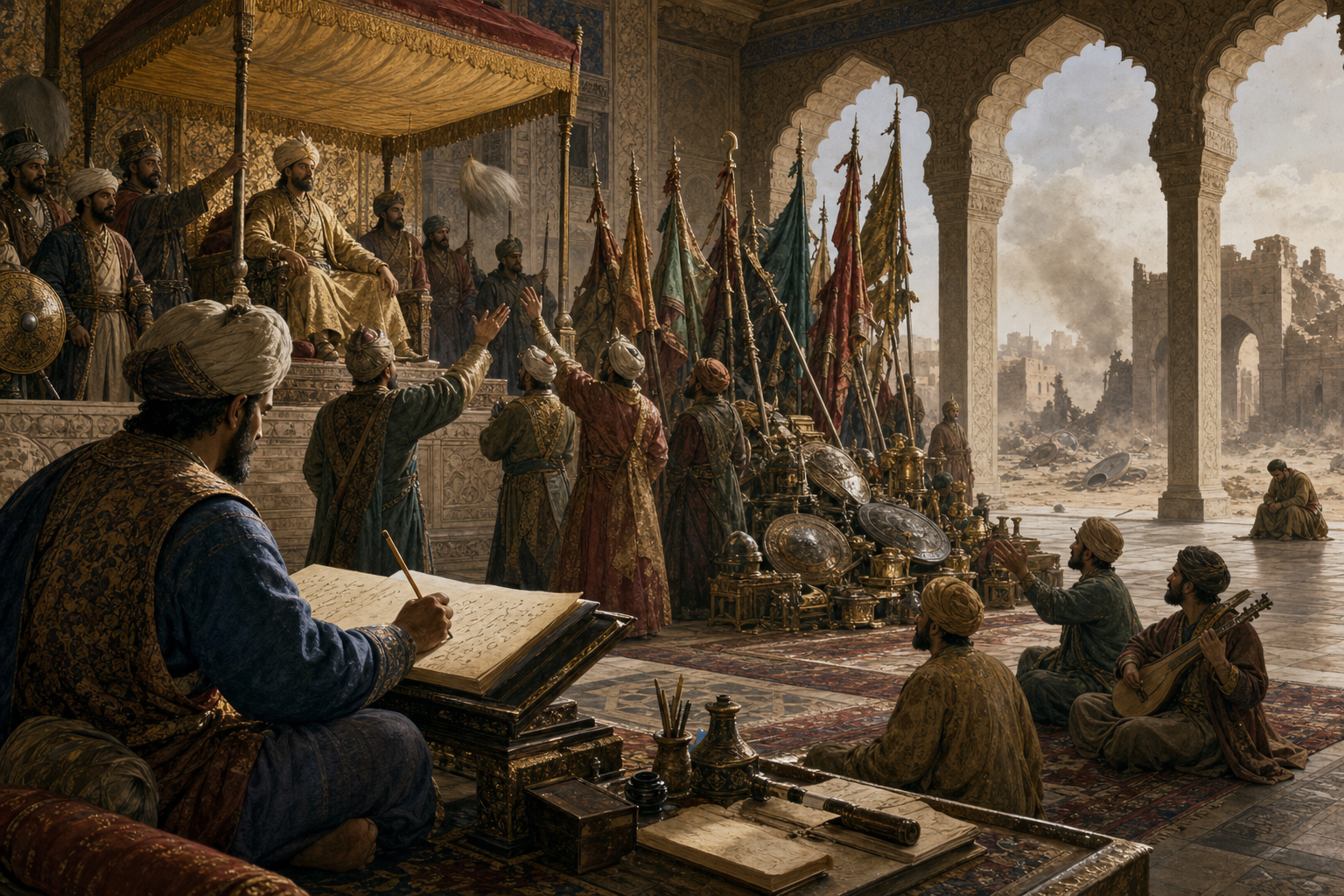
Al-Utbi’s treatment of Jayapala shows why the separation matters. Jayapala’s children, relatives, commanders, and leading men are presented as bound captives, while the defeated ruler is publicly paraded. The announced purpose is that the “fear of Islam might fly abroad.” You can therefore reach a firm conclusion about the rhetoric: Al-Utbi approved of humiliation as theatre, linked the sovereign’s authority to Islam, and wanted fear to travel beyond the immediate battlefield.
The historical claim requires a different formulation: Al-Utbi says that the parade occurred and assigns a purpose to it. That wording neither dismisses the episode nor treats every dramatic detail as independently verified. It preserves the testimony at its proper strength.
Apply the same discipline to Nawasa Shah. Al-Utbi condemns his return to his ancestral religious allegiance and celebrates Mahmud’s violent response through the metaphor “harvest of idolatry.” At the event level, a ruler punished a political and religious defection. At the rhetorical level, the writer turns human beings into a crop fit for cutting. At the political level, the punishment advertises Mahmud’s zeal and warns anyone contemplating a similar break.
Do not merge those levels into a single vague statement such as “religion was just propaganda” or “the passage proves exactly what happened.” Religion is part of the stated justification, propaganda is part of the form, and the narrated action remains a claim that must be weighed. All three matter.
Mark the machinery of conquest rhetoric
Courtly praise becomes easier to evaluate once you learn its recurring moves. Hasan Nizami presents Qutb-ud-Din Aibak as a world-conqueror who cleanses Hind of religious impurity and boasts that he “left not one temple standing”. In the account of the advance on Ajmer, Nizami uses the dehumanizing label “crow-faced Hindus,” claims that 100,000 Hindus were killed, and links the destruction of temple foundations with the establishment of mosques, colleges, Islamic precepts, and law.
Those statements do not all carry the same evidentiary burden. You need no outside confirmation to notice that the writer celebrates religious domination and dehumanizes the defeated. You do need corroboration before treating an absolute claim about every temple or a large casualty total as an audited count.
| Signal to mark | What it accomplishes | Your reading move |
|---|---|---|
| Pollution, animal imagery, or degrading labels | Places the enemy outside the narrator’s moral community and makes harsh treatment appear deserved | Record the exact target and function, but do not adopt the label as your own description |
| Sacred metaphors for killing or destruction | Converts political violence into pious duty or purification | Separate the physical action being claimed from the moral approval attached to it |
| Absolute language about total destruction or complete victory | Projects sovereign control without qualification | Treat completeness as a claim requiring local, administrative, or material corroboration |
| A large, precise casualty figure | Magnifies the scale of victory and the conqueror’s power | Label the number as the named writer’s claim until independent evidence supports it |
| A prescription of ritualized humiliation | Turns unequal status into a visible performance of submission | Distinguish what an adviser advocated from what officials consistently enforced |
| Divine causation for political success | Makes the ruler’s rise appear providential and resistance appear impious | Enter the political outcome and the theological interpretation as separate findings |
The distinction between advocacy and enforcement is especially important with Qazi Mughisuddin. While advising Ala-ud-Din Khalji, he calls for Hindu taxpayers to approach officials with “meekness and humility” and imagines submission even to a collector’s deliberate physical degradation. This is strong evidence that an influential jurist could formulate extreme subordination as a desirable norm. By itself, it does not show that every collector performed the imagined act, that every ruler applied the advice uniformly, or that every Muslim accepted it.
Divine legitimation works differently but serves the same courtly need. Minhaj-us-Siraj casts Balban’s movement from Turkistan to power in Hindustan as the will of God. Political fortune becomes sacred destiny; jealous rivals become obstacles to a providential design. Your notes should preserve both the rise and its theological packaging. If you retain only the first, you erase the ideology. If you repeat the second as neutral causation, you surrender historical judgement to panegyric.
Look for bias in reversals, rivalries, and silence
Hostile labels are the easiest bias to see. Reputation management is subtler. Test a court writer most closely when the preferred sovereign loses, attacks another Muslim ruler, or reaches power through conduct that complicates the ideal image being constructed.
- Mahmud of Ghazni’s unsuccessful operations at Kalinjara are converted into an exhibition of magnanimity. The setback does not disappear; its meaning is recalibrated so that the ruler retains agency and prestige.
- Hasan Nizami softens Iltutmish’s conflict with Taj-ud-Din Yildiz. An intra-Muslim rivalry creates a different apologetic problem from war against a ruler labelled an infidel.
- Minhaj-us-Siraj leaves Balban’s irregular accession unaddressed while portraying his success as providential. Silence protects the sacred arc that a direct explanation could disturb.
This pattern gives you a practical consistency test. Ask what would count as failure within the writer’s moral universe. If victory proves divine favour, defeat becomes mercy or strategic choice, and irregular power becomes destiny, the ruler’s prestige has been insulated from disconfirmation. You are no longer reading a neutral sequence of outcomes. You are watching an argument designed so that its hero cannot truly lose.
Use six questions whenever you evaluate a disputed quotation:
- Who is being praised, and whose position improves if the telling is accepted?
- Is the passage reporting an act, prescribing policy, praising a patron, condemning an enemy, or combining these modes?
- Which part could in principle be observed: a capture, tax demand, destroyed structure, succession, or military result?
- Which part evaluates the event through religious abuse, providence, purity, pollution, heaven, or hell?
- How does the same writer handle a defeat, an ally, a rival Muslim ruler, or a morally awkward succession?
- What remains uncertain without another kind of evidence?
Write your conclusion with matching precision. “A named court writer celebrated the act” is one finding. “The ruler ordered the act” is a stronger factual claim. “The policy was implemented everywhere” is stronger again. “All Muslims endorsed it” is a collective generalization that the court testimony cannot establish. Moving between those sentences without new evidence is where polemic replaces history.
Keep the conclusion as narrow as the evidence
The correct unit of inference is usually the named writer, patron, courtly circle, campaign, legal proposal, or political moment. It is not Islam in every period, every Muslim living under the Sultanate, or a modern neighbour who shares a religious identity.
Ziauddin Barani’s prescriptive mode makes that boundary especially necessary. Within his political world, Hindu comfort could be presented as a failure to defend the faith, and coercive hierarchy could be urged as statecraft. This is evidence of a serious ideological programme, not merely a colourful insult. Yet a prescription reveals what its advocate wanted. It cannot, without additional evidence, prove uniform enforcement or universal agreement.
Amir Khusrau also praised the ascendancy of Islam and the subduing of idol worship in Hindustan. Both Khusrau and Barani had connections to the Chishti network around Nizamuddin Auliya. That overlap tells you that literary, courtly, and religious networks could meet in the same urban environment. It does not make every participant identical, establish that Nizamuddin Auliya endorsed every courtly formulation, or turn all Sufis into a single political bloc. Association is relevant context; it is not automatic proof of shared responsibility.
Three symmetrical mistakes should be rejected:
- Collective indictment: Do not use elite court rhetoric to define the faith and conduct of all Muslims, medieval or modern.
- Secular laundering: Do not reduce explicitly religious purification, iconoclasm, or degradation to ordinary politics when the participants themselves used sacred categories to justify power.
- Norm-to-practice inflation: Do not turn an adviser’s desired policy into proof of consistent administration across every place and reign.
Precision also serves Dharmic memory. Name Jayapala, his family, his chieftains, the communities targeted by degrading language, and the temples whose destruction was celebrated whenever the surviving information permits it. Do not leave them trapped inside a conqueror’s category of anonymous unbelievers. At the same time, place uncertainty beside every uncorroborated total, motive, and boast. Remembering injured people does not require inheriting the chronicler’s contempt for another collective.
When you reproduce a harsh phrase, quote only what the analysis needs. Identify who used it, whom it targeted, and what political work it performed. A dehumanizing label printed without that frame can continue doing the work for which it was written. With the frame in place, it becomes evidence against the ideology that produced it.
Key takeaways for responsible reading
- Read a courtly passage first as a performance of power and then as a provisional claim about events.
- Separate event, rhetorical frame, and political function before deciding what the passage proves.
- Treat dehumanization and sacred justification as historical evidence in their own right; they are not disposable decoration.
- Mark absolute claims and large casualty totals as requiring corroboration rather than silently converting them into verified counts.
- Test bias where the favoured ruler loses, fights a Muslim rival, or acquires power irregularly; apologetic handling and silence are evidence too.
- Do not generalize court ideology to every Muslim, but do not erase the explicitly religious language used to legitimate conquest and hierarchy.
- Distinguish an advocated norm from demonstrated enforcement, especially when reading legal or political prescriptions.
Before you forward the next conquest quotation, write one sentence under four labels: event claim, rhetorical frame, political function, limit. If you cannot state the limit honestly, you are not ready to present the quotation as settled history. If you can, name the ruler, writer, place where given, and remaining uncertainty. That is how truthful memory becomes harder to dismiss and harder to weaponize.


References
