
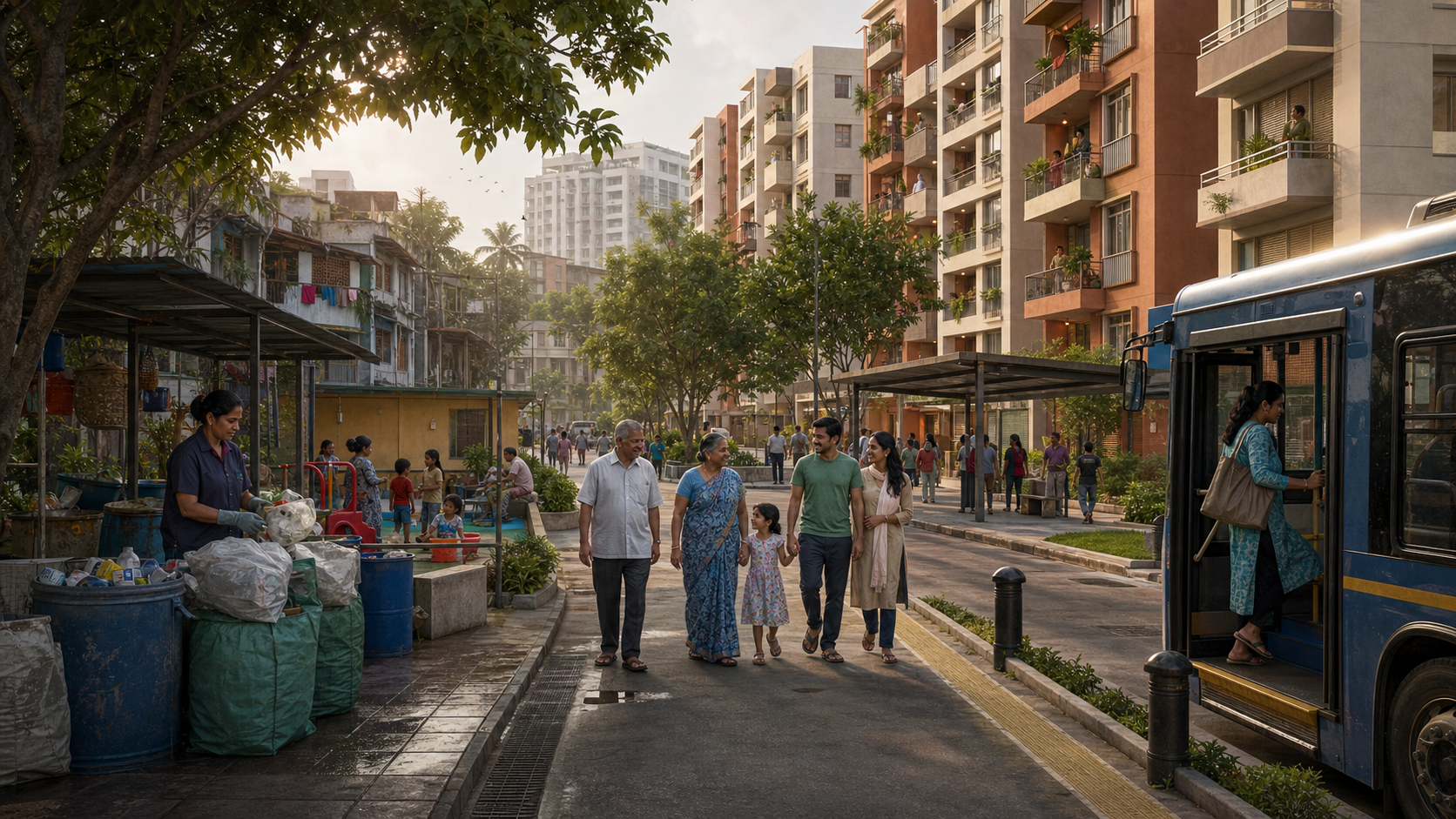
If a Mumbai redevelopment plan promises new flats but says little about jobs, rent, transit, temporary accommodation, or the time between demolition and possession, you do not yet have a housing plan. You have a construction proposal.
Dignified redevelopment must do more than replace hutments with towers. It must leave affected families more secure, preserve the useful economic functions of the neighbourhood, restore lawful urban planning, and prevent the next informal settlement from forming. Before you support or oppose a project, test it against those outcomes.
Dignity is an outcome, not a promise of square footage
Mumbai depends on people whose housing it has failed to accommodate legally. Sanitation workers, domestic workers, drivers, delivery riders, security staff, recyclers, repair workers, and small manufacturers keep the formal city running. Their low housing and transport costs become an invisible subsidy for households and businesses elsewhere in the city.
This is not a small economic fringe. India’s informal sector is estimated to account for roughly half of GDP and more than 90 percent of total employment. Dharavi, occupying only about 2.4 square kilometres and housing more than a million people, contains tens of thousands of enterprises; its annual output is often estimated at USD 1-1.5 billion. Those estimates are necessarily approximate, but they establish the scale of what can be disrupted by a badly designed clearance.
That economic contribution does not make overcrowding, insecure tenure, deficient services, pollution, or encroachment acceptable. It means the city must replace the functions of informality instead of pretending that they disappear when structures are demolished.
A dignified project should therefore be judged by four results:
- Residential security: a lawful home with dependable basic services, usable access, and a clear form of tenure.
- Livelihood continuity: a worker can still reach a shift, and a viable enterprise can still reach workers, suppliers, and customers.
- Procedural fairness: eligibility, verification, consent, objections, and remedies are documented rather than controlled through political or informal intermediaries.
- Urban improvement: redevelopment makes room for coherent transit, drainage, logistics, public services, and other infrastructure instead of permanently freezing a dysfunctional land pattern.
This is where a dharmic approach becomes practical. Compassion cannot mean perpetuating unsafe housing. The rule of law cannot mean treating poor families as disposable. Equal regard requires identity and address verification, eligibility rules, enforcement, and assistance to be applied without communal profiling. Dignity and order are not rival values; each prevents the other from becoming a slogan.
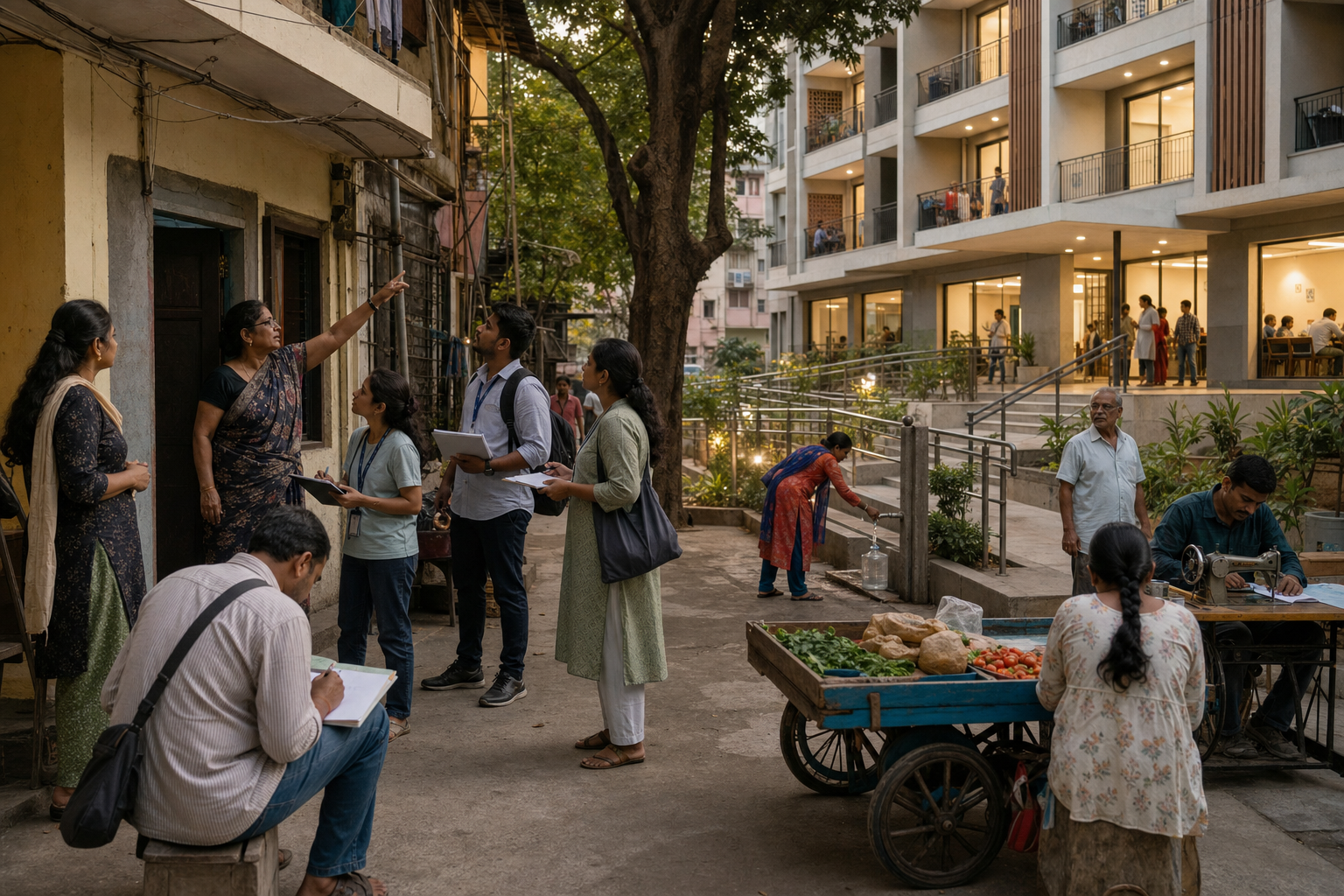
Map the household and the economy before drawing towers
The first redevelopment drawing should not be a building elevation. It should be a map of people, work, movement, and dependencies. If that map is missing, predictable losses will be discovered only after demolition, when they are hardest to reverse.
Separate verification from humane treatment
Occupancy, legal eligibility, and vulnerability are different questions. A person may live in a structure without qualifying for the same rehabilitation entitlement as another occupant. A tenant, subtenant, recent arrival, home-based worker, and verified long-term occupier may each require a different remedy. Dignity does not require pretending that every claim is identical; it requires making the distinctions openly and giving people a fair way to challenge mistakes.
Before clearance, the project should publish the method, timetable, and responsible authority for:
- identifying every occupied residential and commercial structure;
- recording occupants, tenants, dependants, and businesses without publicly exposing sensitive personal information;
- specifying which documents or other evidence will be accepted;
- assigning each claim an eligibility category and proposed remedy;
- correcting omissions and disputed entries through a time-bound review process; and
- matching each eligible household or enterprise to temporary and permanent accommodation.
A total unit count is not enough. Ask to see the chain from a verified household to a specific remedy. That chain is what prevents duplicate claims, arbitrary exclusions, and last-minute bargaining through brokers.
Record what each lane produces
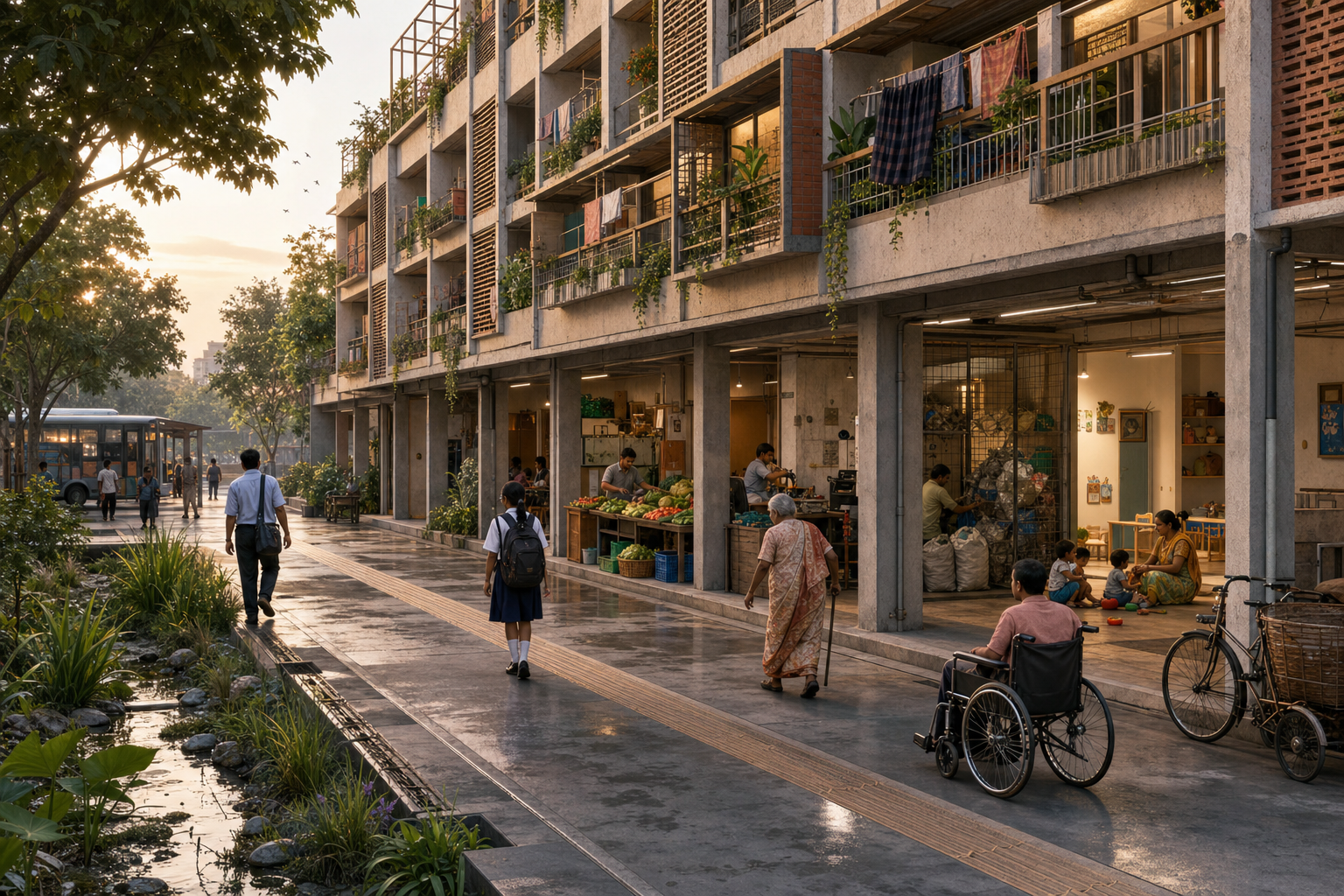
Slum economies do more than house wage labour. They contain recycling networks, repair shops, storage points, small production units, and depots that sort or divide bulk consignments for last-mile delivery. Removing those functions without planned replacements can raise costs well beyond the redevelopment site.
An economic census should record the activity, workers, suppliers, customers, equipment, storage needs, delivery pattern, and environmental risk of each enterprise. It should then place the activity in one of three practical categories:
- Compatible activities that can safely operate in or near mixed-use housing.
- Space-dependent activities that require an affordable shop, workshop, storage bay, or loading point.
- Hazardous or polluting activities that cannot remain in a residential lane and must move to a code-compliant cluster with proper environmental oversight.
Formalisation should preserve legitimate value, not confer immunity on every activity. A useful repair business deserves a legal place to operate. A polluting process does not deserve permission to continue harming neighbours merely because it employs people. The correct response is compliant space and low-friction licensing, backed by enforcement.
Measure access in time and cost, not kilometres
A relocation described as nearby can still destroy a livelihood if the first train or bus does not run before a worker’s shift, if the last connection ends too early, or if fares consume the household’s margin. Test the proposed address at the hours residents actually travel. Record door-to-door time, transfers, fare, reliability, and the journey from home to school, clinic, market, supplier, and customer.
Temporary accommodation needs the same scrutiny. Before demolition, residents should know its address, duration, occupancy terms, utility arrangements, travel consequences, and who bears each cost. Enterprises may also need interim storage or operating space. A promise to settle those details later transfers the project’s execution risk to families least able to carry it.
If you are directly affected, treat consent forms, eligibility records, waivers, transit-accommodation agreements, and possession documents as legal instruments. Do not rely only on verbal assurances or a generic checklist. A qualified local lawyer or authorised legal-aid provider should examine the documents and the facts of your claim before you sign.
Build the replacement city before enforcing the old city away
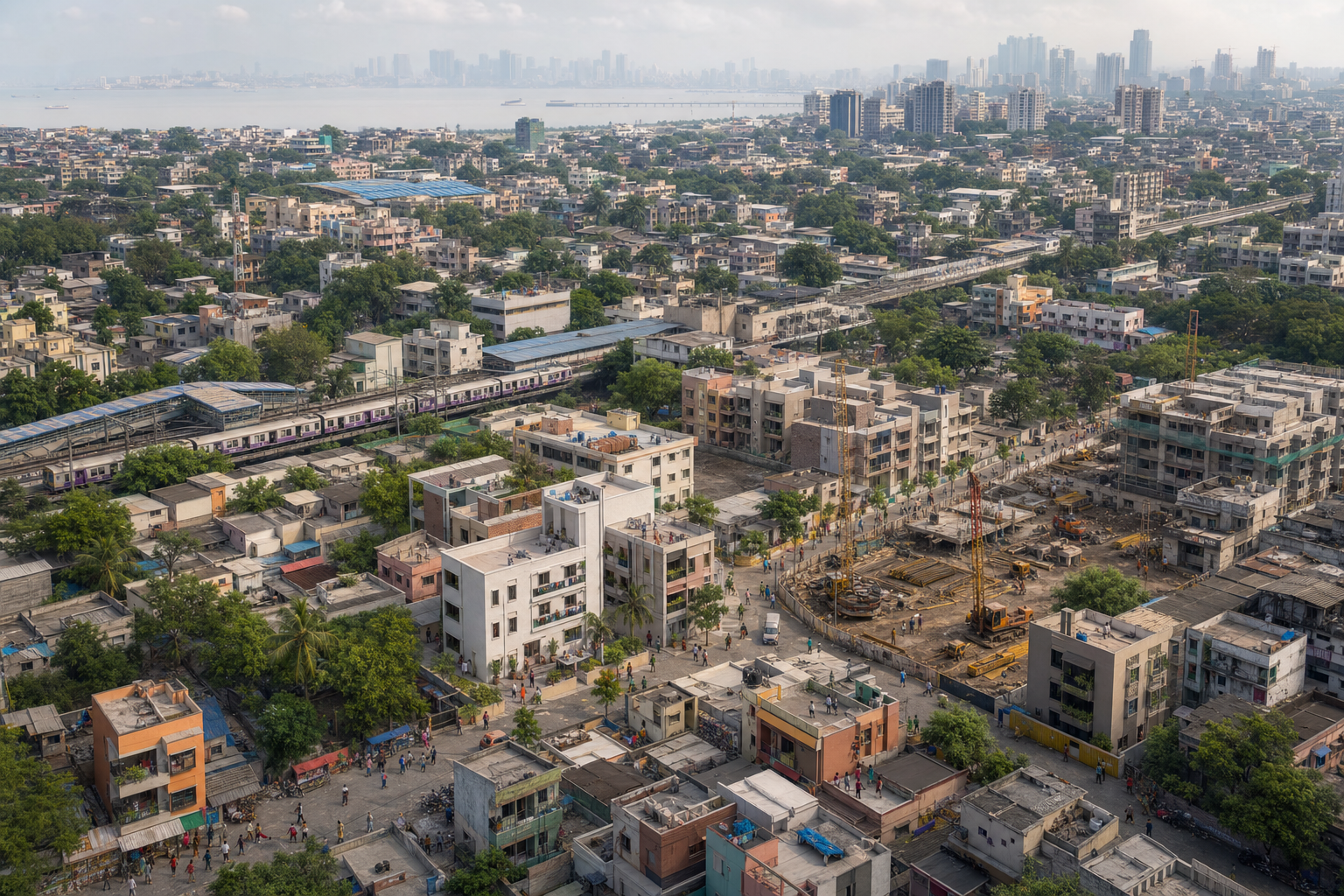
Demolition changes land use immediately. Housing, workshops, logistics, and commuting capacity take much longer to replace. The humane sequence is therefore simple: design and secure the replacement system first, then clear the land according to a disclosed schedule.
Publish a mixed-income housing rule
A neighbourhood of only high-price ownership units cannot support the labour on which it depends. A rehabilitation enclave isolated from jobs and transit is no better. Every major growth area should publish an X:Y rule: for each defined block of higher-income housing, how many well-located affordable rental or rehabilitation homes will be provided, at what locations, and by what date?
The ratio should be based on local employment and transport patterns rather than chosen as a decorative percentage. It should also distinguish ownership from rental housing. Rehabilitation addresses displacement, but Mumbai also needs a lawful entry point for workers who never occupied encroached land. Otherwise, a distant legal renter can remain worse off than someone whose informal occupation eventually produces a saleable unit. That incentive is unfair and encourages recurrence.
Affordability must include the cost of living in the completed building. Maintenance charges, utilities, transport, and restrictions on home-based work can make a nominally free unit economically unusable. These costs should be disclosed before consent and assessed against the household’s likely post-redevelopment income.
Give informal productivity a legal address
Planned logistics micro-hubs can replace improvised bulk-breaking and last-mile depots. Suitable locations include the urban edge and multimodal transport nodes, provided tariffs and access rules are transparent. Repair, refurbishment, recycling, and small production clusters need affordable, code-compliant units rather than conventional commercial space priced for large firms.
Licensing should be simple enough for a small operator to complete without an intermediary, while safety and environmental obligations remain real. Cheap legality is essential. If compliance requires unaffordable premises, repeated visits to several offices, or indefinite waiting, informal operation will remain the rational choice.
Treat in-situ rehabilitation as one tool, not a sacred formula
Rebuilding on the same site can preserve jobs, social networks, and access. It is not automatically the best option when a settlement blocks a necessary transit alignment, stormwater outlet, airport-related requirement, or other critical infrastructure. Freezing every existing footprint can burden the city for decades.
The project authority should compare at least three spatial choices where they are feasible: in-situ reconstruction, nearby relocation, and relocation linked to high-frequency transit. The comparison should show household travel consequences, infrastructure needs, economic-space requirements, project cost, and land recovered for public use. The chosen option may differ by site. What matters is that the trade-off is visible rather than hidden behind the word rehabilitation.
Prevention also reaches beyond Mumbai. More meaningful employment and lawful housing in tier-2 and tier-3 cities can reduce the pressure that channels workers into a few expensive metros. That is a long-term complement, not an excuse to uproot households already supporting Mumbai’s economy.
Make FSI finance rehabilitation without governing it
Bonus Floor Space Index can finance rehabilitation by allowing a developer to build saleable floor area. The mechanism is useful, but it creates a strong arbitrage when encroached land enters a project at little or no acquisition cost while sale units command market prices. The occupier may expect a valuable formal unit; the developer may expect monetisable FSI; political and informal intermediaries may expect control over access. Poor completion or poor-quality rehabilitation can follow when those incentives are stronger than the delivery obligations.
FSI should therefore be treated as a financing instrument, not evidence that a project will serve residents or the city. A credible agreement should make the valuable benefit conditional on verified performance.
- Publish the baseline: land ownership, parcel boundary, verified structures, eligible claims, rehabilitation area, commercial replacement area, sale area, and public infrastructure should reconcile in one record.
- Link benefits to milestones: permissions or sale-side advantages should follow measurable rehabilitation progress rather than arrive entirely at the beginning.
- Define completion properly: a building shell is not successful rehabilitation if water, sanitation, access, lifts where required, occupancy approvals, or livelihood space are missing.
- Assign transition risk: the agreement should identify who pays for temporary accommodation, delayed possession, utilities, moving, and interim business arrangements.
- Expose performance: a public dashboard should show verified households, disputes, construction milestones, occupied units, unresolved defects, and schedule changes.
- Preserve a remedy: residents need a documented grievance and review channel outside the developer’s own allocation process.
This accountability must extend in every direction. Residents must submit truthful claims and comply with lawful allocation terms. Developers must deliver what earns their development benefit. Public authorities must enforce planning rules consistently and act against organised encroachment, political patronage, and coercive intermediaries. Employers and middle-class households must recognise that safe, legal housing has a real cost; poor workers should not be expected to absorb that entire correction through longer commutes or lost income.
Enforcement becomes more legitimate when affordable legal alternatives exist. Mumbai should expand well-located rental supply while acting promptly against new encroachment under clear, religion-neutral rules. Otherwise, redevelopment merely resets the cycle: one settlement is cleared while workers excluded from the formal housing market establish another.
Key takeaways: the seven-question approval test
When you evaluate a redevelopment proposal, ask for documentary answers to these questions:
- Can every affected household and enterprise see how it was recorded, classified, and matched to a remedy?
- Is there a usable objection process for omissions and disputed eligibility before demolition?
- Are temporary housing, business continuity, moving costs, utilities, and delay responsibility settled in writing?
- Does the permanent plan preserve practical access to work, schools, transit, suppliers, and customers?
- Does the area have a published mix of rehabilitation, affordable rental, and market housing rather than an undefined promise of inclusion?
- Are sale-side FSI benefits tied to verified rehabilitation delivery, service quality, and occupancy?
- Will the city provide lawful housing and economic space while enforcing the same rules consistently against future encroachment?
If a proposal cannot answer these questions, do not let the debate collapse into a choice between preserving every informal structure and clearing everything quickly. Demand a revised plan with a household register, economic map, spatial comparison, transition budget, delivery timetable, and accountable decision-maker.
Mumbai can remove slums without removing the people and productive relationships that make the city work. That is the standard to insist on: lawful land use, secure homes, viable livelihoods, uniform enforcement, and duties that remain binding after the demolition machinery leaves.

References
