
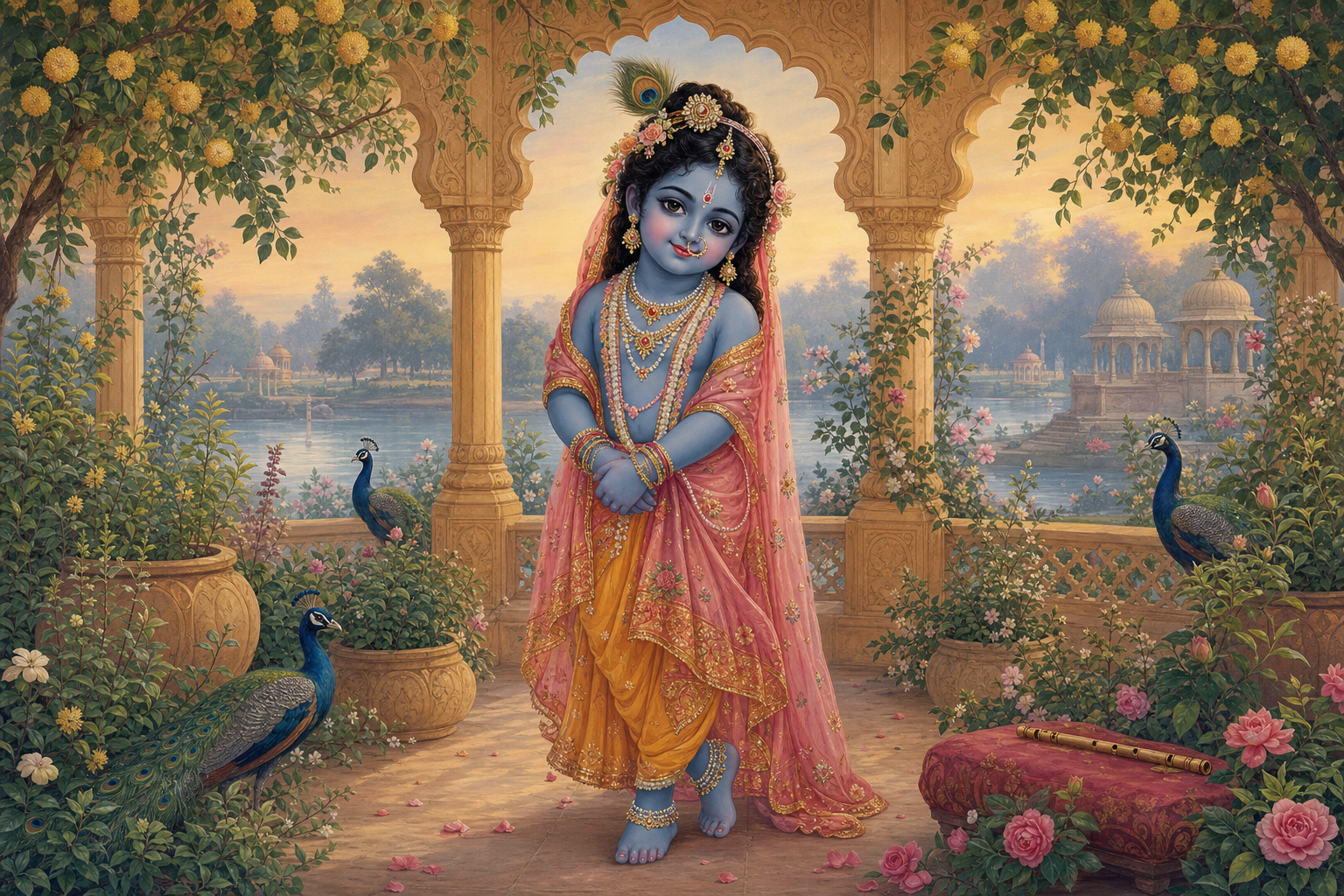
You may have seen Bala Gopala wearing a small nose ring, bindi, anklets, or a softly draped garment associated with a girl in Braj. If you are wondering whether the image is authentic, whether it depicts Vishnu’s Mohini Avatar, or whether a devotee may recreate the dressing at home, the details matter.
The short answer is that stri-vesha is a localized form of Krishna seva remembered in Vrindavan and the wider Braj devotional world. Its governing mood is not novelty. It is vatsalya-bhava: Yashoda’s protective, intimate love for Krishna as her child.
Name the form correctly before interpreting it
Stri-vesha means feminine attire or guise. In this setting it usually refers to Krishna being adorned with ornaments and clothing conventionally associated with a girl. Gopi-vesha is also used in some devotional settings, although the term can carry additional associations with Krishna’s Vrindavan lilas. Context therefore matters more than any single ornament.
Mohini Avatar is a different and more specific idea. The Bhagavata Purana, Skandha 8, recounts Vishnu appearing in a female manifestation during the Samudra Manthana. A child Krishna wearing a nath in a Braj household is not automatically a depiction of that event. Calling every feminine appearance of Krishna the Mohini Avatar collapses distinct narratives into one label.
Mohini Swarupa, as the expression is used in this Braj context, points instead to a form or appearance that the Lord freely assumes within lila. The distinction is practical: avatar identifies a particular divine manifestation and narrative, while vesha identifies an adornment or guise offered in a particular devotional relationship. The child, the maternal setting, and the protective intention identify the stri-vesha tradition more reliably than the nose ring alone.
When you encounter such an image, first ask three questions. Is the deity presented as Bala Gopala? Does the local explanation invoke Yashoda’s care or the protection of the infant Krishna? Is the appearance part of seva rather than a dramatic reenactment of the Samudra Manthana? If the answers point toward childhood, Braj, and maternal devotion, stri-vesha or Mohini Swarupa is the more accurate reading.
The rite begins with Yashoda’s protective love
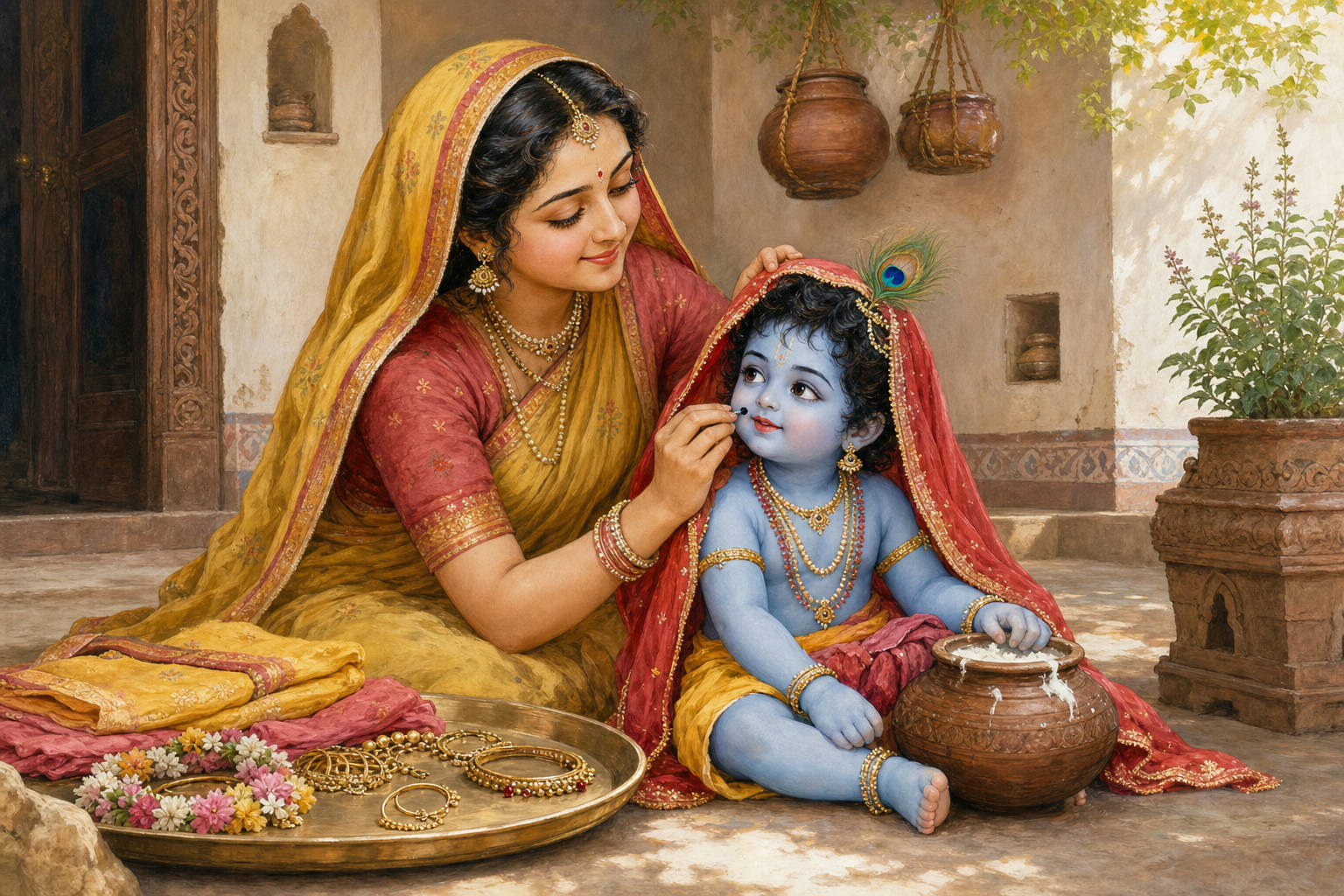
Skandha 10 of the Bhagavata Purana places Krishna’s infancy under repeated threat. Kamsa fears the child destined to destroy him, and hostile agents such as Putana enter the world of Gokula. The exact episode of Yashoda dressing Krishna as a girl is not set out there as a separate scriptural command. It belongs to Braj oral memory, kirtan, and living parampara within that scriptural world of danger.
That distinction helps you defend the tradition without overstating its textual status. The Bhagavata Purana supplies the setting of Kamsa’s fear and the attacks on the child. Braj remembrance supplies the intimate detail of a mother disguising her son so that hostile eyes searching for a male child might pass over him.
The custom also fits a familiar South Asian protective vocabulary. Families have used a dark mark on a child’s cheek, an amulet, deliberately mismatched clothing, or another visual irregularity to turn away nazar or drishti-dosha. Dressing a boy as a girl can serve the same apotropaic purpose, especially where the perceived danger is directed toward a male child. Apotropaic simply means intended to avert harm.
A mature theological reading does not require you to believe that the Supreme became powerless and could survive only through concealment. Vatsalya-bhava works through a devotional paradox: the protector of the cosmos permits himself to be protected by his mother. Yashoda does not relate to Krishna as an abstract metaphysical principle. She feeds him, dresses him, worries over him, and acts decisively when she senses danger.
This is why the nath matters. Removed from the lila, it can look like an unusual accessory. Within Yashoda’s relationship, it becomes a sign of maternal intelligence. Love uses whatever is at hand to shelter the beloved. The rite’s spiritual value lies in remembering that relationship, not in treating the disguise as a mechanical guarantee against misfortune.
Why feminine adornment belongs within Krishna seva
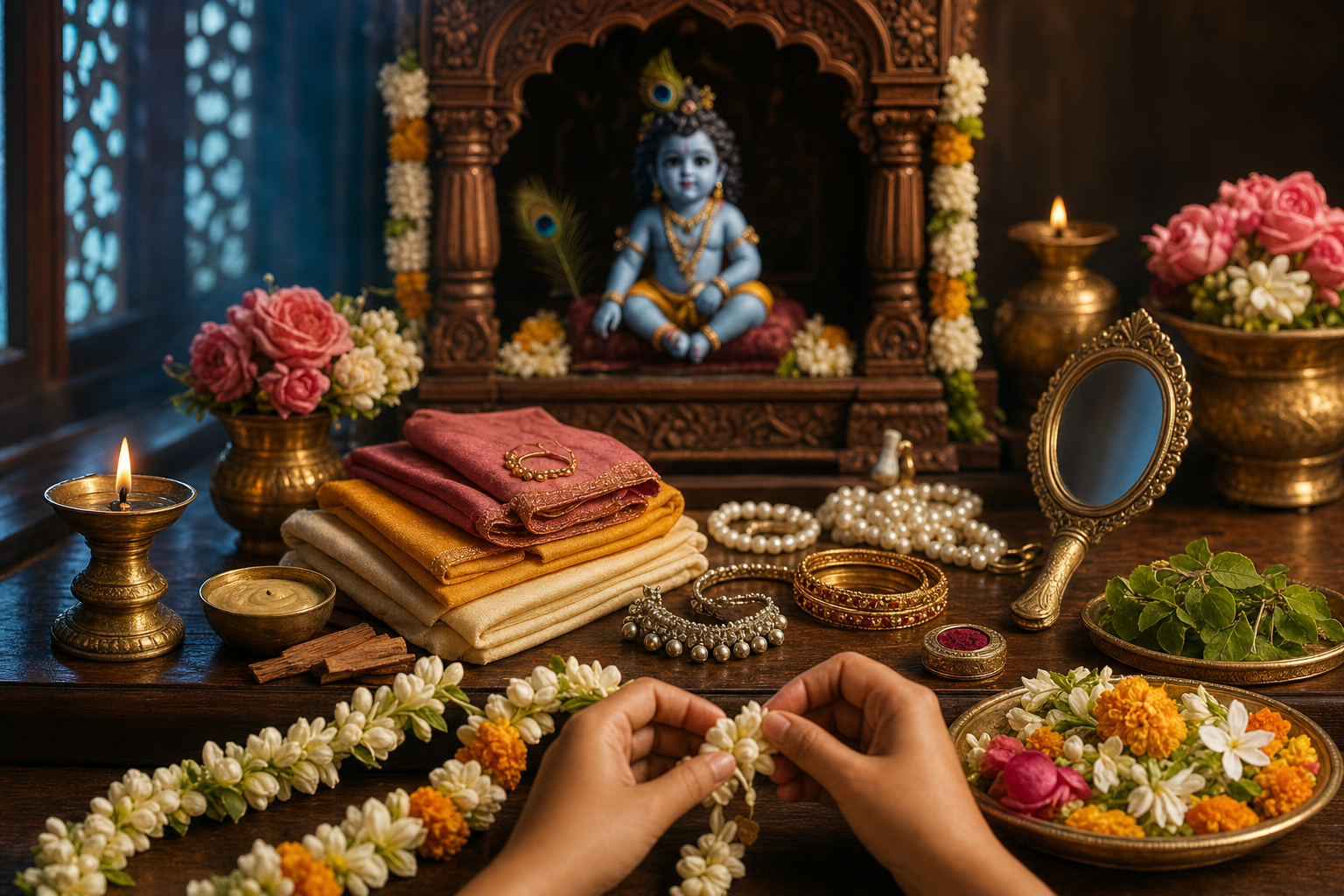
In Vaishnava arcana, dressing the deity is not an optional flourish added after worship. Shringara, bhoga, and arati form a recognizable rhythm of personal service: the deity is adorned, offered food, and worshipped with light. Shringara in this context is not vanity. It is the devotee’s careful use of cloth, color, ornament, season, and occasion to express bhava.
Gaudiya Vaishnavism, Pushtimarg, and related Vaishnava traditions preserve detailed approaches to dress and ornament. Garments may change with the season, festival, time of day, or lila being remembered. Those larger canons explain why a change of vesha is liturgically intelligible. They do not establish every local form of stri-vesha as a universal prescription for every Krishna temple or household.
The observed vocabulary of stri-vesha may include a small nathiya, bindi, anklets, a dupatta-like drape, soft fabrics, and a subtle line of kajra. None of these is mandatory in isolation. Their meaning comes from the seva as a whole: Bala Gopala is being lovingly dressed, remembered, and served.
The same garment can communicate different bhavas in different settings. A household may emphasize Yashoda’s maternal protection. A temple shaped strongly by rasa-lila traditions may connect gopi-vesha with Krishna’s playful sovereignty and the devotional world of Radha and the gopis. Occasional inversions of attire around Gopashtami and other Braj observances add another local layer. Do not assume that one explanation governs every instance.
This variation gives you a simple rule for interpreting temple practice: ask the sevayat or a knowledgeable member of that community what the day’s vesha signifies. A pan-Hindu answer imposed from outside may be less accurate than the local explanation. Parampara often preserves meaning through a calendar, a song, a family practice, or a specific form of seva rather than through a single standardized manual.
What stri-vesha does and does not claim
You do not have to choose between two crude conclusions: that every valid Hindu observance must appear verbatim in one Sanskrit verse, or that any inherited custom is beyond examination. Stri-vesha stands where shastra, regional sacred memory, and living practice meet. Its credibility rests on three different supports: consistency with Krishna’s childhood narrative, continuity within Braj devotion, and coherence with the Vaishnava grammar of vesha and seva.
State each support at its proper strength. The threats surrounding Krishna’s infancy are scriptural. Yashoda’s particular use of feminine disguise is a Braj devotional remembrance. Periodic stri-vesha in select temples and households is a living custom, not a rite uniformly required across all Vaishnava sampradayas. This careful wording protects the tradition from both dismissal and inflated claims.
The gender question also requires precision. Within the rite, Krishna remains Krishna, the beloved child and Svayam Bhagavan. Feminine clothing does not need to be explained as a change in modern human identity categories. At the same time, the form does express a genuine theological freedom: the Divine is not imprisoned within the social limits attached to male or female appearance. The Lord can receive every suitable ornament offered in devotion.
That freedom should not be conscripted into a culture war in either direction. It is unnecessary to turn the rite into a proof-text for a current political position, and equally unnecessary to deny its capacity to teach dignity and humility. The primary interpretive key remains lila, bhava, and the Lord’s grace toward devotees.
Other Dharmic traditions offer useful analogies without becoming interchangeable. An Advaita-informed Vaishnava reflection can distinguish the reality beyond limiting attributes from the forms graciously accepted for worship. Buddhist upaya draws attention to forms adapted for the benefit of beings. Jain anekantavada cautions against mistaking one perspective for the whole. Sikh remembrance of Ik Onkar directs attention to the One who cannot be exhausted by form. These parallels can deepen mutual respect, but Krishna’s stri-vesha should first be understood within its own Vaishnava and Braj setting.
The rite therefore makes a focused claim. Divine reality exceeds the categories through which we approach it, yet devotion does not discard form. It sanctifies form by making it an instrument of relationship. In stri-vesha, fabric and ornament carry Yashoda’s concern for her child.
How to approach stri-vesha in home worship
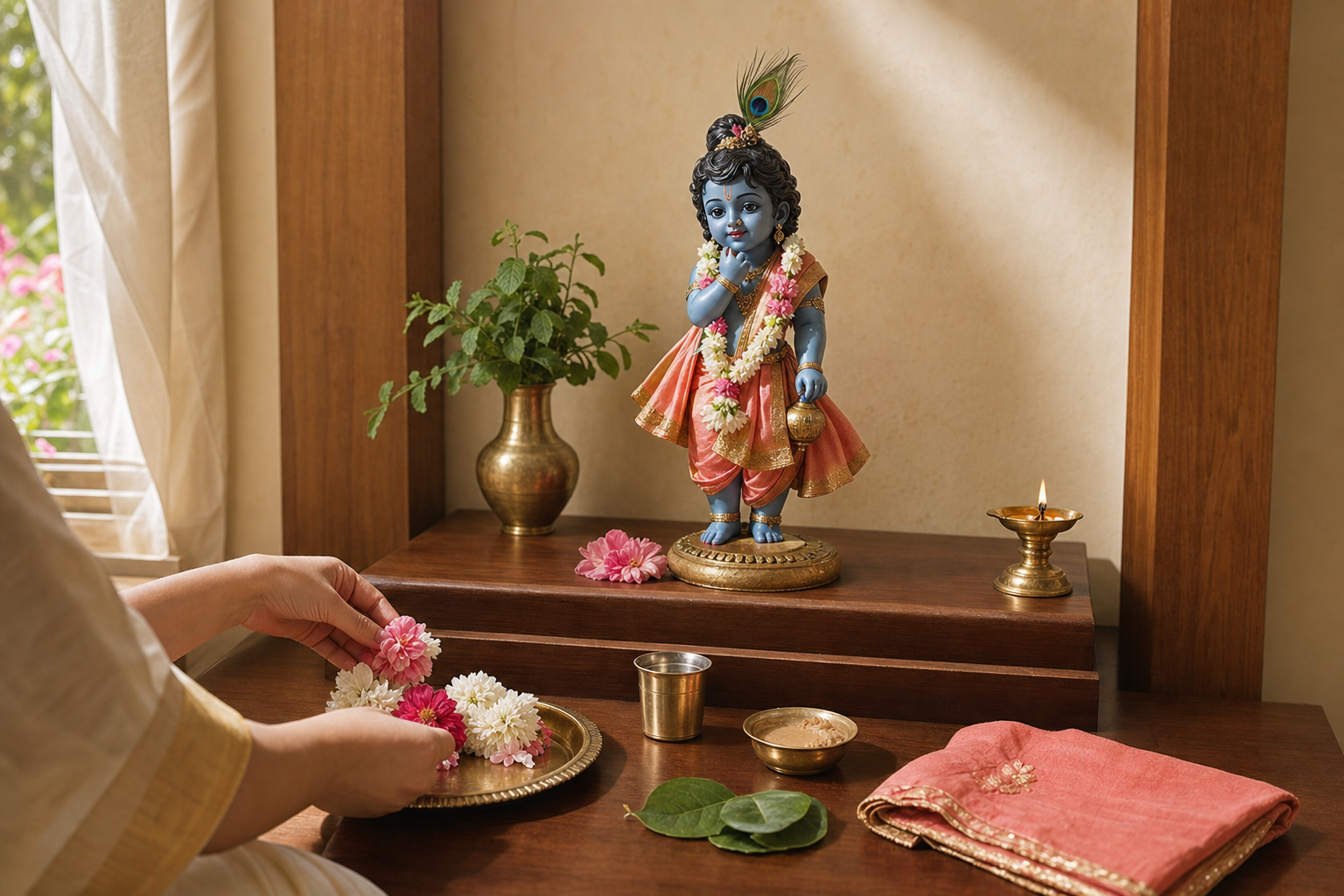
There is no requirement to perform stri-vesha in order to complete ordinary Krishna worship. If the custom is absent from your lineage or household, you can honor it without improvising a new ritual. If you do wish to offer the vesha to Bala Gopala, begin with guidance and keep the arrangement simple.
- Ask where the practice fits. Consult your guru, a family senior, a trusted sevayat, or the customary paddhati of your sampradaya. Ask whether the vesha is associated with a particular day, festival, family observance, or lila.
- Set the devotional intention before selecting ornaments. Remember Yashoda protecting Krishna and cultivate vatsalya-bhava. Do not begin from a desire to produce a surprising image.
- Choose a restrained vesha. A clean soft cloth, a modest drape, and one or two light ornaments can convey the form. A bindi, anklets, subtle kajra, or nath may be included where appropriate, but none is indispensable.
- Protect the murti. Never pierce, force, bend, or place a heavy ornament on Bala Gopala merely to complete the look. If a nath cannot be attached lightly and removed without pressure or damage, omit it. Ask an experienced sevaka which materials are suitable for your deity.
- Keep the vesha inside your normal seva sequence. Perform shringara with the cleanliness and care your household ordinarily follows, use a mantra you have already received or know, offer bhoga, sing a soft Krishna kirtan if customary, and complete arati according to your practice.
- Keep the presentation prayerful. Photography or public sharing should remain secondary to seva and should follow household or temple norms. If the image is likely to be detached from its context and treated as spectacle, preserving the intimacy of the worship may be the wiser choice.
The three safeguards are sampradaya alignment, dignified and sattvic adornment, and a clear devotional intention. If any one is missing, pause. A simpler offering made with coherence is better than an elaborate costume whose meaning no one in the household can explain.
If you are a visitor rather than the sevaka, the corresponding discipline is observation. Do not mock the image, invent a scriptural quotation for it, or declare the local explanation invalid because the form is unfamiliar. Ask what bhava is being served. That question usually reveals more than an argument about the ornament itself.
Key takeaways
- Krishna’s stri-vesha is a localized Braj devotional practice centered on Bala Gopala, maternal protection, and vatsalya-bhava.
- It should not be confused automatically with Vishnu’s Mohini Avatar in the Samudra Manthana narrative.
- The dangers surrounding Krishna’s infancy appear in the Bhagavata Purana; the particular disguise by Yashoda belongs to Braj oral memory and living parampara.
- A nath, bindi, anklets, draped cloth, or kajra receives its sacred meaning from seva and bhava, not from the object alone.
- The practice is respected in some temples and homes but is neither universal nor mandatory across Vaishnava traditions.
- Home observance should follow lineage guidance, use modest removable adornment, protect the murti, and remain an act of worship rather than spectacle.
The next time you see Krishna wearing a nose ring, begin with the relationship rather than the apparent contradiction. Identify the form, ask which lila the community remembers, and listen for Yashoda’s vatsalya behind the ornament. If you bring the vesha into your own seva, let the first offering be careful intention; the cloth and jewelry should only make that intention visible.
References
