

If a curse can turn a king into an elephant or a wealthy youth into a tree, is karma simply a system of supernatural punishment? That question matters. A punitive reading can make you fearful of every setback and eager to interpret another person’s suffering as evidence of hidden wrongdoing.
Hindu sacred narratives offer a more demanding and more useful view. A transformation often confines a being within the very tendency that has gone unexamined: pride becomes immobility, strength meets a grip it cannot overpower, good intention collides with neglected procedure, and inner turbulence releases poison before nectar. Liberation becomes possible when responsibility, disciplined change, surrender, discernment, and divine grace meet. Once you recognize that movement, these narratives give you a practical way to examine your own habits without reducing dharma to blame.
Start by asking what the new form makes impossible

The transformed body is rarely an arbitrary costume. Within the sacred imagination, the jīva can move through different birth-categories under the influence of karma and saṁskāras, yet continuity of consciousness remains. The form changes; the spiritual significance of the being does not disappear.
When you encounter a tree, animal, stone, or other altered state, ask three concrete questions. Which capacity has been removed? Which tendency has been magnified? What can the being now learn that ordinary freedom allowed it to avoid? Those questions keep symbolism tied to the actual plot rather than turning every creature into a fixed entry in a symbolic dictionary.
| Narrative | What becomes constricted | Liberating turn | Question for your own life |
|---|---|---|---|
| Nalakūvara and Maṇigrīva become arjuna trees | Wealth, intoxication, and pride give way to rooted silence and dependence. | Krishna releases them from treehood and reopens their spiritual path. | Where would a voluntary pause interrupt vanity before circumstances impose one? |
| Indradyumna and Hūhū become an elephant and a crocodile | Embodied strength confronts an entrenched, submerged grip that force alone cannot defeat. | Gajendra’s long struggle ripens into surrender, and Vishnu liberates both beings. | Which struggle has reached the limit of force and now requires honest surrender or help? |
| King Nṛiga becomes a lizard in a dry well | A generous intention is trapped by an unresolved ownership dispute and failed restitution. | Krishna releases Nṛiga, but the ethical problem remains part of the teaching. | Have you treated good intentions as a substitute for correcting the actual harm? |
| Ahalyā is bound in a stone-like state | Shame, isolation, and social paralysis harden into immobility. | Rama’s compassionate presence restores movement and personhood. | Does the situation need permanent exclusion, or truthful repair followed by reintegration? |
| The cosmic ocean is churned | Opposing forces generate turbulence, poison, treasures, and finally amṛta. | Stability, containment, cooperation, and discernment turn upheaval toward renewal. | What ethical anchor will keep a difficult change from spreading fresh harm? |
These readings don’t require you to discard devotional faith. Literal, symbolic, psychological, and soteriological readings can operate together. You may remember an episode as divine līlā, receive its ethical instruction, and notice its pattern in your own mind without claiming that one level cancels the others.
Nor should you assume that an elephant, crocodile, tree, or stone always means the same thing. In Gajendra Mokṣa, elephantine strength matters because it meets the crocodile’s tenacious grip in water. In the story of Kubera’s sons, treehood matters because restless privilege is replaced by stillness. Read the form in relation to the character’s previous conduct, the setting, and the means of release.
Karma is a chain to understand, not a verdict to pronounce
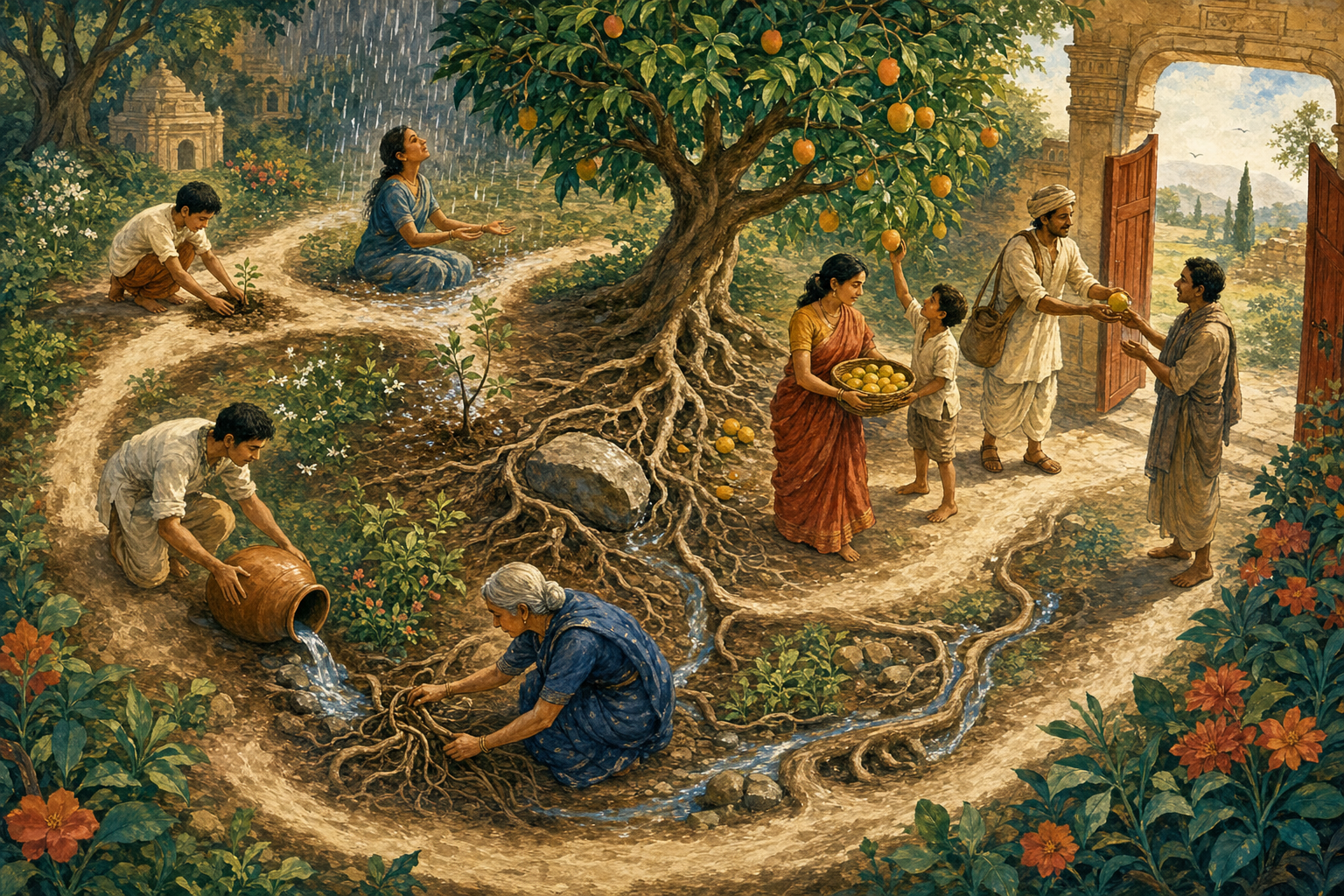
Karma explains moral continuity, but it is not identical to fatalism. A karmic consequence may narrow the field of action, yet it does not always abolish agency. Gajendra can still surrender. The brothers standing as trees can still receive Krishna. Nṛiga can acknowledge the unresolved dispute. Ahalyā can be restored. The condition is serious, but it is not the deepest identity of the jīva.
A śāpa, or curse, should also not be used as a synonym for everything unpleasant. In these narratives it is a particular intervention within a karmic trajectory. Nārada sees arrogance in Nalakūvara and Maṇigrīva and imposes a period of rooted stillness that will eventually place them before Krishna. The constraint interrupts harmful momentum while preserving an opening to liberation. It is both consequence and redirection.
Nṛiga’s predicament adds an essential correction. He intends to give generously, but one donated cow already belongs to another brāhmaṇa. The resulting dispute cannot be dissolved by repeating that his motive was charitable. Dharma requires attention to rightful ownership, consent, procedure, and redress. Applied to your own conduct, the lesson is plain: once you discover that a gift, promise, payment, or decision has harmed someone, verify the facts and repair the transfer. Do not use sincerity to avoid restitution.
The same logic prevents a cruel misuse of karma. A sacred narrative may reveal the hidden history of one of its characters; you do not possess such knowledge about the person suffering beside you. Their illness, poverty, disability, grief, or misfortune is not an invitation to speculate about what they deserve. Your available dharma is compassion, practical help, and restraint. Karma is most useful as a discipline for examining your own actions, not as a theory for prosecuting someone else’s life.
When hardship comes, replace the accusatory question with a workable one. Instead of beginning with, What secret act caused this?, ask, What response is dharmic now? The first question may produce fear or fantasy. The second can produce an apology, restitution, patient endurance, a boundary, a request for help, or a renewed practice.
Use the ocean-churning pattern when change becomes turbulent
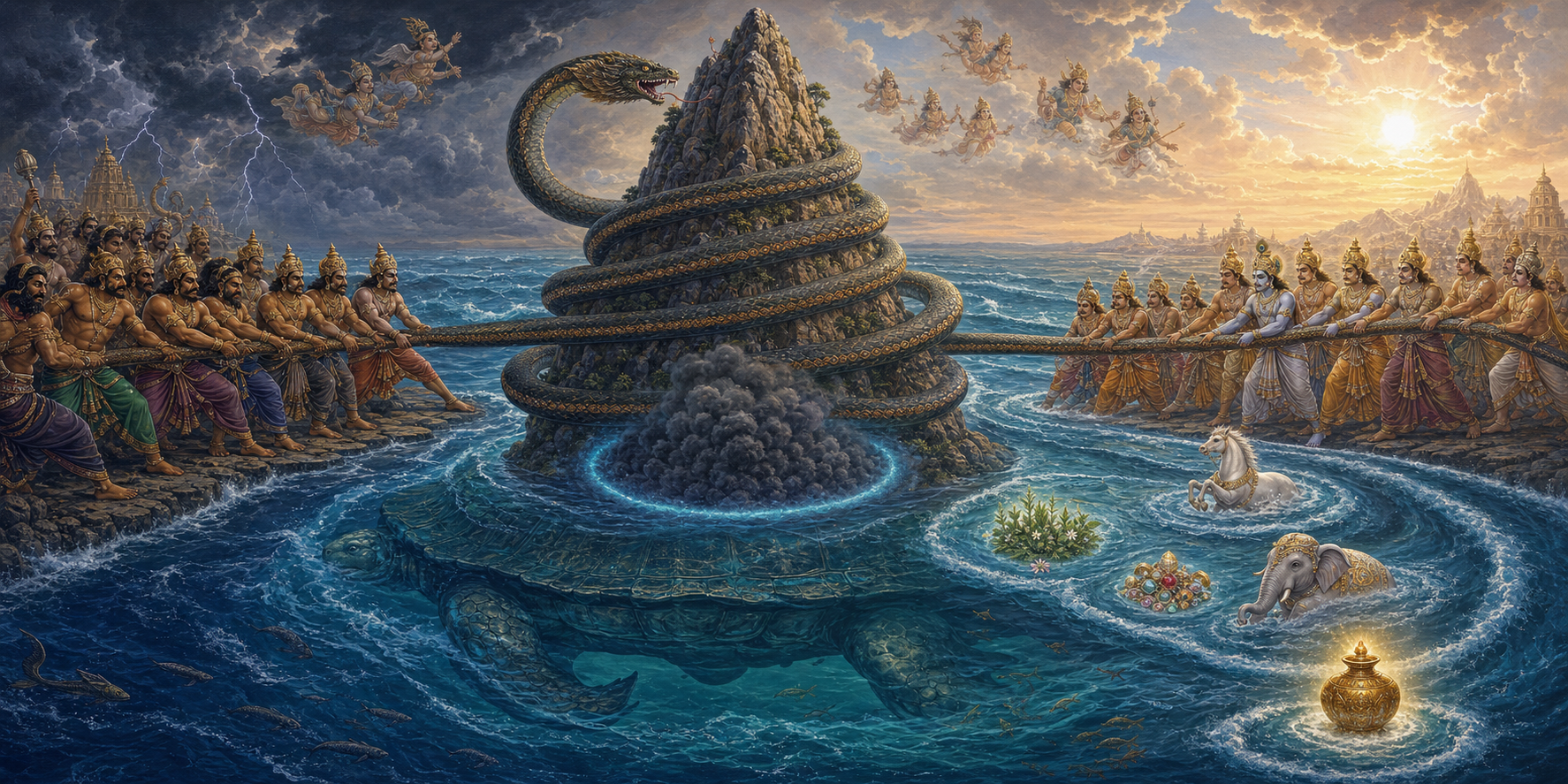
Some transformations happen as a change of form. Samudra Manthan presents transformation as a sustained process. Devas and asuras pull Vasuki around Mount Mandara while Vishnu, as Kurma, supports the axis from below. The rivals cannot produce amṛta independently. Their opposing force becomes useful only because it revolves around a stable centre.
The sequence matters. Hālāhala emerges before the coveted nectar. Shiva contains the poison rather than allowing it to enter the whole body or return to the world as further injury. Treasures then arise, including Lakshmi and Dhanvantari, before Mohini exercises discernment in distributing amṛta. Inner change follows a similar logic: disturbance can expose what was hidden, but exposure alone is not liberation. What surfaces must be held, understood, and directed by dharma.
- Establish your Mandara. Decide on the ethical principle that will remain fixed before you enter a difficult conversation or demanding period of sādhanā. It may be truthfulness, non-retaliation, fidelity to an obligation, or refusal to humiliate the other person. If the centre moves whenever emotion rises, the churning becomes mere agitation.
- Find your Kurma. Give the process ordinary support: a regular practice window, a stable posture, unforced breathing, sufficient rest, and trustworthy guidance. A lofty aim without a supporting base is difficult to sustain.
- Recognize Vasuki’s movement. Transformation usually involves repetition rather than one dramatic breakthrough. Return to japa, attentive breathing, study, prayer, or self-examination; then release unnecessary force and return again. Effort and relaxation must remain in relationship.
- Treat reactivity as hālāhala, not as revelation. Anger, grief, envy, shame, or old resentment may become more noticeable when you begin looking inward. Naming an emotion does not authorize you to discharge it into another person. Pause, contain it, and choose the next action only after the initial heat has reduced. If spiritual practice brings overwhelming memories, severe distress, or an inability to function safely, do not intensify the practice or treat the crisis as proof of spiritual advancement. Seek qualified mental-health support.
- Let Mohini represent discernment. Not every impulse uncovered during reflection deserves expression. Direct energy toward what strengthens clarity, responsibility, compassion, and steadiness. Withhold your cooperation from impulses that seek spiritual language for revenge, vanity, or escape.
This gives you a practical test for sādhanā. Do not judge it only by intensity, visions, unusual sensations, or the amount of emotion released. Look at your conduct in the next conflict. Are reactions less automatic? Are you more willing to tell the truth, repair harm, keep a commitment, and refrain from passing pain onward? If not, more churning may not be the answer; a firmer ethical axis may be.
Read any transformation narrative with five questions
Before applying a narrative to your life, identify what kind of change you are seeing. A curse-led transformation is not the same as a deceptive appearance. Mārīca’s golden-deer form in the Ramayana is a conjured lure rather than a karmic sentence. Its central problem is captivated perception: beauty has been separated from truth. That distinction keeps you from treating every strange form as a lesson imposed for the character’s improvement.
- What action, attachment, or failure of attention begins the movement? Name the conduct before assigning symbolism. Pride, heedlessness, unresolved ownership, sensory attraction, and the misuse of force create different karmic problems.
- What does the changed condition remove or magnify? Treehood removes mobility. Elephant form magnifies embodied strength and instinct. The crocodile magnifies grip and endurance. Stone-like isolation removes participation. Churning magnifies everything mixed within the ocean.
- What responsibility remains available? Look for restraint, endurance, restitution, remembrance, surrender, truthful recognition, or the refusal to harm. If your interpretation leaves the character with no meaningful response, you may have mistaken karma for mechanical destiny.
- Where does grace enter? Notice whether liberation comes through Krishna, Vishnu, Rama, a sage’s intervention, recovered devotion, or discerning intelligence. Grace reveals that spiritual recovery is not a fantasy of complete self-sufficiency.
- What has actually been liberated? A recovered body is not the whole answer. Look for release from arrogance, compulsion, isolation, deception, or the belief that force can solve every problem. Mokṣa-oriented reading asks what bondage has ended, not merely what appearance has returned.
You can use these questions on a recurring pattern without pretending that your life is identical to a Purāṇic episode. Suppose the same quarrel keeps returning. Name the initiating tendency as a verb: gripping, hardening, showing off, avoiding repair, or demanding control. Then identify the capacity the pattern removes, such as listening or honest speech. Choose the responsibility still available, and ask where you need counsel, prayer, community, or forgiveness. Verbs are useful because they describe movement; they do not turn a temporary bondage into your permanent identity.
Questions readers often bring to these stories
Does a curse mean that free will has disappeared?
No. A curse may drastically restrict circumstances, but many of these narratives preserve a meaningful response within the restriction. Gajendra remembers and surrenders. Nalakūvara and Maṇigrīva pass through imposed stillness until their encounter with Krishna. The freedom available may be narrower than before, yet the direction of consciousness still matters.
Should the transformations be read literally or symbolically?
You do not have to force that choice. A devotional reading can receive the event as sacred history or līlā, while a symbolic reading examines treehood as stillness, the crocodile as entrenched habit, or the ocean as consciousness under discipline. A psychological reading asks how awareness becomes constricted; a soteriological reading asks how release occurs. The reading is sound when it respects the narrative’s details rather than replacing them with a preferred theory.
Does divine grace cancel karma without responsibility?
These episodes do not present grace as permission to call adharma harmless. Nṛiga’s release does not make careless giving ethically correct. Gajendra’s rescue comes after struggle has exposed the limit of strength and surrender has become complete. In Samudra Manthan, poison must be contained before nectar can be received. Grace opens a future that bondage could not produce by itself; it does not make honesty, restraint, or repair unnecessary.
On your next reading, keep two unfinished sentences beside the text: The pattern that binds is ____. The dharmic response still available is ____. Fill them with verbs and actions, not labels. Then take that response into your next decision before searching for a grand explanation of your destiny. A sacred narrative becomes personally liberating when it changes what you do with the freedom that remains.
References
- DharmaRenaissance Blog — Samudra Manthan Unveiled: Esoteric Symbolism, Yogic Science, and Dharmic Unity for Inner Alchemy
- DharmaRenaissance Blog — From Curse to Liberation: Why Beings Become Trees or Animals in Hindu Scriptures
