
You can finish a demanding yoga session feeling thoroughly worked and still not feel lighter. If your breath is noisy, your jaw is set, and your mind remains restless, more intensity is probably not the missing ingredient. The useful question is whether your practice is reducing unnecessary effort.
Yogic laghava gives you a way to answer that question. It is an embodied lightness in which posture requires less force, breath becomes subtler, attention steadies, and ordinary stress leaves less residue. You do not have to treat it as a mystical claim: laghava has practical signs that can be noticed, cultivated, and tracked.
Key takeaways
- Laghava is precision with less unnecessary effort. It is not limpness, numbness, dizziness, or a temporary rush after forceful breathing.
- Begin with structural organization and smooth breathing. Equal-ratio Nadi Shodhana is more appropriate than ambitious breath retention when stability has not yet been established.
- Ethics, digestion, sleep, and restraint are part of the mechanism. You cannot reliably outbreathe a life organized around conflict, excess, or chronic depletion.
- Measure progress in familiar conditions: quieter breath, lower perceived effort, easier upright sitting, digestive comfort, sleep latency, and faster recovery after stress.
- If practice produces persistent dryness, insomnia, agitation, irritability, dizziness, or anxiety, treat that as imbalance rather than spiritual progress.
Recognize lightness before trying to produce it
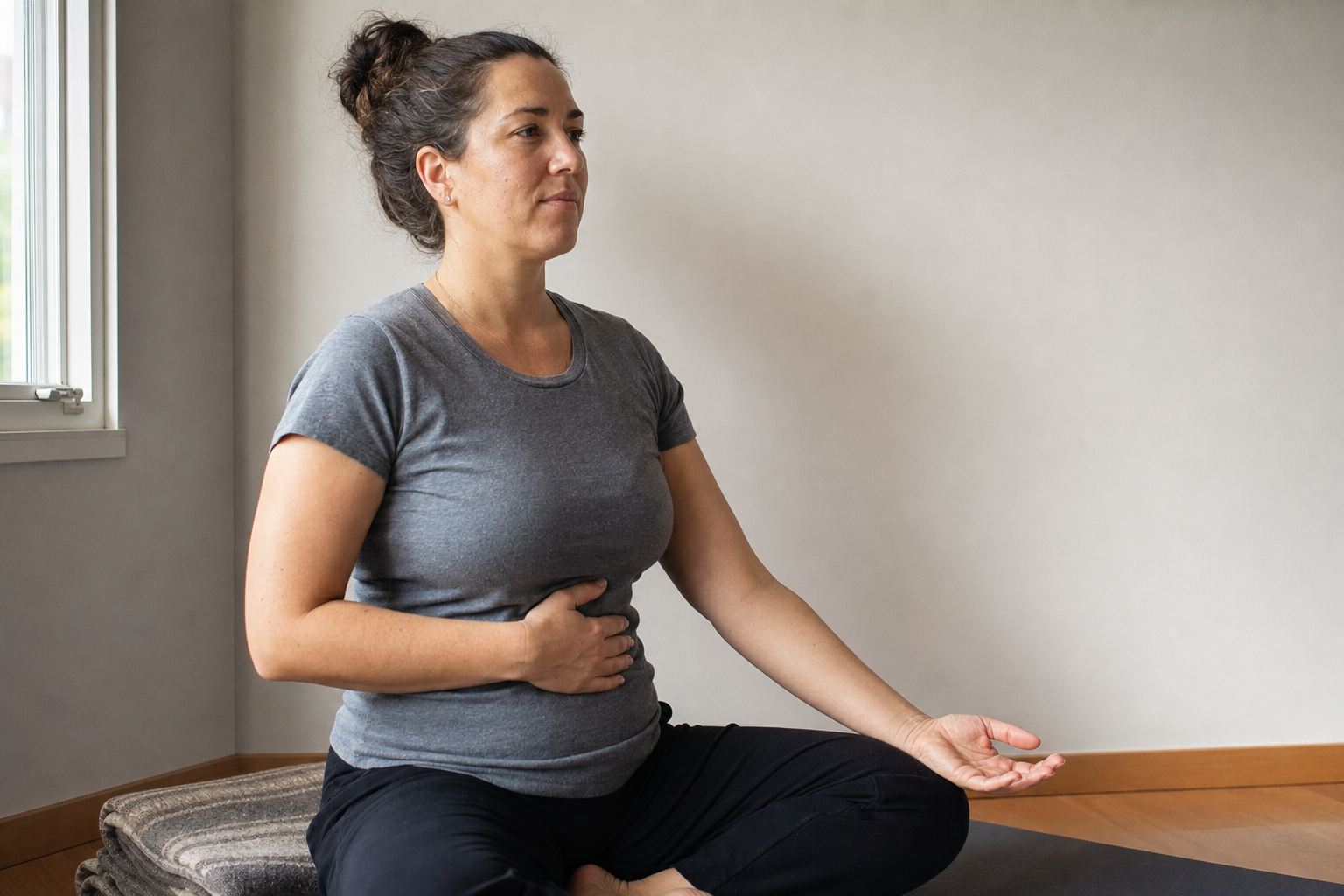
The Sanskrit word laghava grows from laghu, meaning light. It stands in a useful relationship with guru, heavy or weighty. Yoga needs both qualities. Grounding without lift becomes dullness; lift without grounding becomes instability. Genuine lightness is buoyant but dependable.
This is different from laghima, the legendary power of becoming extraordinarily light among the eight siddhis. Patanjali uses a cotton-like image when discussing mastery of the body’s relationship with space, but you do not need to literalize that image as levitation. The test that matters is functional: can you remain organized with less strain and meet life with greater clarity?
Use this three-part check in a familiar asana:
- Listen to the breath. It should remain smooth enough that you do not have to gasp, gulp, or force the next inhalation. A quiet nasal breath is more informative than how impressive the posture looks.
- Inspect the structure. Let the feet, shins, pelvis, or hands receive the load. Notice whether the rib cage can feel supported over the pelvis while the jaw and tongue stay soft. If peripheral muscles are gripping to compensate for poor load distribution, you are manufacturing effort rather than cultivating lightness.
- Observe the aftermath. A sound practice should leave calm alertness, not collapse or nervous stimulation. Notice how you walk, speak, digest, and respond to the next minor frustration. Laghava that disappears the moment you leave the mat has not yet become embodied.
The qualities must coexist. A relaxed but collapsed posture is not light. A technically precise posture held through bracing is not light either. Laghava appears where steadiness, ease, and clarity meet.
Traditional yogic anatomy describes this change through prana and apana coming into balance, udana supporting upward movement, samana organizing digestion and agni, and pranic flow becoming less obstructed. Contemporary physiology offers a parallel vocabulary: slower diaphragmatic breathing can accompany calmer autonomic regulation, a lower resting respiratory rate, improved tolerance of carbon dioxide, and increased heart-rate variability. These descriptions can illuminate one another, but a wearable cannot prove that a nadi is open, and a strong sensation of energy does not prove that your breathing is well regulated.
Use a practice sequence that removes effort in stages
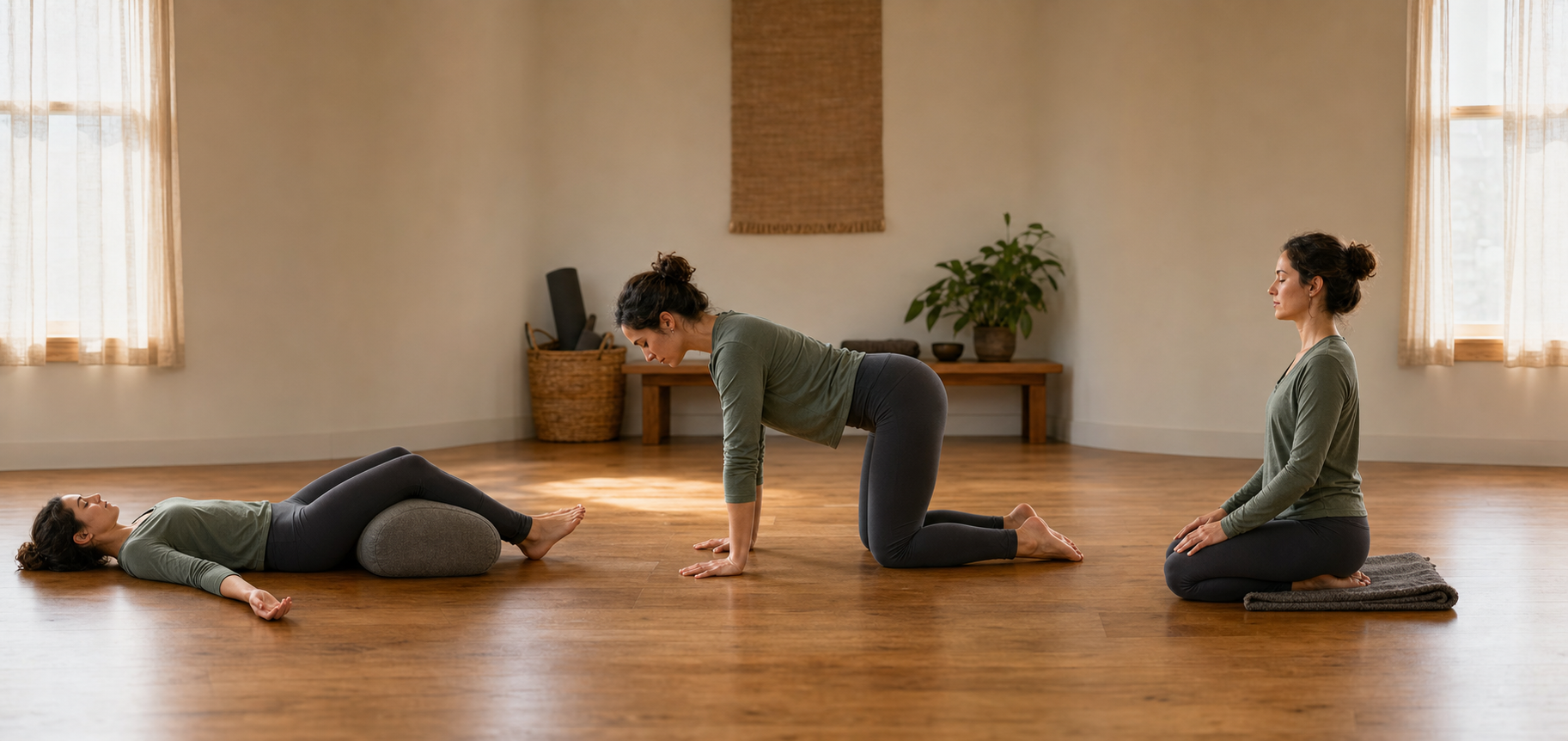
A useful laghava practice does not begin by demanding lightness. It progressively removes the reasons your body is bracing. The following sequence is a conservative template, not an individual prescription. Modify it for your mobility, health, and training level, and learn unfamiliar breath practices or bandhas from a qualified teacher.
- Mobilize the spine for 8-12 minutes. Use gentle movements rather than trying to reach maximum range. The immediate goal is to find where movement and breathing interrupt each other.
- Practice a light Surya Namaskar sequence. Let breath set the pace. Reduce the range or number of movements when the breath turns rough; completing the sequence is less important than preserving coordination.
- Spend 12-18 minutes in standing postures and balances. Emphasize clear contact with the ground and a relaxed exhalation. In a balance, look for the moment when skeletal organization replaces frantic correction.
- Add seated forward bends and a mild backbend. Forward bends can settle excess effort; the backbend should restore lift without hardening the throat, face, or lower back.
- Use a supported inversion such as Viparita Karani. Support matters. The posture should become quieter with time, not more stressful.
- Practice equal-ratio Nadi Shodhana, followed by brief Bhramari. A 1:1 ratio means that inhalation and exhalation receive the same comfortable count. It does not mean choosing a count so long that the final part of either phase becomes strained.
- Sit for 10-15 minutes, then rest in Savasana. Meditation lets you notice whether the breath becomes subtle on its own. Savasana allows the change to settle instead of sending you directly back into stimulation.
Stay with an even Nadi Shodhana ratio until it feels consistently unforced. Ratios such as 1:1.5 or 1:2 belong later, after months of stability, and are best developed with competent guidance. Kumbhaka, or breath retention, is not a shortcut. Long or forceful retentions can produce anxiety, dizziness, and agitation, especially in people with panic tendencies or cardiovascular concerns.
Bandhas require the same restraint. Gentle mula bandha can support pelvic stability; uddiyana bandha can contribute to a sense of upward organization; jalandhara bandha affects the relationship among the neck, breath, and retention. Applied too early or too forcefully, however, they add tension while imitating refinement. If you have to clamp the pelvic floor, pull the abdomen aggressively, or compress the throat to feel uplifted, step back.
Kapalabhati, Nauli, and other cleansing methods can be valuable when individually appropriate, but they are not universal remedies for heaviness. Fast breathing can create a bright, floating sensation that resembles laghava for a few minutes while actually leaving the nervous system unsettled. Dizziness is a reason to stop, sit or lie down safely, and return to ordinary breathing. Pronounced, recurrent, or persistent symptoms warrant advice from an appropriate health professional rather than further experimentation.
Measure progress without turning lightness into a contest
Laghava usually develops through ordinary changes before it becomes a stable meditative quality. A simple record helps you distinguish a trend from a memorable good session.
| Stage | What you may notice | What to do with the information |
|---|---|---|
| Early | Less stiffness on waking, steadier nasal airflow, less sighing or yawning, and greater ease in an upright seat | Keep the practice simple. Do not add intensity merely because the first layer of resistance is receding. |
| Developing | A longer and quieter exhale, an unforced pause after exhalation, a more buoyant gait, and less reactivity to minor stress | Protect smoothness. Let any pause occur naturally rather than converting it into a deliberate retention. |
| Maturing | Consistently subtle breath in meditation, little postural effort over time, and heavy moods that arise less often or pass more quickly | Judge the change by daily conduct and resilience, not by unusual sensations during practice. |
Your journal does not need to become elaborate. Track a few repeatable observations:
- Resting respiratory rate under broadly similar conditions.
- Perceived effort in the same familiar asanas.
- Heart-rate variability, if available, as a trend rather than a verdict from one reading.
- How long it takes to fall asleep and how rested you feel on waking.
- Digestive comfort after ordinary meals.
- The point in practice at which breath first becomes subtle.
- How quickly you regain composure after a minor, real-world stressor.
Do not chase a lower respiratory number or a higher heart-rate variability score. Those measurements are contextual and can be influenced by factors outside yoga. Their purpose here is comparison with your own baseline. If the numbers look favorable while sleep, digestion, mood, or physical steadiness deteriorates, the practice is not moving toward integrated lightness.
The most useful measure is energy economy: does less unnecessary effort now accomplish the same task? That may show up as an easier seat, a cleaner transition between postures, a conversation without defensive tightening, or a quicker return to equilibrium after irritation. These changes are quieter than a dramatic experience, but they are harder to fake.
Remove the burdens that practice cannot outbreathe

Yama and niyama are often treated as moral preparation for the supposedly technical work of asana and pranayama. For laghava, they are part of the technique. Ahimsa reduces the conflict that becomes physical guarding. Satya closes the gap between what you know and how you act. Aparigraha reduces the burden of acquisition and grasping. Sauca supports clarity, while santosa interrupts the conviction that one more attainment will finally make practice complete.
You can make those principles physical. Practice ahimsa by leaving a posture before pain turns it into combat. Practice satya by using the range you actually have, not the range you want observers to see. Practice aparigraha by declining the extra technique you cannot yet integrate. This is not lowering the standard. It is removing the inner contradiction that makes the body brace.
Food can either support that economy or work against it. Fresh, seasonal, minimally processed meals suited to your agni are generally more compatible with practice than eating that repeatedly leaves you dull and overfull. Yet “lighter” food is not automatically better. A person prone to dryness, restlessness, poor sleep, or a scattered floating feeling may need warmer and more unctuous nourishment rather than additional restriction. Digestive comfort, stable energy, hydration, regular sleep, and circadian consistency are better guides than an abstract ideal of purity.
Persistent dryness, insomnia, jitteriness, or irritability are not badges of intensified prana. They indicate that stimulation has outrun integration. Simplify the breathwork, suspend forceful methods, favor grounding forward bends and gentle twists, eat adequately, and restore sleep. If the disturbance continues or is severe, seek qualified professional help.
The wider Dharmic family recognizes this unburdening through distinct disciplines. Buddhist Abhidhamma speaks of kaya-lahuta and citta-lahuta, lightness of body and mind. Jain practice joins purity of food with vrata and samayik so that restraint reduces the weight of reactivity. Sikh practice finds a related ease through simran and sehaj, remembrance and equipoise. These are not interchangeable doctrines, but they share a practical warning: craving lightness creates another burden.
Stay rooted in the discipline native to your own sadhana instead of collecting techniques from every tradition. The common test is ethical and embodied. Does practice make you less compelled, less reactive, and more capable of lucid kindness? If not, an attractive sensation of buoyancy is not yet the lightness that Dharma asks you to cultivate.
At your next session, choose one familiar standing posture. Let the exhalation soften your jaw and tongue, distribute the load through the actual contact points, and stop increasing the demand when breath loses its smoothness. Follow with comfortable equal-ratio Nadi Shodhana and a quiet seat. Record three things: breath quality, unnecessary effort, and how readily calm returns after the next ordinary stressor. Repeat the same experiment across familiar sessions. Let laghava reveal itself through less force and better action, not through spectacle.
References
