

You may be trying to deepen your spiritual practice without treating marriage, work, children, ageing parents, or household duties as interruptions. Shiva and Parvati do not ask you to choose between the cave and the kitchen. They ask whether the clarity found in silence can survive contact with another person’s needs.
That is the practical force of the grihastha ideal. It is not simply the condition of being married. It is the discipline of making a home answerable to dharma: stillness without withdrawal, desire without enslavement, power without domination, and responsibility without spiritual exhaustion.
The apparent contradiction is the heart of the teaching
Shiva begins as the complete yogi on Kailasa. He possesses nothing, depends on no social identity, and remains absorbed in consciousness. Parvati approaches him with an equally formidable power: tapas, or deliberately sustained discipline. The resulting marriage does not make one of them spiritual and the other domestic. It brings two forms of spiritual strength into relationship.
The narrative movement from Sati’s death at Daksha’s sacrifice through Parvati’s rebirth, tapas, and marriage matters here. Parvati does not secure Shiva by becoming less herself. Her intention becomes steadier, clearer, and more closely aligned with dharma. Shiva, in turn, does not cease to be the primordial yogi. His self-mastery acquires a relational and social expression.
This is why the story should not be reduced to the familiar fantasy of a woman reforming an unavailable man. Parvati is not a device for repairing Shiva. She is Shakti, an agent of transformation in her own right. Nor is Shiva dragged from a superior spiritual life into an inferior domestic one. Grihastha becomes the field in which his realization must generate care, continuity, protection, and order.
Kama Dahana sharpens the distinction between desire and compulsion. Shiva burns Kama with the third eye, yet in many tellings desire returns as Ananga, the bodiless one. The practical lesson is not that a householder must become cold or desireless. It is that desire must lose its power to command. Affection, sexuality, pleasure, ambition, and comfort can belong in a dharmic home, but none of them should be allowed to overrule a vow merely because the urge is strong.
The Hara-Gauri wedding makes that ordering visible. Its depictions include familiar Vedic elements such as Agni as witness, kanyadana, and, in several recensions, saptapadi. A samskara gives desire a form that memory, family, and community can recognise. The ceremony, however, is only the public beginning. Daily conduct decides whether the vow becomes real.
Grihastha therefore has a larger civilizational function. The householder generates and shares resources, sustains learning and lineage, welcomes guests, practises dana, and enables forms of life that do not produce their own material support. The home is not spiritually important because it is private. It is important because disciplined private life can nourish people and institutions beyond its walls.
This intuition appears across the wider Dharmic family without making the traditions identical. Buddhism remembers Vimalakirti as a realised lay figure. Jainism gives rigorous form to shravaka-dharma for lay practitioners. Sikh tradition honours grihasth jeevan, joining remembrance and ethical labour to family life. If you are weighing household life against spiritual seriousness, do not mistake monastic visibility for a monopoly on depth.
Four tests of a Shiva-Parvati household

1. Does solitude improve the way you relate?
Shiva contributes the capacity to remain centred rather than being pulled about by every stimulus. In a household, that capacity should make you less reactive, not less available. Meditation that produces contempt for ordinary duties has not yet crossed the threshold from private experience to grihastha dharma.
Keep a modest daily practice that does not require everyone else to absorb its cost. You might use japa of Om Namah Shivaya, silent observation, or measured breathing. Then test the practice at the moment it ends: can you listen without reaching for your phone, complete an unglamorous task, or answer an interruption without treating the person as an obstacle? Your conduct after meditation is part of the meditation’s result.
2. Is desire governed, suppressed, or secretly governing you?
A household cannot run on the denial of desire. Suppressed wants often return as resentment, manipulation, hidden spending, status competition, or demands that another person should somehow anticipate. Nor can every want be declared authentic and therefore binding. Kama must answer to dharma.
When a live desire affects the household, pause before debating whether it is good or bad. Ask three more exact questions:
- Does pursuing this desire violate a promise we have already made?
- Who will carry the financial, emotional, or practical cost?
- Can I accept delay, modification, or refusal without punishing someone?
A desire that cannot survive those questions is behaving like a ruler. A desire that can be discussed, bounded, and integrated has begun to serve the household rather than consume it.
3. Can both people teach, question, and be corrected?
Reciprocity is embedded in the theological relationship. Revelation often unfolds as dialogue between Shiva and Parvati in Shaiva Agamas and Tantras, with speaker and listener changing places. Uma Haimavati instructs the gods about Brahman in the Kena Upanishad. The Goddess is not merely the recipient of insight; knowing itself appears through her.
That gives you a concrete test for household decisions. Before resolving a disagreement, let each person state three things: what they know, what they fear, and what responsibility they are willing to carry. The listener should restate the other person’s position accurately before answering it. Greater income, louder speech, ritual learning, or family seniority may be relevant facts, but none should automatically cancel the other’s agency.
Complementarity does not require two people to have identical abilities. It does require both sets of abilities to be recognised. If one person makes every meaningful decision while the other performs the work, the household has divided consciousness from energy rather than united them.
4. Does your home produce anything beyond private comfort?
Ganesha and Skanda show why the divine household cannot close in on itself. Ganesha brings order to beginnings and obstacles. Skanda protects dharma against destructive force. Their symbolism directs attention beyond the couple’s satisfaction toward clarity, continuity, and protection.
Audit your household through four outward-facing duties:
- Resources: Decide what portion of your capacity can become dana instead of waiting for generosity to happen spontaneously.
- Learning: Protect regular time for study, teaching, language, scripture, craft, or cultural memory.
- Hospitality: Make room for a guest, relative, student, elder, pilgrim, or neighbour who should not be left alone.
- Protection: Identify who depends on your reliability and which boundary, institution, or vulnerable person requires support.
You do not need wealth or a large family to fulfil these duties. A phone call made reliably, a meal shared, a child taught, or a recurring act of dana can give household discipline a social direction. The key is to make the duty specific enough that someone owns it and knows when it will happen.
Parvati’s tapas must not be misused to sanctify one-sided endurance. Her discipline is chosen, purposeful, and joined to agency. A demand that one person silently absorb disrespect, coercion, danger, or every domestic burden is not complementarity. It is a failure of the reciprocity the divine pair represents.
Let the sacred images diagnose the life of the home
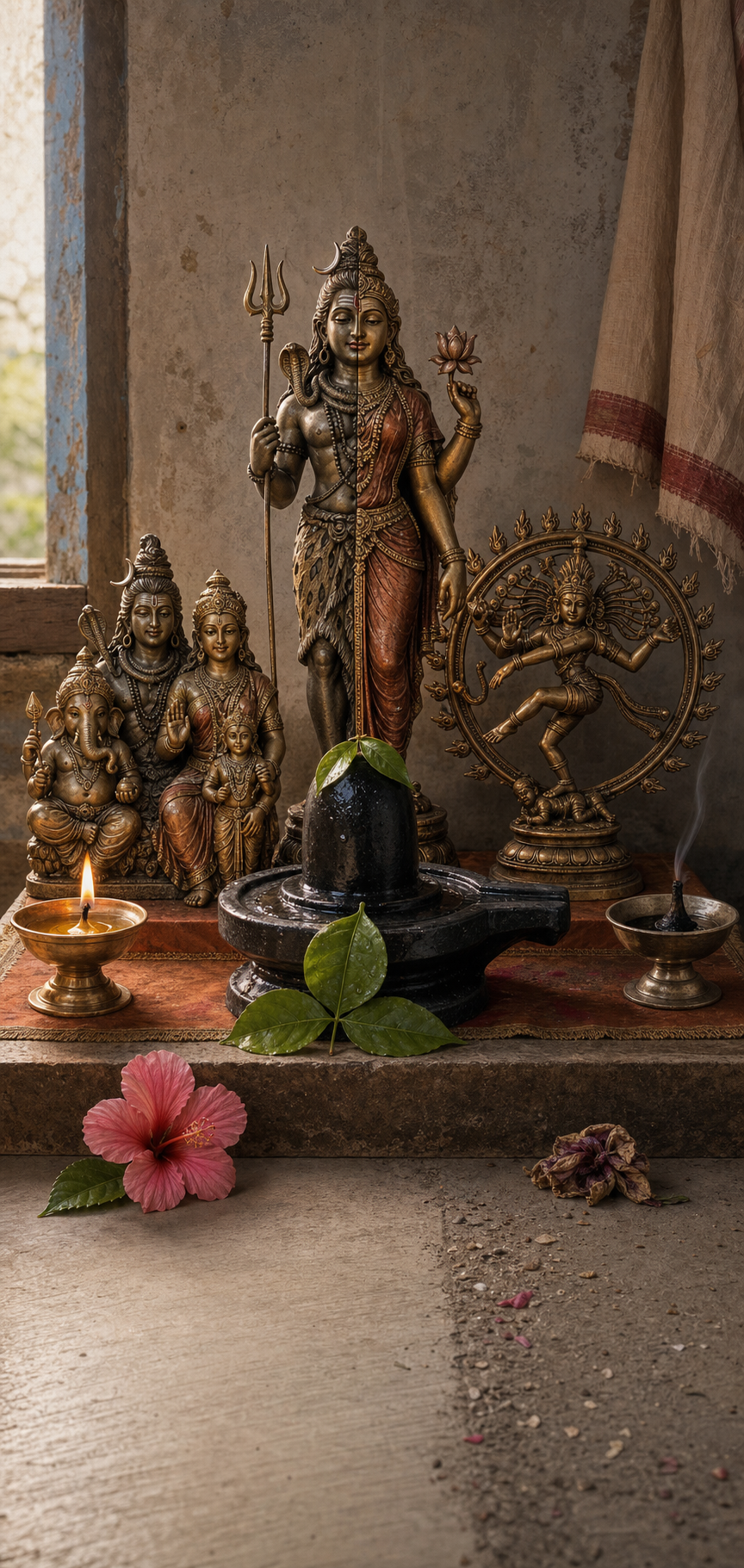
Shaiva imagery is most useful when it becomes a mirror rather than a decoration. Kalyanasundara, Ardhanarishvara, the linga in the yoni-pitha, and Somaskanda illuminate different pressures within household life. Each can be turned into a practical question.
| Image | Principle | Question for your household |
|---|---|---|
| Kalyanasundara | Spiritual freedom enters a publicly accountable vow. | Which promise currently needs a clear owner, time, and repeated action? |
| Ardhanarishvara | Awareness and Shakti are distinguishable but inseparable. | Where does one person set direction while another carries all the execution? |
| Linga in the yoni-pitha | Still consciousness and creative power become fruitful through union. | Where do you have activity without purpose, or intention without energy and resources? |
| Somaskanda | The couple’s serenity is joined to continuity and guardianship through Skanda. | What are you cultivating or protecting beyond the couple’s immediate comfort? |
Ardhanarishvara is especially easy to admire and easy to misuse. It is not a chore chart, a personality test, or proof that every man and woman must embody a fixed list of traits. Its force lies in inseparability. Consciousness without Shakti remains unrealised potential; activity without awareness loses direction. If a household praises the symbol while assigning one person all the care work and the other all authority, its daily structure contradicts its altar.
The same discipline applies to Kalyanasundara. The image celebrates a wedding, but its deeper demand concerns vows. An elaborate ceremony cannot substitute for remembered commitments. Look at the recurring places where trust is either built or depleted: money disclosed honestly, care work completed without reminders, relatives treated with agreed boundaries, and apologies followed by changed conduct.
Somaskanda then widens the frame. Not every household has children, and the icon should not be turned into a judgment on those who do not. Its transferable question is what the union brings forth. That may be a child, but it may also be service, scholarship, cultural transmission, protection of a temple, care for elders, or work that strengthens the community.
A seven-day practice for making the ideal concrete
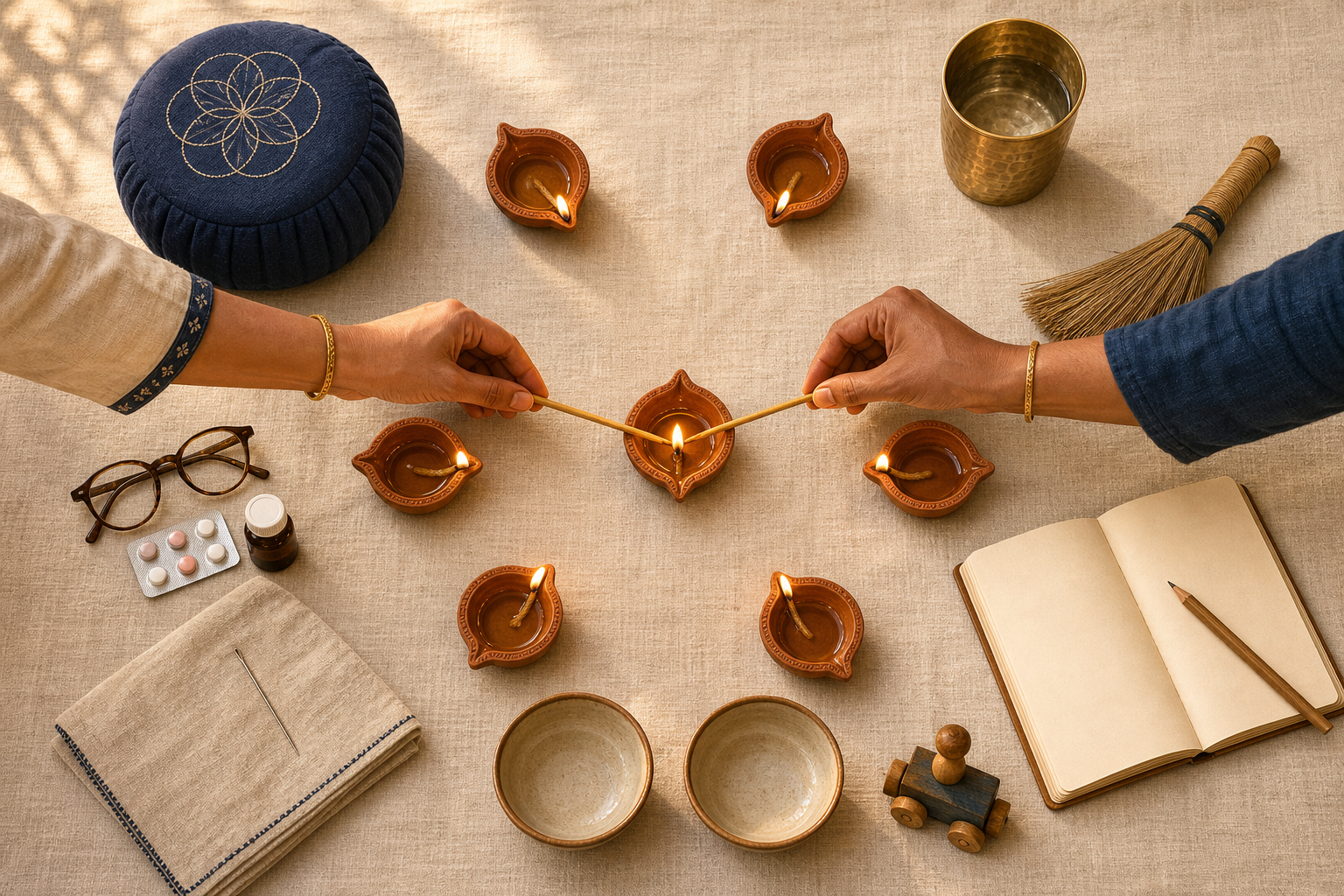
The following routine is a contemporary application, not a claim that any named text prescribes this exact schedule. Use it as a household reset. If you live alone, are widowed, or belong to a multigenerational household, assign the exercises according to actual relationships and duties rather than trying to imitate the form of a married couple.
- Day one – write the sankalpa. Complete one sentence describing what your home exists to support. Keep it usable: May this home sustain truth, learning, care, and service. Remove any word that no one can translate into conduct.
- Day two – protect ten minutes of stillness. Practise Om Namah Shivaya, quiet observation, or another discipline consistent with your tradition. When the period ends, complete one waiting household task without announcing that you have done it.
- Day three – expose invisible labour. List recurring tasks that are usually remembered, planned, or completed by only one person. Give each task an owner and a fallback. Helping occasionally is not the same as owning responsibility.
- Day four – examine one desire. Choose a real request involving money, time, intimacy, status, travel, or family. Ask whether it honours existing vows, who will pay its cost, and whether refusal can be accepted without retaliation.
- Day five – reverse teacher and student. Discuss one unresolved issue. Each person states what they know, what they fear, and what they will carry. No answer is allowed until the other person’s position has been restated fairly.
- Day six – send care beyond the home. Choose one act of dana, hospitality, teaching, or protection. Put a date and a responsible person’s name beside it. Good intention becomes grihastha dharma when it enters a dependable rhythm.
- Day seven – worship and review. If it belongs to your practice, perform simple Panchopachara worship before a linga or an Uma-Maheshvara image. Then name one promise kept, one repair still owed, and one duty arriving in the next week.
Do not turn the seven days into another performance of perfection. Repeat the practices that exposed a real imbalance or established a useful rhythm. Tapas matures through steadiness, not through a burst of intensity followed by neglect.
Key takeaways
- Grihastha is not merely marital status; it is the dharmic use of attention, desire, labour, and resources.
- Contemplative practice belongs in the home when it makes you more patient, available, and reliable.
- Kama need not be denied, but it must answer to vows, consequences, and another person’s agency.
- Shiva-Shakti complementarity requires reciprocal authority and responsibility, not a fixed gender hierarchy.
- A household fulfils its larger purpose when it supports learning, dana, hospitality, continuity, and protection.
Begin with one shared sankalpa and one unglamorous duty you will reliably own. Kailasa does not have to disappear for the home to become sacred. Its stillness has to enter the next promise you keep.
References
