
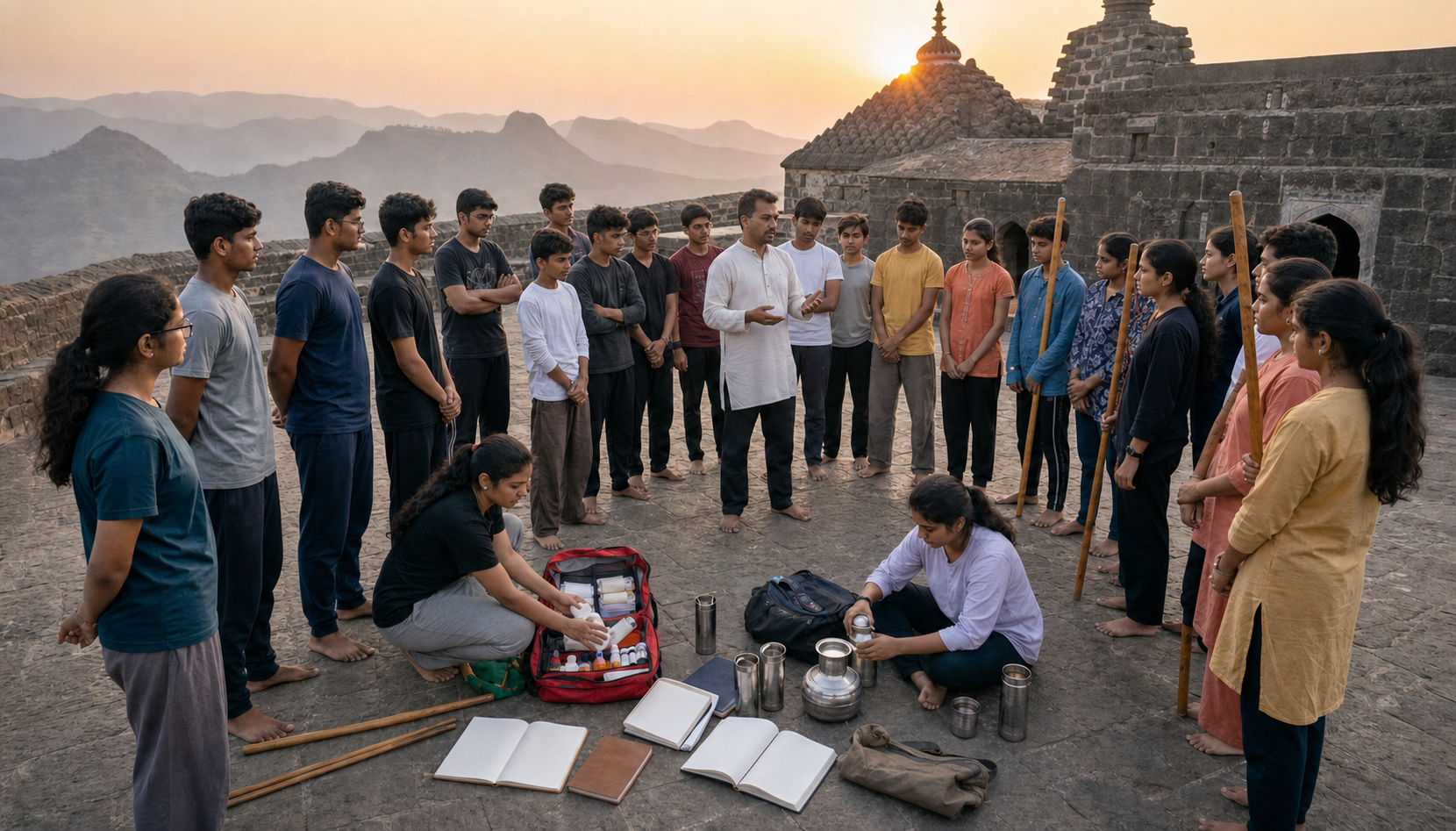
If you are deciding whether to send a young person to a Dharma camp, or you are trying to organize one, ask a harder question than whether the program looks devotional: what will the participant be able to do differently after returning home?
The Sajjangad model gives you a practical answer. It joins Dharma education, self-defence, civic responsibility and the ideal of just governance in one course of formation. A Sajjangad camp near Satara brought together more than seventy young participants, but its most useful lesson is not the cohort size. It is the way inner discipline is connected to visible conduct.
Judge the training by the conduct it produces
A Dharma camp can be full of sincere prayer, stirring speeches and cultural pride yet still leave a young person without a usable method for making decisions. Sanskar becomes leadership only when a value can survive inconvenience, peer pressure, anger and the absence of supervision.
Begin with three outcomes: character, courage and service. Character means governing your own speech, appetites and commitments. Courage means acting steadily when fear or social pressure makes the right choice difficult. Service means using your capacity for someone beyond yourself. Each outcome needs an observable expression.
- Character: Does the participant keep an agreed time, speak truthfully when a lie would be easier, and accept correction without immediate defensiveness?
- Courage: Can the participant set a clear boundary, seek help, resist a reckless group decision and remain composed during a tense scenario?
- Service: Does the participant complete a useful task after the applause and photographs are over?
This standard is at home in Sajjangad. The place is associated with Samarth Ramdas (1608-1681), with Dasbodh and Manache Shlok providing a setting for reflection on discipline, duty and public virtue. Those names should not be used merely to decorate a syllabus. A mentor should help participants extract a decision rule from the teachings: govern the mind before trying to lead others, join devotion to effort, and treat public responsibility as part of spiritual formation.
If you are assessing a program, ask its organizers for written learning outcomes. “Awareness” is too vague. “Participants will be able to explain a safe exit sequence, identify one civic duty, complete a local service commitment and describe how truthfulness applies to digital conduct” is much better. Specific outcomes reveal whether the camp has been designed as education or assembled as an event.
Build leadership through four linked disciplines
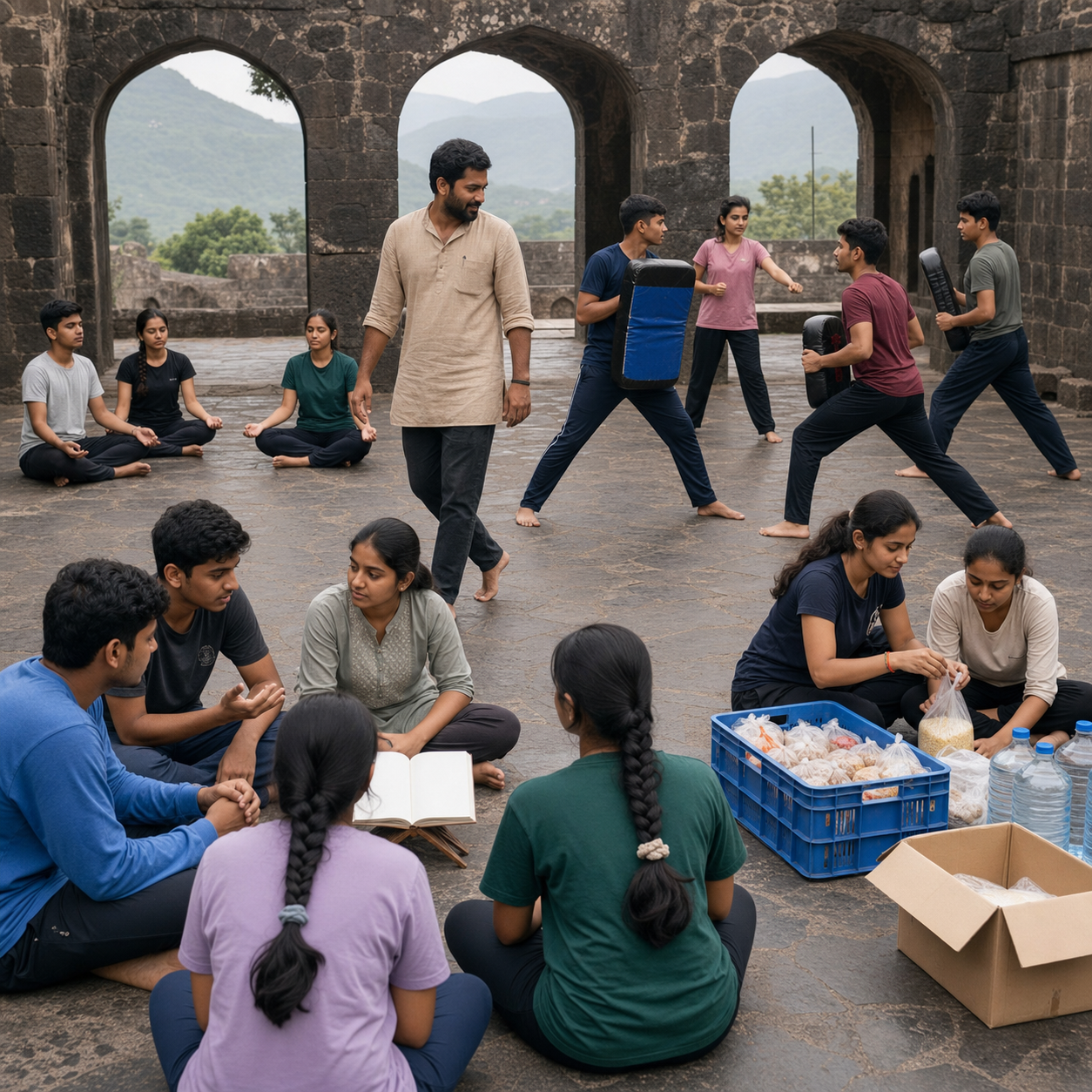
The strength of the Sajjangad approach lies in the relationship among its four strands. Remove Dharma and physical confidence can lose its moral boundary. Remove courage and Dharma can be reduced to private sentiment. Remove service and national feeling can become rhetoric. Remove a standard of just governance and leadership can become loyalty to personalities rather than principles.
1. Dharma education: practise judgment, not recitation alone
Teach satya, daya, ahimsa, aparigraha and seva through choices a young person actually faces. What should you do before forwarding an inflammatory message? How do you respond when friends humiliate someone? Is an achievement still honourable if it depends on deception? What does self-restraint require when anger is justified but an impulsive reply will cause more harm?
A useful session begins with a concrete case, allows disagreement, identifies the competing duties and ends with a reasoned action. This brings shraddha and yukti together: reverence gives the inquiry moral seriousness, while reasoned questioning prevents reverence from becoming passive obedience.
The mentor should also distinguish restraint from weakness. Ahimsa does not require ignoring danger, humiliation or wrongdoing. It requires that your response be governed by protection and proportion rather than vengeance. Similarly, compassion does not mean removing accountability. It affects how correction is given and what restoration is sought.
2. Self-defence: make safe withdrawal the first success
Self-defence belongs in leadership training because fear affects judgment. The ethical goal, however, is not to make participants eager for confrontation. It is to help them notice risk earlier, communicate clearly, coordinate with others and leave danger safely.
The instructional sequence should be explicit: situational awareness first; boundary-setting through voice and posture second; movement toward safety third; coordinated exit and help-seeking fourth; physical technique only as a last resort. Any physical response must remain tied to necessity and proportionality. Participants should never be encouraged to test techniques outside supervised drills.
This sequence also corrects a common misunderstanding of courage. The person who prevents a fight, moves a vulnerable companion out of danger or calls for responsible help has not failed the drill. That person has shown judgment under pressure, which is the leadership capacity the training is meant to build.
3. Nation-building: turn belonging into a local duty
Love for Bharat becomes credible through repeated acts that strengthen trust. Constitutional values and the spirit of Article 51A’s fundamental duties can be connected to environmental stewardship, gender dignity, respect for elders, volunteerism and responsible digital conduct. This keeps nation-building close enough to practise.
Every cohort should therefore leave with a bounded service action. It might maintain a public space, support learners who need tutoring or improve the reliability of a continuing community initiative. The task should have a named responsibility, a clear completion condition and a method for recording participation. “Serve society” inspires; “complete this agreed task and report what changed” forms a habit.
Do not confuse visibility with value. A small task completed reliably teaches more than an ambitious campaign abandoned after its launch. The mentor’s job is to help participants experience the full cycle of leadership: notice a need, define a realistic response, obtain cooperation, do the work, review the result and correct the next attempt.
4. Ram Rajya: evaluate power by justice and duty
Within this training model, Ram Rajya is most useful when taught not as a demand for theocracy or a slogan of group entitlement, but as a standard for dharma-guided governance. Ask whether institutions are fair, law is applied with integrity, the vulnerable can reach necessary support, human dignity is protected and public power accepts limits.
This gives participants a test that can be applied to any leader, including a leader they admire. Does the person keep promises? Is criticism answered with reasons or intimidation? Are benefits distributed fairly? Are mistakes corrected? Is care for nature treated as a real obligation? Ram Rajya loses its moral meaning when it is used to exempt preferred leaders from scrutiny.
The wider dharmic family offers parallel vocabularies for ethical public life: dhamma-raja in Buddhist thought, rajadharma in Jain traditions and the Sikh synthesis of Miri-Piri. The purpose of bringing these into the room is not to claim that Hinduism, Buddhism, Jainism and Sikhism are identical. It is to recognize shared commitments such as truth, compassion, restraint and service while allowing each lineage to speak in its own voice.
Make self-defence training lawful, proportionate and accountable
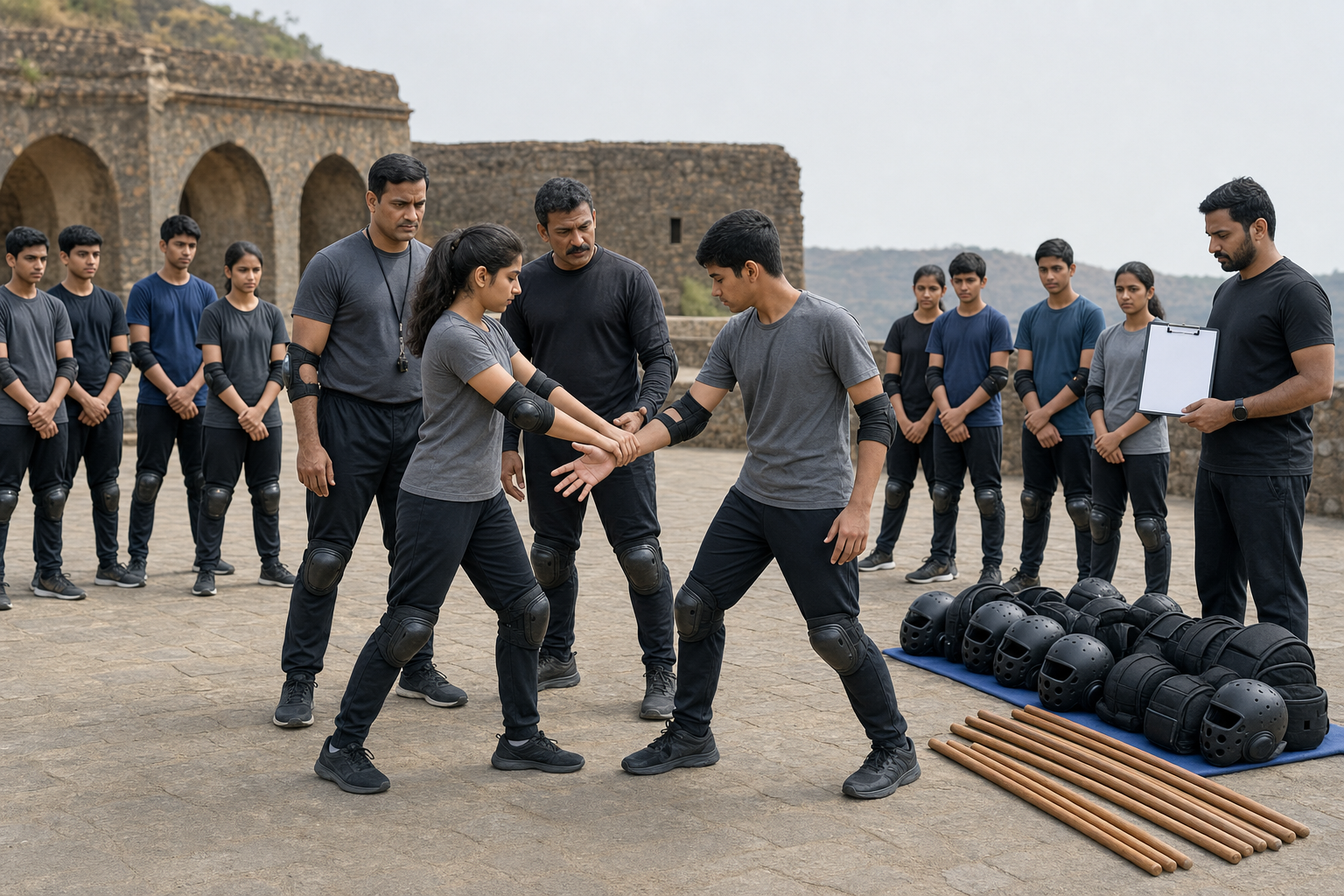
Because this part of the curriculum touches physical safety and legal exposure, good intentions are insufficient. A camp should have trained instructors, age-appropriate drills, active supervision, a written code of conduct and a clear process for reporting discomfort or misconduct. Gender inclusion cannot be treated as an attendance statistic; participants need a setting in which boundary concerns are heard without ridicule.
Legal literacy should explain that the right of private defence has boundaries and that a live incident depends on its facts. General camp instruction is not individual legal advice. Any reused handout carrying an Indian Penal Code citation should be checked for current accuracy by a suitably qualified Indian legal professional rather than assumed to remain current. Outdated legal language can give a participant false confidence precisely when careful judgment matters most.
Before enrollment, a parent or participant should ask:
- Who teaches the physical component, and what relevant training do they have?
- Does the curriculum reward avoidance, de-escalation and safe exit, or does it celebrate confrontation?
- How are drills adapted for age, physical capacity and emotional comfort?
- What contact is permitted during practice, and how can a participant stop a drill immediately?
- Who reviewed the legal material, and when was that review completed?
- How are injuries, bullying, harassment or instructor misconduct reported and handled?
Watch the language used by instructors. Talk of awareness, boundaries, protection, necessity and proportion is consistent with disciplined training. Talk that humiliates cautious participants, invents enemies or treats aggression as proof of commitment is a red flag. Bhakti joined to kshatra should produce controlled strength in the service of protection, not appetite for conflict.
Carry the camp into home, study and community life

The most vulnerable point in any camp is the return home. The setting, schedule and shared enthusiasm temporarily support good behaviour. Once those supports disappear, inspiration must compete with old routines. Follow-through therefore belongs inside the program design, not as an optional reunion discussed after the closing ceremony.
Before participants leave, have each person write four commitments:
- One personal discipline, such as a rule for speech, punctuality or focused study.
- One dependable duty at home that does not require repeated reminders.
- One act of service with a clear recipient or community purpose.
- One digital discipline, such as verifying a claim before forwarding it or refusing to join online humiliation.
Each commitment needs a cue and evidence. “Be more disciplined” cannot be reviewed. “Complete the agreed household duty before leisure” can. “Use social media responsibly” is too broad. “Pause and verify provocative claims before sharing” identifies the moment in which the virtue must operate.
Establish the first post-camp circle before the cohort disperses. In that circle, each participant should report what was attempted, what evidence exists, where the habit failed and what will be adjusted. The tone should be firm but not performative. Honest recognition of failure is more useful than polished declarations of success.
A balanced scorecard can remain simple:
- Use the same self-assessment prompts before and after training so that changes in confidence and attitude can be compared.
- Give a short knowledge check on civic duties, safety sequence and the ethical limits of self-defence.
- Record completed service tasks and volunteer hours rather than intentions alone.
- Ask mentors to observe specific behaviours such as punctuality, respectful speech, teamwork and willingness to accept correction.
- Track one community signal connected to the service project, such as continuity of tutoring or upkeep of the selected public space.
Use these measures for learning, not status. A participant who reports every weakness honestly may be developing more than one who learns to produce desirable answers. No single self-rating proves transformation. Look for convergence among personal reflection, mentor observation, completed service and conduct noticed at home.
The changes worth looking for are deliberately ordinary: greater punctuality, more considerate speech, better peer boundaries, steadier attention to studies and a willingness to help without being chased. These are not lesser outcomes than public speaking or commanding a team. They show that leadership has begun with self-government.
Key takeaways
- A credible Dharma camp defines leadership through observable character, courage and service rather than devotional enthusiasm alone.
- The four strands belong together: Dharma directs power, self-defence develops judgment under pressure, nation-building turns belonging into duty, and Ram Rajya supplies a standard for accountable governance.
- Safe self-defence begins with awareness, boundaries, de-escalation and exit. Physical force is a last resort governed by necessity, proportion and current law.
- Shared dharmic values should encourage cooperation among Hindu, Buddhist, Jain and Sikh participants without erasing distinctions among their traditions.
- The program is incomplete until every participant has a concrete service action, a post-camp accountability circle and evidence that new habits survived the return home.
If you are evaluating a Sajjangad-inspired program, ask for five things before committing: written outcomes, the safety sequence, current legal review, the service plan and the follow-up method. If the organizers cannot explain those plainly, the curriculum is not ready. If you are building the program, start there and let every prayer, discussion and drill answer one question: what responsible action should the participant now be able to take?
References
