

When a relative asks you to defend what you know is wrong, the hardest question is often not whether the act is wrong. It is whether refusing to support it makes you disloyal. If you comply, affection becomes cover for harm. If you refuse, you may be accused of betraying your own.
Vibhishana in the Ramayana and Yuyutsu in the Mahabharata faced that conflict at its most severe. Neither chose estrangement casually. Both tried to preserve what could be preserved, refused to let ancestry redefine right and wrong, and accepted responsibility for the order that had to follow. Their conduct gives you something more useful than a slogan: a sequence for discerning when loyalty remains a duty and when it has become complicity.
Family loyalty is a duty, not a blank cheque
Dharma does not begin by treating family bonds as disposable. Parents, siblings, spouses, children, elders and inherited communities place real claims on us. Gratitude, patience, protection and honest counsel are not optional merely because a relationship has become difficult.
But kinship cannot turn adharma into dharma. A relative’s injustice does not become just because admitting it would embarrass the family. A ruler’s misconduct does not become rajadharma because his ministers are bound to the throne. A warrior’s faction does not become righteous because his brothers stand inside it.
This is where three layers of duty matter. Sadharana dharma concerns ethical obligations that are not erased by faction, including truthfulness, restraint and concern for those who may be harmed. Rajadharma binds political authority to justice, order and the welfare of subjects. Kshatra dharma disciplines the exercise of power; it does not give a warrior permission to make pride, resentment or family ambition sovereign.
The difficult task is to identify a genuine collision of duties rather than dress a personal quarrel in sacred vocabulary. Before invoking dharma against your family, ask five questions:
- Can you name the wrong precisely? Identify the act, decision or demand. Dislike, rivalry and wounded pride are not enough.
- Would it remain wrong if an adversary did it? If your judgement changes with the person’s identity, faction may be speaking louder than conscience.
- Who is bearing the harm? Look beyond the family’s reputation to the person, community or institution paying the actual cost.
- Does loyalty require care, or does it require concealment and participation? Supporting a relative through consequences is different from helping that relative evade accountability.
- What correction would satisfy you? A dharmic objection should point toward restitution, restraint or restored order, not merely humiliation.
If you cannot answer those questions, pause before declaring a moral rupture. If you can answer them consistently, the next question is whether honest counsel can still correct the wrong.
Vibhishana shows why counsel must come before departure
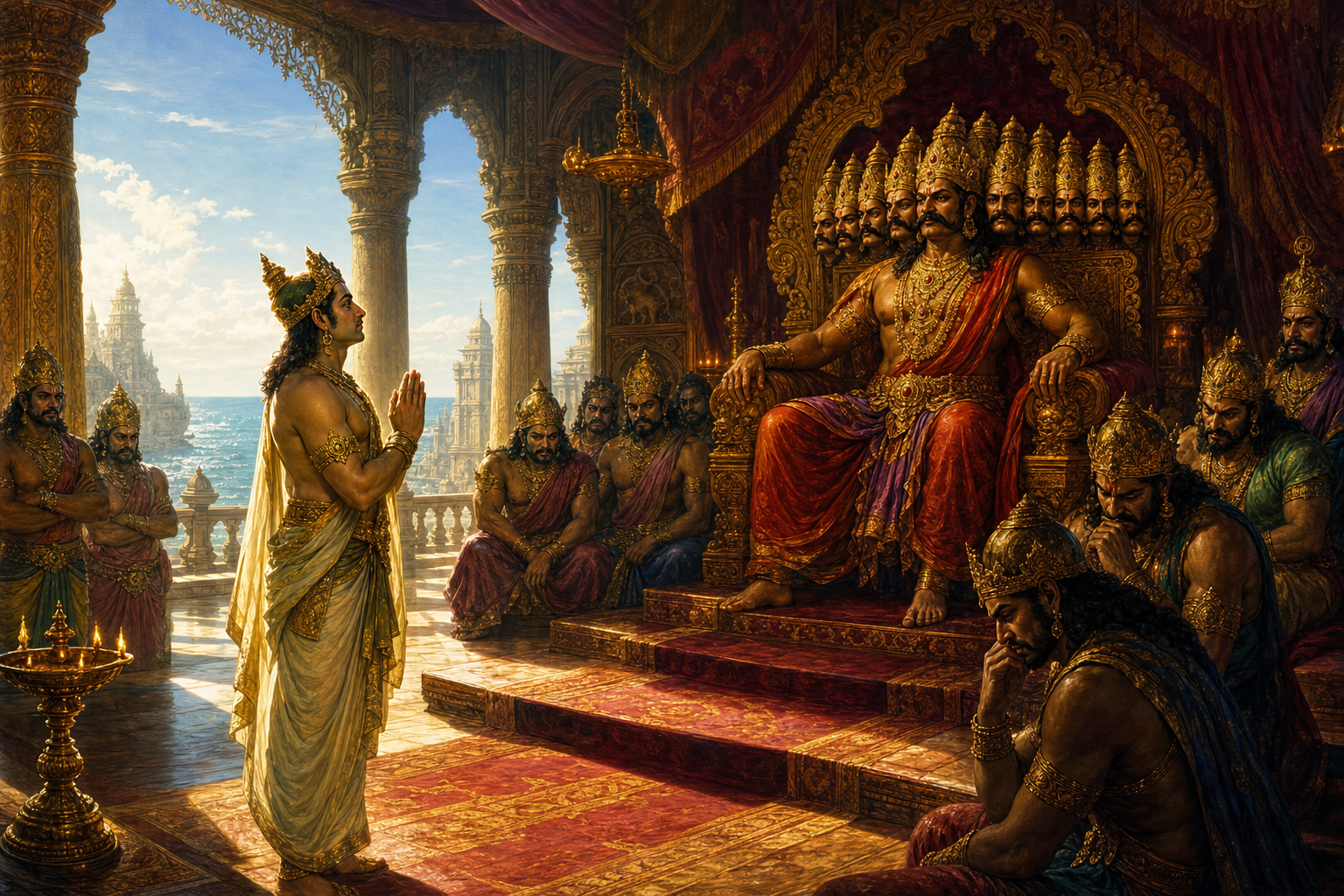
Vibhishana was not a detached critic of Lanka. He was Ravana’s brother, a minister within the kingdom and someone with obligations to both ruler and realm. That position made silence easier to excuse: he could have called obedience prudence, treated Sita’s abduction as a settled royal decision, or waited for someone else to speak.
Instead, he repeatedly urged Ravana to return Sita. His counsel joined ethics to statecraft. Restitution would correct the injustice, avert a destructive war and protect Lanka’s people from the consequences of their ruler’s pride. This was not timid advice. It was rajadharma spoken to a sovereign who had begun to treat personal desire as public policy.
The order of events matters. Vibhishana did not begin by seeking Ravana’s defeat. He first sought Ravana’s correction. He gave his brother a path back that did not require the destruction of Lanka: acknowledge the wrong, return the person who had been abducted and step away from escalation.
That sequence gives you a practical standard when someone close to you is acting wrongly:
- State the conduct without attacking the person’s entire identity. Say what happened and why it violates a duty. Do not turn one accountable act into a claim that the person has no worth.
- Ask for a concrete remedy. Returning what was taken, correcting a falsehood, ending an abusive practice or accepting legitimate scrutiny is clearer than demanding a vague change of heart.
- Explain the wider consequences. Private misconduct can endanger employees, dependants, institutions and bystanders who had no part in the decision.
- Leave room for voluntary correction. Counsel is meaningful only if the person can still choose a better course.
- Set the boundary before pressure peaks. Make clear what you will not endorse, conceal or help carry out.
Only after Ravana rejected repeated counsel did Vibhishana leave. At that point, remaining in the royal camp would no longer have meant merely loving a flawed brother. It would have tied his position, knowledge and service to an injustice Ravana had consciously chosen to continue.
This distinction prevents a common misuse of Vibhishana’s example. His departure is not permission to abandon relatives over ordinary disagreements, differences in temperament or disputes in which your own responsibility remains unexamined. The threshold is not discomfort. It is a serious wrong, a failed opportunity for correction and a demand that your continued allegiance help sustain the wrong.
When Vibhishana sought refuge with Sri Rama, suspicion followed him. Sugriva and others had reason to consider whether an enemy insider might be deceptive. Rama’s response joined prudence to sharanagati: motives could be examined, but a sincere seeker of protection was not to be rejected merely because of his birth or former camp. A dharmic community must be able to receive someone who leaves adharma; otherwise it punishes conscience while claiming to defend righteousness.
Yuyutsu shows why timing reveals the motive
Yuyutsu’s choice occurred inside another collapsing family order. He was a son of Dhritarashtra, born to a Vaishya mother, and belonged by lineage to the Kaurava side. He had watched the Kuru court move through the dice game, the Pandavas’ exile and the repeated rejection of prudent counsel. By the eve of Kurukshetra, neutrality could no longer disguise the choice in front of him.
Yudhishthira then offered warriors an extraordinary opening: anyone who judged the Pandava cause to be just could cross over without fear. Yuyutsu stepped forward before the battle began.
The timing is morally decisive. He did not wait until the Kaurava defeat was obvious and then attach himself to the victor. He changed sides while the danger was real, his relatives were present and the personal cost could not be calculated away. That is what separates a costly act of conscience from convenient repositioning.
When you are weighing a break with your own group, apply the same timing test. Would you state your objection while your side still holds power? Would you refuse the benefit before the misconduct fails? Would you accept the same rule if it cost you status, inheritance, promotion or belonging? A principle discovered only after defeat may still be true, but your motive deserves closer examination.
Yuyutsu also clarifies what it means to put dharma above blood. He did not need to deny his parentage or pretend that family bonds had never existed. He rejected the Kaurava cause at the point where martial loyalty would have made him an active participant in its adharma. The object of his refusal was the wrongful alignment, not the humanity of every relative within it.
His duty continued after the war. Yuyutsu survived and was entrusted with administrative responsibility in Hastinapura under Yudhishthira; later tradition also remembers him as a stabilising presence during Parikshit’s reign. Crossing to the just side was therefore not the completion of his dharma. It prepared him to help preserve a damaged polity after victory.
Leaving adharma does not excuse revenge or opportunism
Vibhishana and Yuyutsu made parallel choices, but not identical ones. Vibhishana left an unjust sovereign and aligned with an external claimant who could end the wrong; he later became responsible for Lanka’s restoration. Yuyutsu remained inside the larger Kuru civilisational order while transferring his martial allegiance to the Pandavas; his later service helped maintain continuity in Hastinapura.
One path involved a change of ruler. The other preserved an existing political centre under rightful rule. You should notice the distinction because dharma does not prescribe the same institutional remedy for every failure. Sometimes an authority has made itself inseparable from continuing injustice. Sometimes the institution can be repaired by withdrawing support from the faction that captured it.
Both men also assisted the side they joined. Vibhishana’s knowledge of Lanka, including his counsel concerning the protective rite associated with Indrajit, became important to Rama’s forces. Yet the moral logic is not that resentment permits a defector to do anything against former kin. His assistance belonged to a campaign directed toward ending the original injustice and restoring order.
That places four restraints on anyone claiming to act from conscience:
- Use truth, not embellishment. Refusing to conceal wrongdoing does not permit invented accusations, gossip or the exposure of unrelated private matters.
- Disclose for correction, protection or legitimate accountability. If the real aim is humiliation, leverage or personal advancement, the act has drifted away from dharma.
- Accept scrutiny from the new side. Rama’s camp did not treat Vibhishana’s arrival as automatically trustworthy. A person who changes allegiance should expect reasonable questions about motive and responsibility.
- Serve after the confrontation. Rebuilding trust, protecting those affected and preserving just institutions matter as much as making the dramatic break.
The leaders on the receiving side have duties too. Rama and Yudhishthira did not demand that conscientious defectors erase their origins. They accepted them into responsible service after the relevant moral choice had been made. A movement that welcomes useful information but permanently degrades the person who supplied it has not achieved reconciliation. It has merely found another instrument.
Use this dharma test when family and conscience collide
A modern family dispute rarely resembles Lanka or Kurukshetra in scale. That makes careful discernment more important, not less. Grand comparisons can inflate your certainty and hide the ordinary remedies still available. Work through the conflict in this order:
- Separate injury to yourself from injury to dharma. Write down the specific conduct, the duty it violates and the people affected. If your account consists mainly of insults to your dignity, first consider whether this is a relationship conflict rather than a demand for moral realignment.
- Check for symmetry. Ask what judgement you would make if your closest ally and your strongest opponent exchanged places. Keep only the standard that survives the exchange.
- Identify your actual role. A sibling, employee, trustee, community officer and public official do not carry identical responsibilities. Determine what your position enables and what silence from that position would communicate.
- Offer a proportionate path of correction. Name the remedy and give the responsible person a genuine opportunity to choose it. Do not demand total submission when restitution, acknowledgement or cessation would repair the wrong.
- Refuse the part that would make you complicit. You may continue to care for a relative while declining to lie, endorse, finance, conceal or participate. State the boundary in terms of your own conduct rather than threatening control over theirs.
- Escalate only as the harm requires. Move from counsel to withdrawal of support, and from withdrawal to accountable intervention, according to the seriousness and persistence of the wrong. Do not treat every failed conversation as proof that total estrangement is dharmic.
- Choose before advantage decides for you. If a public stand is necessary, take it while it can still cost you something. Do not wait merely to see which side wins.
- Plan for the day after. Decide how you will support those harmed, preserve what remains worthy and participate in repair. Moral courage that stops at denunciation leaves the field to someone else.
If coercion, threats or violence are present, do not arrange a solitary confrontation simply to prove courage. Immediate safety comes first; use trustworthy local support and appropriate professional or legal help. Dharma does not require you to offer an aggressor an easier opportunity to cause harm.
A clear boundary can be stated without theatrical condemnation: name the conduct, say why you cannot support it, identify the correction you are asking for, and explain what you will do if it continues. That approach keeps the focus on duty. It also leaves a door open for repentance without making your participation in the wrong the price of reconciliation.
Key takeaways
- Kinship creates genuine duties, but it cannot make an unjust act righteous.
- Vibhishana sought correction and restitution before leaving Ravana, showing that departure should follow serious, rejected counsel rather than ordinary disagreement.
- Yuyutsu crossed before the outcome of the war was known, showing that the timing and cost of a stand help reveal its motive.
- Putting dharma above blood means refusing complicity, not denying every bond or seeking revenge against former kin.
- A conscientious break remains incomplete until it contributes to protection, repair and just order.
If you are facing this choice, do not begin by asking whether you must abandon your family. Begin with the conduct in front of you. Name it accurately, seek its correction, refuse the part that requires your complicity, and remain ready to help rebuild whatever truth can still save.


References
