
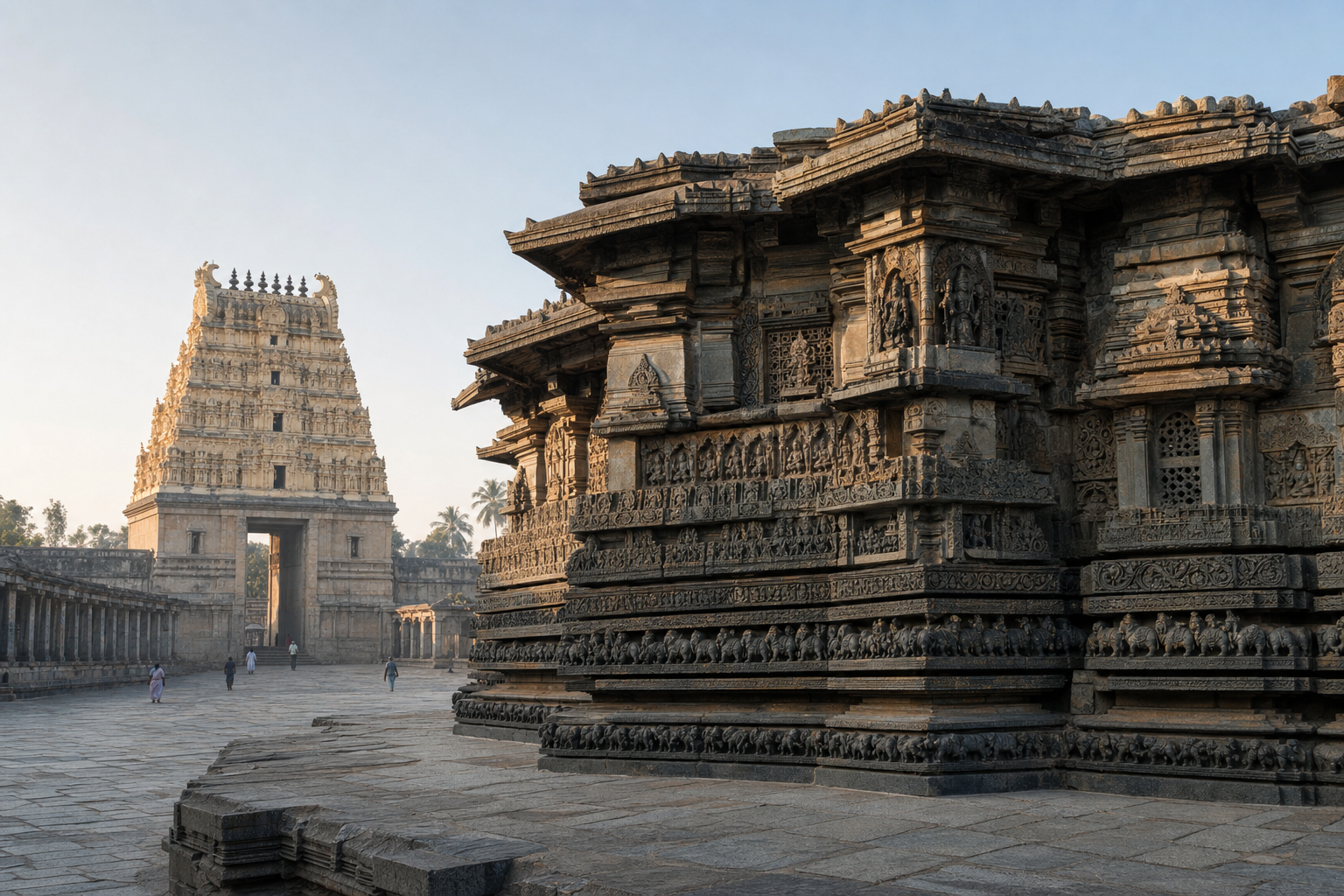
If you arrive at Belur wondering why the monumental entrance looks different from the finely carved Hoysala temple behind it, you have noticed exactly what matters. The contrast is not an architectural mistake. It is the visible record of destruction, recovery, and continued worship.
Read the complex in chronological layers. The Hoysala sacred core came first. In 1397 CE, an attack from Kalaburagi, or Gulbarga, broke and burned the temple gateway. Gunda Dandanatha, serving under Vijayanagara ruler Harihara II, then caused the entrance tower to be rebuilt to seven storeys. Once you know that sequence, the difference between gateway and shrine becomes the key to understanding Belur rather than a distraction from it.
See two architectural languages, not one mismatched temple
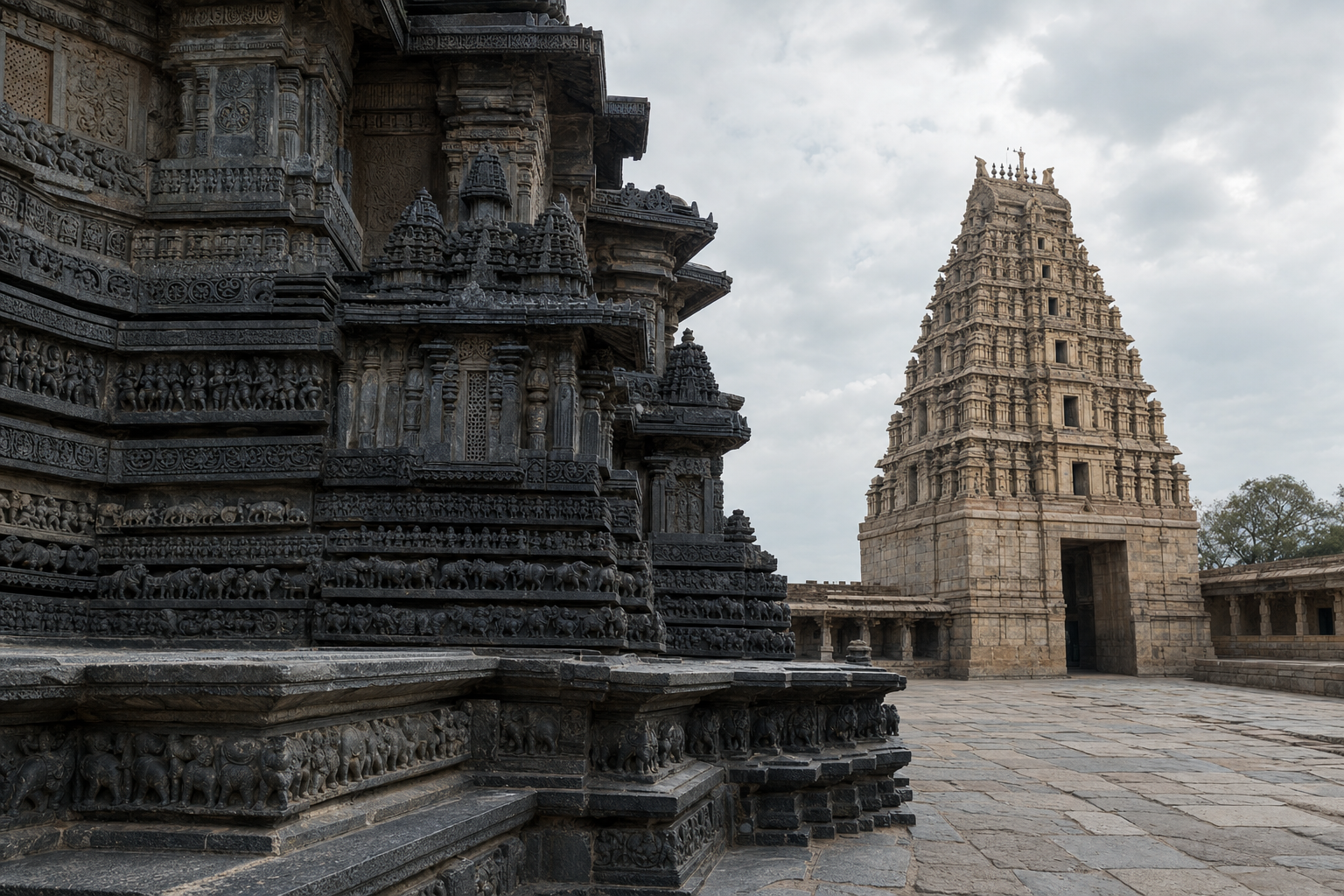
The Chennakeshava complex joins a Hoysala interior world to a Vijayanagara threshold. You should not expect the two phases to use the same material, proportions, or ornamental grammar. Their differences help you identify where one historical moment ends and another begins.
| What to inspect | Hoysala sacred core | Vijayanagara gateway |
|---|---|---|
| Primary material | Chloritic schist, commonly called soapstone | A strong granite base with lighter brick-and-lime construction above |
| Overall form | Stellate planning and intricately articulated shrine and mantapa surfaces | A Dravida tower composed of diminishing superstructure tiers |
| Craft language | Lathe-turned pillars and filigree-like stone carving | Repeated cornices, mouldings, and small shrine-shaped architectural units |
| Ritual role | Organizes worship around the deity and the inner sacred spaces | Marks the passage from the civic approach into the temple enclosure |
This is why calling the entrance merely a later addition misses the point. The Vijayanagara intervention did not need to imitate Hoysala carving to protect Hoysala sacred continuity. It used the engineering and monumental vocabulary of its own age to place a functioning threshold before the older temple.
That distinction also corrects a common misunderstanding of restoration. Medieval restoration was not necessarily an attempt to reproduce a damaged structure exactly as it had looked. At Belur, it meant restoring access, ritual order, public presence, and the dignity of the temple through a recognizably Vijayanagara rayagopura. The stylistic break is therefore evidence of survival.
The 1397 rebuilding was a civilizational decision
The historical sequence should be stated without euphemism and without turning the violence into the whole story. A raid from Kalaburagi damaged and burned the gateway in 1397. In the immediate aftermath, Gunda Dandanatha rebuilt it under Harihara II’s authority. The response was not a token repair. A seven-storeyed entrance restored the temple’s commanding place in Belur’s sacred and civic landscape.
Period praise treated the completed tower as an ornament of the city. Its height was compared with Sumeru, Himavan, Malaya, and Mandara, the great mountains associated with Vishnu’s sacred world. Such imagery tells you how the rebuilding was understood: not simply as replacement masonry, but as the re-establishment of an ordered cosmos at the city’s threshold.
Gunda’s title, dandanayaka, combined the responsibilities of commander and administrator. That matters. His achievement was not confined to defeating an enemy or approving a building. Restoration required authority, resources, technical coordination, and the renewed confidence to invest in a public sacred institution after conflict. When a site label reduces this episode to a generic Vijayanagara addition, it removes the named human agency that makes the history intelligible.
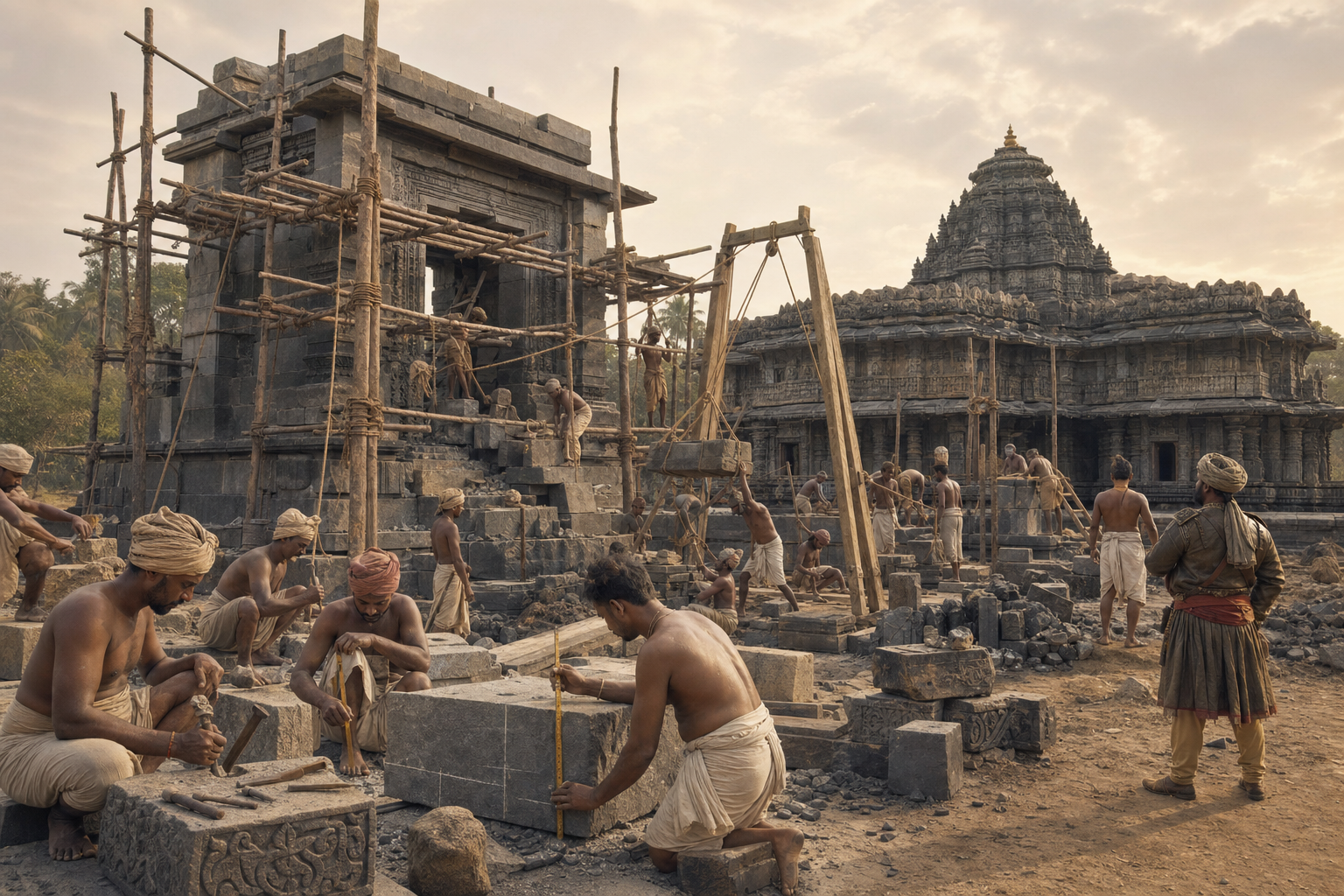
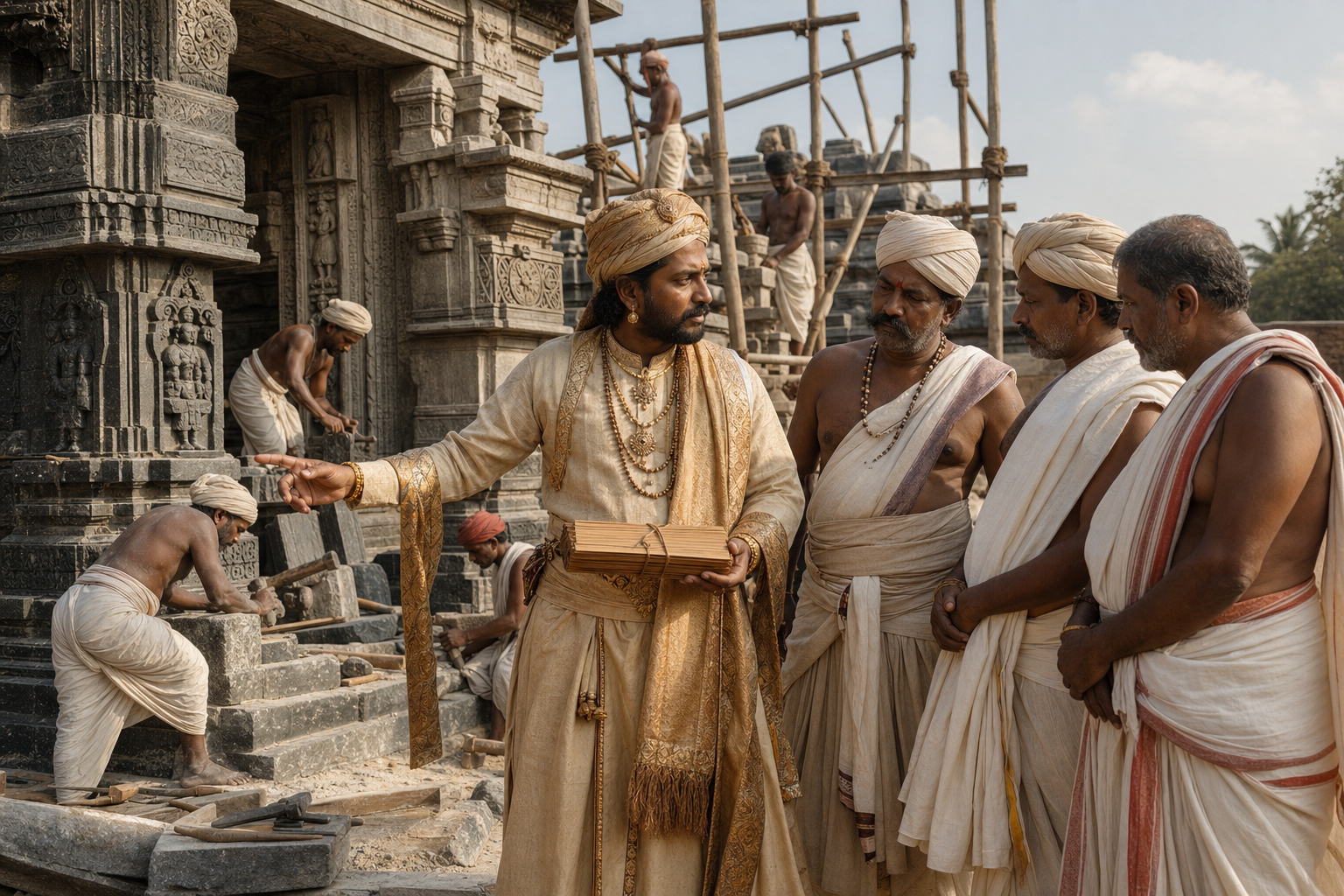
At the same time, naming Gunda should not make the many other participants disappear. A tower of this scale would ordinarily have required royal authorization, local cooperation, sthapatis, artisan guilds, suppliers, and ritual specialists responsible for reconsecration. Granite had to be quarried and moved. Brick, timber, and lime had to be prepared. Labour had to be organized, and worship had to be brought back into proper order. This is the likely institutional network demanded by the project, not a recovered roster naming every worker.
You can therefore hold two truths together. Gunda Dandanatha deserves precise historical credit, and the gopura was also a collective accomplishment. Heritage interpretation becomes stronger when it names the patron without treating artisans and local stakeholders as anonymous scenery.
Read the seven-storeyed gopura from the ground upward
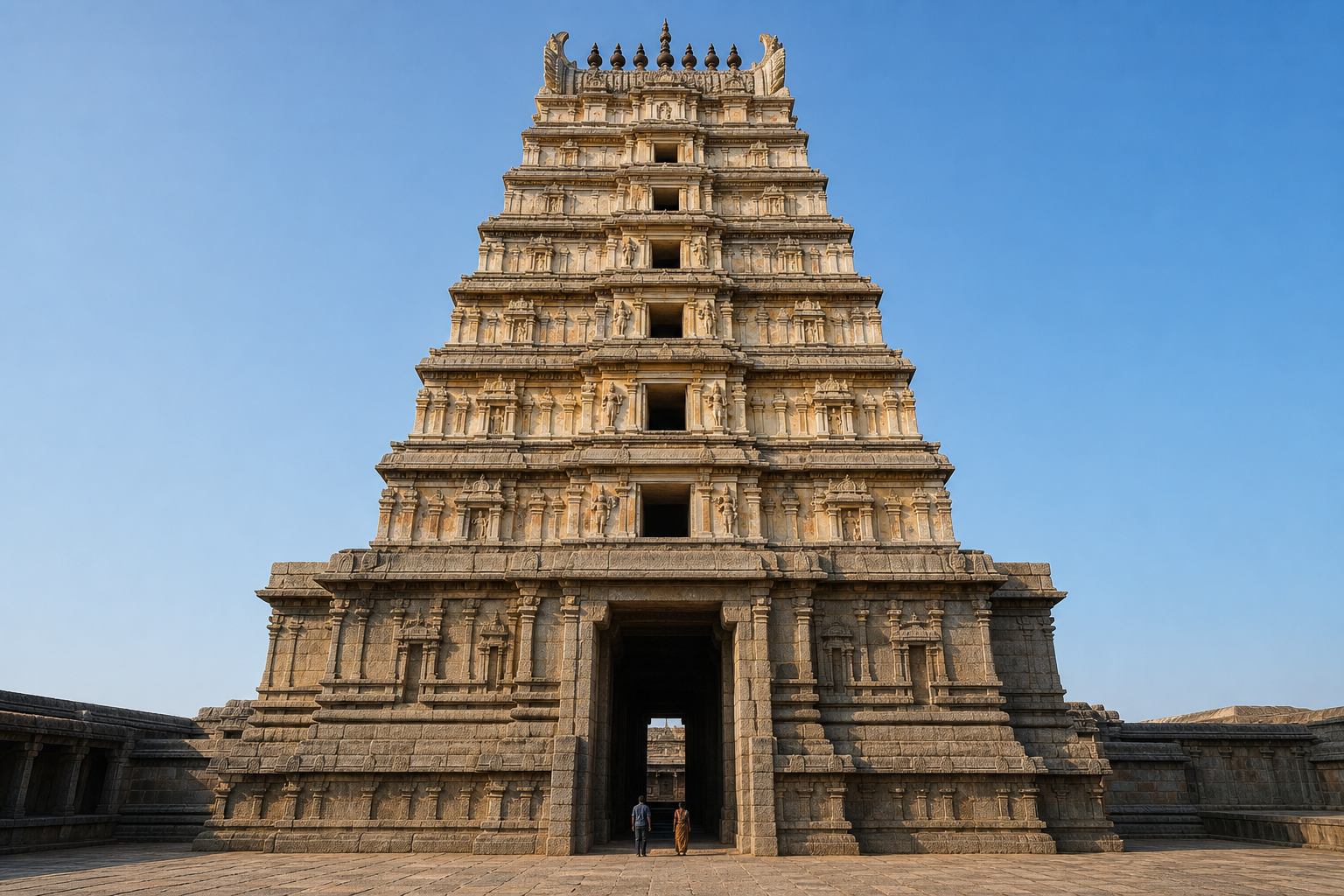
A sapta-tala, or seven-level, gateway tower has to solve a structural problem before it can express a theological idea. If you want to understand the design, begin at the bottom and let the changing weight of the materials guide your eye.
- Start with the granite base. The foundation and lower levels carry the greatest vertical load. Their mass gives the tall structure the stable platform it needs.
- Notice how the upper construction becomes lighter. Brick and lime mortar reduce the weight imposed on the base, while the tiers diminish as they rise. The mountain-like outline is therefore both visual composition and load management.
- Follow the horizontal rhythm. Kapota cornices and hara mouldings divide the ascent into readable stages. Repeated kuta, sala, and panjara forms make each level feel like a miniature architectural world rather than a plain wall stacked on another.
- Return your gaze to the central opening. The mahadvara belongs on the sanctum axis. The relationship among the entrance, bali-pitha, dhvaja-stambha, forecourt, and Kesava shrine maintains ritual direction and processional flow.
This last point is easy to miss if you look only upward. The gopura is not merely a giant sculpture seen from the street. It is an instrument of movement. It receives the approaching devotee, frames the change from public street to temple enclosure, and directs attention toward the deity. Height announces the sacred precinct from a distance; alignment makes the threshold work once you enter it.
The mountain comparisons now become more precise. The tower does not evoke sacred geography only because it is tall. Its diminishing tiers turn an engineered vertical load into a legible ascent. The devotee moves horizontally through the gateway while the architecture draws the mind upward. Structure, symbolism, and ritual action reinforce one another.
Pūrvada maryāde explains what Vijayanagara restored
Vijayanagara governance often appealed to Pūrvada maryāde: inherited customs, laws, rights, and proper modes of conduct. The principle helps explain why rebuilding a temple entrance was more than architectural patronage. A damaged gateway disrupted an established relationship among deity, worshippers, festivals, endowments, processions, and the town surrounding the temple.
Restoration therefore meant putting customary life back into motion. It reaffirmed who maintained worship, how people entered and moved through the precinct, and why the temple remained a legitimate centre of public life. Vijayanagara power presented itself here as the protector of an inherited sacred order rather than as the author of an entirely new one.
This does not require you to romanticize every action of a medieval state. It asks for a more exact reading of this particular act. The new gateway protected an older Hoysala institution without erasing its architectural identity. Continuity was achieved through a new layer, not through pretending that rupture had never occurred.
The distinction matters for present-day preservation. Saving isolated carvings while weakening worship, customary access, artisan knowledge, or the temple’s relationship with its community would preserve only part of the inheritance. Belur’s rebuilding offers a harder standard: protect the physical work, but also protect the practices and responsibilities that allow the sacred institution to remain alive.
It also gives us a disciplined way to speak about the raid. Erasing the destruction would falsify the need for restoration. Using one medieval episode as a blanket accusation against living communities would exceed the evidence. The honest scale is the event itself: identify what happened, name those who repaired it, examine how they repaired it, and preserve the result.
How to read and explain Belur without flattening it
A five-minute on-site sequence
Belur remains a place of worship as well as part of a UNESCO World Heritage ensemble. Follow temple instructions, keep ritual movement unobstructed, and use this sequence to make your visit more attentive.
- Pause before entering. Compare the gateway’s vertical, tiered silhouette with the lower, intricately carved Hoysala forms visible beyond it.
- Identify the material change. Look for the transition from the massive gateway base and lighter superstructure to the soapstone surfaces of the older shrine and mantapas.
- Stand on the principal axis where access permits. Trace the line from the mahadvara through the forecourt toward the sanctum. This reveals why the gateway is part of ritual planning, not an ornamental screen.
- Look up one tier at a time. Find the repeated cornices and miniature architectural forms. Reading the tower level by level is more informative than treating it as a single tapering mass.
- Name the historical agents. Remember the 1397 destruction, Harihara II’s reign, and Gunda Dandanatha’s commission. A date, a ruler, and an administrator turn an undefined later addition into a comprehensible act of restoration.
- Look back after crossing the threshold. The reverse view helps you understand the gateway as a mediator between town and sacred enclosure, not only as a facade presented to the outside world.
If you write a label, teach a group, or advocate for the site
Ask for interpretation that lets visitors verify the history instead of receiving a vague dynasty label. The most useful installation would include a bilingual presentation of the 1397 text, a transliteration, an accessible translation, and a diagram distinguishing the Hoysala core from the Vijayanagara intervention. A QR-linked epigraphic dossier could provide fuller context without crowding the temple precinct. Artisan traditions and the practical work of reconstruction should appear beside the names of royal and administrative patrons.
A good explanation should also distinguish fact from inference. The date, destruction, seven-storeyed rebuilding, Gunda Dandanatha, and Harihara II belong to the documented historical core. The full workforce and supply system can be reconstructed only in general terms from what a project of this scale required. Marking that boundary makes the restoration more credible, not less compelling.
Key takeaways
- The difference between Belur’s Hoysala core and Vijayanagara gateway is a visible historical sequence, not a failure of architectural unity.
- After the gateway was broken and burned in 1397, Gunda Dandanatha rebuilt it to seven storeys under Harihara II.
- Restoration meant renewing worship, movement, civic presence, and inherited custom; it did not require copying the earlier Hoysala style.
- The gopura works simultaneously as a load-bearing structure, a sacred mountain image, a processional threshold, and an urban marker.
- Responsible remembrance neither conceals the raid nor allows the raid to eclipse the administrators, artisans, worshippers, and institutions that restored Belur.
Before you leave Belur, give the gateway one final, deliberate look. Do not ask only which dynasty built each part. Ask what had to be restored for worship and civic life to continue. Then carry that question to the next temple you visit, and insist that its dates, patrons, artisans, ruptures, and recoveries are named with the same care.
References
