
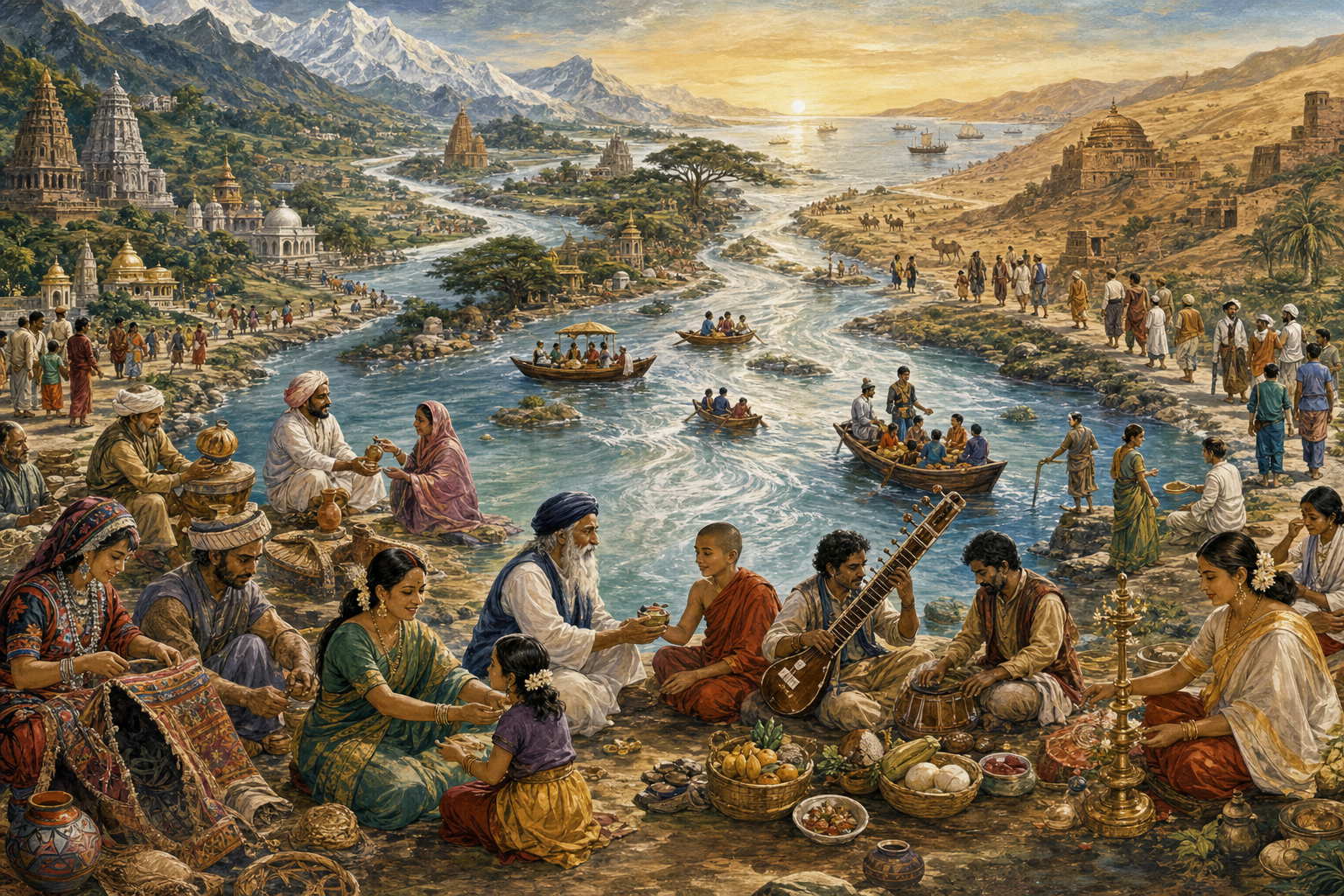
If someone tells you that Bharat became a nation only when the British assembled its territories, you do not need to answer by pretending that the subcontinent always had one ruler, one language or one set of customs. Those claims are unnecessary, and they weaken the case.
The stronger answer begins with a distinction: political administration is one kind of unity; civilisational belonging is another. Bharat’s political arrangements changed repeatedly, but its peoples could still recognise a shared land, travel through a common sacred geography and inherit related forms of social and spiritual life. Once you see those layers separately, diversity stops looking like evidence against unity.
First, separate unity from uniformity
Arguments about Bharat often become confused because three different ideas are treated as if they were interchangeable:
- Political unity means government under one sovereign authority.
- Civilisational unity means that people across different political regions recognise a shared geography, inherited memory, sacred landscape and field of cultural exchange.
- Uniformity means sameness of language, theology, ritual or local custom.
Bharat did not need permanent political unity or cultural uniformity in order to possess civilisational unity. A land can contain many kingdoms and still be understood as a greater whole. It can speak many languages without becoming a collection of unrelated worlds.
The colonial denial of this possibility was unusually explicit. In 1888, John Strachey maintained that India had never possessed physical, political, social or religious unity. The problem lies in the test itself: political division is treated as proof of civilisational nonexistence. Applied consistently, that test would make any change of dynasty, border or capital evidence that a people had ceased to exist.
When you hear the claim that India was never united, therefore, ask a precise question: united in what sense? If the speaker means that every region was continuously ruled from one capital, the claim addresses political history. It does not settle whether people recognised Bharat as a shared civilisational space. Refusing to confuse those questions is the first step toward an honest discussion.
Bharat was remembered as a geographic and cultural whole
A clear expression of this larger geography appears in Vishnu Purana 2.3.1:
Uttaram yat samudrasya himadreschaiva dakshinam, varsham tad Bharatam nama Bharati yatra santatih.
Vishnu Purana 2.3.1
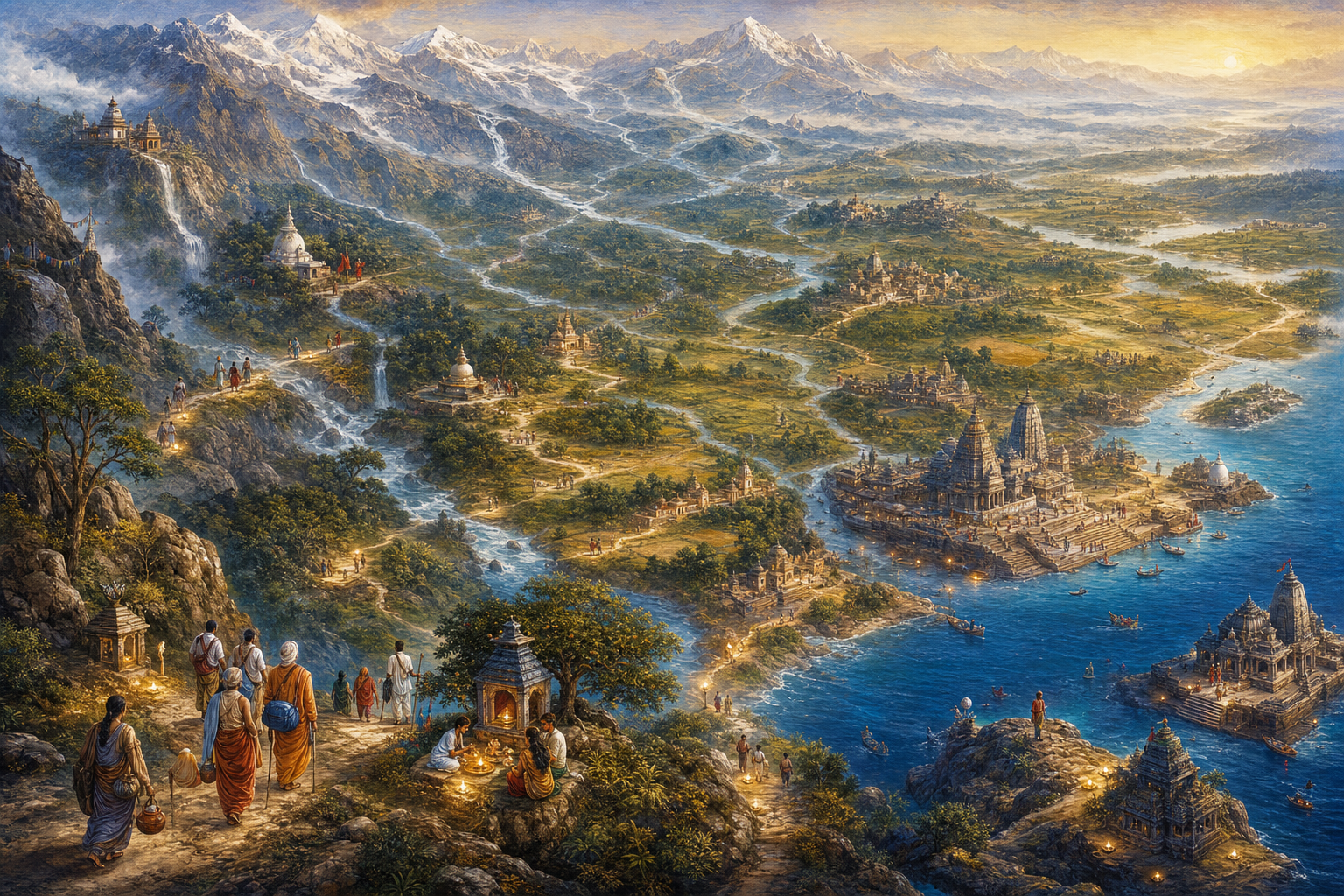
The verse identifies Bharat as the region north of the sea and south of the Himalaya, inhabited by Bharati santati. Its importance is not that it supplies a modern border survey. It does not. Its importance is that it names a subcontinental whole and connects that geography with a people.
This is evidence of a civilisational conception, not proof of an uninterrupted central state. That distinction protects the argument from exaggeration. A sacred or cultural map should not be mistaken for a modern constitution, but neither should it be dismissed because it was expressed in a different political vocabulary.
The term Bharatavarsha also reaches beyond the territory of a single kingdom. Varsha denotes a broad region within the geographic imagination of the text. Bharati santati adds a human dimension: the land is not merely terrain between two natural boundaries; it is a place of inherited belonging.
Traditions do not all identify the name’s ancestral Bharata in exactly the same way. One association is with Bharata, son of Rishabhadeva; another is with Bharata, son of Dushyanta and Shakuntala. You need not force those traditions into one genealogy. The more durable point is that the name Bharat, the idea of Bharatavarsha and the sense of a wider peoplehood were intelligible across political divisions.
Pilgrimage turned geography into lived relationship
A name on a page cannot sustain unity by itself. People must repeatedly experience the larger geography. In Bharat, pilgrimage made that possible long before convenient transport. Travellers crossed regional boundaries to reach sacred mountains, rivers, temples and gathering places, accepting considerable physical hardship along the way.
These journeys created a network rather than a single religious centre. Places where travellers paused became part of an expanding sacred landscape. Events such as the Kumbh Mela brought distant communities into a shared ritual geography. A pilgrim did not need every region to speak the same language in order to understand that the journey crossed one sacred land.
Movement for learning and spiritual teaching reinforced the same pattern. Students travelled beyond their home regions, while teachers and renunciants carried ideas across kingdoms. Adi Shankara’s establishment of monastic centres in different parts of Bharat is meaningful in this context: the journey itself assumes that distant regions belong within one field of spiritual responsibility.
Family life supplied another layer. Practices such as naming a child or marking a death can have different regional names and procedures while retaining a recognisable underlying purpose. The pattern is neither total sameness nor total isolation. It is a shared ritual architecture expressed through local forms.
You can notice this structure in your own family without turning family custom into a universal rule. Record the regional name used for a naming, marriage or ancestral rite. Then distinguish its local features from the purpose it shares with practices elsewhere. This simple exercise reveals how continuity actually works: a form travels because communities adapt it, not because every community performs it identically.
Diversity does not need to be flattened to defend unity
Ancient Bharat contained janapadas and mahajanapadas, as well as powerful regional polities associated with names such as Magadha, Kosala, Kuru, Chola and Pandya. Their political plurality is real. It should not be concealed, because the argument for civilisational unity does not depend on concealing it.
The ideal of the chakravartin is revealing precisely because multiple kingdoms existed. It imagined a ruler whose authority could extend across the wider land from the Himalaya toward the southern sea. Imperial ambitions associated with Ashoka and Samudragupta were political projects, not proof that one government existed forever. Yet the aspiration to bring Bharatavarsha under wider authority presupposed that this greater geographic horizon was already meaningful.
The same care is needed when discussing religion. Hindu traditions contain immense internal variety, and Buddhism, Jainism and Sikhism possess distinct teachings, institutions and identities. Civilisational kinship does not require you to erase those distinctions or declare every path theologically identical. Shared land, sustained encounter, related ethical concerns and centuries of dialogue can create belonging without abolishing difference.
A credible account of Bharat should therefore reject four shortcuts:
- Do not claim that every region has the same customs.
- Do not claim that Bharat has always been governed by one state.
- Do not reduce distinct Dharmic traditions to interchangeable labels.
- Do not treat a strong Tamil, Bengali, Punjabi, Marathi or other regional identity as the opposite of Bharatiya identity.
Layered belonging is not a defect that needs repair. A person can be loyal to a region, language, sampradaya and civilisation at the same time. The larger unity becomes credible when it protects these inheritances and helps them remain in relationship with one another.
Key takeaways: test the claim before answering it
- Ask what kind of unity is being discussed. Evidence of changing kingdoms answers a political question; it does not by itself disprove civilisational consciousness.
- Use one exact example. Vishnu Purana 2.3.1 provides a named geography of Bharat between the Himalaya and the sea. Pilgrimage provides evidence that people experienced that geography through movement.
- Preserve the qualification. A remembered Bharatavarsha is not the same thing as an uninterrupted modern state. Say what the evidence establishes and no more.
- Do not defend unity with sameness. Regional languages, customs and distinct Dharmic paths are part of Bharat’s historical form, not embarrassing exceptions to it.
- Look for networks, not only empires. Pilgrimage routes, centres of learning, monastic institutions and recurring rites can connect a civilisation even when political authority is divided.
The next time you encounter the claim that the British created India out of unrelated fragments, make one precise correction instead of offering ten slogans: Bharat was not continuously one state, but it was understood and lived as a wider civilisational geography. Then support that distinction with one named passage, pilgrimage network or shared cultural form.
You can strengthen that unity in the same spirit. Learn the local name of a family rite, the history of a pilgrimage beyond your region or the teaching lineage that connected distant parts of Bharat. Keep the difference intact, and then trace the relationship. Bharat’s unity is most persuasive when you can see both at once.
References
