
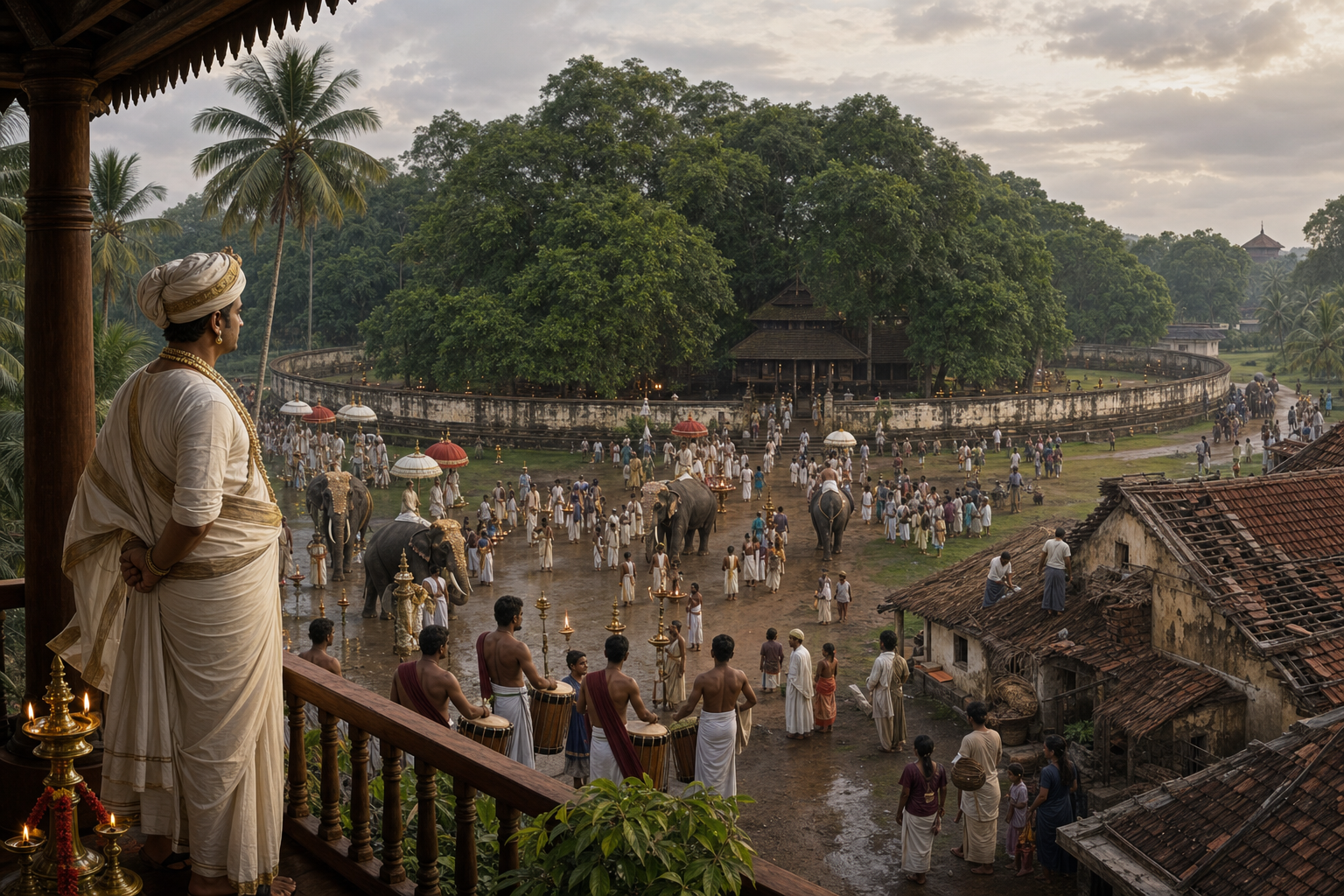
If you came asking whether Thrissur Pooram was created to celebrate Tipu Sultan’s defeat, the short answer is no. The festival was first convened in 1799, but its immediate trigger was a ritual exclusion in 1798. Its deeper setting was three decades of invasion, occupation, displacement, and political pressure.
That distinction matters. Thrissur Pooram is better understood not as a victory carnival after one battle, but as Shaktan Thampuran’s answer to a harder question: once a kingdom has survived, how does it restore confidence, sacred continuity, and cooperation among its people?
Pooram did not begin as a battlefield commemoration
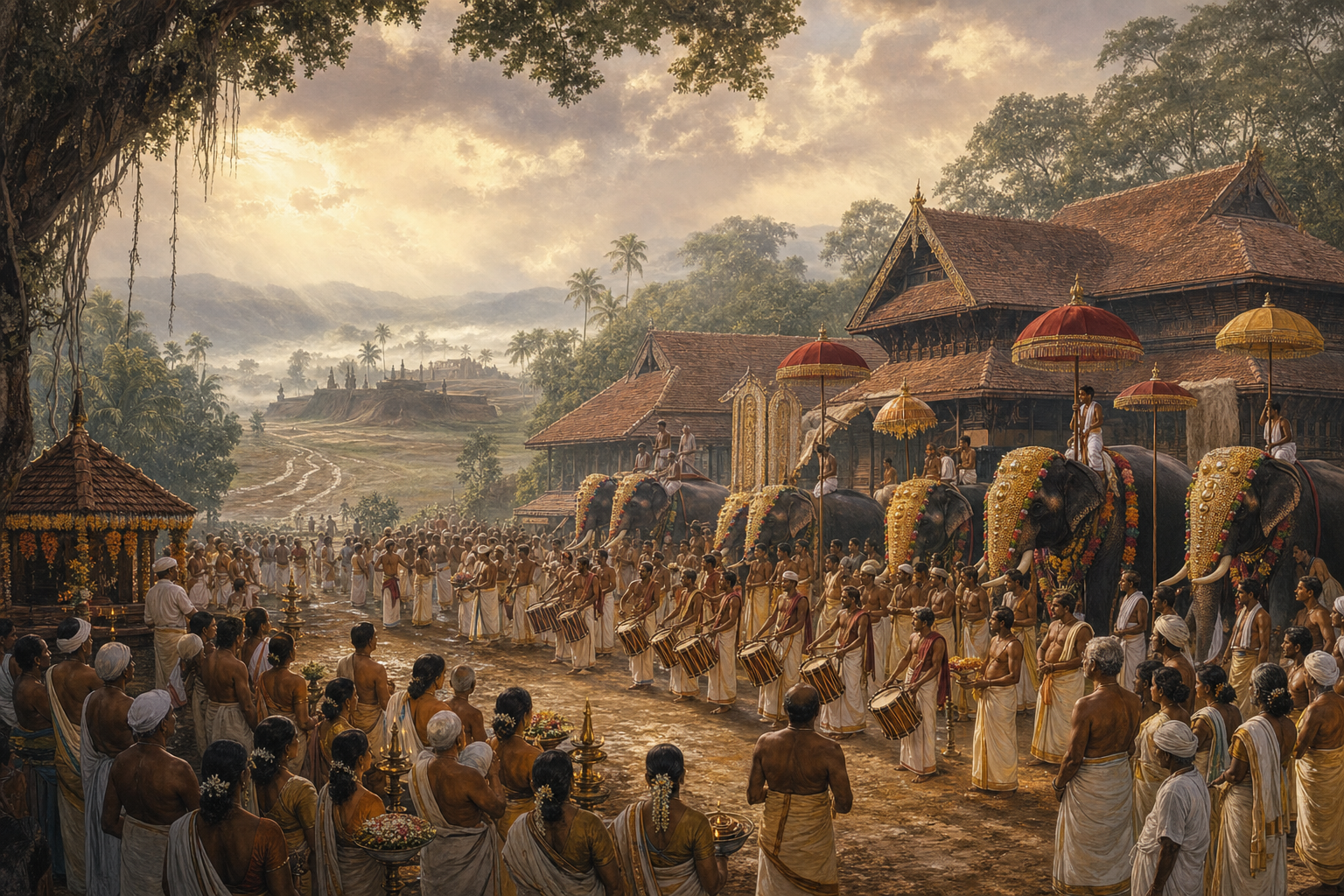
The historical sequence is easy to blur because several decisive events occurred within one generation. Hyder Ali entered Malabar in 1766. Mysorean troops reached Thrissur and camped near the Vadakkunnathan Temple in 1776. Tipu Sultan’s Malabar campaigns intensified from 1787, and his forces occupied Thrissur in 1789. The Arattupuzha Pooram affront occurred in 1798. Shaktan Thampuran convened the first Thrissur Pooram in 1799, the same year Tipu died at Srirangapatna.
Sharing a year does not establish the festival as a celebration of Tipu’s death. The specific catalyst came in 1798, when processional deities from the Thrissur area were delayed by rain on their way to the prestigious Arattupuzha Pooram. They arrived late, were denied entry, and had to return. The rejection distressed the participating temples and devotees.
Shaktan’s response was institutional rather than retaliatory. He created a new gathering at Thrissur and drew temple communities into a coordinated sacred occasion around Vadakkunnathan. The military history explains why this act carried unusual weight, but the festival’s immediate origin lies in exclusion from Arattupuzha.
When you encounter a simplified origin story, ask two questions: which event is being described, and in what year did it occur? Those two checks prevent three different histories from being collapsed into one: Mysorean expansion, Cochin’s survival, and the founding of Pooram.
Shaktan’s achievement was preserving room to act
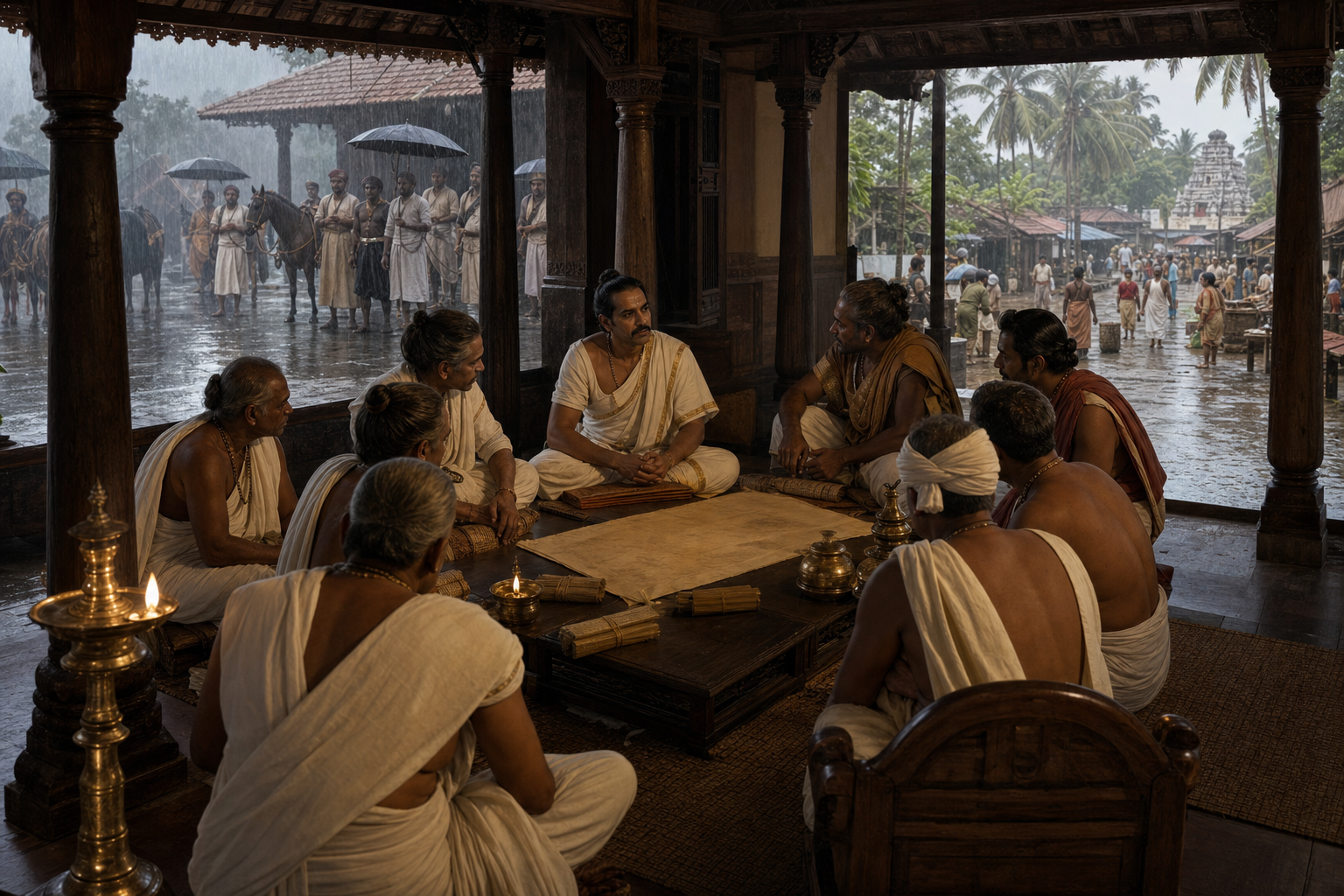
Shaktan Thampuran, Rama Varma IX (1751-1805), received effective administrative and sovereign authority at eighteen. He did not inherit the military position of a great imperial power. Cochin was a small coastal kingdom constrained by Travancore to the south, unstable political conditions in Malabar to the north, and Dutch and English commercial interests along the coast. It lacked a formidable standing army and could not depend on a durable alliance to solve every crisis.
This is why judging Shaktan only by battlefield victories misses his central skill. He repeatedly tried to preserve Cochin’s freedom of decision under conditions in which open defiance could destroy the kingdom and passive compliance could reduce it to an instrument of someone else’s war.
His encounter with Hyder Ali illustrates the method. Shaktan used courtesy, negotiation, and a clear reading of the balance of power to secure a precarious peace. He also obtained the return of disputed territories to Cochin. This was neither heroic theatre nor unconditional submission. It was bargaining from weakness while refusing to surrender every political objective.
The limits of that peace became visible in 1776. Hyder wanted leverage against Travancore’s Nedumkotta defensive works and sent 10,000 men under Sirdar Khan. When Cochin delayed the war contributions demanded by Mysore, the force advanced to Thrissur. Shaktan could not simply order it away; his task was to keep pressure from becoming the extinction of Cochin’s political agency.
He used the same discipline when Tipu summoned the Raja of Cochin to Palakkad before the southern offensive. Shaktan had previously avoided such a personal meeting, but refusing the summons had become more dangerous than attending. Tipu pressed Cochin to join the war against Travancore. Shaktan deferred a military commitment and instead offered to explore whether Travancore might acknowledge Mysorean suzerainty. The answer gave Tipu a ceremonially respectful path forward without binding Cochin to the requested war.
If you want a practical measure of Shaktan’s statecraft, look for preserved options. After each encounter, could Cochin still negotiate, administer its territory, protect institutions, or change alignment when conditions shifted? By that measure, his flexibility was not indecision. It was the means by which a vulnerable kingdom outlasted stronger powers.
The invasions changed Thrissur’s sacred geography
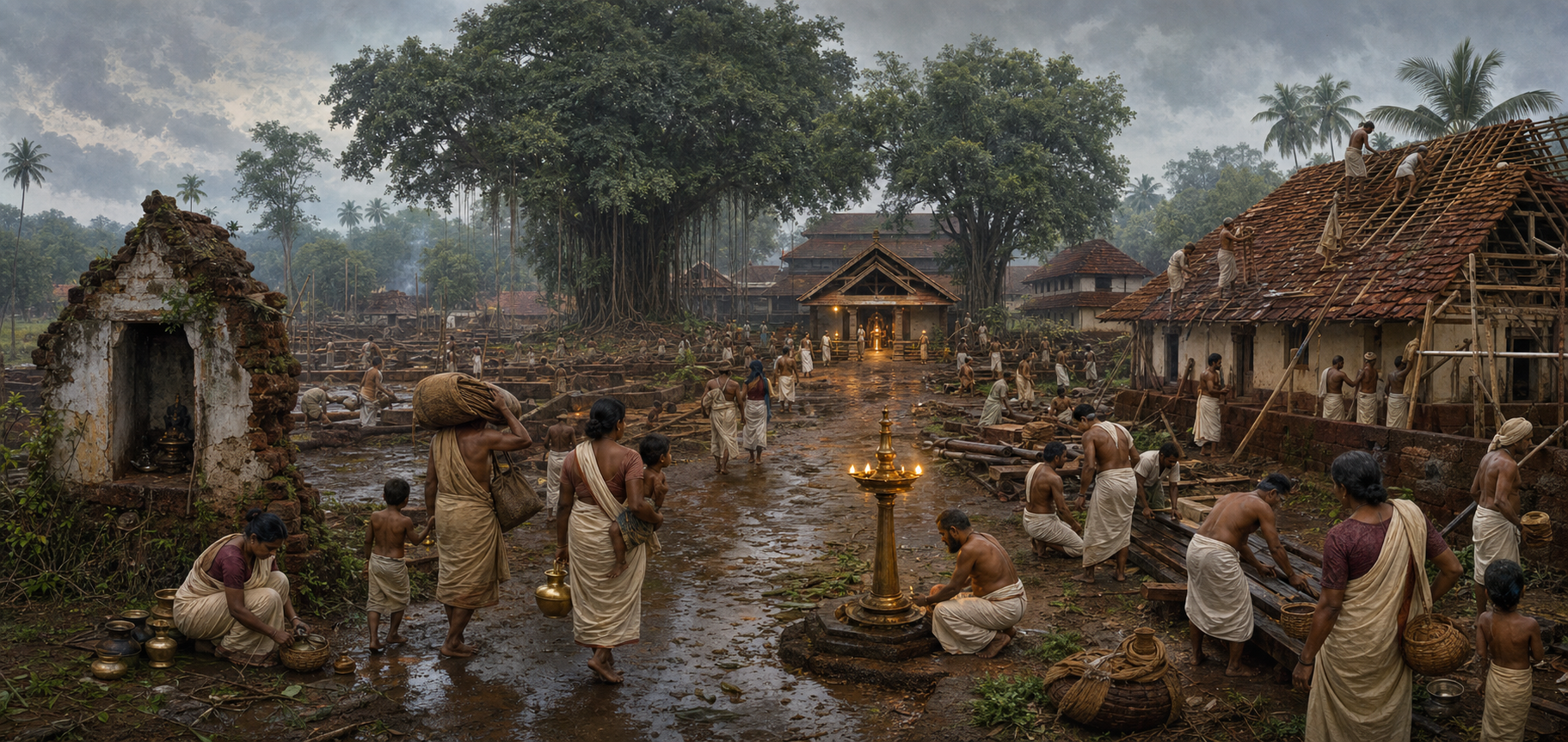
The Pooram grounds cannot be separated from the places surrounding them. The Thekkinkadu Maidan encircles Vadakkunnathan Temple, now the sacred and spatial centre of Thrissur Pooram. During the Mysorean era, that same landscape was used for military encampment and administration. Guruvayoor, another living centre of Kerala’s Hindu devotion, also stood in the path of the campaigns.
Hyder Ali’s pressure came in distinct phases
Hyder Ali marched into Malabar in 1766 and encountered determined resistance. The Zamorin of Calicut chose death by self-immolation in his palace rather than capitulation. Subsequent Nair resistance produced punitive reprisals, and Hyder returned in 1773 to enforce disarmament and diminish the political standing of the Nair nobility. People did not respond uniformly: some resisted, some sought accommodation, some converted under pressure, and others fled south toward Travancore.
When Sirdar Khan’s force reached Thrissur in 1776, it encamped near Vadakkunnathan. Priests sealed the sancta and withdrew, a protective response used when levies or armies threatened temple establishments. The complex was spared wholesale demolition. That qualification is important. Occupation of sacred space was a profound violation without every episode taking the form of total physical destruction.
Hyder’s attention was eventually diverted into war with the English, and he died in 1782. His campaigns had destabilised Malabar, but they did not settle the struggle over Travancore, Cochin, or the regional balance of power.
Tipu Sultan brought a more coercive phase
Tipu’s Malabar campaigns, beginning in 1787, differed in policy and intensity. The period included the imposition of jizya and contemporary testimony describing organised pressure for conversion. Nambudiris were a particular focus, and many sought refuge in Travancore. Tipu demanded their return from Dharmaraja; the unanswered demand became part of the widening confrontation.
One episode shows the scale of coercion without requiring vague claims. Material preserved by Gopalan Nair from William Logan’s Malabar Manual describes approximately 2,000 Nairs at Kuttipuram surrounded by 19,000 Mysorean troops supported by 46 field guns. Their capitulation terms stipulated conversion. A named place, a military imbalance, and an explicit condition tell you more than a sweeping slogan ever could.
In 1789, Tipu advanced with approximately 30,000 infantry and 5,000 cavalry. The movement of such a force damaged both religious and economic life. Temples and churches were plundered, markets were stripped, and pepper vines were cut. Destroying pepper production attacked more than an individual harvest; it struck at one of Malabar’s critical commercial resources.
Guruvayoor’s custodians reacted before the army arrived. They concealed the principal murti in the temple tank and transferred the processional deity to Ambalappuzha Sree Krishna Temple. The memory that Tipu’s men set the temple structure on fire and that an abrupt downpour extinguished it belongs to the site’s layered local tradition. The firmly useful point is the human one: ritual communities protected continuity by separating what could be hidden, what could be moved, and what might have to be rebuilt.
Tipu occupied Thrissur for roughly a month. Vadakkunnathan’s precincts became an administrative office, while officers were housed in neighbouring mutts. Accounts of the occupation describe cattle being killed and temple wells being polluted. These actions carried symbolic force in a Hindu sacred precinct even when they also arose within the logistics of a large encampment. Shortages, famine, and disease followed the occupation.
You do not need to minimise this evidence to discuss it responsibly. You do need to preserve its boundaries. Hyder and Tipu should not be treated as interchangeable. A spared structure does not prove the absence of coercion, just as a remembered act of desecration does not prove that every site met the same fate. Specific evidence of state violence also does not create inherited guilt for present-day Muslims. Historical seriousness means naming perpetrators, policies, victims, places, and degrees of certainty as precisely as the evidence allows.
The 1798 affront became a public institution in 1799
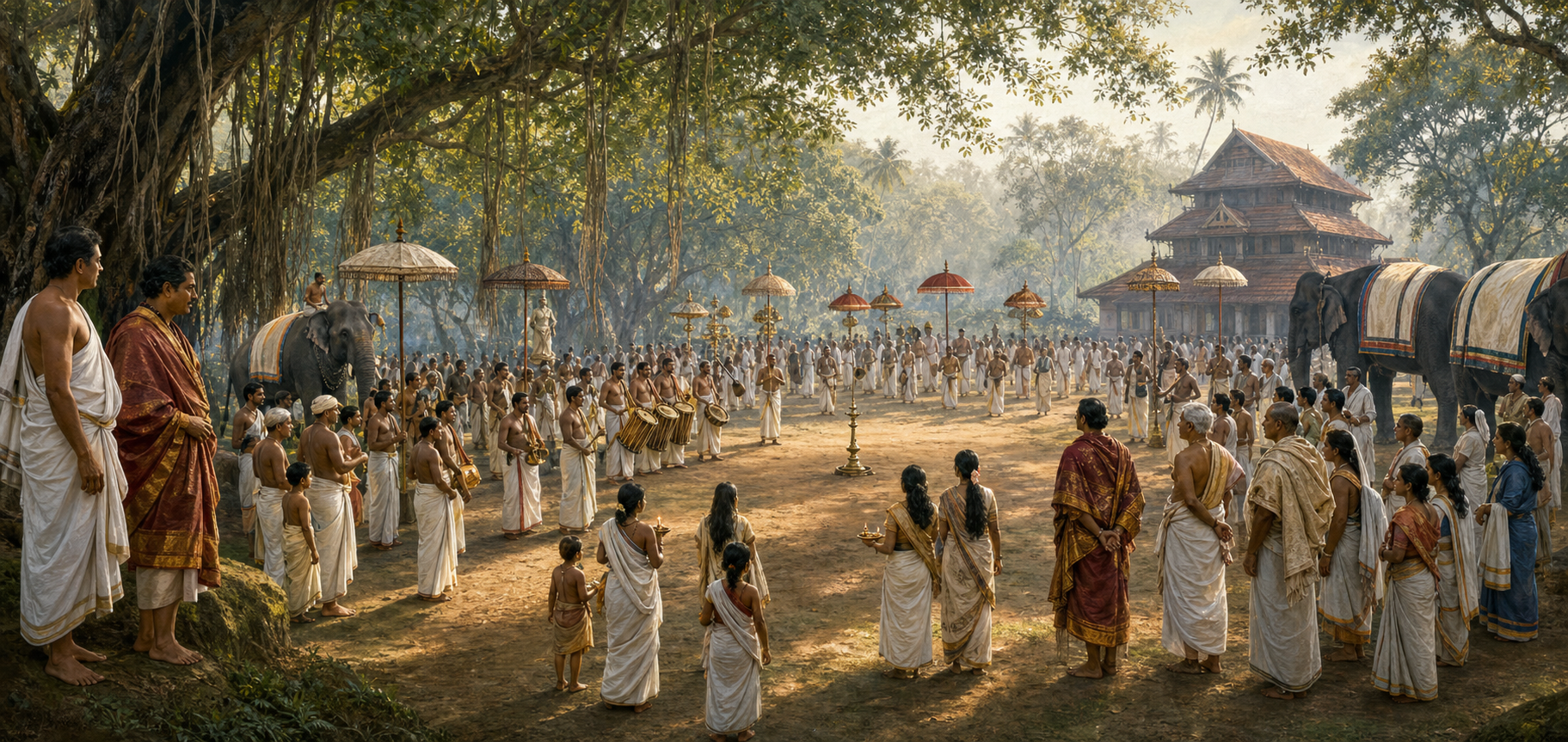
By 1798, Thrissur’s temple communities were not operating on an untouched landscape. They carried memories of levies, military occupation, damaged sacred institutions, hunger, and displacement. When their delayed processions were refused entry at Arattupuzha Pooram, the humiliation therefore landed within a society that had already spent decades responding to powers beyond its control.
Shaktan changed the structure of the problem. Instead of pleading indefinitely for readmission or turning a ritual dispute into violent retaliation, he made Thrissur capable of convening its own major festival. In 1799, he brought participating temples into a new Pooram centred on Vadakkunnathan and the Thekkinkadu Maidan.
The choice of ground did political work. Space that had served levy, drill, muster, encampment, and foreign administration was reclaimed for sacred assembly. A landscape formerly organised by military command would now be organised through processions, percussion, ritual timing, aesthetic display, and negotiated participation.
That is why the founding should be read as cultural statecraft. Survival had kept Cochin on the map; Pooram helped give people a shared civic rhythm after survival. It turned wounded prestige into an institution that could return each year. It also converted competition among temples and local interests into disciplined cooperation before a public audience.
This does not mean one festival erased caste hierarchy, political rivalry, or the losses of the Mysorean period. Public ritual rarely abolishes social divisions by itself. It can, however, require groups with distinct identities and interests to inhabit one calendar, one route, and one field under common rules. That recurring practice is more durable than a single proclamation of unity.
The present-day Pooram, held during the Malayalam month of Medam in April-May, is known for chenda percussion, rapid exchanges of ornamental parasols, and caparisoned elephants. You should not assume every current feature appeared in its mature form in 1799. What belongs securely to Shaktan’s founding act is the larger architecture: a central sacred space, invited temple participation, and an annual public occasion strong enough to answer exclusion with creation.
Pooram is therefore not best described as a festival against another religious community. Its enduring statement is affirmative: dharmic institutions that have survived coercion need not remain trapped in a posture of injury. They can preserve memory while creating beauty, order, and confidence on their own ground.
Key takeaways for reading Thrissur Pooram historically
- Keep the immediate cause distinct from the deeper background. The 1798 exclusion at Arattupuzha prompted the first Thrissur Pooram in 1799; decades of Mysorean pressure gave Shaktan’s response its larger political meaning.
- Do not turn Pooram into a victory parade over Tipu Sultan. Tipu died on 4 May 1799, but sharing the festival’s founding year does not make his death its documented cause.
- Distinguish Hyder Ali’s and Tipu Sultan’s campaigns. Both imposed severe pressure on Malabar and Cochin, but their policies, encounters with Shaktan, and treatment of local institutions were not identical.
- Judge Shaktan by the options he preserved. His strength lay in negotiation, delay, calibrated accommodation, and the ability to act independently when the balance of power changed.
- Read the physical setting as evidence. Vadakkunnathan, the Thekkinkadu Maidan, and Guruvayoor connect military occupation, ritual protection, and cultural reconstruction to places that still shape Kerala’s public life.
- Be exact about coercion without assigning collective guilt. Named policies and episodes of conversion, plunder, and desecration should not be erased, exaggerated beyond their evidence, or transferred to people living centuries later.
On your next visit to Thrissur Pooram, pause at the edge of the Thekkinkadu Maidan before the spectacle commands your attention. Look toward Vadakkunnathan and then across the open ground. You are seeing a precinct once used by invading forces for encampment and administration, and later made the centre of an annual sacred gathering. That turn from order imposed by an army to order created by a community is Shaktan Thampuran’s most durable answer.
References
