
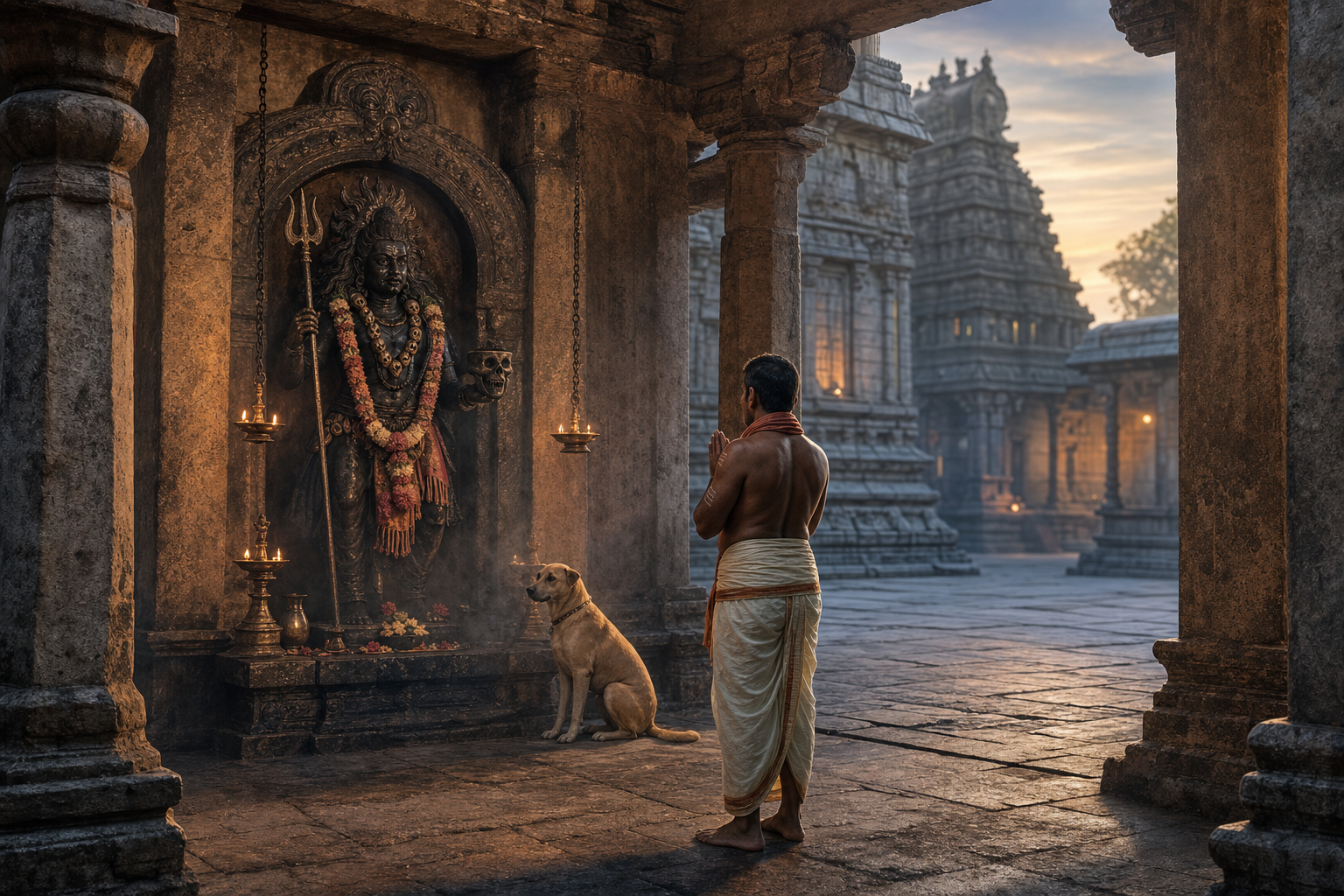
You have completed darshan at a Tamil Shiva temple and are walking through the outer prakara when a fierce form arrests your attention: matted hair, trident, skull-bowl, perhaps a dog nearby. The shrine may be identified as Sattainathar, yet the image seems closely related to Bhairava. Should you offer worship, regard him as Kala Bhairava, or understand him through the temple’s own story?
Begin with the shrine’s function rather than forcing a universal label onto it. Sattainathar commonly expresses Shiva’s ascetic and protective presence at a sacred boundary. That gives you a reliable way to approach the form while leaving room for the local identity preserved by each temple.
Why the shrine’s location matters more than a fixed label
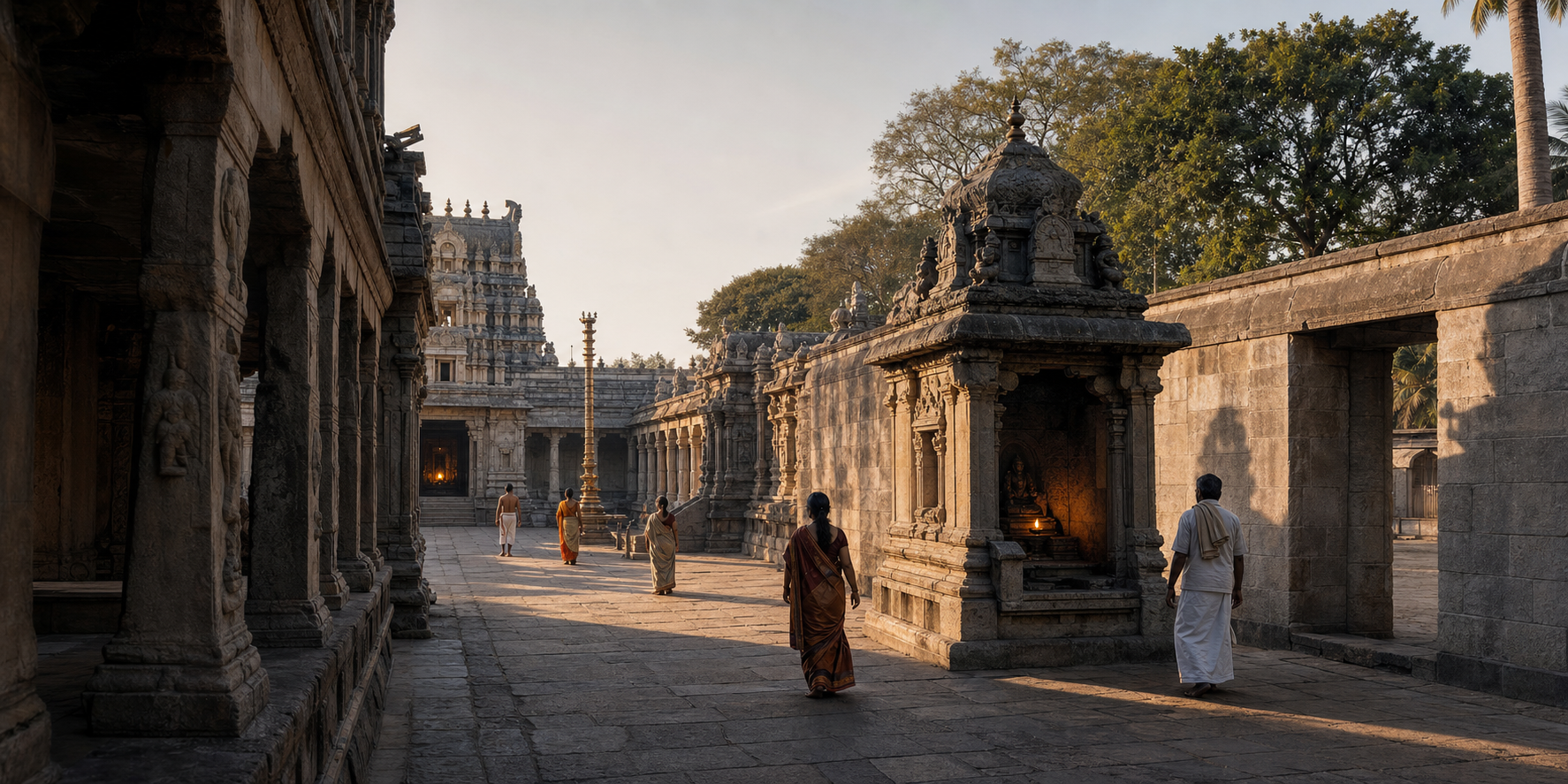
Tamil Shaiva temples teach through placement as well as sculpture. A deity encountered near an outer precinct is not less important because the shrine stands away from the central sanctum. The location can reveal the deity’s work: guarding the kshetra, regulating passage into sacred space, and reminding the devotee that darshan includes the manner in which one enters and leaves.
Sattainathar is often understood in this setting as an austere, watchful manifestation of Shiva, functionally aligned with Bhairava. The useful word is functionally. The equation “Sattainathar is always one standardized form of Bhairava” is too rigid for a living temple tradition. In another sthala-purana, the same title may carry a more particular memory of Shiva’s protection, renunciation or intervention.
You can therefore read the shrine at three connected levels. The theological identity is Shiva. The ritual role may be that of kshetrapala, the guardian of the sacred field. The local identity comes from the temple’s own name, history and order of worship. None of these levels needs to cancel the others.
Bhairava and Sattainathar sannidhis occur throughout major Tamil Shaiva temple landscapes, including those of Madurai, Chidambaram, Kanchipuram, Kumbakonam and Thanjavur. Devotees commonly encounter the guardian in an outer prakara and, where local custom prescribes it, conclude their circuit there. This final salutation gives ritual form to a simple recognition: the power that opens a sacred passage also watches over its completion.
At an unfamiliar temple, notice four things before deciding what to do. Read the shrine’s displayed name. Observe its position in the circumambulatory route. Look for Bhairava-family attributes without demanding that every one be present. Then follow the temple’s established sequence. If the order remains unclear, ask at the temple rather than importing a practice from another kshetra.
How to read the fierce iconography without mistaking its purpose
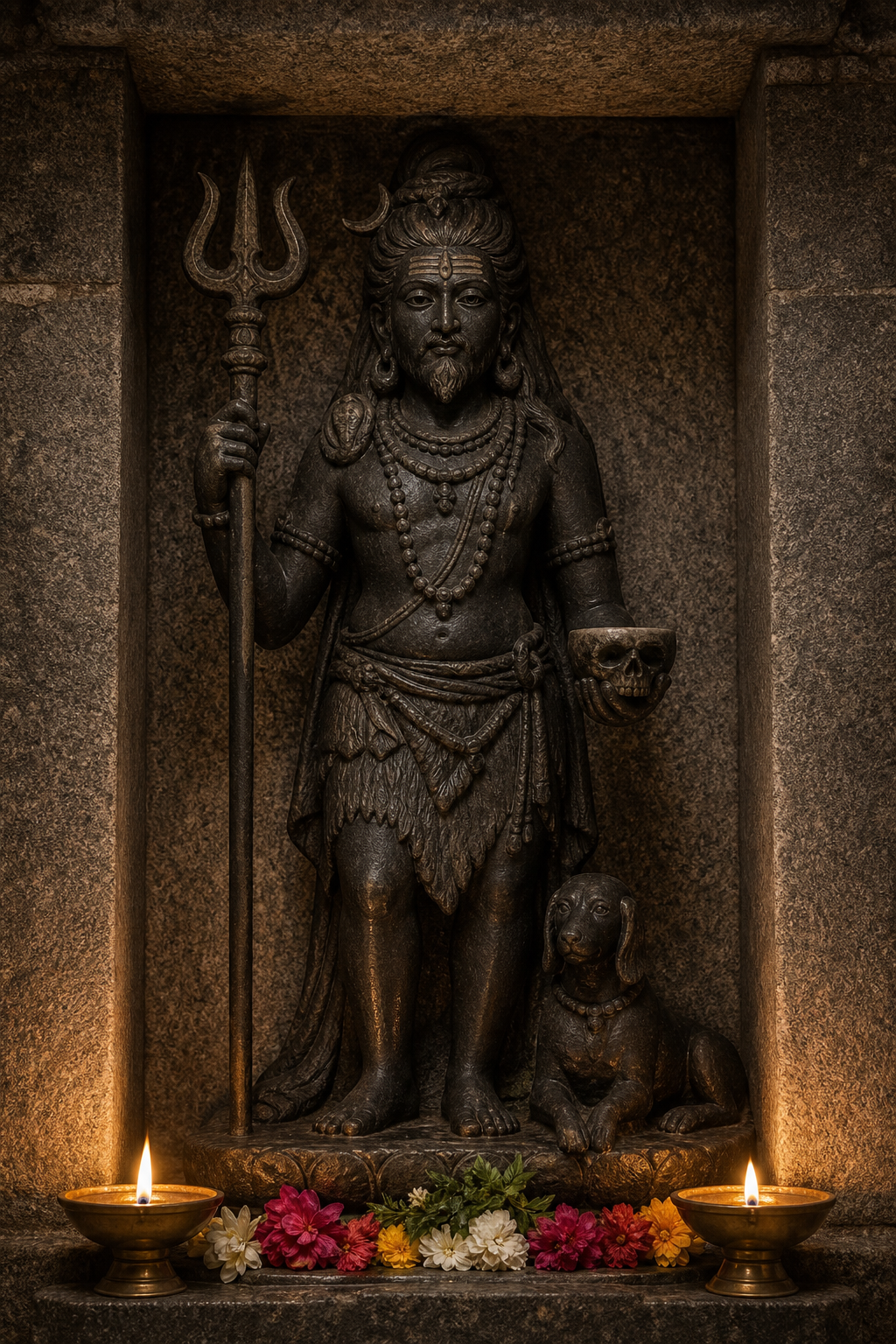
Sattainathar’s appearance can be unsettling if you read every skull, serpent or weapon as a threat. Tamil Shaiva iconography uses fierceness more precisely. The guardian confronts what ordinary consciousness avoids: mortality, impurity, fear, broken restraint and the instability of worldly attachments. His severity is directed against delusion, not against a sincere devotee seeking clarity.
- Matted locks, tiger-skin, rudraksha and vibhuti: These mark tapas, inward concentration and renunciation. They ask whether your religious life is changing your habits or merely decorating them.
- The trishula: The trident signifies Shiva’s authority over the bonds and obscurations that keep consciousness confined. Read it as a demand to cut through self-deception, not as an emblem of uncontrolled anger.
- The damaru: The drum holds creation and dissolution within one rhythm. A beginning and an ending are not opposing failures of order; both belong to a larger movement sustained by Shiva.
- The kapala: The skull-bowl places mortality in the open. What is accepted clearly can become a vessel for insight and compassion. What is denied continues to rule through fear.
- The khatvanga and skull ornaments: These signs disclose samsara rather than celebrating violence. The cycles of arising and passing are worn visibly because liberation cannot be built on refusal to face endings.
- The dog: Bhairava’s companion represents vigilance, loyalty and life at the social boundary. Its presence reverses conventional exclusion: what is treated as low or impure can become the vehicle of sacred protection.
Do not turn this list into an identification test. A stone image need not carry every attribute, and a bronze need not reproduce the same posture or ornament. Tamil Bhairava images from the 10th through the 13th centuries already display a mature but varied visual language: dynamic stances, balanced asymmetry, matted hair, skull and serpent ornament, weapons and the canine vahana. Variation within that language is evidence of a living ritual form, not necessarily a problem to solve.
The most useful way to contemplate the murti is to convert each visual sign into a question. The skull asks what truth about change you are refusing. The trident asks which attachment or falsehood needs to be pierced. The dog asks whom your idea of purity has pushed outside the circle of concern. The ascetic body asks what discipline you are willing to sustain after leaving the temple.
How to approach a Sattainathar shrine respectfully
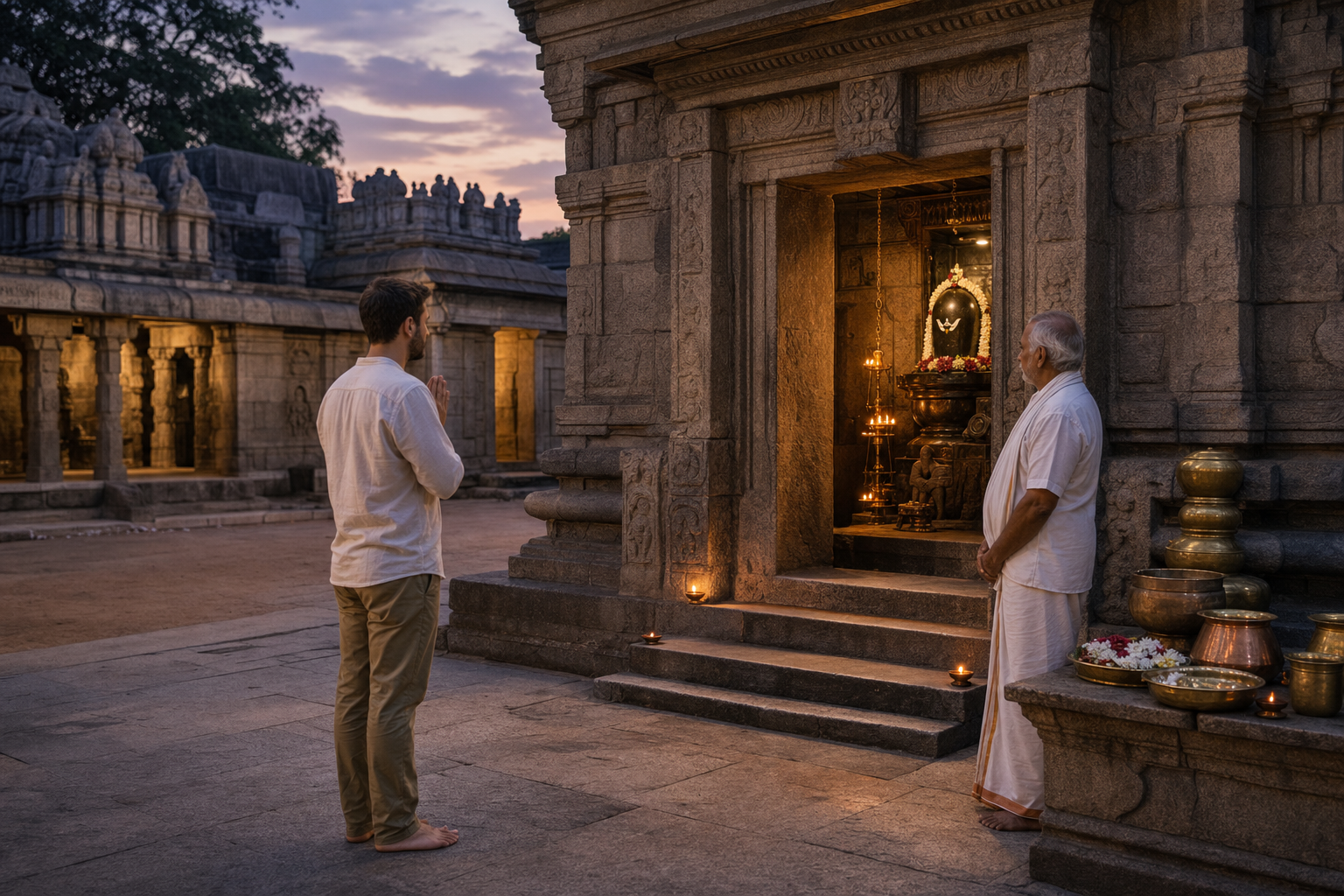
Local temple discipline comes first. The Kamikagama, Karanagama and Suprabhedagama provide Agamic foundations for Shaiva worship, but a visitor does not need to reconstruct a specialized ritual from textual fragments. The temple’s own liturgical sequence, permissions and sthala-purana govern what is appropriate at that shrine.
- Complete the established circuit attentively. If Sattainathar stands on the outer route, approach in the order followed at that temple. Do not assume that the sequence from another Shiva temple applies unchanged.
- Pause before making an offering. Lamps, sesame oil, bilva leaves and vibhuti are commonly associated with Sattainathar-Bhairava worship, but availability does not equal permission. Use only what the temple accepts and place it only where instructed.
- Treat special timings as local observances. Some temples conduct nocturnal worship on Ashtami or Amavasya, times associated with thresholds and intensified guardianship. This is a recurring pattern, not a universal timetable for every Sattainathar shrine.
- Let the salutation complete rather than interrupt darshan. Where the guardian shrine is visited toward the end, do not approach it as an anxious attempt to placate a dangerous deity. Acknowledge Shiva’s protection of the precinct and examine the integrity with which you are leaving it.
- Carry away a discipline, not merely a request. Choose truthfulness, restraint, courage, dana or care for a vulnerable being as the practical continuation of worship.
Kala Bhairava’s description as the guardian or kotwal of a sacred city in the Kashi Khanda can help you understand the protective function, but it should not erase Tamil temple particularity. Sattainathar belongs within a local ecology of sanctum, prakara, procession, sthala memory and Shaiva Siddhanta practice. The analogy illuminates the office of the guardian; it does not replace the temple’s own identity.
If you want to continue the observance at home, keep it proportionate and intelligible. Light a lamp with a clear intention. Maintain the time-discipline you have undertaken. Practise dana and ahimsa. Feeding someone in need or caring responsibly for an animal, especially a dog, extends the guardian’s protection beyond the stone boundary of the temple. These actions are not ornamental additions to worship. They test whether reverence has become conduct.
What Sattainathar’s guardianship asks of you outside the temple
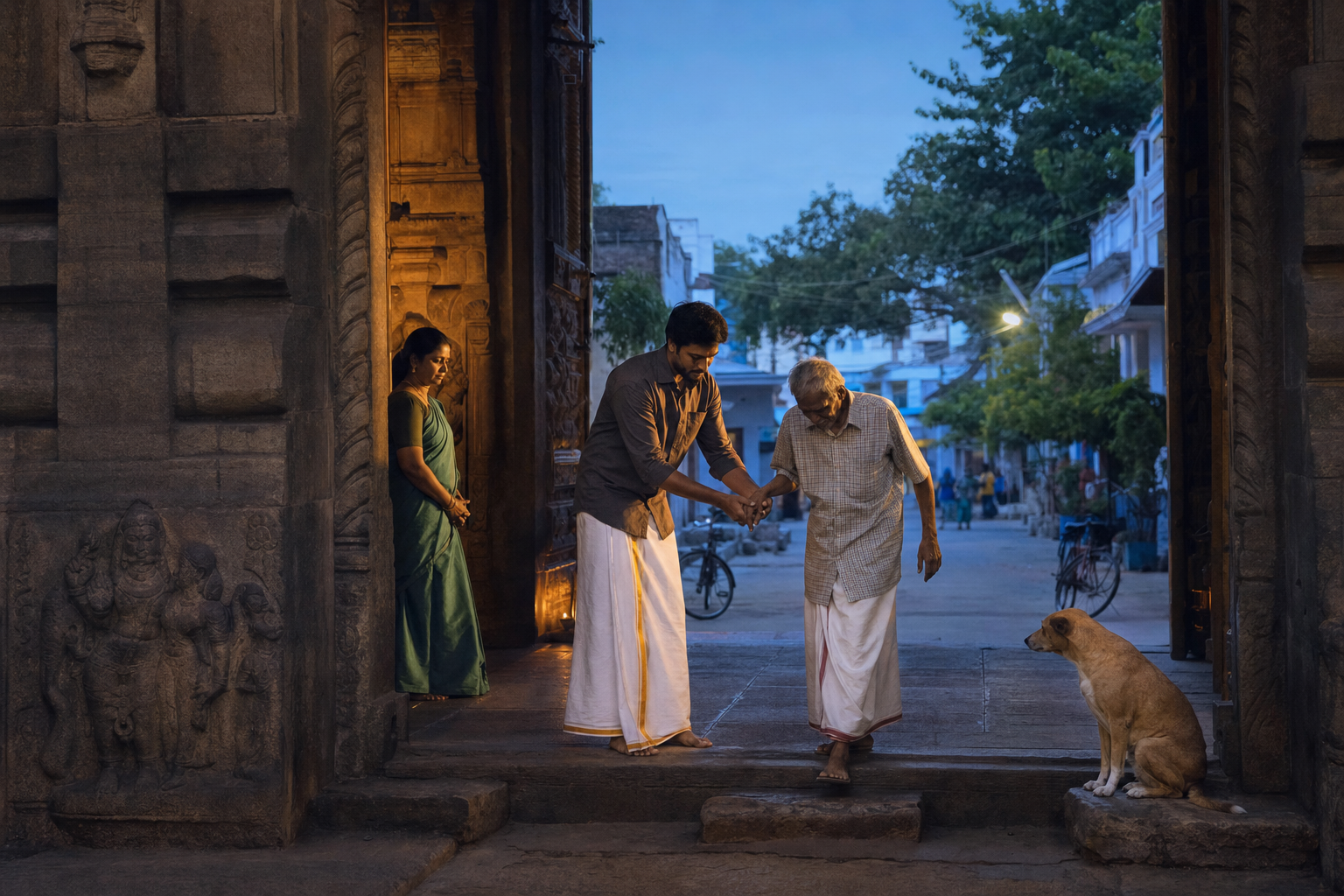
A boundary is not automatically dharmic because it is firm. Anger, pride and fear can also build hard boundaries. Sattainathar represents a more demanding combination: vigilance without hatred, austerity without indifference, and strength used to protect rather than dominate.
Begin at a threshold you already cross. Before entering your home after work, decide what agitation should remain outside and what responsibility must enter with you. Before a difficult conversation, separate the truth that needs to be spoken from the desire to punish. Before accepting an obligation, ask whether you can honour its time and limits. This is how kshetrapala symbolism becomes an ethical practice rather than an exotic image.
The skull-bowl adds a necessary correction. Vigilance can become compulsive if it is driven by a fantasy of controlling every outcome. Mortality and change cannot be guarded away. The mature guardian protects what is entrusted to him while remaining unattached to permanence. In ordinary life, that means repairing what can be repaired, finishing what should be finished, and allowing an exhausted role or resentment to end.
The dog at Sattainathar’s feet supplies another test. Protection that extends only to the respectable is incomplete. Care for animals, service to people in need and refusal to treat vulnerability as pollution bring the icon’s reversal of exclusion into daily life. A devotee need not imitate the deity’s fierceness. The task is to imitate its direction: toward the defence of sacred order and the inclusion of beings left at the edge.
Comparable protective patterns appear elsewhere in the Dharmic family. Mahakala and Vajrabhairava serve transformative protective roles in Vajrayana Buddhism. Jain temple guardians and yakshas express disciplined watchfulness. The Sikh pairing of nirbhau, without fear, and nirvair, without enmity, gives ethical language to courage free of hostility. These are not interchangeable deities or doctrines. They reveal a related civilizational insight: power becomes worthy of reverence when it guards truth without feeding hatred.
You can use that insight as a test whenever “fierce” religious imagery is invoked. Does the interpretation produce restraint, responsibility and protection of the vulnerable? Or does it excuse rage, contempt and self-display? The first is consonant with Sattainathar’s ascetic guardianship. The second mistakes personal aggression for divine force.
Key takeaways
- Sattainathar commonly names an ascetic, boundary-guarding manifestation of Shiva that is functionally related to Bhairava, but the local sthala-purana remains decisive.
- A shrine in the outer prakara expresses guardianship, not marginal status. Follow the temple’s own circumambulatory and worship sequence.
- The fierce attributes teach tapas, impermanence, clarity and inclusion. They should not be reduced to threats or spectacles of violence.
- Lamps, sesame oil, bilva, vibhuti, Ashtami and Amavasya observances belong to recurring patterns, not rules that can be imposed on every temple.
- The most faithful continuation of darshan is ethical: maintain boundaries without anger, honour time, practise dana and ahimsa, and protect beings at the social edge.
At your next encounter with Sattainathar, do not hurry past the shrine and do not approach it through fear alone. Notice where the guardian stands, learn the temple’s name and custom, and leave with one boundary made more truthful or one vulnerable being brought within your care. The outer prakara then becomes what it was meant to be: the place where sacred vision is tested before you return to the world.
References
