
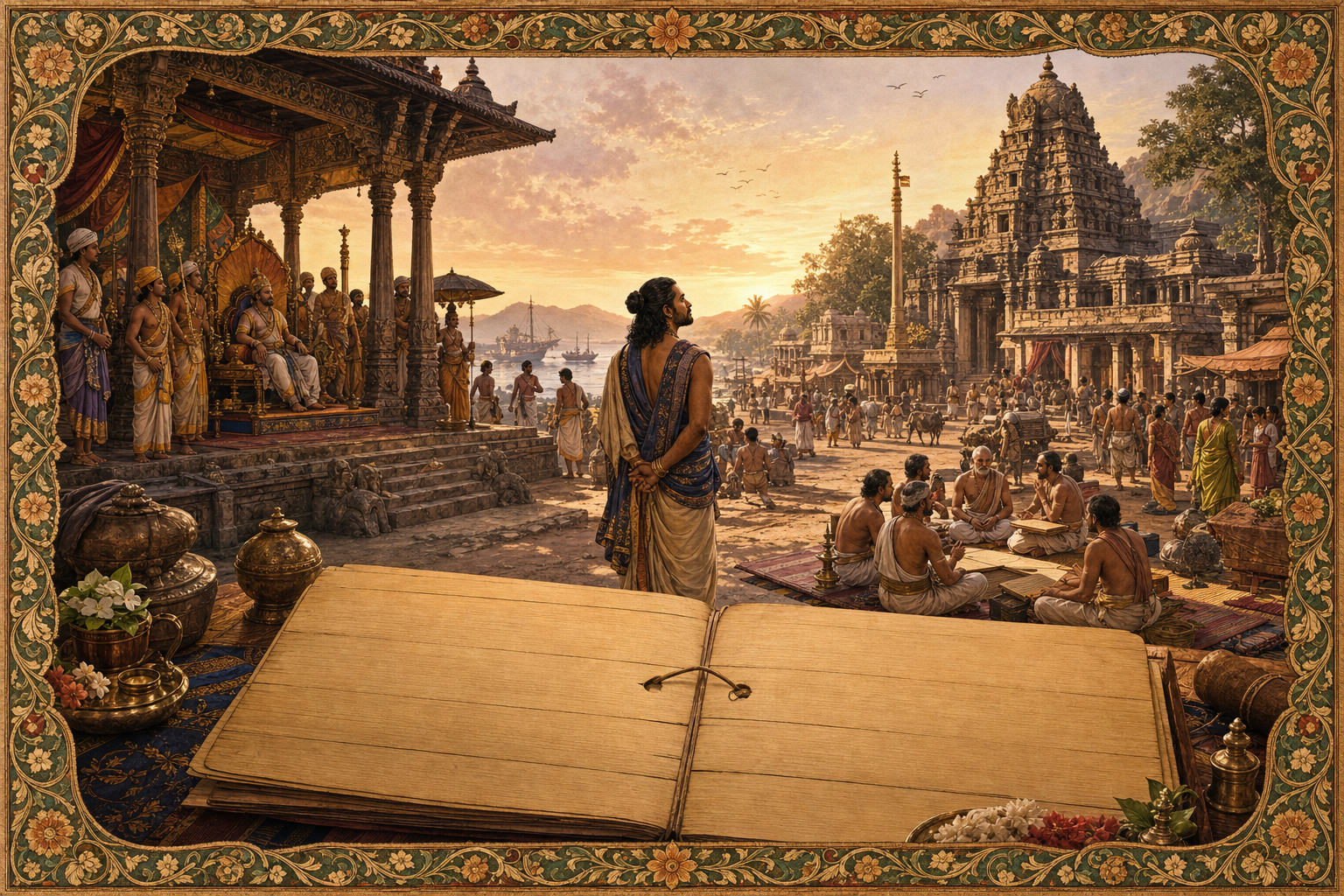
You may have heard Nori Narasimha Sastry praised as a great Telugu historical novelist and still face a practical problem: which novel should you choose, and what should you watch for once the poets, courts, and traditions begin to accumulate? The most rewarding approach is to read him not merely for period drama, but for his reconstruction of how a Dharmic literary civilization worked.
Nori places a poet’s inner life within the courts, patronage networks, temples, customs, and scholastic traditions that sustained it. Your reading question therefore matters. Decide whether you chiefly want to understand public literary greatness, the meeting of courtly art and bhakti, or the conflict between patronage and spiritual allegiance. That decision will point you toward the right book.
Choose a reading order that exposes Nori’s method
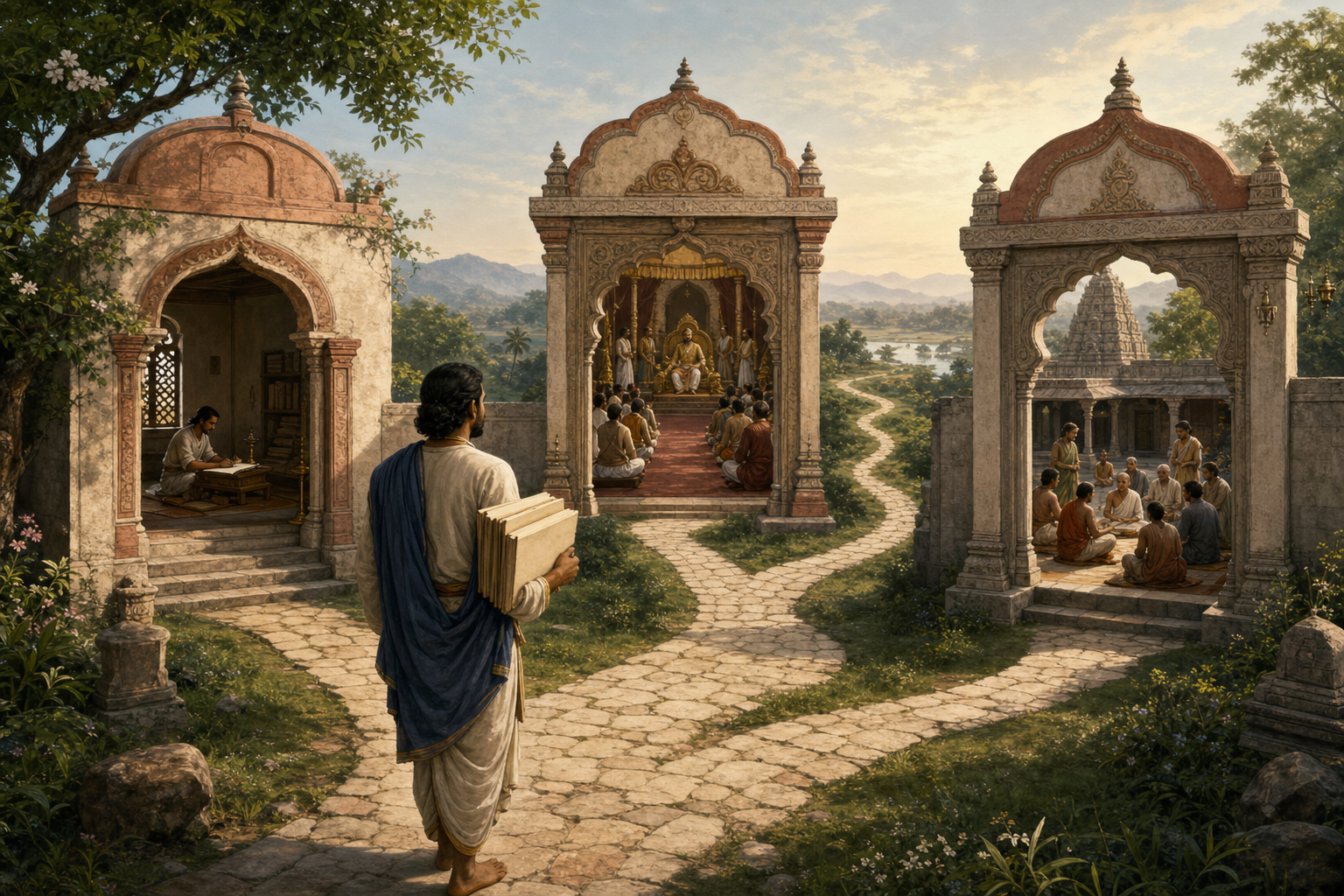
You don’t need to approach Nori’s fiction as an exhaustive chronological project. A more useful route follows an ethical and literary movement: from public eminence, to two contrasting forms of poetic authority, and then to renunciation.
- Begin with Kavisarvabhaumudu for Srinatha’s public world. Srinatha’s brilliance and commanding personality occupy a large place in accounts of medieval Telugu poetry. As you read, notice how poetic mastery acquires social form through reputation, learned performance, courtly recognition, and proximity to power. Your question is not simply whether Srinatha is admirable. Ask what kind of society can recognise and sustain such a poet.
- Continue with Kavidvayamu to place Srinatha beside Bammera Potana. Nori had envisaged a separate Potana novel, Sahajapandityudu, before bringing the two poets into a shared design. The resulting work prevents Srinatha’s flamboyance from obscuring Potana’s quieter devotional luminosity and functions as a considered continuation of Kavisarvabhaumudu. Read it for the relationship between two kinds of greatness, not for a contest that produces one winner.
- Turn to Dhurjati for the problem of patronage and renunciation. The sixteenth-century poet belongs to Sri Krishnadevaraya’s court, yet his path eventually leads away from royal patronage. This novel is the strongest starting point if your immediate concern is what a poet owes political power when devotion demands a different allegiance.
If you plan to read all three, keep that order. If you will read only one, let your question decide: choose Kavisarvabhaumudu for courtly literary culture, Kavidvayamu for the relationship between virtuosity and bhakti, or Dhurjati for Vijayanagara and the ethics of patronage.
See Dharma in the structure of life, not in religious decoration
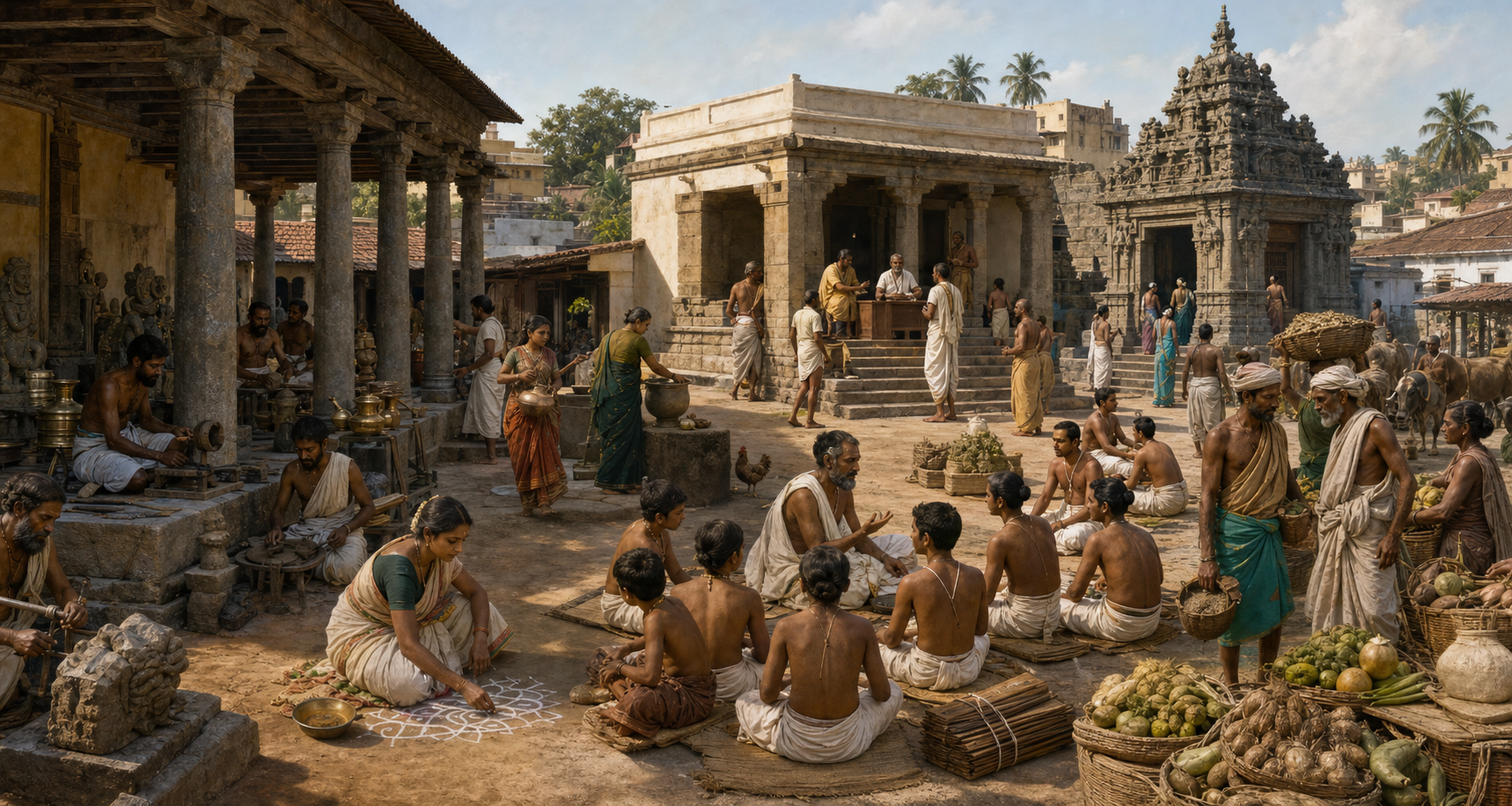
A novel does not become Dharmic merely by mentioning a deity, temple, or scripture. Its deeper test is whether Dharma shapes the relationships among knowledge, power, livelihood, devotion, and obligation. Nori’s civilizational reach becomes visible precisely at those intersections.
Use four lenses while reading. First, identify the institution: a court, temple, learned lineage, household, or patronage relationship. Second, identify the practice that gives the institution meaning. Third, ask what kind of knowledge or excellence it preserves. Fourth, find the moral choice placed before the character. This prevents a richly detailed setting from dissolving into undifferentiated “historical atmosphere.”
- At a court scene, ask how political authority turns poetic ability into public status.
- At a devotional scene, ask whether bhakti changes a character’s duties, ambitions, or dependence on worldly recognition.
- When a custom appears, identify the relationship it regulates rather than treating it as colorful scenery.
- When learning is displayed, ask whether scholarship serves fame, truth, devotion, political order, or some combination of them.
This method is especially useful because Nori reconstructs more than royal events. His historical canvas includes religious life, scholastic lineages, social customs, literary institutions, and knowledge systems. The details matter individually, but their relationships reveal the civilization.
Srinatha and Potana embody different kinds of authority
The easiest misreading of Kavidvayamu is to reduce its poets to a simple opposition: Srinatha as worldly and Potana as holy. That moral shortcut destroys the reason they belong together.
Srinatha represents extraordinary poetic virtuosity joined to a large public personality. Potana led a frugal, unpretentious life and gave Telugu readers the Mahabhagavata in sweet, flowing verse that became deeply embedded in popular memory. One poet makes literary power spectacular; the other shows how poetic beauty can become an intimate vehicle of bhakti. Their differences sharpen both portraits without requiring you to deny either form of achievement.
Track the pair across three questions. Where does each poet locate authority? What does each need from society? What remains after public reputation is removed? The answers will help you see why the combined narrative is more revealing than two isolated literary biographies would have been.
Dhurjati turns royal patronage into an ethical question
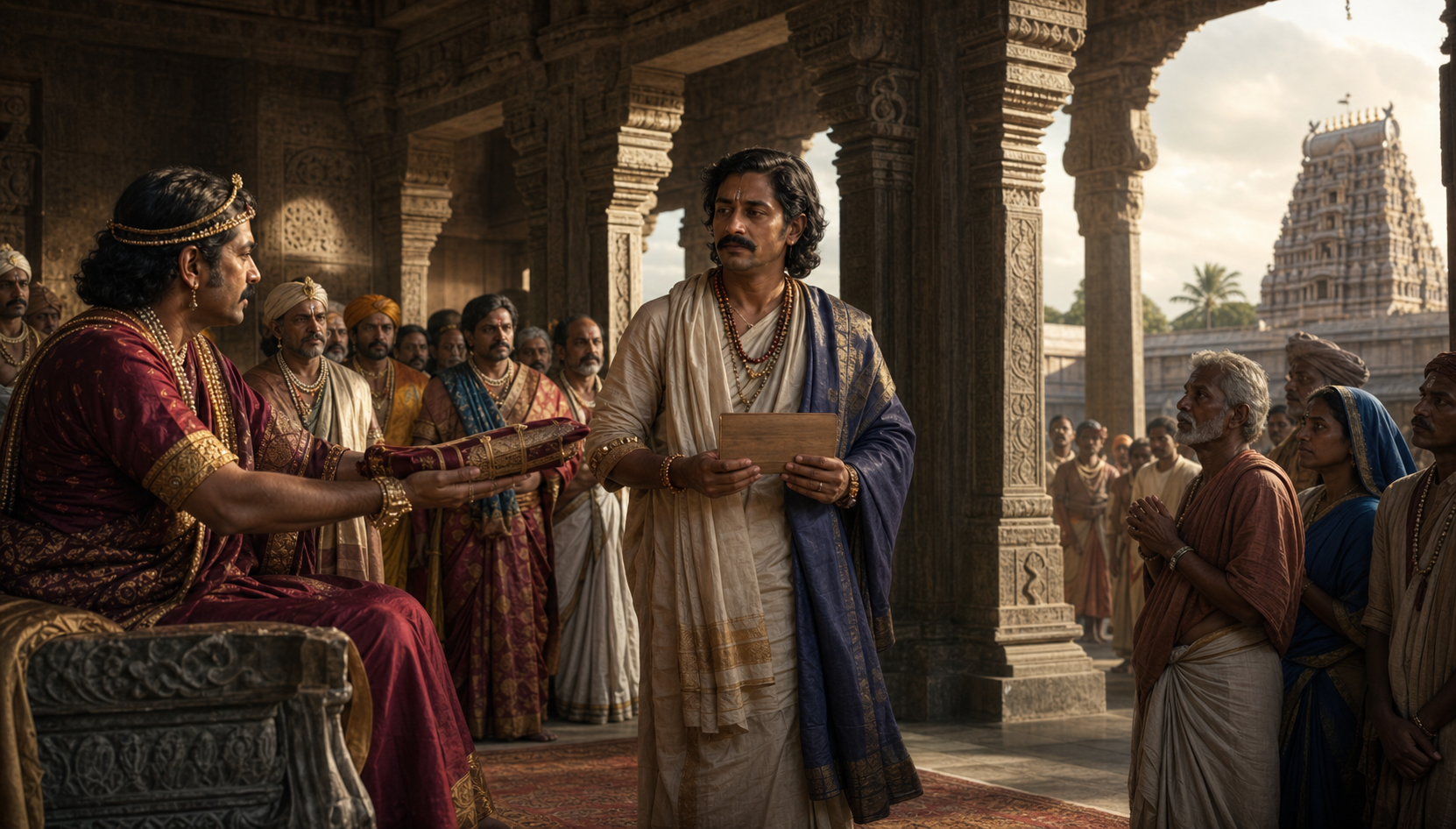
Dhurjati should not be approached as a tale in which spirituality merely defeats a corrupt court. Sri Krishnadevaraya’s Vijayanagara possesses political power, aesthetic refinement, and a temple-centered cultural economy. That grandeur makes the poet’s eventual renunciation more demanding, not less. He leaves an institution capable of sustaining real artistic and civilizational excellence.
Use a page divided into two columns while reading. Under “What the court gives,” record the resources, audience, recognition, order, or artistic opportunity the poet receives. Under “What the court claims,” record every expectation, dependence, divided loyalty, or constraint you perceive. Do not decide in advance that every gift is corrupting or every demand legitimate. Let the imbalance emerge through the narrative.
When renunciation arrives, examine what has actually been renounced. Is it wealth, status, dependence, a particular obligation, or the court’s authority to define the poet’s highest purpose? Then ask what remains: poetry, devotion, responsibility, or a reordered relationship among them. This is where the historical setting becomes a living Dharmic problem. Patronage can nourish culture, yet no patron automatically becomes the final judge of conscience.
That distinction also protects Vijayanagara from two opposite distortions. You needn’t romanticize every exercise of royal power in order to appreciate the empire’s cultural institutions. Nor must you diminish its grandeur in order to take Dhurjati’s spiritual withdrawal seriously. Read the court and the renunciation at full strength.
Read the moral clarity without mistaking it for simplicity
Nori often gives his characters clearly bounded ethical identities: they may be good, evil, venerable, or exemplary. This produces moral clarity and strong narrative movement, with less psychological ambiguity than many modern readers expect. That is both an artistic strength and a genuine limitation.
Don’t conceal the trade-off by pretending every character contains endless interior grayness. At the same time, don’t dismiss moral definition as childish characterization. Ask what the defined figure makes visible. An exemplary poet may embody a relationship between learning and humility. A flamboyant poet may reveal the social force of literary genius. A renunciant may clarify the boundary between gratitude to a patron and surrender of moral autonomy.
Nori’s prose also asks for a different pace from ordinary plot-driven fiction. His reputation as Kavi Samrat rests partly on a prose style aspiring to gadya-kavya: prose formed with poetic density, cadence, and resonance. His work in lyrical drama, verse drama, narrative epic poetry, and the Champu translation of the Devi Bhagavata, alternating prose and verse, helps explain why form is not mere ornament in his fiction.
If you read Telugu, read an important paragraph aloud before moving on. Listen for rhythmic balance, changes of register, and the weight given to formal speech. If you read in translation, place more emphasis on scene architecture: who speaks with authority, which institution frames the exchange, and how the scene moves from public conduct to inward judgment. Either way, racing only for the next event will discard part of the intended aesthetic experience.
Separate three kinds of truth
Nori’s learning supported unusually dense historical reconstruction. His command of Telugu, Kannada, Sanskrit, Prakrit, Hindi, and English enabled engagement with inscriptions, Puranic material, regional chronicles, and modern historiography. Yet a researched historical novel is still a novel. You will read it more responsibly if you separate three layers.
- The reconstructed world: institutions, customs, religious practices, literary traditions, and political arrangements that make the period intelligible.
- The narrative design: selected scenes, contrasts, pacing, and ethically defined characters that turn history into an intelligible story.
- The Dharmic inquiry: questions about duty, devotion, power, learning, fame, patronage, and renunciation that the historical lives allow you to examine.
Confusing these layers produces two avoidable errors. One is demanding that every invented conversation function like an archival record. The other is treating carefully reconstructed civilizational detail as expendable scenery. Test historical claims as claims, literary choices as choices, and ethical insight through the quality of the question it places before you.
Key takeaways
- For a connected reading route, move from Kavisarvabhaumudu to Kavidvayamu and then to Dhurjati.
- Measure Dharmic depth by the relationships among knowledge, devotion, livelihood, power, and duty, not by the number of religious references.
- Read Srinatha and Potana as complementary forms of poetic authority rather than as a shallow contest between worldliness and holiness.
- In Dhurjati, give Vijayanagara’s cultural grandeur and the poet’s renunciation equal interpretive weight.
- Accept Nori’s moral clarity as a deliberate narrative strength while remaining alert to its reduced psychological ambiguity.
- Distinguish reconstructed history, literary shaping, and Dharmic inquiry before deciding what kind of truth a scene offers.
Before opening your chosen novel, write one question at the top of a blank page: “What gives this poet authority, and what limits that authority?” Keep returning to it whenever a court, temple, patron, learned exchange, or act of renunciation appears. That single practice will turn Nori’s dense historical world from a procession of names into an intelligible map of Dharma in public life.
References
