
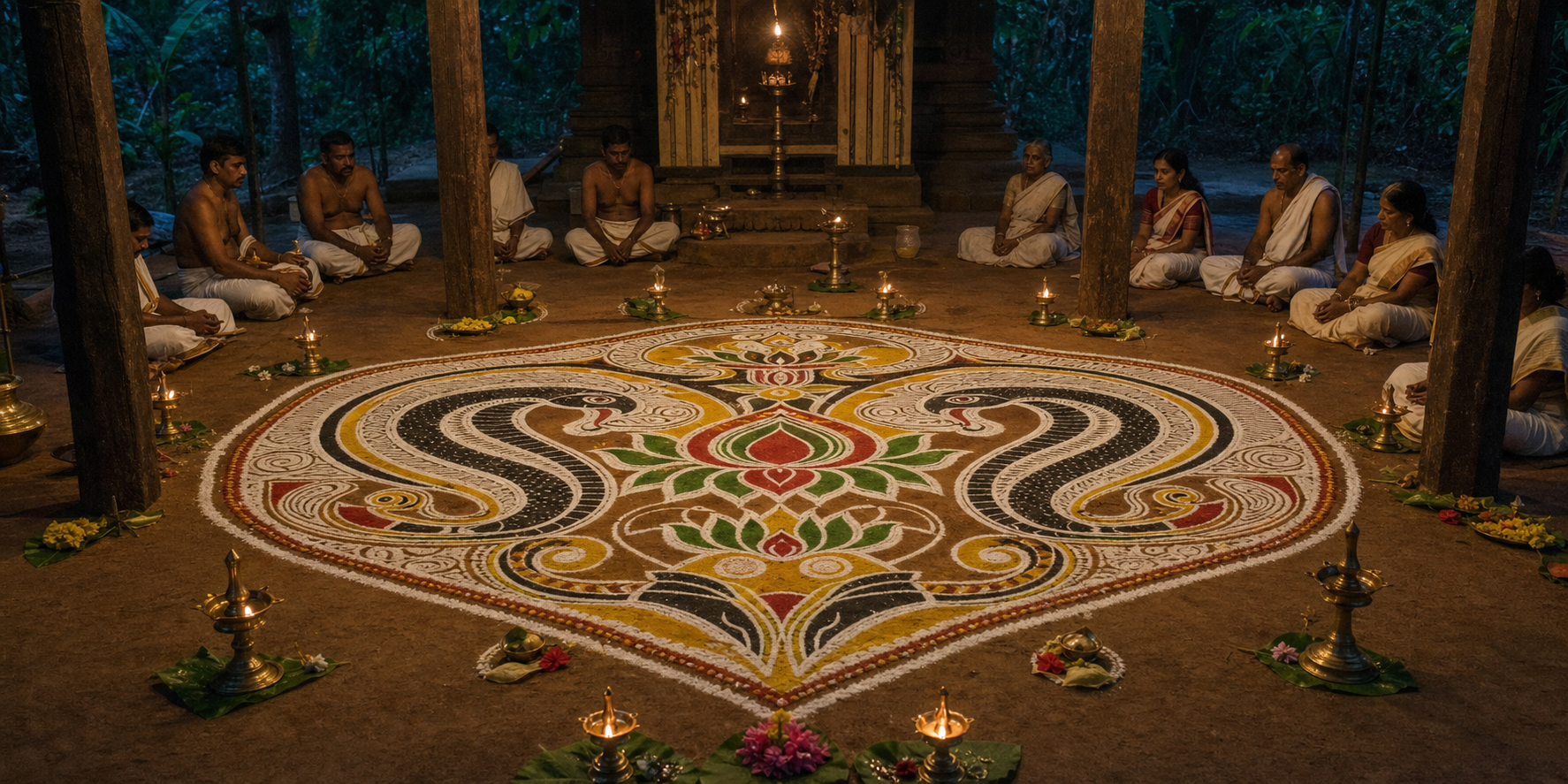
If you are preparing to witness Nagapadma Kalam, you may be unsure whether you are looking at devotional art, a serpent puja, a form of parihara, or a ceremony tied to Kerala’s sacred groves. It is all of these at once, but it should first be understood as prayer in progress.
That distinction changes how you approach the kalam. You do not judge it only by visual beauty, step around it as though it were an exhibition, or treat its powders as craft materials. You enter a consecrated setting shaped by geometry, mantra, music, family memory, and responsibility toward the land.
First decide what you are seeking from the ritual
People approach Nagapadma Kalam with different intentions. A family may be fulfilling a vow, seeking blessings for progeny or health, praying for agricultural well-being, or performing parihara in response to a perceived Naga dosha. Another visitor may simply want to understand Kerala’s serpent traditions. These intentions are not interchangeable, and clarity prevents you from treating a lineage-based rite as a generic spiritual service.
If your concern involves Naga dosha, begin by asking what the relevant temple or household tradition actually prescribes. The grammar of the kalam is transmitted substantially through oral instruction, apprenticeship, and local custom rather than through one universally binding manual. A procedure followed at one shrine should not automatically be copied elsewhere.
Parihara is best approached as disciplined participation: making a vow carefully, attending to the recitation, waiting without demanding a spectacle, and fulfilling any commitment accepted within that tradition. It is not a mechanism through which a payment guarantees pregnancy, healing, or the removal of every difficulty attributed to a horoscope. If you have a medical concern, use the ritual as spiritual support, not as a substitute for qualified medical evaluation or treatment.
Key takeaways
- Treat the kalam as a temporary altar, not as decorative floor art.
- Ask the temple, Pulluvan performers, or household custodians which local procedure applies; do not assume that every serpent shrine uses the same design or offerings.
- Let spiritual vows remain spiritual. Do not turn claims about fertility or health into guaranteed outcomes or medical diagnoses.
- Plan around the shrine’s announced calendar. Ayilyam, or Ashlesha, nakshatra days are important, while major observances fall in Kanni and Vrischikam in many local traditions.
- Protect the Sarpa Kavu as carefully as you respect the painted boundary. The grove is part of the religious obligation, not scenery around it.
Read the kalam as a consecrated field
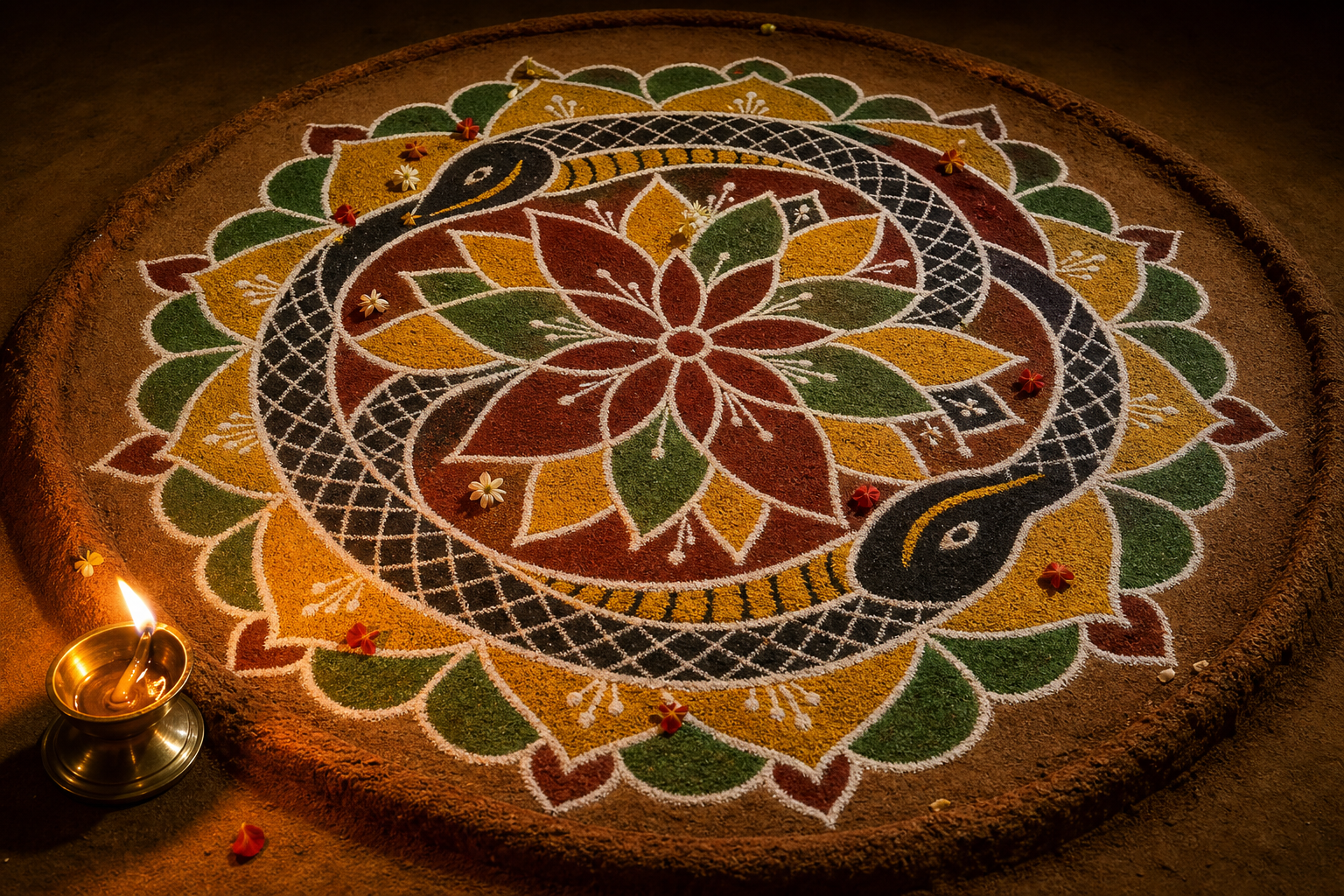
The name gives you the central visual relationship: Naga, the serpent presence, is placed within padma, the lotus order. The lotus stabilizes the composition; the serpent supplies movement, vigilance, and protective force. A bindu anchors the center, concentric petals organize the surrounding space, and the coils, hoods, and gaze are arranged in relation to that structure.
The common lotus formats include eight, twelve, or sixteen petals. The choice can depend on the invoked deity, the vow, and the temple’s inherited practice. The serpent may have one hood or several; some compositions show an intertwined pair, while others use radiating coils to create a protective orientation. Dots, wave-like marks, and leaf forms define rhythm and boundaries rather than filling empty space.
You do not need specialist knowledge to notice the fundamental discipline. Look for the balance between a still center and curving movement, the repeated modules that hold the petals together, and the deliberate direction of the hood and eyes. Then stop trying to decode every line in isolation. Its meaning also comes from the mantra, the deity being invoked, the vow, and the ritual moment in which the image is made.
The traditional palette makes that relationship with the ritual setting visible. White can come from powdered raw rice, black from charcoal or burnt paddy husk, yellow from turmeric, red from earth or prepared turmeric, and green from powdered leaves. The artist releases powder through the fingers or a simple coconut-leaf funnel, building edges, gradients, and dense fields without converting the work into a permanent object.
This is trained ritual work. Steadiness of line matters, but so do liturgical timing, the cohesion of the color fields, and the artist’s ability to work with the musical pace of the ceremony. If you want to learn the form, seek lineage-based instruction. Copying a photographed pattern for decoration reproduces its surface while separating it from the invocation that gives it purpose.
Follow the rite from prepared earth to ritual erasure
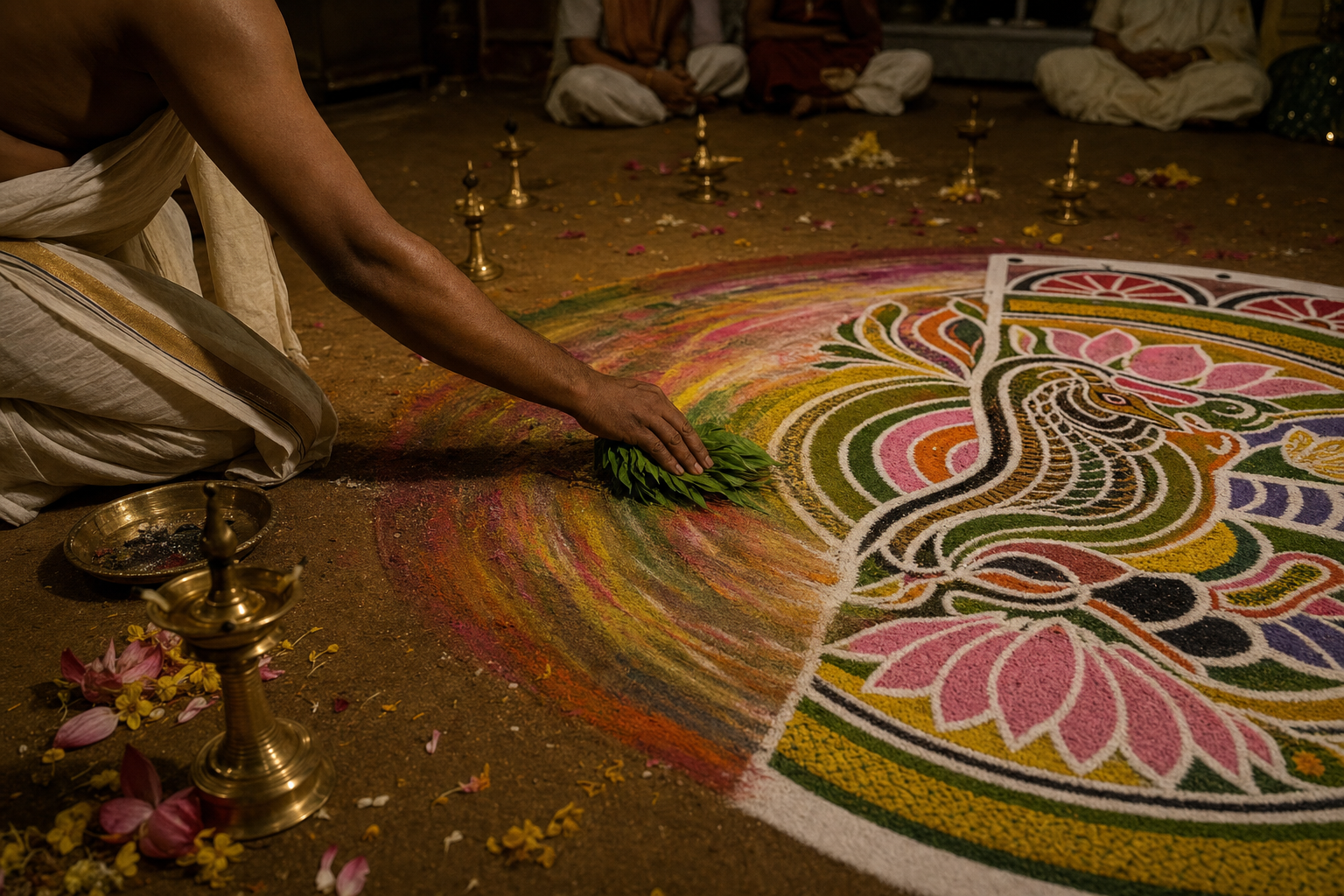
Nagapadma Kalam is not simply unveiled after an artist finishes working. Its emergence is part of the liturgy. Watching the sequence helps you understand why arriving only for a finished photograph misses so much of the practice.
- The floor is purified, and a perimeter is established, commonly with rice powder.
- The lotus lattice is laid out around its central bindu. Petals and repeated measures create the field in which the Naga will appear.
- The serpent form, its coils, hood, eyes, and surrounding motifs are completed in accordance with the local pattern.
- Nilavilakku lamps are installed at the cardinal points, marking the kalam as an active sacred center.
- Offerings are placed. These may include turmeric, flowers, tender coconut, and lineage-specific preparations such as Noorum Palum, which can involve milk, turmeric, and lime.
- Mantras, circumambulation, and the articulation or fulfillment of vows organize the community around the consecrated image.
- The kalam is deliberately erased. Its mingled powders may be given as prasada, returning the temporary image to devotees and the earth.
The final erasure is not damage to an artwork. It completes the offering. The same elemental materials that allowed the deity’s presence to be visualized cease to belong to a bounded image. This movement from earth to sacred form and back to earth is one reason permanence would change the rite rather than preserve it.
Do not prepare Noorum Palum or reproduce another offering from a short description. Ingredients and procedures can be specific to a lineage, and ritual suitability is determined locally. Ask what you may bring, who prepares it, and whether devotees are expected to handle it at all.
Listen for the part of the kalam that cannot be photographed
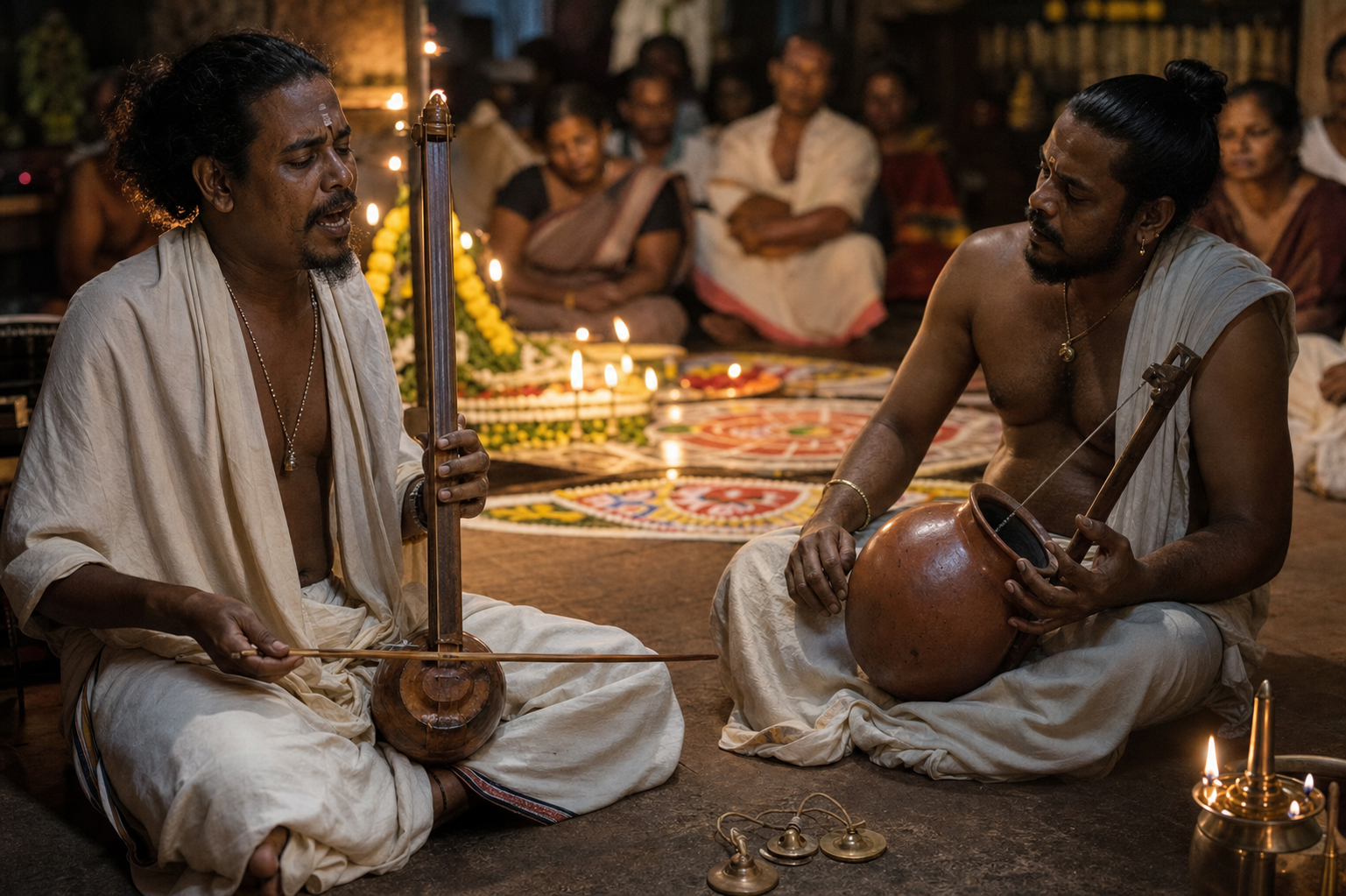
Pulluvan Pattu is not background music placed beside the image. Members of the Pulluvan community sustain the rite through songs honoring serpent guardianship, fertility, and the removal of obstacles. The pulluvaveena provides a resonant string voice, while the pulluvankudam uses a pot-based resonance. Their recurring drone and rhythm organize attention, breath, and the pace of the ceremony.
If you attend, notice how the completed geometry and cyclic music work together. The visual form repeatedly brings the eye toward the center; the music repeatedly returns the ear to its tonal and rhythmic ground. Lamps, the fragrance of turmeric, the texture of powder, chanting, and collective stillness make the rite multisensory without requiring theatrical display.
In some household groves and temples, the ceremony may culminate in Sarpam Thullal. Women or girls of the household can enter an intensified devotional or trance state while supported by Pulluvan Pattu. Do not crowd them, touch them, provoke a response, or treat the moment as paranormal entertainment. Within the ritual, the state is received as embodied presence arising through devotion, sound, concentration, and the charged setting.
The Naga also belongs to a wider Dharmic vocabulary of protection and sanctuary. Mucalinda shelters the meditating Buddha, Parshvanatha is represented beneath a serpent canopy in Jain tradition, and Hindu Vaishnava, Shaiva, and Shakta streams all carry forms of Naga guardianship. These parallels do not make every tradition identical. They help you recognize a shared civilizational respect for protective serpent imagery, non-harm, and refuge.
Attend in a way that protects both sanctity and habitat
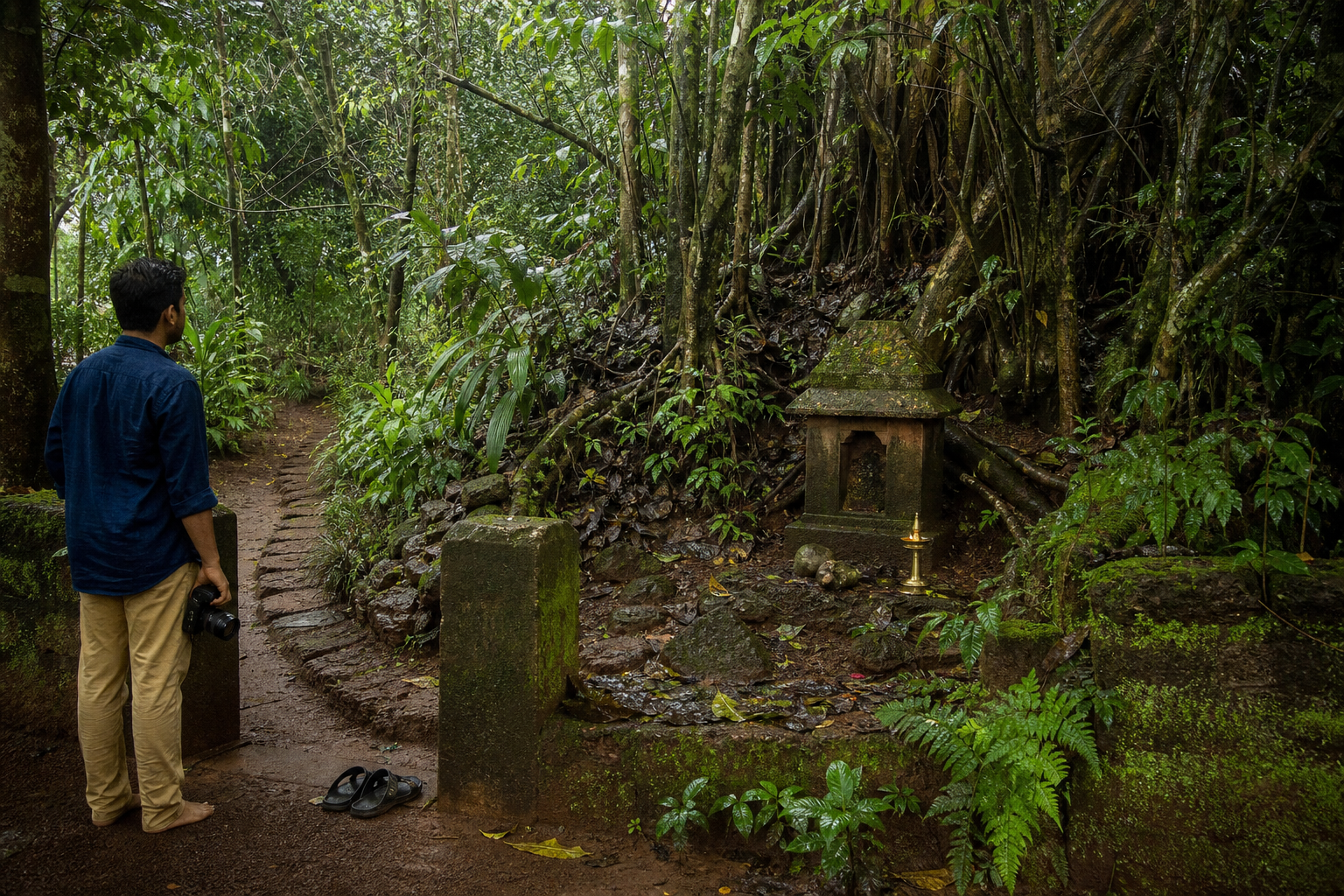
For a first visit, Mannarasala Sree Nagaraja Temple, Vettikode Nagaraja Temple, and Pambummekkattu Manam are among Kerala’s prominent serpent-worship settings. Each maintains its own patterns and procedural nuances. Check the institution’s actual observance schedule rather than assuming that every Ayilyam day includes the same public ritual.
Once there, the essential rule is simple: the boundary is part of the worship. Do not step across the powder line, lean over the image for a closer photograph, shift a lamp, touch an offering, or enter a grove area merely because there is no physical fence. Follow the temple functionaries and Pulluvan performers when they indicate where observers may stand or sit.
Ask before photographing or recording. Permission to enter a temple space is not automatically permission to document a family vow, a trance, a performer, or the final distribution of prasada. If permission is refused, put the device away without negotiation. The most meaningful part of your visit may be the attention you can give precisely because you are not trying to capture it.
Your conduct toward the Sarpa Kavu matters just as much. A serpent grove can function as a small forest sheltering birds, amphibians, medicinal plants, and other life. Do not remove leaves, powders, plants, soil, or offerings as souvenirs. Avoid litter, unnecessary noise, and damage to vegetation. The ecological ethic is concrete: a community that invokes Naga protection also accepts a duty not to destroy the habitat under that protection.
Go with one workable intention: to participate in the manner the local tradition permits. Ask what observance is taking place, learn where its boundary lies, listen through the full cycle if possible, and leave the grove undisturbed. That is how Nagapadma Kalam becomes more than an image you have seen; it becomes a discipline of attention, restraint, reciprocity, and care that you have respected.
References
