
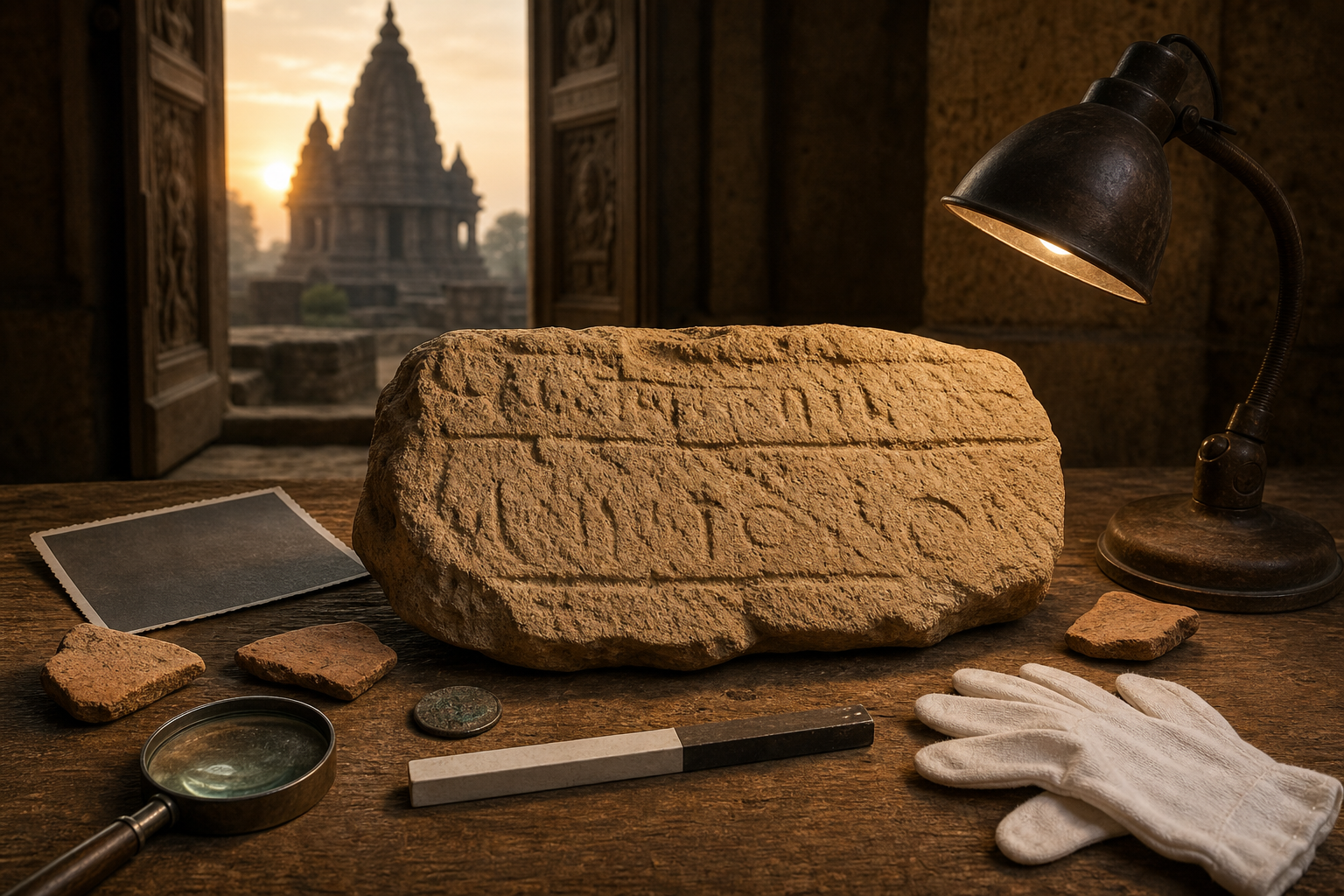
You have a sweeping claim in front of you: an ancient shrine proves uninterrupted worship, a royal inscription settles the identity of an entire region, or a shared symbol establishes one continuous lineage across centuries. If the claim affirms what you already believe, the temptation to share it is strongest. That is precisely when historical discipline matters most.
Before deciding whether a claim is pro-Dharma or anti-Dharma, ask whether it survives a visible chain of evidence: physical object, reliable reading, defensible date, independent corroboration, and a conclusion no larger than the evidence permits. That method lets you defend civilisational memory without turning memory into speculation.
The first question is not “What does it mean?”
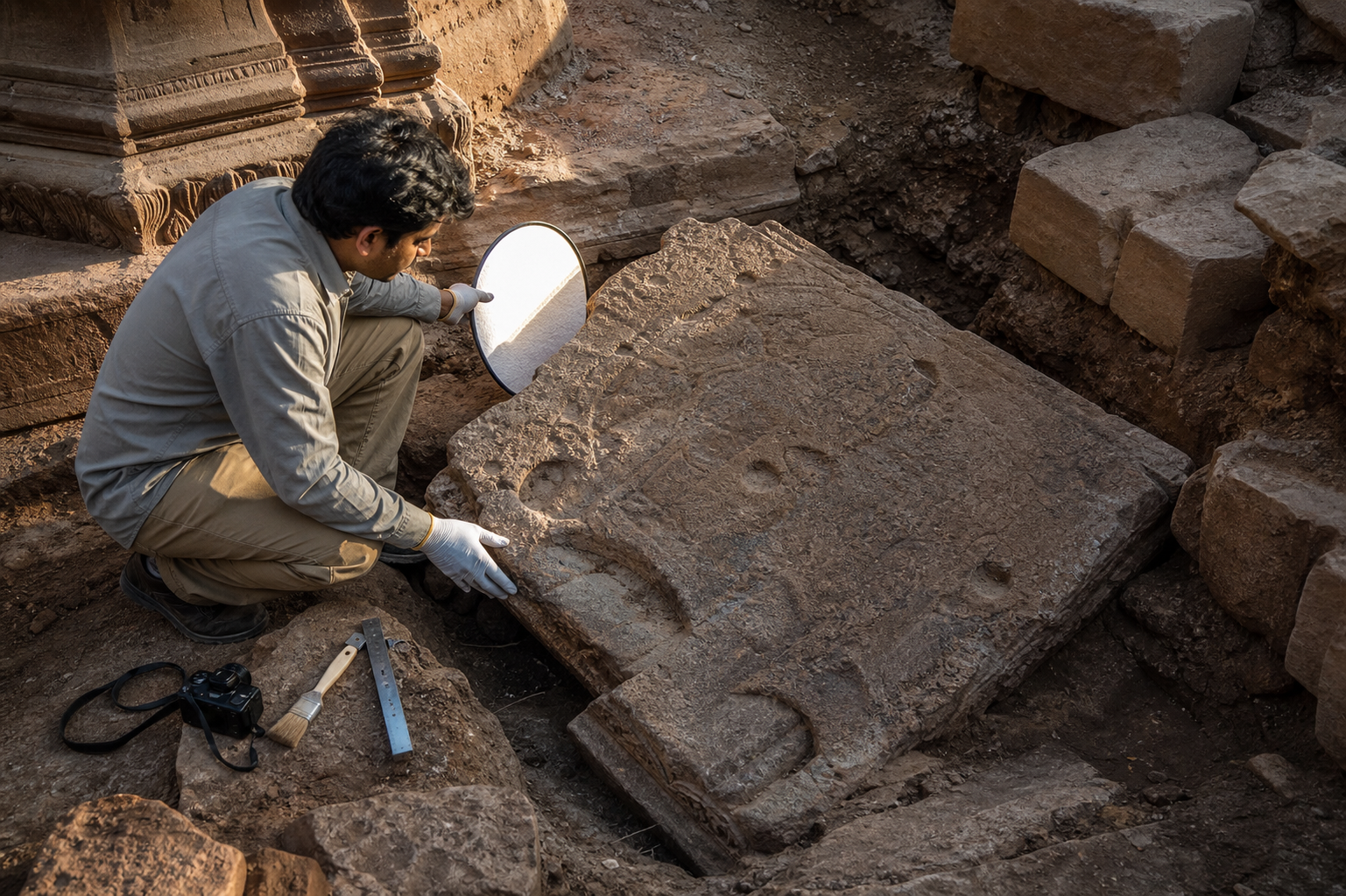
Begin with what exists. An inscription is simultaneously a physical object, a written communication, and a surviving fragment of a lost setting. Its historical meaning comes later. When these levels are collapsed, a plausible interpretation starts circulating as an observed fact.
Keep four levels separate in your notes:
- Observation: What can be seen or measured on the object and at its location? Record the support, dimensions, damage, imagery, architectural relationship, and findspot.
- Reading: Which characters can actually be read? Distinguish transcription, transliteration, translation, damaged letters, and editorial restoration.
- Inference: What do palaeography, grammar, titles, iconography, and archaeological context make likely?
- Historical construction: What larger account of patronage, institutions, political authority, religious practice, or continuity best explains the evidence?
Susunia Hill in present-day West Bengal shows why the separation matters. Three short Sanskrit lines in a northern form of Brahmi are cut into a cave wall, with a flame-spoked chakra above them. The names include Maharaja Singhanavarman, his son Maharaja Chandravarman, Pushkarana, and Cakrasvamin. The setting was associated with a hill stream and waterfall.
Those are observations and readings. A fourth-century date is an inference based on palaeography: the letter forms are compared with other datable writing. The combined appearance of the chakra and the name Cakrasvamin strongly supports a Vaishnava interpretation. Yet the stone does not, by itself, count the region’s worshippers, describe a complete theology, establish the size of an institution, or prove an unbroken organisational lineage into later centuries.
This distinction gives you a practical vocabulary for judging claims:
- Attested: directly present in the object, text, or secure archaeological context.
- Corroborated: supported by another evidentiary chain, such as a separate inscription, coin series, stratigraphic sequence, or independently preserved record.
- Plausible: consistent with the surviving evidence, but not the only possible explanation.
- Unproven: possible in principle, but larger or more precise than the surviving evidence allows.
“Unproven” does not mean “false.” It means you should not present the claim as established. This one word prevents both premature dismissal and premature certainty.
Read every inscription in six passes
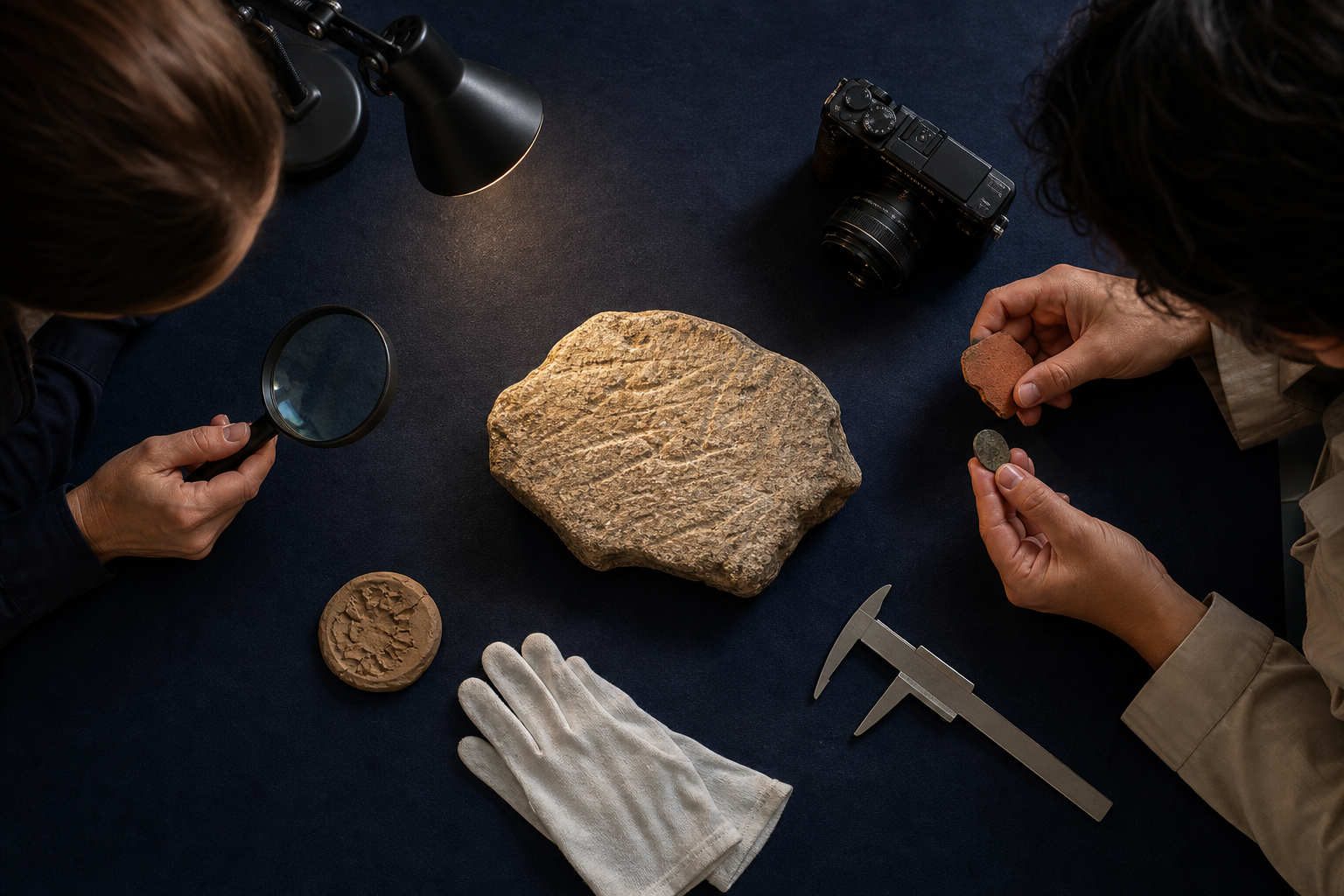
A translation is not the beginning of inscriptional study. By the time you reach a smooth English sentence, several consequential decisions have already been made. Use six passes so that you can see where certainty enters and where it weakens.
- Establish provenance and setting. Determine whether the inscription remains in its original position, was found loose nearby, or was moved from an unknown location. Photograph or study the whole surface before concentrating on the letters. A cropped image can hide an emblem, doorway, water feature, reused building block, or later alteration that changes the interpretation.
- Record physical condition. Mark breaks, weathered areas, overwritten characters, and missing edges. Keep visible letters separate from supplied letters. A restoration may be philologically persuasive, but it remains a restoration.
- Separate script, language, and date. Script is the writing system; language is what the characters express. At Susunia, the language is Sanskrit and the script belongs to the northern Brahmi tradition. Calling “Brahmi” the language is a basic category error. Likewise, a palaeographic date is normally a reasoned range based on letter forms, not a date visibly written on the stone. Regnal formulas, changing scripts, coin hoards, and archaeological strata can provide additional chronological controls.
- Parse grammar and institutional roles. Identify the ruler, donor, commissioner, engraver, officiant, deity, beneficiary, and recipient instead of treating every named person as the speaker. At Susunia, the expression associated with the chief servant of Cakrasvamin may indicate a senior devotee, officiant, or donor. It should not be silently converted into a claim that every act and title belongs to Chandravarman personally.
- Use iconography as corroboration. A symbol can narrow an interpretation when text and image converge. The chakra above a reference to Cakrasvamin is stronger evidence than either element would be alone. Even then, iconography does not substitute for a readable name, datable context, or comparison with related objects.
- Cross-check another archive. Look for the same ruler, place, title, deity, grant formula, or political event in coins, copperplates, other inscriptions, excavation records, chronicles, travel accounts, and institutional ledgers. The Prayaga Prasasti names Chandravarman among rulers overcome by Samudragupta, giving the Susunia ruler a wider political context. The identification is persuasive because name, chronology, geography, and political setting can be considered together; a shared personal name alone would be much weaker.
Always keep the original wording beside the translation. Terms such as dasa, svamin, maharaja, and paramabhagavata carry social and devotional implications that one English equivalent may not preserve. If two translations differ, locate the disagreement at the level of letters, grammar, or historical interpretation. Do not simply choose the version that gives you the grander conclusion.
Silence also requires discipline. An inscription made for a grant, victory, consecration, or donation was not designed to answer every question we now ask. The absence of a community, practice, or institution from a short royal record does not prove that it was absent from society. It proves only that it was not named in the surviving text.
Triangulation turns an attractive claim into history
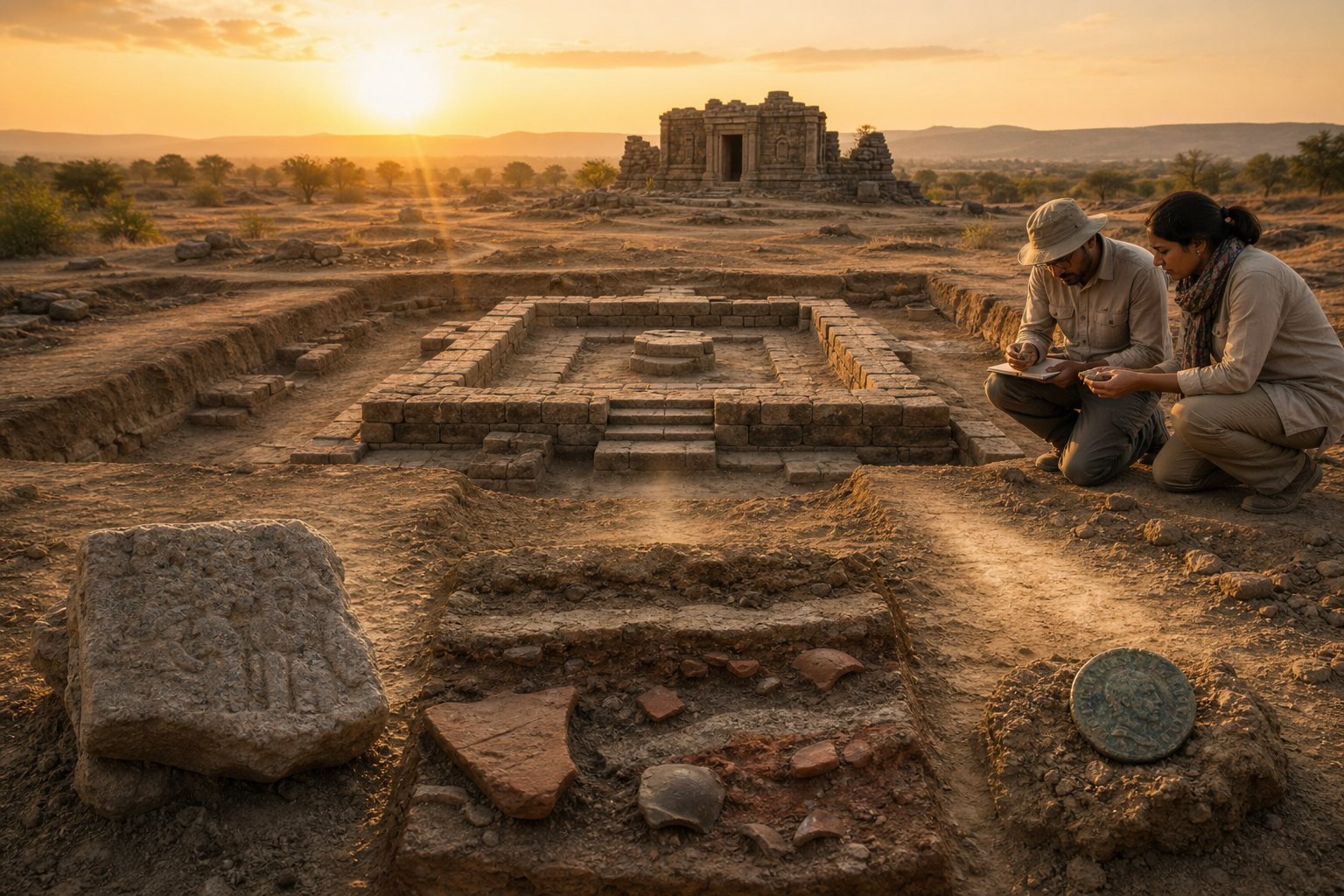
Several citations do not necessarily mean several kinds of evidence. If five modern publications reproduce one transcription, you still have one inscriptional chain. Strong reconstruction usually combines records created for different purposes: a royal eulogy, a land grant, a coin hoard, an excavated layer, a temple account, and a traveller’s description can correct one another because their motives and blind spots differ.
Build that reconstruction in five moves:
- Write the smallest defensible claim. Start with “this patron used this title at this place within this date range,” not “the whole civilisation believed this.”
- Seek a different evidence class. Pair an inscription with archaeology, a copperplate with local topography, or a literary reference with dated material remains.
- Align chronology. Check whether the proposed ruler, script, institution, and comparison object could actually have coexisted. Similar names or symbols separated by centuries require an argument, not an assumption.
- Test geography. Distinguish original findspot, place named in the text, ruler’s political centre, later repository, and modern administrative boundary. These may be five different places.
- Try to disprove your preferred reading. Ask what evidence would favour a rival identification, a later date, a reused object, or a narrower conclusion. A claim that survives an honest counter-reading is more useful than one protected from questions.
| Question | Evidence that can answer it | Safe conclusion | Overreach to avoid |
|---|---|---|---|
| Who sponsored the act? | Name, title, grammar, donative formula | A named person or office was connected to the recorded act | The patron represented every inhabitant or worshipper |
| When did it occur? | Internal date, regnal year, palaeographic range, datable layer | A date or explicitly stated date range | False precision from handwriting alone |
| Which devotion is attested? | Deity name, epithet, image, ritual object, dedication | The named patron or institution used that devotional vocabulary | Exclusive adherence or regional religious percentages |
| What did an institution do? | Endowment, irrigation, guild, educational, or judicial record | The recorded institution performed the named function | Every comparable institution worked identically |
| Does recurrence prove continuity? | Linked evidence across successive periods | A practice or name recurred at identifiable times | An uninterrupted lineage where the intervening chain is missing |
Applied to Susunia, the minimum secure conclusion is already significant: fourth-century, elite-linked devotion to Cakrasvamin is attested in the Pushkarana–Susunia setting through a royal name, a dedicatory formula, and a matching chakra emblem. You do not need to inflate that finding into a claim about every resident of Bengal for it to matter.
The historical horizon can be widened when later evidence is added carefully. Cakrasvamin-related evidence appears by the eighth century along the Purnia–Baigram–Paharpur corridor; Alberuni later described a substantial Cakrasvamin image at Sthanesvara; and Chakrapani entered the devotional world of the thirteenth-century Mahanubhava tradition. These points establish recurrence, geographical reach, and later reception. They do not, without intermediate institutional links, prove that one organisation operated continuously from fourth-century Susunia through every later manifestation.
The same restraint applies to inter-Dharmic history. Vaishnava remains in the wider Paharpur region and the Buddhist Somapura Mahavihara demonstrate an overlapping sacred landscape. Proximity makes exchange possible and worth investigating; proximity alone does not prove either harmonious synthesis or permanent conflict. To establish interaction, look for shared donors, borrowed terminology, artistic transmission, itinerant teachers, institutional transactions, or texts that acknowledge an encounter.
Material evidence can also correct the assumption that religious institutions concerned themselves only with private belief. Inscriptions from Chola, Hoysala, and Vijayanagara temple settings preserve evidence concerning endowments, irrigation, guild transactions, education, adjudication, and public obligations. Such records let you reconstruct lived Dharma through institutions and transactions rather than projecting a modern division between “religious” and “secular” life onto the past.
A pan-Dharmic framework should sharpen these distinctions, not erase them. A Hindu temple grant, Buddhist vihara seal, Jain manuscript colophon, and Sikh gurudwara ledger may all illuminate patronage, learning, service, and community organisation, but each belongs to its own vocabulary, chronology, and institutional history. Shared ethical ideas such as satya, ahimsa, karuna, aparigraha, and seva can guide comparison. They should not be inserted into an inscription that does not use them.
Build a local evidence file that another person can audit
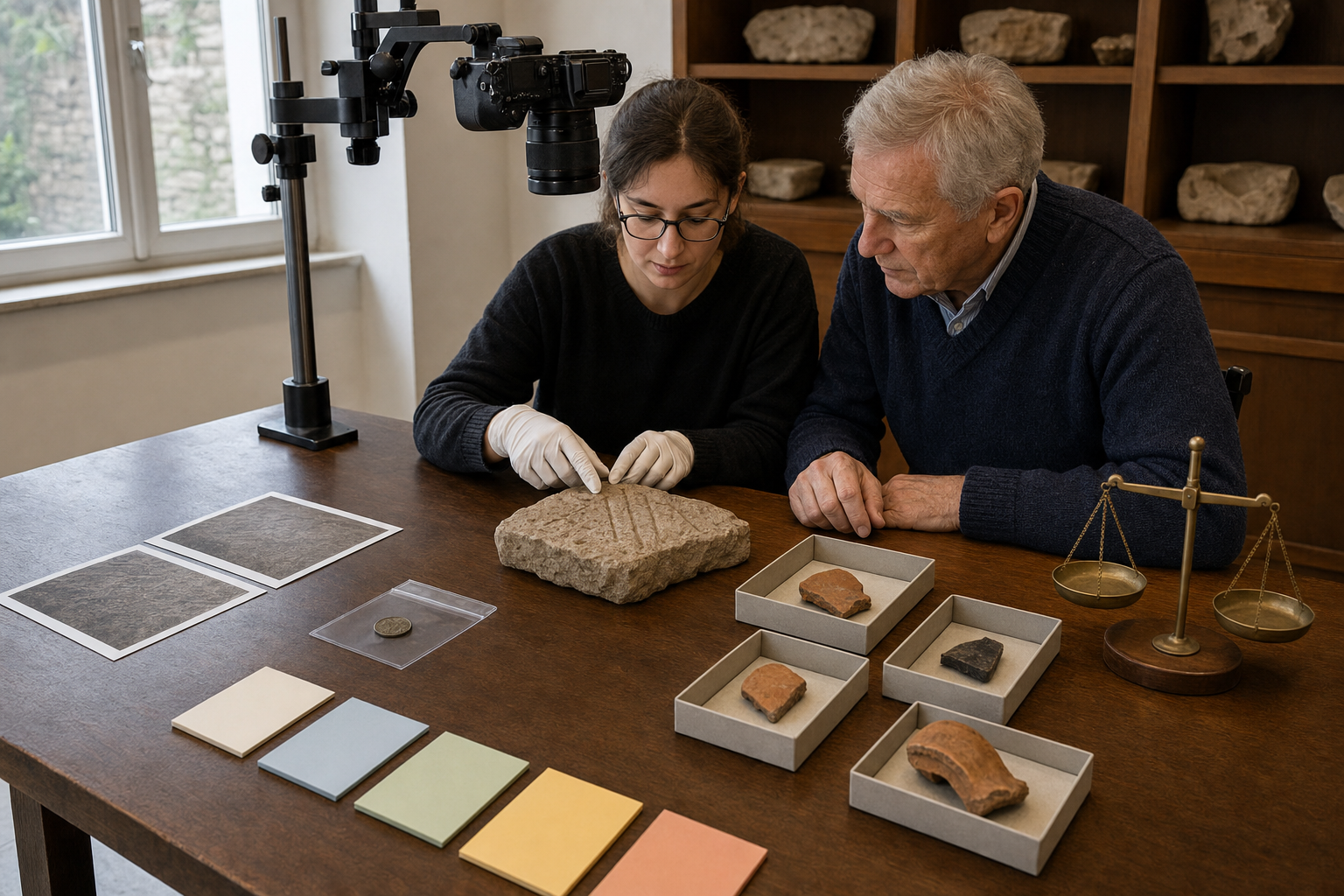
You do not need to reconstruct all of Bharat before making a useful contribution. One well-documented inscription, sculpture, copperplate, ledger, or sacred site can be more valuable than a hundred unsourced civilisational claims. The standard is simple: another careful reader should be able to see what you saw, trace every interpretive step, and identify where uncertainty remains.
Use this workflow for a local documentation project:
- Define one question. Ask who endowed a shrine, when a named deity is first attested locally, how an institution managed land, or whether two historical place-names refer to the same location. A bounded question prevents indiscriminate fact collection.
- Record provenance before interpretation. Note the present custodian, reported findspot, whether the object was moved, and the publication or catalogue through which it became known. Label oral information as oral testimony rather than converting it into an archaeological fact.
- Document context and detail. With the custodian’s permission, capture the entire object, its surroundings, and close views of the writing or imagery. Preserve the original image files. Do not chalk letters, scrape deposits, clean a surface, take rubbings, or move an object merely to improve legibility. At a protected site, follow the relevant conservation and photography rules.
- Create a metadata record. Include the object type, material, dimensions if securely available, location, custody, script, language, proposed date and dating method, condition, image creator, image date, bibliographic history, and rights or access restrictions. A photograph without provenance is an illustration, not a reproducible historical record.
- Separate textual layers. Store the photograph, character-by-character transcription, transliteration, translation, and commentary as distinct fields. Mark uncertain readings visibly. Preserve older readings so that later corrections remain auditable.
- Maintain a claim ledger. For every conclusion, list the evidence, date basis, corroborating record, rival explanation, confidence level, and unresolved question. If a claim has no row in the ledger, it is not ready for public circulation.
- Invite correction and publish versions. Ask readers with the relevant language, script, regional, archaeological, or institutional knowledge to review the file. Give each revision a date and retain the change history. Correction is evidence that the method works, not a loss of cultural standing.
Local repositories deserve special attention. Temple and panchayat records, matha libraries, gurudwara ledgers, and Jain bhandaras can preserve micro-histories of grants, festivals, endowments, and arbitration. Begin by documenting custody and access conditions. Do not separate a manuscript or ledger from the community that preserved it, even digitally, by omitting the collection name and provenance.
Digital tools help only when the record is sound. High-resolution imaging can reveal faint forms; OCR trained for Indic scripts can accelerate a first pass; IIIF-compatible viewers can make large images inspectable; and structured metadata can connect names, places, dates, and objects across collections. Crowdsourced transcription becomes reliable when paired with transparent metadata and peer review. Treat OCR as a draft to be checked character by character, especially where weathering, ligatures, or historical letter forms are involved.
Apply the same method before sharing a viral historical image. Check whether the image has been cropped, reversed, relabelled, or detached from its findspot. Verify the personal names, place-name, script, date, and translation separately. A reverse-image search can identify earlier uses, but the earliest page you find is not automatically the object’s provenance.
This is where satya becomes an operational discipline. A pro-Dharmic history does not need the largest possible claim. It needs claims strong enough to withstand scrutiny, translations honest about ambiguity, and custodians treated as participants rather than obstacles. Confidence built on bounded evidence lasts longer than confidence built on a caption no one can verify.
Key takeaways
- Trace the physical object and its provenance before debating its civilisational meaning.
- Keep observation, reading, dating, inference, and historical construction in separate layers.
- Distinguish script from language and an internal date from a palaeographic estimate.
- Begin with the smallest claim the evidence directly supports, then widen it through independent corroboration.
- Do not confuse royal patronage with population-wide belief, recurrence with uninterrupted continuity, or geographical proximity with proven harmony or conflict.
- Preserve photographs, metadata, uncertain readings, rival explanations, and revision history so another person can audit your conclusion.
Choose one local claim before you share the next sweeping one. Build a one-page evidence file for it, state the narrow conclusion, and write down what would change your mind. If the claim survives, you have strengthened Dharmic history. If it does not, you have protected that history from an avoidable weakness.
References
- Dharma Dispatch — Unlocking Susunia’s Sudarshana Secret: Chakrasvamin, Gupta Power, and Bengal’s Living Dharma
- Hindu Janajagruti Samiti — Transcend False Narratives: Sadguru Charudatta Pingale’s Ajmer Call to Reclaim Dharmic History
